











Passive Components Blog
No Result
View All Result
  • Home
  • NewsFilter
    • All
    • Aerospace & Defence
    • Antenna
    • Applications
    • Automotive
    • Capacitors
    • Circuit Protection Devices
    • electro-mechanical news
    • Filters
    • Fuses
    • Inductors
    • Industrial
    • Integrated Passives
    • inter-connect news
    • Market & Supply Chain
    • Market Insights
    • Medical
    • Modelling and Simulation
    • New Materials & Supply
    • New Technologies
    • Non-linear Passives
    • Oscillators
    • Passive Sensors News
    • Resistors
    • RF & Microwave
    • Telecommunication
    • Weekly Digest

    AI-Assisted Structural Diagnostics and Physics-Based Reliability Interpretation of Tantalum Capacitor Anodes

    YAGEO Introduces EMI Suppression High‑Current 3‑phase Common Mode Chokes

    KYOCERA AVX MIL-PRF-32535 BME NP0 MLCCs Approved to the DLA QPD

    ECIA March 2026 Industry Pulse Points to Best Sales Climate in Five Years

    Vishay Releases 2-Way Wilkinson Divider / Combiner for 15–20 GHz RF Front Ends

    Wk 15 Electronics Supply Chain Digest

    Exxelia Releases Updated Microwave Materials and Frequency Tuning Catalogues

    Coilcraft Unveils Molded Power Inductors for High‑Current VRMs

    Murata Automotive MLCCs Push Capacitance Limits for ADAS and Power Lines

    Trending Tags

    • Ripple Current
    • RF
    • Leakage Current
    • Tantalum vs Ceramic
    • Snubber
    • Low ESR
    • Feedthrough
    • Derating
    • Dielectric Constant
    • New Products
    • Market Reports
  • VideoFilter
    • All
    • Antenna videos
    • Capacitor videos
    • Circuit Protection Video
    • Filter videos
    • Fuse videos
    • Inductor videos
    • Inter-Connect Video
    • Non-linear passives videos
    • Oscillator videos
    • Passive sensors videos
    • Resistor videos

    Transformer-Based Power-Line Harvester Magnetic Design

    Thermal Modeling of Magnetics

    Standard vs Planar LLC transformers Comparison for Battery Chargers

    How Modern Tools Model Magnetic Components for Power Electronics

    Advanced Loss Modeling for Planar Magnetics in the Frenetic Planar Tool

    2026 Power Magnetics Design Trends: Flyback, DAB and Planar

    Enabling Software‑Defined Vehicle Architectures: Automotive Ethernet and Zonal Smart Power

    Calculating Resistance Value of a Flyback RC Snubber 

    One‑Pulse Characterization of Nonlinear Power Inductors

    Trending Tags

    • Capacitors explained
    • Inductors explained
    • Resistors explained
    • Filters explained
    • Application Video Guidelines
    • EMC
    • New Products
    • Ripple Current
    • Simulation
    • Tantalum vs Ceramic
  • Knowledge Blog
  • DossiersNew
  • Suppliers
    • Who is Who
  • PCNS
    • PCNS 2025
    • PCNS 2023
    • PCNS 2021
    • PCNS 2019
    • PCNS 2017
  • Events
  • Home
  • NewsFilter
    • All
    • Aerospace & Defence
    • Antenna
    • Applications
    • Automotive
    • Capacitors
    • Circuit Protection Devices
    • electro-mechanical news
    • Filters
    • Fuses
    • Inductors
    • Industrial
    • Integrated Passives
    • inter-connect news
    • Market & Supply Chain
    • Market Insights
    • Medical
    • Modelling and Simulation
    • New Materials & Supply
    • New Technologies
    • Non-linear Passives
    • Oscillators
    • Passive Sensors News
    • Resistors
    • RF & Microwave
    • Telecommunication
    • Weekly Digest

    AI-Assisted Structural Diagnostics and Physics-Based Reliability Interpretation of Tantalum Capacitor Anodes

    YAGEO Introduces EMI Suppression High‑Current 3‑phase Common Mode Chokes

    KYOCERA AVX MIL-PRF-32535 BME NP0 MLCCs Approved to the DLA QPD

    ECIA March 2026 Industry Pulse Points to Best Sales Climate in Five Years

    Vishay Releases 2-Way Wilkinson Divider / Combiner for 15–20 GHz RF Front Ends

    Wk 15 Electronics Supply Chain Digest

    Exxelia Releases Updated Microwave Materials and Frequency Tuning Catalogues

    Coilcraft Unveils Molded Power Inductors for High‑Current VRMs

    Murata Automotive MLCCs Push Capacitance Limits for ADAS and Power Lines

    Trending Tags

    • Ripple Current
    • RF
    • Leakage Current
    • Tantalum vs Ceramic
    • Snubber
    • Low ESR
    • Feedthrough
    • Derating
    • Dielectric Constant
    • New Products
    • Market Reports
  • VideoFilter
    • All
    • Antenna videos
    • Capacitor videos
    • Circuit Protection Video
    • Filter videos
    • Fuse videos
    • Inductor videos
    • Inter-Connect Video
    • Non-linear passives videos
    • Oscillator videos
    • Passive sensors videos
    • Resistor videos

    Transformer-Based Power-Line Harvester Magnetic Design

    Thermal Modeling of Magnetics

    Standard vs Planar LLC transformers Comparison for Battery Chargers

    How Modern Tools Model Magnetic Components for Power Electronics

    Advanced Loss Modeling for Planar Magnetics in the Frenetic Planar Tool

    2026 Power Magnetics Design Trends: Flyback, DAB and Planar

    Enabling Software‑Defined Vehicle Architectures: Automotive Ethernet and Zonal Smart Power

    Calculating Resistance Value of a Flyback RC Snubber 

    One‑Pulse Characterization of Nonlinear Power Inductors

    Trending Tags

    • Capacitors explained
    • Inductors explained
    • Resistors explained
    • Filters explained
    • Application Video Guidelines
    • EMC
    • New Products
    • Ripple Current
    • Simulation
    • Tantalum vs Ceramic
  • Knowledge Blog
  • DossiersNew
  • Suppliers
    • Who is Who
  • PCNS
    • PCNS 2025
    • PCNS 2023
    • PCNS 2021
    • PCNS 2019
    • PCNS 2017
  • Events
No Result
View All Result
Passive Components Blog
No Result
View All Result

Samsung Electro-Mechanics Releases Miniature Slim 3-terminal MLCC for 5G Smartphones

21.1.2021
Reading Time: 2 mins read
A A

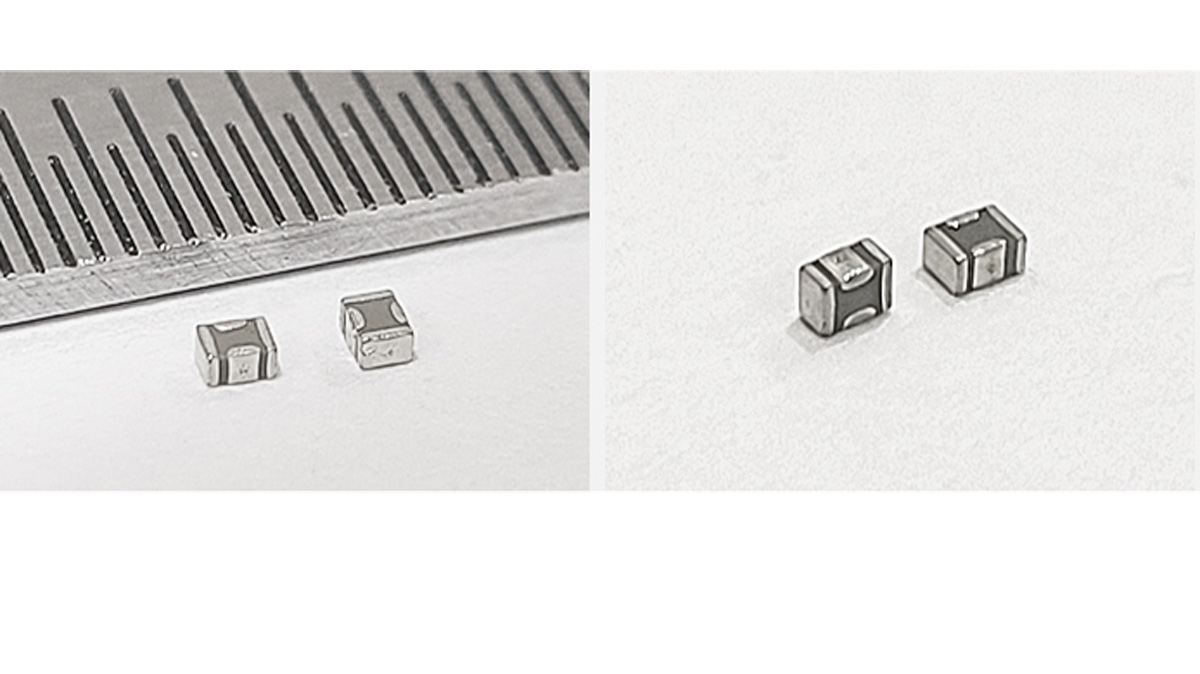
Samsung Electro-Mechanics developed 0.65mm ultra-slim 3-socket MLCC, which is 18% thinner than previous products, and began supplying them to global smartphone companies.

There has been an increase in requests for slimmer components with the increase in the number of components and reduction in thickness of recent smartphones, with multi-functional and high-performance requirements, including 5G mobile communication and multi-cameras.

The slim 3-socket MLCC, developed by Samsung Electro-Mechanics, is the thinnest among 1209-size 3-socket MLCC, with size of 1209 (length 1.2mm, width 0.9mm) and thickness of 0.65mm. Previous products had width of 0.8mm due to limitations in minimizing the internal dielectric layer. Samsung Electro-Mechanics increased the freedom of smartphone design by reducing the previous thickness by 18% by applying independent thin layer molding technology and superfine dielectric layer.

In particular, given the characteristics of the 5G smartphone, which has high-processing speed, it is a component that has added earth sockets to efficiently remove high-frequency noise occurring from the AP (Application Processor) power unit, and it has increased internal space efficiency by replacing 1 3-socket MLCC with 3~4 general MLCCs.

RelatedPosts

NIC Components Extends SMD High Voltage MLCC Offering

Stackpole Offers RoHS Compliant Lead-Free Thick Film Chip Resistors

Smiths Interconnect’s SMD Power Resistors with Heat Sink Qualified to Space Flights

Doo Young Kim, Head of the Component Unit at Samsung Electro-Mechanics, revealed, “There has been a massive increase in miniature, high-performance, and highly-reliable MLCC demand with the commercialization of 5G mobile communication and electrification of automobiles. Samsung Electro-Mechanics will secure a leading position in the market by strengthening its distinctive technology, including the internal development of core materials and internalization of equipment, and manufacturing capabilities”.

  • 3-socket MLCC adds one additional earth socket to the general MLCC and is a product that allows for easy reduction in high-frequency power noise.
  • socket (端子): The end area that is attached in order to attach the electrode to the input or output area of the current for electric circuits or electric devices
  • earth (接地): connecting to the ground or reference point by means of a conductor (an object capable of electricity flow) in an electrical circuit or part of an electrical equipment

Related

Source: SEMCO

Recent Posts

AI-Assisted Structural Diagnostics and Physics-Based Reliability Interpretation of Tantalum Capacitor Anodes

14.4.2026
6

KYOCERA AVX MIL-PRF-32535 BME NP0 MLCCs Approved to the DLA QPD

14.4.2026
8

ECIA March 2026 Industry Pulse Points to Best Sales Climate in Five Years

13.4.2026
23

Coilcraft Unveils Molded Power Inductors for High‑Current VRMs

8.4.2026
38

Murata Automotive MLCCs Push Capacitance Limits for ADAS and Power Lines

8.4.2026
37

TDK and Nippon Chemical Launch Joint Venture for MLCC Materials

7.4.2026
41

March 2026 Interconnect, Passives and Electromechanical Components Market Insights

2.4.2026
93

APEC 2026 Power Electronics Trends and Implications for Passive Components

1.4.2026
108

Hydra Enhances Film Capacitor Robustness by Novel Gel Filler

1.4.2026
35

Upcoming Events

Apr 21
16:00 - 17:00 CEST

Heatsink Solutions: Thermal Management in electronic devices

May 5
16:00 - 17:00 CEST

Understanding and Selecting Capacitors – Fundamentals, Technologies and Latest Trends

May 19
16:00 - 17:00 CEST

Designing Qi2 Wireless Power Systems: Practical Development and EMC Optimization

View Calendar

Popular Posts

  • Buck Converter Design and Calculation

    0 shares
    Share 0 Tweet 0
  • Boost Converter Design and Calculation

    0 shares
    Share 0 Tweet 0
  • Flyback Converter Design and Calculation

    0 shares
    Share 0 Tweet 0
  • LLC Resonant Converter Design and Calculation

    0 shares
    Share 0 Tweet 0
  • Dual Active Bridge (DAB) Topology

    0 shares
    Share 0 Tweet 0
  • MLCC and Ceramic Capacitors

    0 shares
    Share 0 Tweet 0
  • Capacitor Charging and Discharging

    0 shares
    Share 0 Tweet 0
  • Plastic Materials Dielectric Constant and DF

    4 shares
    Share 4 Tweet 0
  • Ripple Current and its Effects on the Performance of Capacitors

    3 shares
    Share 3 Tweet 0
  • MLCC Case Sizes Standards Explained

    0 shares
    Share 0 Tweet 0

Newsletter Subscription


Passive Components Blog

© EPCI - Leading Passive Components Educational and Information Site

  • Home
  • Privacy Policy
  • EPCI Membership & Advertisement
  • About

No Result
View All Result
  • Home
  • Knowledge Blog
  • PCNS

© EPCI - Leading Passive Components Educational and Information Site

This website uses cookies. By continuing to use this website you are giving consent to cookies being used. Visit our Privacy and Cookie Policy.
Go to mobile version