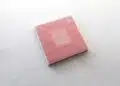



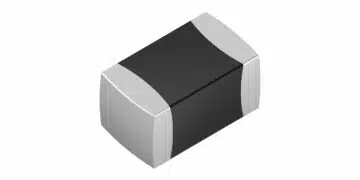

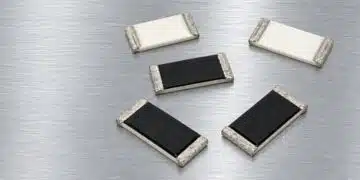


KYOCERA AVX has expanded its series of MIL‑PRF‑32535 base metal electrode (BME) NP0 multilayer ceramic capacitors (MLCCs) qualified by the Defense Logistics Agency (DLA) and listed in the Qualified Products Database (QPD).
These small, high‑CV C0G/NP0 ceramic capacitors target compact aerospace and defense designs that demand MIL‑grade reliability, stable capacitance, and improved size, weight, and component count (SWaP).
Key features and benefits
The KYOCERA AVX MIL‑PRF‑32535 BME NP0 MLCC family aims to narrow the gap between commercial BME MLCCs and traditional precious metal electrode (PME) MIL parts, while meeting M‑level and T‑level reliability requirements.
Series overview
| Parameter | Value / Range | Notes |
|---|---|---|
| Dielectric | C0G / NP0 (class I) | Ultra‑stable, low‑loss ceramic |
| Electrode system | Base metal electrode (BME) | Higher CV vs. PME MIL MLCCs |
| Qualification standard | MIL‑PRF‑32535, DLA QPD listed | M and T reliability levels |
| Case sizes | 0402, 0603, 0805, 1206, 1210 | Small, high‑CV footprints |
| Capacitance range | 68 pF – 47 000 pF | Tolerances typically ±1–10% |
| Rated voltage range | 4 VDC – 100 VDC | According to manufacturer datasheet |
| Termination system | FLEXITERM | Flexible, crack‑resistant |
| Packaging | Waffle pack, tape & reel | For automated assembly |
Practical electrical and mechanical advantages
- Higher CV in compact sizes
Thanks to BME technology and thin dielectric layers, the series offers higher capacitance per footprint than many traditional PME MIL MLCCs, helping to:- Reduce the number of capacitors in parallel for a given capacitance.
- Migrate designs from larger footprints (for example, 1210 to 0805 or 0603 where ratings allow).
- Free PCB area while keeping MIL‑qualified parts.
- C0G/NP0 stability
The C0G/NP0 dielectric is a class I ceramic with:- Very low capacitance drift over the specified temperature range.
- Negligible DC‑bias dependence compared to class II dielectrics.
- Low dielectric losses, suitable for RF, timing, and precision analog circuits.
In practice, this gives designers predictable impedance and phase behaviour across operating conditions.
- Improved robustness with FLEXITERM
FLEXITERM is a patented flexible termination that significantly improves resistance to thermomechanical stress during assembly and operation. It helps:- Reduce the risk of board‑flex‑induced micro‑cracks.
- Increase robustness in larger case sizes mounted on stiff substrates.
- Enhance long‑term reliability in harsh environments.
- MIL‑grade reliability with commercial‑like CV
By combining M and T reliability levels with high CV, the series provides:- A path to use fewer devices or smaller cases without abandoning MIL qualification.
- Easier migration from commercial prototypes to flight or mission hardware when required by the program.
Typical applications
The MIL‑PRF‑32535 BME NP0 MLCCs are approved for high‑reliability aerospace and defense applications that need stable capacitance, low loss, and rugged mechanical behaviour.
Typical functions:
- Filtering and decoupling
- High‑frequency decoupling near RF ICs, FPGAs, and ASICs.
- Local filtering in avionics, radar, and communication modules.
- Tuning and timing
- Resonant circuits and tank networks in RF stages.
- Precision timing elements in analog and mixed‑signal front ends.
- Blocking and coupling
- RF and IF coupling capacitors where low loss and predictable impedance are needed.
- DC‑blocking in high‑reliability signal paths.
Typical platforms and environments:
- Land‑ and air‑based military equipment (communications, radar, control systems).
- Satellite launchers and related control/telemetry electronics.
- Communication, Earth‑observation, and science‑exploration satellites where project standards permit use of MIL‑PRF‑32535 components.
For space programs, engineers should always cross‑check project‑specific requirements, derating rules, and any ESCC, NASA, or mission‑specific component lists before committing to a particular part number.
Technical highlights
BME NP0 vs. traditional PME MIL MLCCs
Compared to standard PME MIL‑qualified MLCCs, the BME NP0 series provides:
- Higher capacitance values in the same case size, enabling SWaP improvements without sacrificing MIL qualification.
- Potentially lower ESR/ESL in many combinations, which benefits high‑frequency filtering and resonant networks.
- Better volumetric efficiency, helping designers reduce capacitor count or shrink footprints.
However, system‑level design must still consider:
- Surge, ESD, and transient stress.
- Maximum operating voltage, temperature, and ripple conditions per MIL‑PRF‑32535 and the manufacturer datasheet.
Reliability levels and lead times
The series supports M‑level and T‑level reliability as defined in MIL‑PRF‑32535. Lead times reported in the press release are:
| Reliability level | Region | Typical lead time |
|---|---|---|
| M‑level | U.S. / Asia | 18 weeks |
| M‑level | Europe | 16 weeks |
| T‑level | U.S. / Asia | 25 weeks |
| T‑level | Europe | 23 weeks |
Current lead times should always be verified via distributor stock checks or the manufacturer’s sales channels, as they are subject to change.
FLEXITERM termination behaviour
FLEXITERM is engineered to absorb a portion of the strain between the ceramic body and PCB solder joints. In practice, this helps:
- Improve resistance to board flex during depanelization, connector mating, or handling.
- Mitigate stress from thermal cycling in harsh environments.
- Reduce latent cracking issues that are difficult to detect in standard inspection.
Good PCB design practices are still required: avoid locating large MLCCs near scoring lines, mounting holes, or stiffeners that induce bending.
Availability and part numbers
The latest release offers higher‑capacitance 1206 and 1210 devices to the existing MIL‑PRF‑32535 BME NP0 portfolio, extending the CV options within these larger footprints.
Key availability points:
- Case sizes: 0402–1210, including new high‑CV 1206 and 1210.
- Capacitance: 68–47 000 pF, with ±1–10% tolerance, depending on value.
- Voltage ratings: 4–100 VDC, according to the latest datasheet.
- Termination: FLEXITERM, with options for standard automated assembly.
- Packaging: Standard waffle pack and tape & reel for SMT production.
Exact part numbers, capacitance/voltage combinations, and screening options must be taken from the up‑to‑date product selector and MIL‑PRF‑32535 QPD entries on the KYOCERA AVX website.
KYOCERA AVX is also offering complementary BME MLCC ranges, including MIL‑PRF‑32535 X7R BME MLCCs and DSCC 25007 stacked X7R BME MLCCs, which can be combined with NP0 devices to cover both high‑stability and higher‑capacitance roles in the same design.
Design‑in notes for engineers
1. Choosing NP0 in high‑reliability circuits
Select NP0/C0G when:
- The capacitor participates directly in frequency‑setting, timing, or resonant networks.
- Low loss and high Q are needed at RF or high‑frequency switching harmonics.
- Long‑term stability and repeatability are more important than maximum capacitance.
In DC‑link, bulk filtering, or high‑energy storage nodes, NP0 typically complements larger class II ceramics or film capacitors rather than replacing them.
2. Voltage and temperature derating
Even with NP0’s relatively benign bias behaviour, high‑reliability designs should:
- Follow voltage derating rules from MIL‑PRF‑32535 and manufacturer application notes.
- Consider the sum of DC bias, AC ripple, and transient conditions when selecting the rated voltage.
- Respect the specified operating temperature range, referring to the latest datasheet for exact limits and derating curves.
3. PCB layout and mechanical stress
To leverage FLEXITERM without relying on it as the sole protection against mechanical stress:
- Keep MLCCs away from board edges, V‑grooves, and break‑off areas.
- Avoid alignment along the primary bending axis near large connectors.
- Use recommended pad geometries and solder profiles from KYOCERA AVX assembly guidelines.
These practices help maintain margin even in demanding aerospace and defense environments.
4. Prototyping with Engineering Module (EM) parts
For non‑flight prototypes or early evaluation, KYOCERA AVX recommends the Engineering Module (EM) Range X7R BME MLCCs, which share materials and construction with ESCC 3009041, NASA S311‑P838, and MIL‑PRF‑32535 devices but omit full DLA and ESCC screening. This:
- Shortens lead times significantly compared to fully qualified parts.
- Allows rapid evaluation of BME technology, voltage behaviour, and thermal performance.
- Simplifies later migration to the corresponding fully screened part numbers.
5. System‑level integration examples
- In RF front‑ends, NP0 capacitors can be used as matching and tuning elements in L‑ or Pi‑networks, where their stable capacitance reduces re‑tuning over temperature.
- In precision analog sections, NP0 devices are suited for reference filtering, integrator networks, and high‑Q filters where low dielectric absorption is beneficial.
- In converter control and gate‑drive circuits, small NP0 capacitors can support snubbers and high‑frequency decoupling in conjunction with larger class II or film capacitors.
Source
This article is based on the official KYOCERA AVX press release announcing the expansion of the MIL‑PRF‑32535 BME NP0 MLCC series, along with associated product and range overview pages describing the high‑CV NP0 portfolio, high‑reliability MLCC offerings for aerospace and defense, and the Engineering Module (EM) range used for prototyping.
References
- KYOCERA AVX press release – New MIL‑PRF‑32535 BME NP0 MLCCs Approved to the DLA QPD
- KYOCERA AVX product page – MIL‑PRF‑32535 BME NP0 MLCCs
- KYOCERA AVX – High‑reliability MLCCs for aerospace and defense
- KYOCERA AVX – MIL‑PRF‑32535 X7R BME MLCC series
- KYOCERA AVX – DSCC 25007 X7R BME stacked MLCCs
- KYOCERA AVX – Engineering Module (EM) Range X7R BME MLCCs