




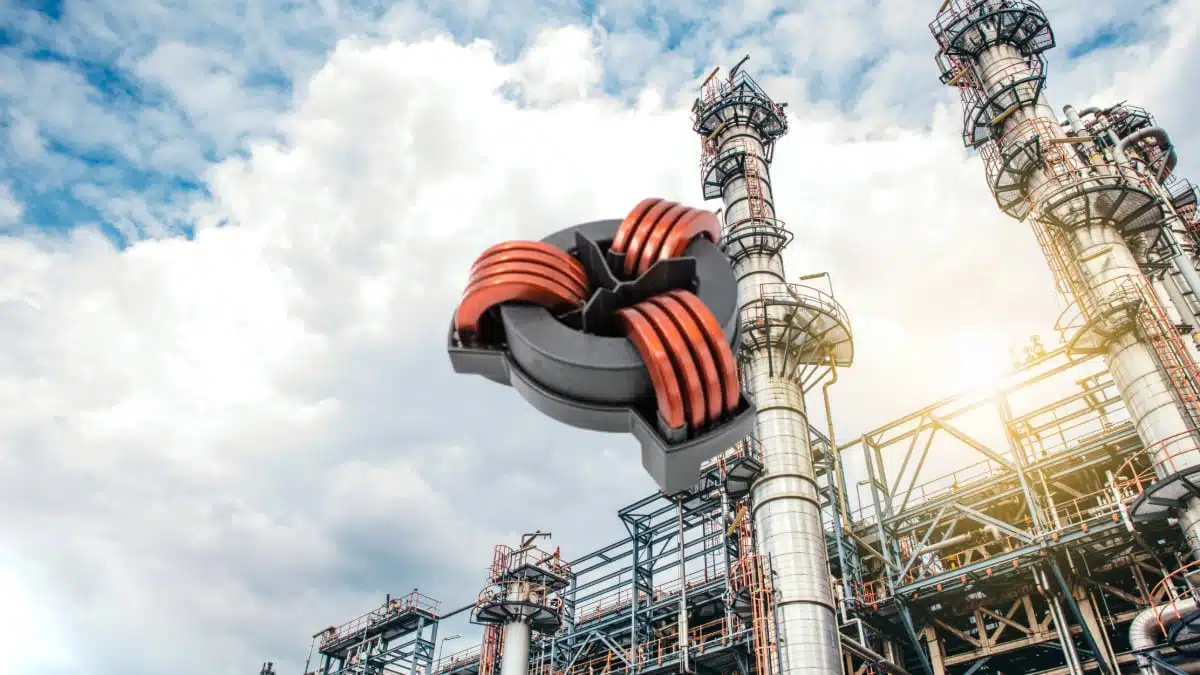
The new SCF76X series from YAGEO Group is a family of three‑phase common mode chokes for high‑current EMI suppression in industrial and infrastructure power electronics.
These YAGEO components are intended for equipment such as inverters, motor drives, power conditioners, and HVAC systems, where three‑phase mains interfaces must meet stringent EMC limits at currents up to 110 A in compact, thermally demanding environments.
Key features and benefits
The SCF76X common mode chokes series combines nanocrystalline core technology, high current capability, and a robust mechanical design optimized for modern three‑phase platforms.
Core characteristics and construction
| Parameter | SCF76X series overview |
|---|---|
| Function | Three‑phase common mode choke for EMI suppression |
| Rated voltage | Up to 500 VAC/VDC (quick facts list up to 800 VAC/VDC; check datasheet per type) |
| Rated current range | 65 A – 110 A |
| Inductance range | 0.35 mH – 0.77 mH |
| Typical DCR range | 0.27 mΩ – 0.97 mΩ |
| Operating temperature range | −40 °C to +130 °C |
| Core technology | Nanocrystalline metal core |
| Mechanical layout | Horizontal layout, approx. 76 mm core diameter |
Technology and materials
- Nanocrystalline core for high magnetic permeability and high common‑mode impedance across relevant EMI frequency bands.
- Low DC resistance windings to minimize conduction losses and self‑heating at high current.
- UL 94 V‑0 rated base and cap for improved fire safety compliance in industrial equipment.
Practical benefits
- Superior common‑mode EMI suppression over a wide frequency range, supporting EMC compliance in fast‑switching inverters and drives.
- High‑power three‑phase designs without oversizing or paralleling multiple common mode chokes.
- Improved thermal performance, as low DCR reduces copper losses and heat generation.
- Stable operation in harsh environments, with a wide operating temperature range suited to industrial cabinets and infrastructure sites.
For design engineers, the nanocrystalline core means that the choke can maintain useful impedance at higher frequencies and currents, which helps reduce conducted noise peaks associated with modern high‑density power stages.
Typical applications
SCF76X targets three‑phase power conversion systems where EMI on mains or motor cables is a design bottleneck.
- Industrial equipment and motor drives (variable‑speed drives, conveyor systems, pumps).
- Industrial inverters and power converters, including grid‑connected converters.
- Power supplies and power conditioners for industrial and commercial installations.
- Air conditioning and HVAC systems with three‑phase compressor or fan drives.
- Robotics and automation platforms with three‑phase servo or spindle drives.
- Green energy systems, such as inverter‑based renewable and storage interfaces.
Where the choke sits in real circuits
In typical system schematics, SCF76X can be used in:
- Input EMI filter stages between three‑phase mains and the rectifier or active front‑end.
- Output filters of inverters, to limit common‑mode noise on long motor cables and reduce bearing currents.
- Intermediate common‑mode filters on DC buses in multi‑converter systems, where common‑mode noise must be contained toward grid or sensitive subsystems.
Using a single, high‑current three‑phase common mode choke can simplify filter topologies compared to multi‑choke or per‑phase solutions.
Technical highlights
Nanocrystalline core for high‑density EMI performance
The use of a nanocrystalline metal core is a key differentiator of SCF76X compared to conventional ferrite‑based chokes.
For practical design work, this implies:
- High permeability allows a given inductance to be achieved in a more compact core size.
- High common‑mode impedance over a broad frequency band improves attenuation at the dominant noise frequencies of modern switching inverters.
- Better performance under high current density, which is essential in drives and power supplies operating in the 65–110 A range.
This responds directly to the trend toward higher switching speeds and higher power density, where maintaining EMC margins with older core materials becomes increasingly difficult.
High current capability and low losses
The SCF76X series is specified for rated currents from 65 A to 110 A with typical DCR values from about 0.27 mΩ up to 0.97 mΩ across the range.
From an engineering standpoint:
- Low DCR directly reduces I²R copper losses, which helps keep the temperature rise within limits and can ease cooling design.
- High current rating means the choke can be placed in series with main three‑phase lines without excessive efficiency penalties.
Robust industrial operating range
SCF76X is designed for −40 °C to +130 °C operation.
In the context of industrial systems, this allows:
- Installation in environmentally exposed cabinets or equipment rooms with elevated ambient temperature.
- Use in continuous duty applications with minimal derating, provided the specific part’s thermal curves and mounting conditions are respected according to the official datasheet.
The UL 94 V‑0 rated base and cap contribute to meeting system‑level safety and fire‑resistance requirements, which are commonly specified in industrial drives and power conversion platforms.
Availability and series overview
The SCF76X family is presented as a series of parts covering the key combinations of current and inductance needed for mainstream high‑power three‑phase filters.
| Aspect | SCF76X series notes |
|---|---|
| Current range | 65 A – 110 A |
| Inductance range | 0.35 mH – 0.77 mH |
| Voltage rating (overview) | Up to 500 VAC/VDC; quick facts list 800 VAC/VDC |
| Operating temperature | −40 °C – +130 °C |
| Intended markets | Industrial drives, power conditioners, HVAC, robotics |
| Documentation | Product brief, product page, and detailed datasheet |
Exact values for inductance, current, DCR, insulation parameters, dimensions, and test conditions are defined per individual part number in the manufacturer’s product brief and datasheets. Engineers should always refer to these documents for final selection and qualification.
Design‑in notes for engineers
1. EMC targets and filter topology
Before selecting a specific SCF76X type:
- Define the applicable EMC standards (for example, conducted emission limits for industrial environments).
- Characterize the common‑mode noise spectrum of the power stage over the full operating range.
- Choose an SCF76X part whose inductance and current rating meet the required insertion loss and thermal margins according to the manufacturer’s datasheet.
In many cases, SCF76X forms the core of the common‑mode branch of an input or output filter, combined with X and Y capacitors and possibly a differential‑mode choke.
2. Thermal management and mounting
Although the DCR values are low, currents in the 65–110 A range naturally generate heat.
- Check temperature rise curves and derating guidance for each SCF76X variant.
- Ensure sufficient cooling path, either via natural convection in spacious cabinets or forced airflow where power density is higher.
- The horizontal 76 mm core layout offers mechanical stability for high‑current windings; mounting should maintain good mechanical support and heat dissipation.
3. Mechanical and electrical integration
For reliable operation:
- Consider clearance and creepage distances around the choke and its terminals according to the system voltage class; refer to mechanical drawings and insulation data in the datasheet.
- Use low‑inductance, mechanically robust connections (busbars or cabling) to avoid parasitic resonances and to withstand mechanical forces during faults.
- Evaluate audible noise and vibration if the choke operates near mechanical resonance frequencies; the robust design helps, but system‑level testing remains important.
4. Coordination with other EMI components
SCF76X can reduce filter complexity at high power, but it is usually part of a multi‑component EMI network:
- Combine with properly selected X capacitors (line‑to‑line) and Y capacitors (line‑to‑earth) to form a complete mains filter.
- In high‑performance drives, a differential‑mode choke may still be needed to meet all emission limits.
- Verify that the combined filter does not destabilize active front‑ends or grid converters; check control‑loop stability with the full filter impedance included.
5. Background reading and selection help
For additional design context on common mode chokes and EMI filters, it is useful to review general reference articles, for example on:
- The role of common mode versus differential mode inductors in EMI filters.
- Core material choices, including ferrite versus nanocrystalline, and their impact on saturation and loss behavior.
- Typical EMI mitigation strategies for variable‑speed drives, inverters, and long‑cable motor applications.
These resources can help in selecting the right SCF76X variant and integrating it into a robust three‑phase EMI filter structure.
Source
This article is based on the official description and quick‑facts information for the SCF76X three‑phase common mode choke series provided by YAGEO Group, complemented with independent technical interpretation and generic design‑in guidance for three‑phase EMI filters. For any final design or qualification work, numerical ratings, safety data, and mechanical details must be taken from the latest official manufacturer product brief and datasheet.