






Passive Components Blog
No Result
View All Result
  • Home
  • NewsFilter
    • All
    • Aerospace & Defence
    • Antenna
    • Applications
    • Automotive
    • Capacitors
    • Circuit Protection Devices
    • electro-mechanical news
    • Filters
    • Fuses
    • Inductors
    • Industrial
    • Integrated Passives
    • inter-connect news
    • Market & Supply Chain
    • Market Insights
    • Medical
    • Modelling and Simulation
    • New Materials & Supply
    • New Technologies
    • Non-linear Passives
    • Oscillators
    • Passive Sensors News
    • Resistors
    • RF & Microwave
    • Telecommunication
    • Weekly Digest

    Designing a Custom Core Transformer for 10 kW LLC Data Center Power Stages

    Magnetics Design in High‑Frequency GaN Converters

    ECIA Industry Pulse April 2026: Sentiment Cools but Stays Strong

    Industrial Passive Components Markets and Technologies 2026

    Automotive Passive Components Technology Dossier

    Samsung Electro-Mechanics Signs 1.5T KRW Silicon Capacitor AI Contract

    Murata Expands Thermistor Production Capacity at Yokaichi Plant

    Hirose Expands Compact High‑Voltage EV connectors

    Qi2 Wireless Charging: Inductors, Capacitors and EMC Filters

    Trending Tags

    • Ripple Current
    • RF
    • Leakage Current
    • Tantalum vs Ceramic
    • Snubber
    • Low ESR
    • Feedthrough
    • Derating
    • Dielectric Constant
    • New Products
    • Market Reports
  • VideoFilter
    • All
    • Antenna videos
    • Capacitor videos
    • Circuit Protection Video
    • Filter videos
    • Fuse videos
    • Inductor videos
    • Inter-Connect Video
    • Non-linear passives videos
    • Oscillator videos
    • Passive sensors videos
    • Resistor videos

    Magnetics Design in High‑Frequency GaN Converters

    Qi2 Wireless Charging: Inductors, Capacitors and EMC Filters

    Two‑capacitor paradox explained for engineers

    Capacitances of Nonlinear MLCCs: What Datasheets Don’t Tell You

    Tapped Inductor Buck Converter Fundamentals

    Planar vs Conventional Transformer: When it Make Sense

    Modeling Fringing Field Losses in Inductors & Transformers

    Why Power Inductors Use a Ferrite Core With an Air Gap

    Transformer-Based Power-Line Harvester Magnetic Design

    Trending Tags

    • Capacitors explained
    • Inductors explained
    • Resistors explained
    • Filters explained
    • Application Video Guidelines
    • EMC
    • New Products
    • Ripple Current
    • Simulation
    • Tantalum vs Ceramic
  • Knowledge Blog
  • DossiersNew
  • Suppliers
    • Who is Who
  • PCNS
    • PCNS 2025
    • PCNS 2023
    • PCNS 2021
    • PCNS 2019
    • PCNS 2017
  • Events
  • Home
  • NewsFilter
    • All
    • Aerospace & Defence
    • Antenna
    • Applications
    • Automotive
    • Capacitors
    • Circuit Protection Devices
    • electro-mechanical news
    • Filters
    • Fuses
    • Inductors
    • Industrial
    • Integrated Passives
    • inter-connect news
    • Market & Supply Chain
    • Market Insights
    • Medical
    • Modelling and Simulation
    • New Materials & Supply
    • New Technologies
    • Non-linear Passives
    • Oscillators
    • Passive Sensors News
    • Resistors
    • RF & Microwave
    • Telecommunication
    • Weekly Digest

    Designing a Custom Core Transformer for 10 kW LLC Data Center Power Stages

    Magnetics Design in High‑Frequency GaN Converters

    ECIA Industry Pulse April 2026: Sentiment Cools but Stays Strong

    Industrial Passive Components Markets and Technologies 2026

    Automotive Passive Components Technology Dossier

    Samsung Electro-Mechanics Signs 1.5T KRW Silicon Capacitor AI Contract

    Murata Expands Thermistor Production Capacity at Yokaichi Plant

    Hirose Expands Compact High‑Voltage EV connectors

    Qi2 Wireless Charging: Inductors, Capacitors and EMC Filters

    Trending Tags

    • Ripple Current
    • RF
    • Leakage Current
    • Tantalum vs Ceramic
    • Snubber
    • Low ESR
    • Feedthrough
    • Derating
    • Dielectric Constant
    • New Products
    • Market Reports
  • VideoFilter
    • All
    • Antenna videos
    • Capacitor videos
    • Circuit Protection Video
    • Filter videos
    • Fuse videos
    • Inductor videos
    • Inter-Connect Video
    • Non-linear passives videos
    • Oscillator videos
    • Passive sensors videos
    • Resistor videos

    Magnetics Design in High‑Frequency GaN Converters

    Qi2 Wireless Charging: Inductors, Capacitors and EMC Filters

    Two‑capacitor paradox explained for engineers

    Capacitances of Nonlinear MLCCs: What Datasheets Don’t Tell You

    Tapped Inductor Buck Converter Fundamentals

    Planar vs Conventional Transformer: When it Make Sense

    Modeling Fringing Field Losses in Inductors & Transformers

    Why Power Inductors Use a Ferrite Core With an Air Gap

    Transformer-Based Power-Line Harvester Magnetic Design

    Trending Tags

    • Capacitors explained
    • Inductors explained
    • Resistors explained
    • Filters explained
    • Application Video Guidelines
    • EMC
    • New Products
    • Ripple Current
    • Simulation
    • Tantalum vs Ceramic
  • Knowledge Blog
  • DossiersNew
  • Suppliers
    • Who is Who
  • PCNS
    • PCNS 2025
    • PCNS 2023
    • PCNS 2021
    • PCNS 2019
    • PCNS 2017
  • Events
No Result
View All Result
Passive Components Blog
No Result
View All Result

Stress Testing Evaluation of Chip Aluminum Polymer Capacitors for Space Applications

27.4.2025
Reading Time: 4 mins read
A A

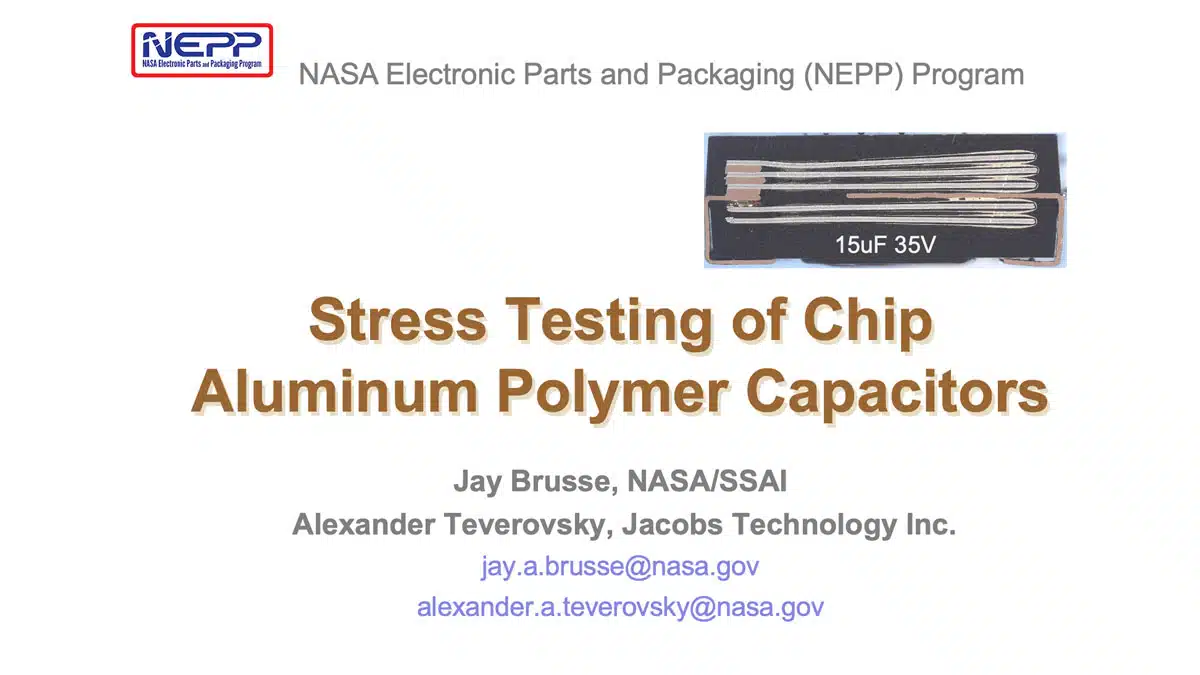
This paper Stress Testing of Chip Aluminum Polymer Capacitors was authored by Alexander Teverovsky Jacobs Technology Inc., NASA/GSFC and presented by Jay Brusse, NASA/SSAI during the 5th Space Passive Component Days (SPCD), an International Symposium held from October 15th to 18th, 2024, at ESA/ESTEC in Noordwijk, the Netherlands. Published under permission from ESA SPCD organizers.

Introduction:

RelatedPosts

ESA SPCD 26 Registration Open

ESA SPCD 26 Call for Papers Extended to 30th March

High-Density PCB Assemblies For Space Applications

The study “Stress Testing of Chip Aluminum Polymer Capacitors” by Alexander Teverovsky explores the reliability and performance of Aluminum Polymer Capacitors (APCs) as potential alternatives to traditional chip tantalum capacitors.

Given their advantageous properties such as lower Equivalent Series Resistance (ESR), reduced weight, and compact size, APCs present promising applications, particularly in space environments.

However, there is limited comprehensive data on their reliability under various environmental stress conditions.

Key Points:

  1. Scope of Study: Analysis of seven types of commercial APCs from four vendors, rated from 6.3 to 35 V.
  2. Testing Conditions: High-temperature storage (100–150 °C), high humidity (85 °C), and Highly Accelerated Life Tests (HALT) at voltages 1.2–1.9 times the rated voltage.
  3. Parameters Measured: Breakdown voltages, anomalous charging currents (ACC), capacitance, Dissipation Factor (DF), ESR, and leakage currents.
  4. Comparison: Reliability compared with Polymer Tantalum Capacitors (PTCs).

Extended Summary:

The introduction contextualizes APCs’ development, tracing their evolution from cylinder aluminum cases to chip designs that facilitate surface-mount assembly, boosting their appeal for modern electronic applications. The study emphasizes the need to understand their reliability, especially considering their growing usage in industries like automotive and aerospace.

APCs were subjected to rigorous experiments, including high-temperature storage tests at varying conditions (100, 125, and 150 °C) and humidity exposure tests.

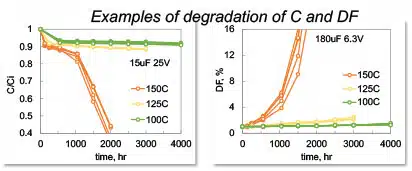
The capacitors demonstrated different degradation rates based on temperature, with significant ESR increases observed at extreme temperatures. Parametric failures were defined by specific thresholds in capacitance loss, DF increase, and ESR rise. The degradation mechanisms were linked to thermo-oxidative processes and moisture impacts on the dielectric materials.
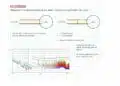
Humidity tests revealed that while APCs are sensitive to high moisture environments, some types managed to maintain stability under moderate humidity conditions. Interestingly, leakage currents increased significantly after exposure to high humidity but tended to decrease under bias, indicating self-recovery mechanisms similar to those in PTCs.
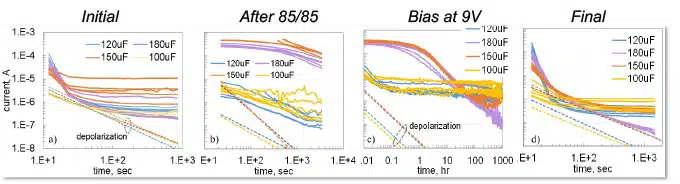
effect of humidity on DCL of APCs

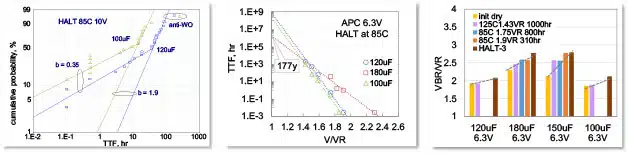
HALT experiments highlighted the capacitors’ behaviors under excessive stress. The study observed infant mortality failures, wear-out mechanisms, and “anti-wear-out” phenomena, where certain capacitors exhibited improved breakdown voltages after prolonged stress. The results suggested that APCs could achieve extended lifetimes under controlled operating conditions, with projected life spans exceeding several decades when appropriately derated.
Conclusion:

The comprehensive analysis indicates that APCs, with proper handling, screening, and derating, can be viable for demanding applications, including spaceflight.

Their performance under stress conditions is comparable to, and in some cases exceeds, that of PTCs. Nevertheless, variability among different manufacturers underscores the necessity for rigorous qualification protocols.

The findings support the broader adoption of APCs while highlighting areas for future research, particularly concerning long-term reliability in extreme environments.

Read the full paper:

ORAL_Day 3_34_JACOBS USA_Stress test of Al polymer capacitorsDownload

Related

Source: ESA SPCD

Recent Posts

Industrial Passive Components Markets and Technologies 2026

21.5.2026
55

Automotive Passive Components Technology Dossier

21.5.2026
45

Samsung Electro-Mechanics Signs 1.5T KRW Silicon Capacitor AI Contract

21.5.2026
33

Qi2 Wireless Charging: Inductors, Capacitors and EMC Filters

21.5.2026
22

Samsung Introduced Low ESL 3-Terminal Reverse-Geometry MLCCs for High-Performance ADAS

20.5.2026
42

Using Stress–Strain Curves to Diagnose Tantalum Powders for Capacitors

20.5.2026
26

Samsung Launches Ultra-Compact 008004 High Q MLCC for Next-Generation RF Applications

20.5.2026
31

Nichicon Extends Rechargeable Batteries Temperature to Rival Supercapacitors

19.5.2026
31

Two‑capacitor paradox explained for engineers

18.5.2026
69

Upcoming Events

Jun 2
16:00 - 17:00 CEST

Calculation, Simulation and Measurement of 800V EMC Filters

Jun 16
16:00 - 17:00 CEST

EMC with EMC – EMC‑compliant design with electromechanical connectors

View Calendar

Popular Posts

  • Buck Converter Design and Calculation

    0 shares
    Share 0 Tweet 0
  • Boost Converter Design and Calculation

    0 shares
    Share 0 Tweet 0
  • Flyback Converter Design and Calculation

    0 shares
    Share 0 Tweet 0
  • LLC Resonant Converter Design and Calculation

    0 shares
    Share 0 Tweet 0
  • MLCC and Ceramic Capacitors

    0 shares
    Share 0 Tweet 0
  • Capacitor Charging and Discharging

    0 shares
    Share 0 Tweet 0
  • What Electronics Engineer Needs to Know About Passive Low Pass Filters

    0 shares
    Share 0 Tweet 0
  • Dual Active Bridge (DAB) Topology

    0 shares
    Share 0 Tweet 0
  • Ripple Current and its Effects on the Performance of Capacitors

    3 shares
    Share 3 Tweet 0
  • Samsung Electro-Mechanics Releases High-Capacitance MLCCs for AI Server Applications

    0 shares
    Share 0 Tweet 0

Newsletter Subscription


Passive Components Blog

© EPCI - Leading Passive Components Educational and Information Site

  • Home
  • Privacy Policy
  • EPCI Membership & Advertisement
  • About

No Result
View All Result
  • Home
  • Knowledge Blog
  • Dossiers
  • PCNS

© EPCI - Leading Passive Components Educational and Information Site

This website uses cookies. By continuing to use this website you are giving consent to cookies being used. Visit our Privacy and Cookie Policy.
Go to mobile version