











Passive Components Blog
No Result
View All Result
  • Home
  • NewsFilter
    • All
    • Aerospace & Defence
    • Antenna
    • Applications
    • Automotive
    • Capacitors
    • Circuit Protection Devices
    • electro-mechanical news
    • Filters
    • Fuses
    • Inductors
    • Industrial
    • Integrated Passives
    • inter-connect news
    • Market & Supply Chain
    • Market Insights
    • Medical
    • Modelling and Simulation
    • New Materials & Supply
    • New Technologies
    • Non-linear Passives
    • Oscillators
    • Passive Sensors News
    • Resistors
    • RF & Microwave
    • Telecommunication
    • Weekly Digest

    Power Electronics Tools for Passives and Magnetic Designs

    Modelithics Releases Component Model Library for SIMULIA CST Studio Suite

    Exxelia Publishes Micropen White Papers for Printed Electronics

    Stackpole Releases AlN High‑Power Thick Film Chip Resistors

    Samsung Q4 2025 Results: MLCC focus for AI, Server and Automotive

    Würth Elektronik Developed a Custom Transformer for Active Hand Orthosis

    Wk 4 Electronics Supply Chain Digest

    Capacitor Technology Dossier

    ROHM Extends 2012 Shunt Resistors Power Rating up to 1.25 W

    Trending Tags

    • Ripple Current
    • RF
    • Leakage Current
    • Tantalum vs Ceramic
    • Snubber
    • Low ESR
    • Feedthrough
    • Derating
    • Dielectric Constant
    • New Products
    • Market Reports
  • VideoFilter
    • All
    • Antenna videos
    • Capacitor videos
    • Circuit Protection Video
    • Filter videos
    • Fuse videos
    • Inductor videos
    • Inter-Connect Video
    • Non-linear passives videos
    • Oscillator videos
    • Passive sensors videos
    • Resistor videos

    One‑Pulse Characterization of Nonlinear Power Inductors

    Thermistor Linearization Challenges

    Coaxial Connectors and How to Connect with PCB

    PCB Manufacturing, Test Methods, Quality and Reliability

    Transformer Behavior – Current Transfer and Hidden Feedback

    Choosing the Right Capacitor: The Importance of Accurate Measurements

    RF Inductors: Selection and Design Challenges for High-Frequency Circuits

    Transformer Safety IEC 61558 Standard

    3-Phase EMI Filter Design, Simulation, Calculation and Test

    Trending Tags

    • Capacitors explained
    • Inductors explained
    • Resistors explained
    • Filters explained
    • Application Video Guidelines
    • EMC
    • New Products
    • Ripple Current
    • Simulation
    • Tantalum vs Ceramic
  • Knowledge Blog
  • DossiersNew
  • Suppliers
    • Who is Who
  • PCNS
    • PCNS 2025
    • PCNS 2023
    • PCNS 2021
    • PCNS 2019
    • PCNS 2017
  • Events
  • Home
  • NewsFilter
    • All
    • Aerospace & Defence
    • Antenna
    • Applications
    • Automotive
    • Capacitors
    • Circuit Protection Devices
    • electro-mechanical news
    • Filters
    • Fuses
    • Inductors
    • Industrial
    • Integrated Passives
    • inter-connect news
    • Market & Supply Chain
    • Market Insights
    • Medical
    • Modelling and Simulation
    • New Materials & Supply
    • New Technologies
    • Non-linear Passives
    • Oscillators
    • Passive Sensors News
    • Resistors
    • RF & Microwave
    • Telecommunication
    • Weekly Digest

    Power Electronics Tools for Passives and Magnetic Designs

    Modelithics Releases Component Model Library for SIMULIA CST Studio Suite

    Exxelia Publishes Micropen White Papers for Printed Electronics

    Stackpole Releases AlN High‑Power Thick Film Chip Resistors

    Samsung Q4 2025 Results: MLCC focus for AI, Server and Automotive

    Würth Elektronik Developed a Custom Transformer for Active Hand Orthosis

    Wk 4 Electronics Supply Chain Digest

    Capacitor Technology Dossier

    ROHM Extends 2012 Shunt Resistors Power Rating up to 1.25 W

    Trending Tags

    • Ripple Current
    • RF
    • Leakage Current
    • Tantalum vs Ceramic
    • Snubber
    • Low ESR
    • Feedthrough
    • Derating
    • Dielectric Constant
    • New Products
    • Market Reports
  • VideoFilter
    • All
    • Antenna videos
    • Capacitor videos
    • Circuit Protection Video
    • Filter videos
    • Fuse videos
    • Inductor videos
    • Inter-Connect Video
    • Non-linear passives videos
    • Oscillator videos
    • Passive sensors videos
    • Resistor videos

    One‑Pulse Characterization of Nonlinear Power Inductors

    Thermistor Linearization Challenges

    Coaxial Connectors and How to Connect with PCB

    PCB Manufacturing, Test Methods, Quality and Reliability

    Transformer Behavior – Current Transfer and Hidden Feedback

    Choosing the Right Capacitor: The Importance of Accurate Measurements

    RF Inductors: Selection and Design Challenges for High-Frequency Circuits

    Transformer Safety IEC 61558 Standard

    3-Phase EMI Filter Design, Simulation, Calculation and Test

    Trending Tags

    • Capacitors explained
    • Inductors explained
    • Resistors explained
    • Filters explained
    • Application Video Guidelines
    • EMC
    • New Products
    • Ripple Current
    • Simulation
    • Tantalum vs Ceramic
  • Knowledge Blog
  • DossiersNew
  • Suppliers
    • Who is Who
  • PCNS
    • PCNS 2025
    • PCNS 2023
    • PCNS 2021
    • PCNS 2019
    • PCNS 2017
  • Events
No Result
View All Result
Passive Components Blog
No Result
View All Result

TDK Combines Varistor and Gas Discharge Tube into One Component

21.11.2025
Reading Time: 3 mins read
A A

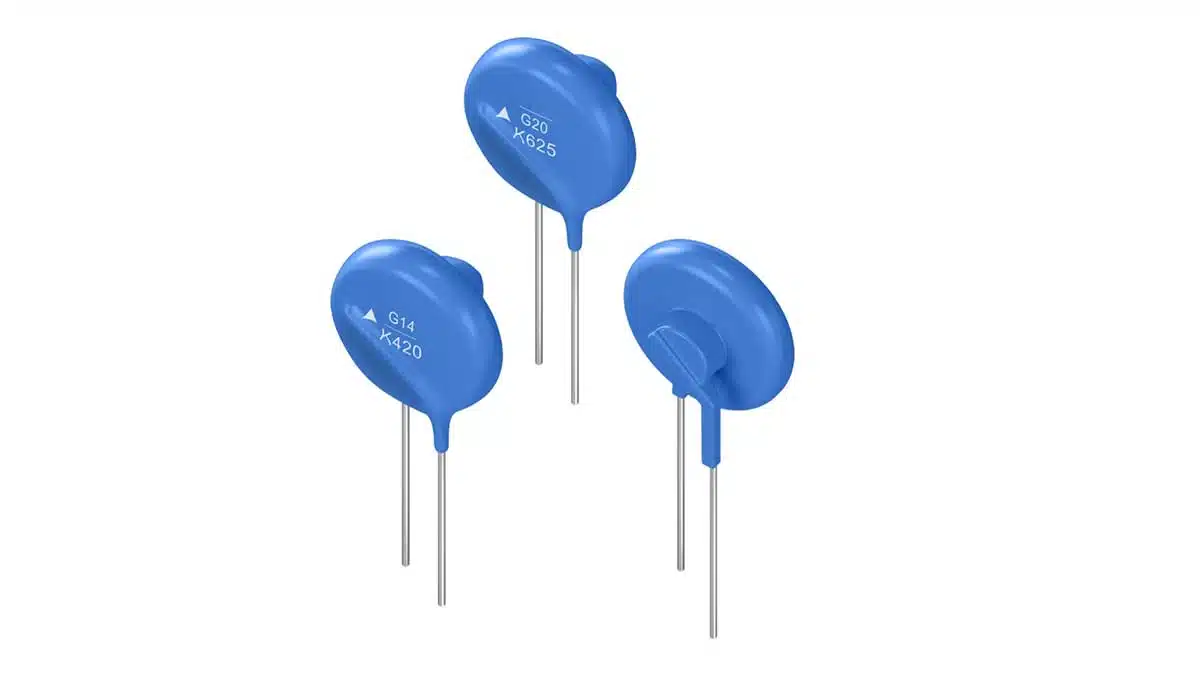
TDK Corporation introduced the G series of surge protection components, comprising the G14 (ordering code: B72214G) and the G20 (B72220G). 

Integrating a metal oxide varistor (MOV) and a gas discharge tube (GDT) into a single hybrid design and connecting them in series leverages the strengths of both elements.

RelatedPosts

0603 Automotive Chip Varistors as TVS Diode Replacements, TDK Tech Note

TDK Releases High Performance 105C DC Link Film Capacitors

TDK Unveils Small Automotive Power Inductors

This configuration reduces leakage current to virtually zero, extends the lifetime of the whole component, and provides superior surge protection compared to using either element separately in parallel.

These new components are commonly used in power supplies, chargers, appliances, surge protection devices, and communication systems that demand both efficiency and reliability.

Innovation through series hybrid design:

  • Zero standby leakage current: With the GDT isolating the MOV during normal operation, leakage currents are virtually eliminated, maximizing efficiency.
  • Extended MOV lifetime: The MOV is only engaging when the GDT has fired, drastically reducing stress and aging.
  • Reliable surge handling: When fired, the GDT quickly becomes low resistive and acts as the “first line of defense.” Meanwhile, the MOV clamps residual voltages, absorbs remaining energy, and eliminates follow-current to prevent the GDT from reigniting.
  • Compact integration: A single hybrid device simplifies design and reduces board space compared to discrete solutions.

The G series is available in two leaded versions: G14 and G20, which refer to MOV disk diameters of 14 mm and 20 mm, respectively. G14 models support AC operating voltages from 50 V to 680 V, while G20 versions extend this range to 750 V. The maximum surge current capability for a single pulse (8/20 µs) is 6,000 A (G14) and 10,000 A (G20), absorbing up to 200 J (G14) or 490 J (G20) of energy. Their operating temperature range is specified as -40 °C to +105 °C.

Features

  • Combining the strengths of both technologies
  • Long lifetime
  • Coating: epoxy, flame-retardant according to UL 94 V-0
  • Operating temperature -40 °C to +105 °C
  • Small footprint

Applications

  • Power supplies
  • Surge protection devices
  • White goods / Home appliances
  • Communication equipment
  • Smart metering
  • Drives

Related

Source: TDK

Recent Posts

Stackpole Releases AlN High‑Power Thick Film Chip Resistors

26.1.2026
11

ROHM Extends 2012 Shunt Resistors Power Rating up to 1.25 W

23.1.2026
16

Passive Components in Quantum Computing

22.1.2026
102

0603 Automotive Chip Varistors as TVS Diode Replacements, TDK Tech Note

21.1.2026
27

Conductive Polymer Capacitor Market and Design‑In Guide to 2035

20.1.2026
123

TDK Releases High Performance 105C DC Link Film Capacitors

19.1.2026
57

YAGEO Offers Automotive MOVs for EV and AI power

19.1.2026
33

YAGEO Acquires 100% of Shares of Shibaura Electronics

19.1.2026
96

Vishay Extends Aluminum Capacitors Rating Up to 600 V for DC Links

15.1.2026
37

Upcoming Events

Feb 24
16:00 - 17:00 CET

Designing Qi2 Wireless Power Systems: Practical Development and EMC Optimization

Mar 3
16:00 - 17:00 CET

Cybersecurity at the Eleventh Hour – from RED to CRA – Information and Discussion

Mar 21
All day

PSMA Capacitor Workshop 2026

View Calendar

Popular Posts

  • Buck Converter Design and Calculation

    0 shares
    Share 0 Tweet 0
  • Boost Converter Design and Calculation

    0 shares
    Share 0 Tweet 0
  • LLC Resonant Converter Design and Calculation

    0 shares
    Share 0 Tweet 0
  • Flyback Converter Design and Calculation

    0 shares
    Share 0 Tweet 0
  • Ripple Current and its Effects on the Performance of Capacitors

    3 shares
    Share 3 Tweet 0
  • How Metal Prices Are Driving Passive Component Price Hikes

    0 shares
    Share 0 Tweet 0
  • MLCC and Ceramic Capacitors

    0 shares
    Share 0 Tweet 0
  • What is a Dielectric Constant and DF of Plastic Materials?

    4 shares
    Share 4 Tweet 0
  • Degradation of Capacitors and its Failure Mechanisms

    0 shares
    Share 0 Tweet 0
  • Dual Active Bridge (DAB) Topology

    0 shares
    Share 0 Tweet 0

Newsletter Subscription


Passive Components Blog

© EPCI - Leading Passive Components Educational and Information Site

  • Home
  • Privacy Policy
  • EPCI Membership & Advertisement
  • About

No Result
View All Result
  • Home
  • Knowledge Blog
  • PCNS

© EPCI - Leading Passive Components Educational and Information Site

This website uses cookies. By continuing to use this website you are giving consent to cookies being used. Visit our Privacy and Cookie Policy.
Go to mobile version