






Passive Components Blog
No Result
View All Result
  • Home
  • NewsFilter
    • All
    • Aerospace & Defence
    • Antenna
    • Applications
    • Automotive
    • Capacitors
    • Circuit Protection Devices
    • electro-mechanical news
    • Filters
    • Fuses
    • Inductors
    • Industrial
    • Integrated Passives
    • inter-connect news
    • Market & Supply Chain
    • Market Insights
    • Medical
    • Modelling and Simulation
    • New Materials & Supply
    • New Technologies
    • Non-linear Passives
    • Oscillators
    • Passive Sensors News
    • Resistors
    • RF & Microwave
    • Telecommunication
    • Weekly Digest

    ECIA Industry Pulse Index Cools After Five-Year High

    YAGEO Extends Automotive CAN and CAN-FD Common-Mode Chokes

    Würth Elektronik Updates REDEXPERT DC‑DC Converter Designer

    Stackpole Unveils High-Temperature Automotive Thick Film Chip Resistors for Harsh Environments

    Molex Presents MiniMix Hybrid Power and Signal Connectors for Compact Humanoid Joints

    Bourns Releases Custom SiC AFE/PFC Power Inductor for High‑Voltage Designs

    Littelfuse Releases Toggle Safety Covers for Reliable Control Panels

    Bourns Expanded Blend‑Balance Guitar Potentiometers Resistance Range

    TDK Extends Vibration‑Resistant Axial Aluminum Capacitors for Compact DC‑links

    Trending Tags

    • Ripple Current
    • RF
    • Leakage Current
    • Tantalum vs Ceramic
    • Snubber
    • Low ESR
    • Feedthrough
    • Derating
    • Dielectric Constant
    • New Products
    • Market Reports
  • VideoFilter
    • All
    • Antenna videos
    • Capacitor videos
    • Circuit Protection Video
    • Filter videos
    • Fuse videos
    • Inductor videos
    • Inter-Connect Video
    • Non-linear passives videos
    • Oscillator videos
    • Passive sensors videos
    • Resistor videos

    Current Sense Transformers: Ferrite vs Nanocrystalline Cores for Accurate Current Measurement

    EMC Design Fundamentals: Safe Use of Varistors and Common Mode Chokes in Mains and Data-Line Filters

    Ferrite versus Nanocrystalline Power Inductor Cores: Turns, Gap and Size

    KYOCERA AVX Presents Antenna Integrator Studio Tutorial for Antenna Placement and RF Design

    Power Design Simulation Tools for Faster Inductor Selection and Loss Optimization

    EMC‑Compliant PCB and Connector Design Guidelines

    Why Isolated DC/DC Power Supplies Fail Late, Würth Elektronik Podcast

    Designing 800 V DC EMC Filters: Calculation, Simulation and Measurement

    Current Sense Transformer Datasheet and Design‑in Guide

    Trending Tags

    • Capacitors explained
    • Inductors explained
    • Resistors explained
    • Filters explained
    • Application Video Guidelines
    • EMC
    • New Products
    • Ripple Current
    • Simulation
    • Tantalum vs Ceramic
  • Knowledge Blog
  • Dossiers
    • AI Hardware Dossier
    • Power Converter Dossier
    • Automotive Dossier
    • Capacitor Dossier
    • Resistor Dossier
    • Inductor Dossier
    • Circuit Protection Dossier
  • Suppliers
    • Who is Who
  • PCNS
    • PCNS 2025
    • PCNS 2023
    • PCNS 2021
    • PCNS 2019
    • PCNS 2017
  • Events
  • Home
  • NewsFilter
    • All
    • Aerospace & Defence
    • Antenna
    • Applications
    • Automotive
    • Capacitors
    • Circuit Protection Devices
    • electro-mechanical news
    • Filters
    • Fuses
    • Inductors
    • Industrial
    • Integrated Passives
    • inter-connect news
    • Market & Supply Chain
    • Market Insights
    • Medical
    • Modelling and Simulation
    • New Materials & Supply
    • New Technologies
    • Non-linear Passives
    • Oscillators
    • Passive Sensors News
    • Resistors
    • RF & Microwave
    • Telecommunication
    • Weekly Digest

    ECIA Industry Pulse Index Cools After Five-Year High

    YAGEO Extends Automotive CAN and CAN-FD Common-Mode Chokes

    Würth Elektronik Updates REDEXPERT DC‑DC Converter Designer

    Stackpole Unveils High-Temperature Automotive Thick Film Chip Resistors for Harsh Environments

    Molex Presents MiniMix Hybrid Power and Signal Connectors for Compact Humanoid Joints

    Bourns Releases Custom SiC AFE/PFC Power Inductor for High‑Voltage Designs

    Littelfuse Releases Toggle Safety Covers for Reliable Control Panels

    Bourns Expanded Blend‑Balance Guitar Potentiometers Resistance Range

    TDK Extends Vibration‑Resistant Axial Aluminum Capacitors for Compact DC‑links

    Trending Tags

    • Ripple Current
    • RF
    • Leakage Current
    • Tantalum vs Ceramic
    • Snubber
    • Low ESR
    • Feedthrough
    • Derating
    • Dielectric Constant
    • New Products
    • Market Reports
  • VideoFilter
    • All
    • Antenna videos
    • Capacitor videos
    • Circuit Protection Video
    • Filter videos
    • Fuse videos
    • Inductor videos
    • Inter-Connect Video
    • Non-linear passives videos
    • Oscillator videos
    • Passive sensors videos
    • Resistor videos

    Current Sense Transformers: Ferrite vs Nanocrystalline Cores for Accurate Current Measurement

    EMC Design Fundamentals: Safe Use of Varistors and Common Mode Chokes in Mains and Data-Line Filters

    Ferrite versus Nanocrystalline Power Inductor Cores: Turns, Gap and Size

    KYOCERA AVX Presents Antenna Integrator Studio Tutorial for Antenna Placement and RF Design

    Power Design Simulation Tools for Faster Inductor Selection and Loss Optimization

    EMC‑Compliant PCB and Connector Design Guidelines

    Why Isolated DC/DC Power Supplies Fail Late, Würth Elektronik Podcast

    Designing 800 V DC EMC Filters: Calculation, Simulation and Measurement

    Current Sense Transformer Datasheet and Design‑in Guide

    Trending Tags

    • Capacitors explained
    • Inductors explained
    • Resistors explained
    • Filters explained
    • Application Video Guidelines
    • EMC
    • New Products
    • Ripple Current
    • Simulation
    • Tantalum vs Ceramic
  • Knowledge Blog
  • Dossiers
    • AI Hardware Dossier
    • Power Converter Dossier
    • Automotive Dossier
    • Capacitor Dossier
    • Resistor Dossier
    • Inductor Dossier
    • Circuit Protection Dossier
  • Suppliers
    • Who is Who
  • PCNS
    • PCNS 2025
    • PCNS 2023
    • PCNS 2021
    • PCNS 2019
    • PCNS 2017
  • Events
No Result
View All Result
Passive Components Blog
No Result
View All Result

TDK Extends Compact ThermoFuse Varistors up to 50 kA

5.3.2026
Reading Time: 7 mins read
A A

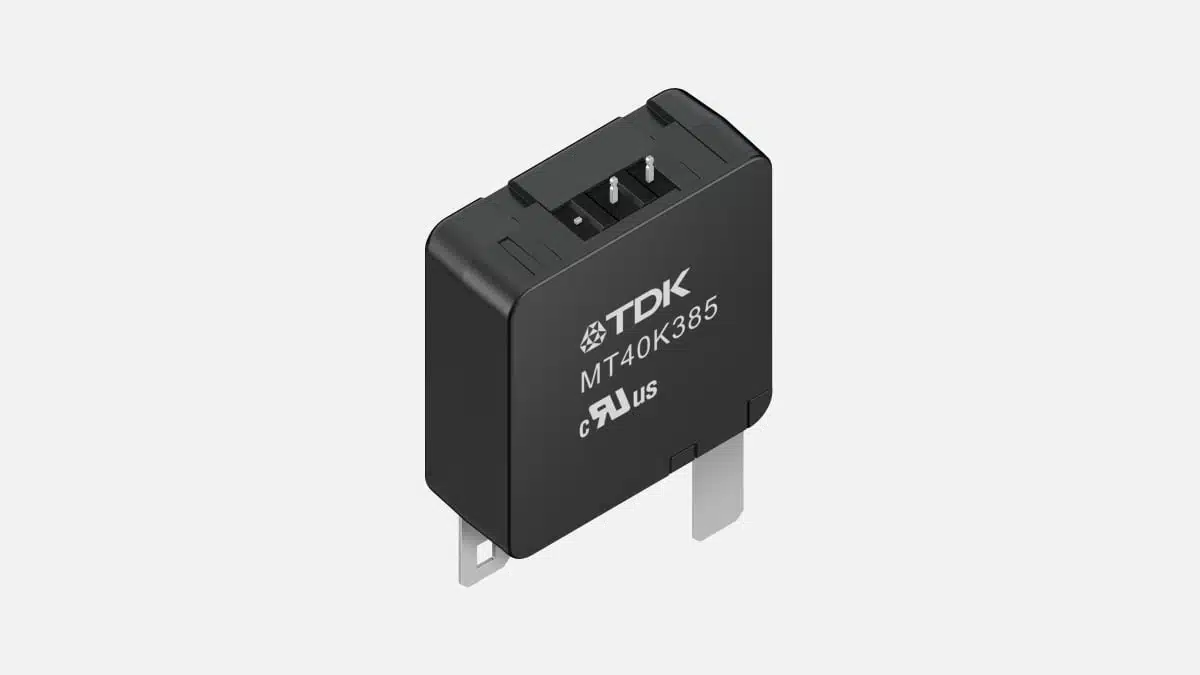
TDK has introduced the MT40 series of ThermoFuse varistors (ordering code B72240M), a new generation of surge protection components combining a compact footprint with enhanced safety features.

These devices target high‑energy surge environments up to 50 kA while integrating a thermal disconnect function and remote monitoring, making them suitable for demanding industrial, PV and communication systems.

RelatedPosts

TDK Extends Vibration‑Resistant Axial Aluminum Capacitors for Compact DC‑links

TDK Releases SMD Common‑Mode Chokes for Compact High‑Current EMI Filtering

TDK Releases Compact SMD Gate Drive Transformers for xEV

Key features and benefits

The MT40 ThermoFuse varistors are strap‑terminated metal oxide varistors (MOVs) with an integrated thermal disconnecting system. This combination is designed to prevent catastrophic failure under prolonged overvoltage protection or end‑of‑life overload conditions, where conventional MOVs can overheat.

Key features include:

  • Peak surge current capability up to 50 kA (8/20 µs pulse)
  • Short‑circuit current rating (SCCR) up to 200 kA according to UL 1449
  • AC operating voltage range from 150 V to 550 V
  • DC operating voltage range from 200 V to 750 V
  • UL 1449 Type 1CA component assembly recognition for both AC and DC applications (file E321126)
  • Integrated, galvanically insulated normally open micro‑switch for remote indication/monitoring
  • Optional visual status indicator for local fault signaling
  • Compact overmolded package: 38.0 × 15.2 × 40.9 mm (L × W × H)
  • Same electrode footprint on the PCB for all types in the series, simplifying layout reuse
  • Flame‑retardant epoxy encapsulation
  • Operating temperature range from −40 °C to +85 °C
  • RoHS, REACH and PFAS compliant construction

For design engineers, the combination of high surge rating, thermal disconnection and status indication provides a more controlled failure behavior than a standard MOV. In practice, this supports coordinated protection concepts where system controllers or upstream breakers can react to an end‑of‑life event instead of relying solely on passive fusing.

Typical applications

The MT40 series targets line‑connected equipment where high surge currents and stringent safety requirements coincide. Typical applications include:

  • PV systems (string inverters, combiner boxes, DC side and AC output surge protection)
  • Industrial power supplies and control cabinets
  • Outdoor lighting systems and LED drivers exposed to lightning‑induced surges
  • Telecommunication systems and outdoor base station cabinets
  • Surge protective devices (SPDs) used at service entrances or sub‑distribution levels

In these use cases, the compact footprint helps when retrofitting additional surge protection into crowded enclosures or DIN‑rail SPD modules. The wide AC and DC voltage range allows one platform to cover different mains systems and DC bus voltages, easing portfolio management for OEMs and panel builders.

Technical highlights

Surge and short‑circuit capability

With a peak surge current rating up to 50 kA (8/20 µs), the MT40 series addresses high‑energy surge environments such as lightning exposure at building entries or long cable runs. A short‑circuit current rating up to 200 kA according to UL 1449 supports coordination with upstream protective devices in installations with high prospective fault currents.

In practice, the SCCR value is important for system certification and selection of upstream breakers or fuses. It ensures that, in the event of a short‑circuit within the SPD path, the assembly can withstand the fault current until an upstream device clears the fault, instead of failing in an uncontrolled way.

Thermal disconnect and monitoring

The integrated thermal disconnecting system is designed to separate the varistor element from the line if it overheats, for example due to sustained overvoltage or end‑of‑life degradation. This helps to prevent thermal runaway and potential fire hazards often cited in MOV application notes.

A galvanically insulated normally open micro‑switch is mechanically coupled to the disconnect function. When the varistor has been thermally disconnected, the micro‑switch can close or open (depending on wiring) a low‑voltage monitoring circuit, allowing:

  • Remote signaling to a PLC, controller or building management system
  • Triggering of alarms or maintenance notifications
  • Coordinated shutdown of affected system sections

An optional visual indicator provides a quick on‑site check of the protection status without opening the enclosure, which is useful for field service.

Mechanical design and footprint

The MT40 series uses a patented overmolding technology to realize a compact package of 38.0 × 15.2 × 40.9 mm. For designers, this means:

  • Reduced volume for high‑energy surge protection stages
  • Easier integration into narrow SPD housings or compact power supplies
  • Consistent PCB electrode footprint across the series, simplifying layout and allowing different voltage ratings to share the same board design

The flame‑retardant epoxy encapsulation adds an extra safety layer against flame propagation and environmental contamination, which is important in harsh industrial and outdoor environments.

Environmental and regulatory aspects

The MT40 ThermoFuse varistors are specified as RoHS, REACH and PFAS compliant. This supports OEMs in meeting current and emerging regulatory requirements without additional material exemptions.

UL 1449 Type 1CA recognition for both AC and DC applications simplifies compliance for SPDs and equipment intended for multiple markets. The wide operating temperature range from −40 °C to +85 °C covers typical outdoor and industrial environments without derating outside this band, though final dimensioning should follow the detailed curves in the manufacturer’s datasheet.

Design‑in notes for engineers

When integrating MT40 ThermoFuse varistors into a design, engineers should consider:

  • Coordination with upstream protection: Verify that the SCCR and UL 1449 Type 1CA classification match the installation’s prospective fault current and protection scheme.
  • Voltage selection: Choose the AC or DC nominal voltage such that continuous operating voltage, temporary overvoltage and system tolerances remain within the varistor’s specified limits.
  • Energy and surge rating: Dimension the device based on expected surge levels from standards (for example, IEC 61643‑type requirements for SPDs) and application‑specific surge testing.
  • Thermal management: While the overmolded housing is compact, ensure adequate spacing and, where relevant, ventilation or thermal coupling to prevent excessive temperature rise in tight enclosures.
  • PCB layout: Use the standardized electrode footprint across the MT40 series to create a modular layout where different voltage ratings can be fitted without redesign. Observe creepage and clearance rules for the highest system voltage and pollution degree.
  • Monitoring integration: Route the galvanically insulated micro‑switch contacts to a low‑voltage I/O, alarm or indicator circuit so that thermal disconnection events are detected. Decide whether to implement latching alarms, automatic system derating or controlled shutdown strategies.
  • Serviceability: If the SPD or protection module is intended to be field‑replaceable, design mechanical access and labeling to make the visual indicator and part markings visible to maintenance staff.

In many industrial and PV systems, these ThermoFuse varistors will form part of a multi‑stage surge protection concept together with gas discharge tubes, series impedance or coordinated SPDs on different lines. Careful system‑level coordination is needed to ensure that the MT40 devices operate within their intended regime and that no single component is overstressed.

Source

This article is based on information provided in a TDK Electronics press release on the introduction of the MT40 ThermoFuse varistor series for surge protection up to 50 kA, complemented by general application considerations for MOV‑based surge protection.
References

  1. TDK introduces compact ThermoFuse varistors for surge protection of up to 50 kA
  2. TDK ThermoFuse varistor product family overview

Related

Recent Posts

YAGEO Extends Automotive CAN and CAN-FD Common-Mode Chokes

10.8.2026
7

Stackpole Unveils High-Temperature Automotive Thick Film Chip Resistors for Harsh Environments

6.8.2026
39

Molex Presents MiniMix Hybrid Power and Signal Connectors for Compact Humanoid Joints

6.8.2026
51

Bourns Releases Custom SiC AFE/PFC Power Inductor for High‑Voltage Designs

6.8.2026
47

Littelfuse Releases Toggle Safety Covers for Reliable Control Panels

6.8.2026
15

TDK Extends Vibration‑Resistant Axial Aluminum Capacitors for Compact DC‑links

4.8.2026
50

YAGEO Releases SMD 0402 Pt Temperature Sensors for Space‑Constrained Designs

3.8.2026
61

Bourns Introduces Automotive Wide Terminal Metal Foil Current Sense Resistors for High‑Reliability Designs

3.8.2026
34

YAGEO Extends Automotive Tantalum Polymer Capacitors for AI and ADAS Controllers

31.7.2026
122

Upcoming Events

Sep 10
11:00 - 12:00 CEST

Equipment models and model strategies for Space Missions

Sep 29
16:00 - 17:00 CEST

Cybersecurity 2026

Nov 24
16:00 - 17:00 CET

Component selection with the WE REDEXPERT® DC-DC Converter Designer Tool

View Calendar

Popular Posts

  • Buck Converter Design and Calculation

    0 shares
    Share 0 Tweet 0
  • Boost Converter Design and Calculation

    0 shares
    Share 0 Tweet 0
  • LLC Resonant Converter Design and Calculation

    0 shares
    Share 0 Tweet 0
  • MLCC and Ceramic Capacitors

    0 shares
    Share 0 Tweet 0
  • Flyback Converter Design and Calculation

    0 shares
    Share 0 Tweet 0
  • MLCCs in the Age of AI: Q2 2026 Market Tightness

    0 shares
    Share 0 Tweet 0
  • YAGEO Announces July 2026 Capacitor Price Increase

    0 shares
    Share 0 Tweet 0
  • Earthing Systems and IEC Classification Explained

    0 shares
    Share 0 Tweet 0
  • Dual Active Bridge (DAB) Topology

    0 shares
    Share 0 Tweet 0
  • Ripple Current and its Effects on the Performance of Capacitors

    3 shares
    Share 3 Tweet 0

Newsletter Subscription


Passive Components Blog

© EPCI - Leading Passive Components Educational and Information Site

  • Home
  • Privacy Policy
  • EPCI Membership & Advertisement
  • About

No Result
View All Result
  • Home
  • Knowledge Blog
  • Dossiers
  • PCNS

© EPCI - Leading Passive Components Educational and Information Site