






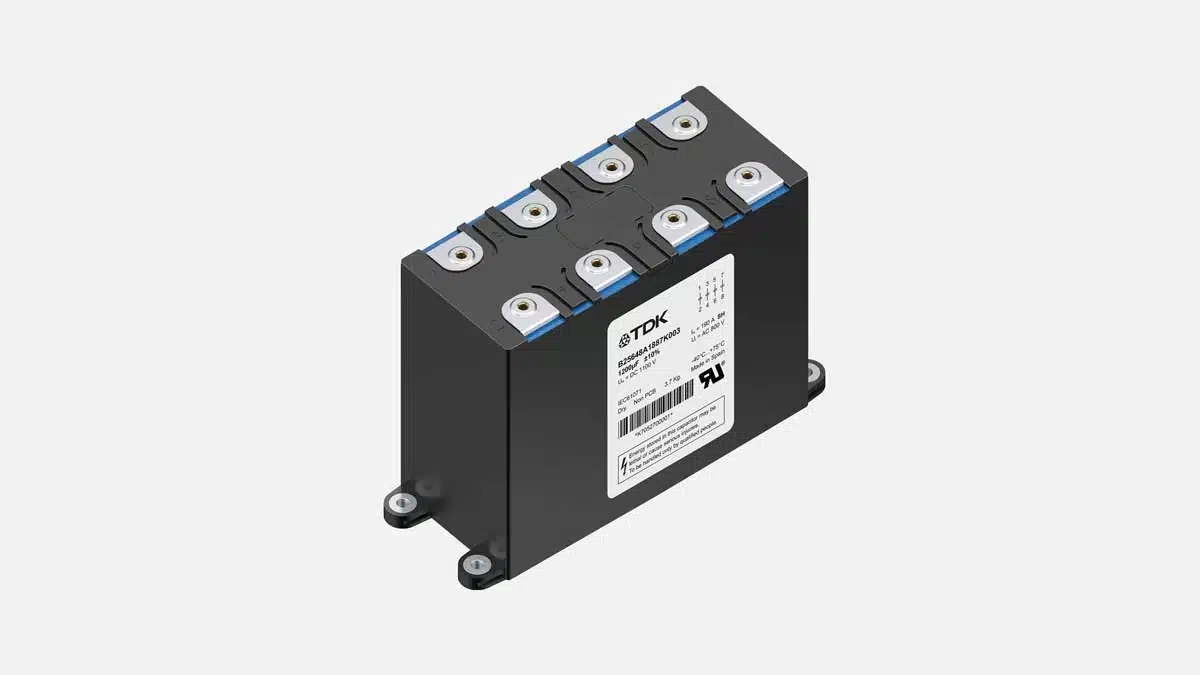
TDK has introduced the ModCap UHP (Ultra‑High Performance) DC link film capacitor series B25648A for high‑current power converters using fast SiC switches.
The new capacitor operate continuously up to a 105 °C hotspot temperature without current derating, enabling higher current density and longer lifetime in demanding DC link applications. Their cubic form factor and low ESL target compact, high‑efficiency inverters in renewable energy, rail, and industrial drives.
Key features and benefits
TDK’s ModCap UHP series is a rectangular, busbar‑mount DC link film capacitor family designed for high current and high ripple current environments in modern power electronics. The design combines a new high‑temperature dielectric system with a modular internal structure to deliver extended lifetime at elevated temperature and high current density.
Key electrical and mechanical features include:
- DC voltage range from 1350 V to 1800 V, suitable for typical 1000–1500 V DC link rails in SiC‑based converters.
- Capacitance values from 470 µF to 880 µF per module, allowing designers to tune energy storage and ripple filtering with a small number of blocks.
- Continuous operation at hotspot temperatures up to +105 °C without power derating, which simplifies thermal design compared with many film capacitors that require derating above about +85 to +90 °C.
- Very low equivalent series inductance (ESL) of 8 nH, supporting the fast switching edges of SiC MOSFETs with reduced overshoot and ringing.
- High current density and rated RMS current up to 205 A at +75 °C depending on the type, supporting compact layouts in high‑power inverters.
- Self‑healing polypropylene film technology with defined overvoltage capability for robust operation in real‑world transient conditions.
- Cubic housing with dimensions 205 mm × 90 mm × 170 mm (L × W × H), optimized for integration between laminated busbars.
From a practical perspective, the combination of 105 °C operation without derating and low ESL makes ModCap UHP attractive for designs that push switching frequency and power density while maintaining margin on capacitor temperature and lifetime. The significantly extended lifetime of up to 200,000 hours at +105 °C, according to manufacturer specification, can translate to fewer service interventions and better total cost of ownership in industrial and energy infrastructure equipment.
Typical applications
The ModCap UHP series targets DC link stages where high DC voltage, large ripple current, and fast switching devices coincide. Typical application areas highlighted by TDK include:
- Renewable energy converters:
- Central and string solar inverters with SiC stages on the DC link.
- Wind power converters, particularly medium‑voltage or high‑power stages requiring compact DC link banks.
- Power conversion in electrolyzers for hydrogen production, where high DC currents and elevated ambient temperatures are common.
- Energy storage systems (ESS):
- Bidirectional battery inverters for utility‑scale or commercial storage.
- DC/DC interfaces between storage and DC bus in microgrids or DC distribution.
- Traction and railway:
- Auxiliary inverters and drives in rolling stock, where EN 45545‑2 HL3 R23 fire behavior is a key requirement.
- Industrial motor drives:
- High‑power variable‑speed drives, especially in compact cabinets where thermal headroom is limited.
In these systems, the ModCap UHP acts as the main DC link capacitor bank, smoothing DC bus voltage, absorbing switching ripple, and limiting voltage overshoot at SiC device terminals. The very low ESL and modular mechanical concept can also reduce or eliminate the need for additional snubber capacitors in some topologies, simplifying BOM and layout.
Technical highlights
From a component selection perspective, three catalog types are currently listed in the ModCap UHP family, all in the same mechanical envelope:
- B25648A1887K003
- Rated DC voltage: 1350 V
- Capacitance: 880 µF
- Rated current at +75 °C: 205 A
- Surge current: 205 kA
- B25648A1647K003
- Rated DC voltage: 1600 V
- Capacitance: 640 µF
- Rated current at +75 °C: 190 A
- Surge current: 175 kA
- B25648A1477K003
- Rated DC voltage: 1800 V
- Capacitance: 470 µF
- Rated current at +75 °C: 180 A
- Surge current: 150 kA
All devices share:
- ESL of 8 nH, which is low for this voltage and capacitance class and particularly relevant with SiC transistors. Low inductance lowers voltage spikes during fast current transitions and allows higher di/dt operation.
- A modular internal structure, known from the broader ModCap family, intended to ease parallelization and tailoring of total capacitance and current capability at the system level.
- A dielectric film specified as ISCC‑certified bio‑circular BOPP (biaxially oriented polypropylene), supporting sustainability targets while maintaining conventional metallized film performance such as self‑healing and low loss.
- A housing that meets UL94 V‑0 and EN 45545‑2 HL3 R23 fire protection requirements, an important point for traction and public infrastructure projects. UL recognition is still pending at the time of the press release and should be verified against the latest datasheet or UL database for safety‑critical designs.
Engineers should refer to the detailed ModCap UHP datasheets for parameters such as dissipation factor, ESR, thermal resistance, permissible ripple current vs. frequency and temperature, and lifetime curves, as only key headline values are provided in the press information. Exact values for design dimensioning should always be taken directly from the manufacturer’s datasheet and design tools rather than inferred from summary figures.
Availability and part numbers
The initial ModCap UHP portfolio comprises the three ordering codes listed in the key data table above: B25648A1887K003, B25648A1647K003, and B25648A1477K003. All three share the same mechanical dimensions, which simplifies mechanical design and allows late selection of voltage/capacitance combination without changing the physical layout.
For component engineers and purchasers, this homogenous footprint means:
- A single busbar and mounting concept can be qualified, then populated with any of the available voltage/capacitance variants.
- Future extensions of the series may drop into the same footprint, as seen in previous ModCap generations, helping long‑term platform design.
- Stocking strategies can be simplified if a design can accept multiple voltage options, potentially easing supply constraints.
TDK references the ModCap power capacitor product page as the central entry point for current availability, datasheets, and detailed application information. Lead times, regional stocking, and lifecycle status (e.g., new, preferred, or not‑for‑new‑designs) should be checked there or through distribution partners.
Design‑in notes for engineers
Thermal and lifetime considerations
The headline feature of ModCap UHP is operation at hotspot temperatures up to +105 °C without power derating and a specified lifetime of up to 200,000 hours at this temperature. In practical terms:
- The capacitor can be run closer to the thermal limits of the surrounding system without having to reduce ripple current as soon as the hotspot exceeds +90 °C, as with previous ModCap generations.
- This is particularly valuable in cabinets with limited cooling, ambient temperatures above +40 °C, or systems where full‑load operation at high temperature is common (for example midday solar peaks in hot climates or rail equipment in tunnels).
For accurate sizing, designers should:
- Use TDK’s CLARA (Capacitor Life and Rating Application) tool to model lifetime versus applied voltage, ripple current, and temperature for the specific part number.
- Combine CLARA results with CAP Thermal simulations to understand internal hotspot temperatures in the given mechanical and cooling setup.
- Place temperature sensors near the capacitor body (or use integrated sensors if available) to validate simulation assumptions during prototype testing.
Electrical design and layout
The low ESL of 8 nH is a key enabler for clean switching waveforms with SiC power devices. To exploit this:
- Use short, wide busbar connections and keep the loop area between the capacitor terminals and the power module as small as possible.
- Place ModCap UHP modules as close as mechanically feasible to the power module DC terminals, ideally directly between laminated busbars.
- If additional snubber capacitors are still required for very fast edge control, their values and placement can often be reduced compared with more inductive DC link solutions.
Rated DC voltages of 1350–1800 V give comfortable margin for typical 1000–1500 V DC bus systems, but derating according to the system’s maximum continuous and transient DC voltage should still be applied in line with the datasheet guidelines. Surge current ratings up to 205 kA indicate the robustness against short‑duration pulses; however, repetitive pulses must stay within the capacitor’s thermal and electrical limits defined in the detailed specifications.
Standards, safety, and sustainability
The use of ISCC‑certified bio‑circular BOPP dielectric reflects the growing demand for sustainable materials in power electronics without compromising performance. For applications with strong ESG requirements, this can support documentation of reduced fossil feedstock usage in the component supply chain.
The enclosure’s compliance with UL94 V‑0 and EN 45545‑2 HL3 R23 is important for:
- Railway and traction projects where EN 45545‑2 is a mandatory requirement.
- Industrial and energy installations where flame‑retardant housings contribute to system safety approval.
As UL recognition is still pending, engineers in safety‑critical applications should check the most recent UL status for the exact ModCap UHP types before final design freeze and safety certification.
Design support tools
TDK provides a set of dedicated engineering tools for ModCap and related film capacitors that can shorten design cycles and improve accuracy:
- SPICE library for ModCap: Enables time‑domain simulation of DC link behavior, including ripple currents, transient response, and interaction with SiC device parasitics.
- CLARA (Capacitor Life and Rating Application): A web tool to estimate lifetime, permissible ripple current, and derating for specific operating profiles, essential for long‑life industrial and energy systems.
- CAP Thermal: A web‑based thermal simulation tool that helps map internal capacitor temperatures from external thermal conditions and loss data.
Using these tools in combination with system‑level simulation and hardware validation is recommended to avoid under‑ or over‑specification of the DC link capacitor bank.
Source
This article is based on information from the official TDK Corporation press release on the ModCap UHP DC link power capacitor series and associated product pages and design support tools, with additional independent commentary intended to support design‑in and component selection.
References
- TDK introduces ModCap UHP for high-current DC link applications with 105 °C operation without derating – official press release
- TDK ModCap DC rectangular power capacitors – product family overview
- TDK ModCap SPICE libraries
- TDK CLARA – Capacitor Life and Rating Application
- TDK CAP Thermal – thermal simulation for film capacitors