




Passive Components Blog
No Result
View All Result
  • Home
  • NewsFilter
    • All
    • Aerospace & Defence
    • Antenna
    • Applications
    • Automotive
    • Capacitors
    • Circuit Protection Devices
    • electro-mechanical news
    • Filters
    • Fuses
    • Inductors
    • Industrial
    • Integrated Passives
    • inter-connect news
    • Market & Supply Chain
    • Market Insights
    • Medical
    • Modelling and Simulation
    • New Materials & Supply
    • New Technologies
    • Non-linear Passives
    • Oscillators
    • Passive Sensors News
    • Resistors
    • RF & Microwave
    • Telecommunication
    • Weekly Digest

    Binder Hybrid Connector Simplifies One Cable Automation

    Tapped Inductor Buck Converter Fundamentals

    TAIYO YUDEN Releases Mini Metal Power Inductors

    Molecular Memristor Shows Record 145 kH Emergent Inductance

    Planar vs Conventional Transformer: When it Make Sense

    Researchers Propose Next‑Gen Compact Memory Using Ultra-thin Ferroelectric Capacitors

    Nichicon ADN Automotive Hybrid Aluminum Capacitors Now Available in EMEA

    Wk 19 Electronics Supply Chain Digest

    Electrocaloric Multilayer Capacitors: Towards Quiet, Solid‑State Cooling Around Room Temperature

    Trending Tags

    • Ripple Current
    • RF
    • Leakage Current
    • Tantalum vs Ceramic
    • Snubber
    • Low ESR
    • Feedthrough
    • Derating
    • Dielectric Constant
    • New Products
    • Market Reports
  • VideoFilter
    • All
    • Antenna videos
    • Capacitor videos
    • Circuit Protection Video
    • Filter videos
    • Fuse videos
    • Inductor videos
    • Inter-Connect Video
    • Non-linear passives videos
    • Oscillator videos
    • Passive sensors videos
    • Resistor videos

    Tapped Inductor Buck Converter Fundamentals

    Planar vs Conventional Transformer: When it Make Sense

    Modeling Fringing Field Losses in Inductors & Transformers

    Why Power Inductors Use a Ferrite Core With an Air Gap

    Transformer-Based Power-Line Harvester Magnetic Design

    Thermal Modeling of Magnetics

    Standard vs Planar LLC transformers Comparison for Battery Chargers

    How Modern Tools Model Magnetic Components for Power Electronics

    Advanced Loss Modeling for Planar Magnetics in the Frenetic Planar Tool

    Trending Tags

    • Capacitors explained
    • Inductors explained
    • Resistors explained
    • Filters explained
    • Application Video Guidelines
    • EMC
    • New Products
    • Ripple Current
    • Simulation
    • Tantalum vs Ceramic
  • Knowledge Blog
  • DossiersNew
  • Suppliers
    • Who is Who
  • PCNS
    • PCNS 2025
    • PCNS 2023
    • PCNS 2021
    • PCNS 2019
    • PCNS 2017
  • Events
  • Home
  • NewsFilter
    • All
    • Aerospace & Defence
    • Antenna
    • Applications
    • Automotive
    • Capacitors
    • Circuit Protection Devices
    • electro-mechanical news
    • Filters
    • Fuses
    • Inductors
    • Industrial
    • Integrated Passives
    • inter-connect news
    • Market & Supply Chain
    • Market Insights
    • Medical
    • Modelling and Simulation
    • New Materials & Supply
    • New Technologies
    • Non-linear Passives
    • Oscillators
    • Passive Sensors News
    • Resistors
    • RF & Microwave
    • Telecommunication
    • Weekly Digest

    Binder Hybrid Connector Simplifies One Cable Automation

    Tapped Inductor Buck Converter Fundamentals

    TAIYO YUDEN Releases Mini Metal Power Inductors

    Molecular Memristor Shows Record 145 kH Emergent Inductance

    Planar vs Conventional Transformer: When it Make Sense

    Researchers Propose Next‑Gen Compact Memory Using Ultra-thin Ferroelectric Capacitors

    Nichicon ADN Automotive Hybrid Aluminum Capacitors Now Available in EMEA

    Wk 19 Electronics Supply Chain Digest

    Electrocaloric Multilayer Capacitors: Towards Quiet, Solid‑State Cooling Around Room Temperature

    Trending Tags

    • Ripple Current
    • RF
    • Leakage Current
    • Tantalum vs Ceramic
    • Snubber
    • Low ESR
    • Feedthrough
    • Derating
    • Dielectric Constant
    • New Products
    • Market Reports
  • VideoFilter
    • All
    • Antenna videos
    • Capacitor videos
    • Circuit Protection Video
    • Filter videos
    • Fuse videos
    • Inductor videos
    • Inter-Connect Video
    • Non-linear passives videos
    • Oscillator videos
    • Passive sensors videos
    • Resistor videos

    Tapped Inductor Buck Converter Fundamentals

    Planar vs Conventional Transformer: When it Make Sense

    Modeling Fringing Field Losses in Inductors & Transformers

    Why Power Inductors Use a Ferrite Core With an Air Gap

    Transformer-Based Power-Line Harvester Magnetic Design

    Thermal Modeling of Magnetics

    Standard vs Planar LLC transformers Comparison for Battery Chargers

    How Modern Tools Model Magnetic Components for Power Electronics

    Advanced Loss Modeling for Planar Magnetics in the Frenetic Planar Tool

    Trending Tags

    • Capacitors explained
    • Inductors explained
    • Resistors explained
    • Filters explained
    • Application Video Guidelines
    • EMC
    • New Products
    • Ripple Current
    • Simulation
    • Tantalum vs Ceramic
  • Knowledge Blog
  • DossiersNew
  • Suppliers
    • Who is Who
  • PCNS
    • PCNS 2025
    • PCNS 2023
    • PCNS 2021
    • PCNS 2019
    • PCNS 2017
  • Events
No Result
View All Result
Passive Components Blog
No Result
View All Result

AVX is Showcasing High-Temperature Capacitor Solutions at HiTEC 2018

30.4.2018
Reading Time: 3 mins read
A A

Source: AVX news

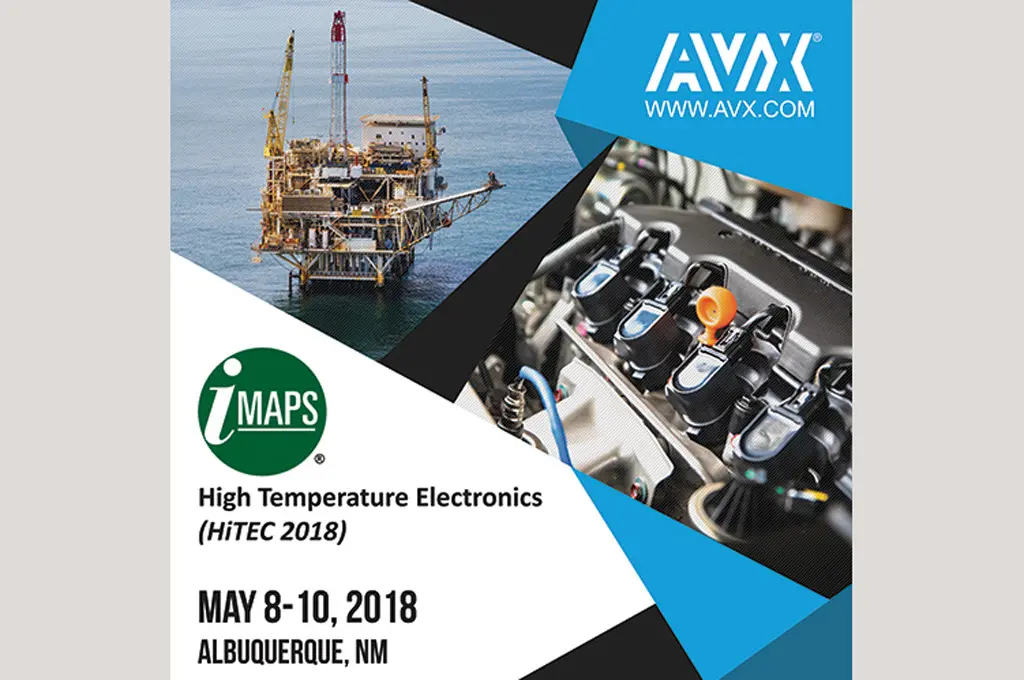
FOUNTAIN INN, S.C. (April 27, 2018) – AVX Corporation, a leading manufacturer and supplier of advanced electronic components and interconnect, sensor, control, and antenna solutions, is showcasing its portfolio of high-temperature capacitor solutions during the exposition portion of the International Microelectronics Assembly and Packaging Society’s (IMAPS’) International Conference on High Temperature Electronics (HiTEC 2018), which will take place May 8-10 in Albuquerque, New Mexico, and is widely recognized as the industry’s premier biennial technical conference dedicated to the advancement of high-temperature electronics research and applications.

RelatedPosts

Binder Hybrid Connector Simplifies One Cable Automation

Tapped Inductor Buck Converter Fundamentals

TAIYO YUDEN Releases Mini Metal Power Inductors

“HiTEC is an important forum that allows AVX engineers to exchange information, discuss the latest applications with both customers and research centers, and participate in the advancement of state-of-the-art high-temperature electronics and applications,” said David DuPré, field applications engineer – ceramics, AVX.

“Our high-temperature solutions portfolio is comprised of an ever-expanding range of both ceramic and tantalum capacitor technologies that are proven reliable in high-temperature applications across many markets. So, we’re looking forward to participating in this year’s conference, advancing our current knowledge, and applying the information we acquire to new products designs that will help our customers solve tomorrow’s high-temperature application challenges today.”

During the exhibition portion of HiTEC, which will take place May 8-9, David DuPré and Chris Reynolds, technical marketing manager – tantalum, will introduce attendees to selections from AVX’s vast portfolio of high-temperature ceramic and tantalum capacitor solutions, including:

  • AT Series High-Temperature, & 200ºC and 250°C Rated MLCCs, which deliver high-reliability, long lifetime performance at operating temperatures in excess of the current 125°C requirement in emerging military and commercial applications, are the only high-temperature MLCCs with reliability test data at 250°C, and are rated at both 250°C and 200°C to provide engineers with optimal derating schemes.
  • SMX-Style Stacked SMPS MLCCs, which exhibit excellent high-frequency performance, exceptional capacitance retention with frequency, high current-handling capabilities, low ESR, ESL, and DC leakage, and a wide frequency response in high-pulse, high-current applications; offer one of the industry’s broadest selections of stacked SMPS MLCCs rated to 200°C; and are ideal for demanding automotive, avionics, aerospace, and energy applications.
  • Encapsulated, Radial-Leaded, SXP-Style MLCCs, which utilize a high-temperature solder construction ideal for harsh-environment downhole oil exploration, aerospace, and hybrid automotive applications up to 200°C.
  • High-Temperature X8R/X8L Dielectric MLCCs, which provide high-reliability performance with low loss and stable capacitance over temperature, are qualified to AEC-Q200, are available with FLEXITERM® terminations, and are ideal for automotive underhood sensors and various industrial applications up to 150°C.
  • AR Series High-Voltage, Radial-Leaded Automotive SkyCap® MLCCs, which are qualified to AEC-Q200, exhibit excellent thermal shock and vibration resistance compared to SMD ceramics, and are ideal for automotive applications with voltage requirements up to 3,000V and temperatures up to 150°C.
  • THH 230°C Hermetic Series tantalum capacitors, which offer the highest temperature ratings of any SMD tantalum capacitors available on the market, have excellent volumetric efficiency, show no capacitance drop-off at even extremely high temperatures, exhibit superior stability in high-temperature, high-humidity, and ambient-atmosphere environments, and provide several significant design benefits over comparable high-temperature solutions, such as 200ºC wet tantalum, including size reductions, lower components counts, and improved reliability.
  • TWC-Y Series COTS-Plus wet tantalum capacitors, which are designed for up to 500 hours of operation at 200ºC with applicable derating and are hermetically sealed to withstand extreme environments.
  • THJ 200ºC Series SMD tantalum capacitors, which exhibits less than 1mA of leakage current after 1,000 hours of operation at 200ºC and is ideal for oil drilling, aerospace, and automotive applications.

For more information about the high-temperature AVX capacitor solutions described above, please click on the embedded links or navigate to AVX’s High-Temperature Product Range Application Guide and AVX’s High-Temperature Solutions Catalog. For more information about HiTEC 2018, please visit http://www.imaps.org/hitec/.
Related

Recent Posts

Binder Hybrid Connector Simplifies One Cable Automation

13.5.2026
4

Planar vs Conventional Transformer: When it Make Sense

11.5.2026
35

Researchers Propose Next‑Gen Compact Memory Using Ultra-thin Ferroelectric Capacitors

11.5.2026
28

Nichicon ADN Automotive Hybrid Aluminum Capacitors Now Available in EMEA

11.5.2026
23

Electrocaloric Multilayer Capacitors: Towards Quiet, Solid‑State Cooling Around Room Temperature

7.5.2026
186

Stackpole Expanded its AlN Thick Film Chip Resistors

6.5.2026
23

KYOCERA 10 µF 0201 MLCC Brings High‑Capacitance into Mobile Designs

6.5.2026
54

Würth Elektronik Introduces Compact Flat-wire SMT Power Inductors for Automotive

5.5.2026
50

KYOCERA AVX Extends MLV Varistors for 48V Automotive Protection

5.5.2026
27

Upcoming Events

May 19
16:00 - 17:00 CEST

Designing Qi2 Wireless Power Systems: Practical Development and EMC Optimization

Jun 2
16:00 - 17:00 CEST

Calculation, Simulation and Measurement of 800V EMC Filters

Jun 16
16:00 - 17:00 CEST

EMC with EMC – EMC‑compliant design with electromechanical connectors

View Calendar

Popular Posts

  • Buck Converter Design and Calculation

    0 shares
    Share 0 Tweet 0
  • Boost Converter Design and Calculation

    0 shares
    Share 0 Tweet 0
  • Flyback Converter Design and Calculation

    0 shares
    Share 0 Tweet 0
  • LLC Resonant Converter Design and Calculation

    0 shares
    Share 0 Tweet 0
  • MLCC and Ceramic Capacitors

    0 shares
    Share 0 Tweet 0
  • Dual Active Bridge (DAB) Topology

    0 shares
    Share 0 Tweet 0
  • What Electronics Engineer Needs to Know About Passive Low Pass Filters

    0 shares
    Share 0 Tweet 0
  • Capacitor Charging and Discharging

    0 shares
    Share 0 Tweet 0
  • Ripple Current and its Effects on the Performance of Capacitors

    3 shares
    Share 3 Tweet 0
  • MLCC Case Sizes Standards Explained

    0 shares
    Share 0 Tweet 0

Newsletter Subscription


Passive Components Blog

© EPCI - Leading Passive Components Educational and Information Site

  • Home
  • Privacy Policy
  • EPCI Membership & Advertisement
  • About

No Result
View All Result
  • Home
  • Knowledge Blog
  • PCNS

© EPCI - Leading Passive Components Educational and Information Site

This website uses cookies. By continuing to use this website you are giving consent to cookies being used. Visit our Privacy and Cookie Policy.
Go to mobile version