

- News
- All
- Aerospace & Defence
- Antenna
- Applications
- Automotive
- Capacitors
- Circuit Protection Devices
- electro-mechanical news
- Filters
- Fuses
- Inductors
- Industrial
- Integrated Passives
- inter-connect news
- Market & Supply Chain
- Market Insights
- Medical
- Modelling and Simulation
- New Materials & Supply
- New Technologies
- Non-linear Passives
- Oscillators
- Passive Sensors News
- Resistors
- RF & Microwave
- Telecommunication
- Weekly Digest






- News
- All
- Aerospace & Defence
- Antenna
- Applications
- Automotive
- Capacitors
- Circuit Protection Devices
- electro-mechanical news
- Filters
- Fuses
- Inductors
- Industrial
- Integrated Passives
- inter-connect news
- Market & Supply Chain
- Market Insights
- Medical
- Modelling and Simulation
- New Materials & Supply
- New Technologies
- Non-linear Passives
- Oscillators
- Passive Sensors News
- Resistors
- RF & Microwave
- Telecommunication
- Weekly Digest

e-PassiveBlog
Current Sense Transformers: Ferrite vs Nanocrystalline Cores for Accurate Current Measurement
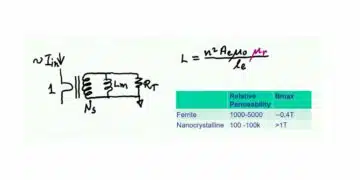
Current sense transformers are widely used to measure AC currents in power electronics, providing galvanic isolation and high bandwidth with...
Read moreDetailsEMC Design Fundamentals: Safe Use of Varistors and Common Mode Chokes in Mains and Data-Line Filters
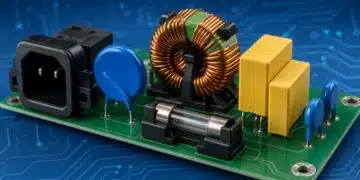
Electromagnetic interference (EMI) remains one of the key challenges in modern electronics, affecting both signal integrity and the reliable operation...
Read moreDetailsSquare-Wave Harmonics and RMS Currents in Power Converters

This article explains how decomposing switching waveforms into harmonics can support the design of inductors, capacitors, gate drivers, and EMI...
Read moreDetailsFerrite versus Nanocrystalline Power Inductor Cores: Turns, Gap and Size
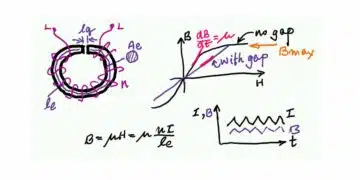
Designers selecting cores for high‑frequency power inductors often face the choice between ferrite and nanocrystalline materials, with conflicting advice on...
Read moreDetailsFrom DCL to SSC: Bridging Electrical Symptoms and Structural Indicators in Tantalum Capacitors
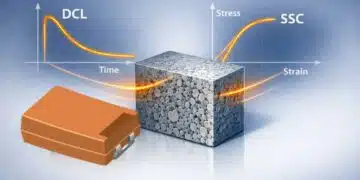
In this article, we look at how tantalum anode SSC (stress–strain characteristics) diagnostics can be used as a structural indicator...
Read moreDetailsEnabling the 800 V AI Server Era: How C0G High-Voltage MLCC Supports Next-Generation Power Architectures
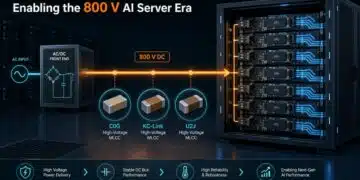
This article, edited from original article by Mark Laps, MLCC specialist at YAGEO Group, reviews why the industry is converging...
Read moreDetailsPower Design Simulation Tools for Faster Inductor Selection and Loss Optimization

Simulation tools such as REDEXPERT and eDesignSuite are increasingly central to modern power converter design workflows, because they let engineers...
Read moreDetailsUsing a Virtual Anode Thermal Model to Evaluate Miniaturization Risk in Tantalum Capacitors
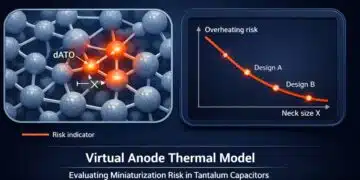
In this article, Dr. Vladimir Azbel presents a virtual anode thermal model that allows engineers to evaluate how far a tantalum...
Read moreDetailsEMC‑Compliant PCB and Connector Design Guidelines

Electromagnetic compatibility (EMC) is decided in the schematic and layout, not in the test chamber. This article distills key lessons...
Read moreDetailsPractical Value of Structural Diagnostics for Tantalum Capacitor Anodes
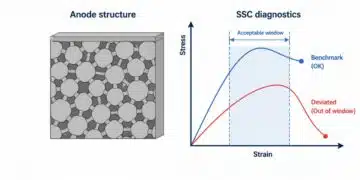
This article, written by Vladimir Azbel, Ph.D., a semiconductor process reliability engineering consultant, and adapted and edited for passive-components.eu, rovides an overview...
Read moreDetailsPopular Posts
-

Buck Converter Design and Calculation
-
LLC Resonant Converter Design and Calculation
-
Boost Converter Design and Calculation
-
Flyback Converter Design and Calculation
-
Earthing Systems and IEC Classification Explained
-
MLCC and Ceramic Capacitors
-
Resistor Symbols
-
Capacitor Charging and Discharging
-
Audio Capacitors: Choosing Capacitors for Crossover Circuits
-
Thermistors Basics, NTC and PTC Thermistors



© 2015–2026
All rights reserved