





Passive Components Blog
No Result
View All Result
  • Home
  • NewsFilter
    • All
    • Aerospace & Defence
    • Antenna
    • Applications
    • Automotive
    • Capacitors
    • Circuit Protection Devices
    • electro-mechanical news
    • Filters
    • Fuses
    • Inductors
    • Industrial
    • Integrated Passives
    • inter-connect news
    • Market & Supply Chain
    • Market Insights
    • Medical
    • Modelling and Simulation
    • New Materials & Supply
    • New Technologies
    • Non-linear Passives
    • Oscillators
    • Passive Sensors News
    • Resistors
    • RF & Microwave
    • Telecommunication
    • Weekly Digest

    Bourns Introduces High Current Chip Ferrite Beads for Dense Power Rails

    Wk 22 Electronics Supply Chain Digest

    Vishay Releases High‑Current Radial Inductors up to 209 A

    May 2026 Interconnect, Passives and Electromechanical Components Market Insights

    Passive Components Enable Safe and Reliable ADAS Architectures

    Current Sense Transformer Datasheet and Design‑in Guide

    Designing a USB Type‑C Flyback Planar Transformer with Frenetic’s Planar Tool

    YMIN Releases Square Supercapacitors for AI Server Power System

    Exxelia Extends Temperature Range of its PP Film Capacitors to 140C

    Trending Tags

    • Ripple Current
    • RF
    • Leakage Current
    • Tantalum vs Ceramic
    • Snubber
    • Low ESR
    • Feedthrough
    • Derating
    • Dielectric Constant
    • New Products
    • Market Reports
  • VideoFilter
    • All
    • Antenna videos
    • Capacitor videos
    • Circuit Protection Video
    • Filter videos
    • Fuse videos
    • Inductor videos
    • Inter-Connect Video
    • Non-linear passives videos
    • Oscillator videos
    • Passive sensors videos
    • Resistor videos

    Current Sense Transformer Datasheet and Design‑in Guide

    Designing a USB Type‑C Flyback Planar Transformer with Frenetic’s Planar Tool

    Magnetics Design in High‑Frequency GaN Converters

    Qi2 Wireless Charging: Inductors, Capacitors and EMC Filters

    Two‑capacitor paradox explained for engineers

    Capacitances of Nonlinear MLCCs: What Datasheets Don’t Tell You

    Tapped Inductor Buck Converter Fundamentals

    Planar vs Conventional Transformer: When it Make Sense

    Modeling Fringing Field Losses in Inductors & Transformers

    Trending Tags

    • Capacitors explained
    • Inductors explained
    • Resistors explained
    • Filters explained
    • Application Video Guidelines
    • EMC
    • New Products
    • Ripple Current
    • Simulation
    • Tantalum vs Ceramic
  • Knowledge Blog
  • DossiersNew
  • Suppliers
    • Who is Who
  • PCNS
    • PCNS 2025
    • PCNS 2023
    • PCNS 2021
    • PCNS 2019
    • PCNS 2017
  • Events
  • Home
  • NewsFilter
    • All
    • Aerospace & Defence
    • Antenna
    • Applications
    • Automotive
    • Capacitors
    • Circuit Protection Devices
    • electro-mechanical news
    • Filters
    • Fuses
    • Inductors
    • Industrial
    • Integrated Passives
    • inter-connect news
    • Market & Supply Chain
    • Market Insights
    • Medical
    • Modelling and Simulation
    • New Materials & Supply
    • New Technologies
    • Non-linear Passives
    • Oscillators
    • Passive Sensors News
    • Resistors
    • RF & Microwave
    • Telecommunication
    • Weekly Digest

    Bourns Introduces High Current Chip Ferrite Beads for Dense Power Rails

    Wk 22 Electronics Supply Chain Digest

    Vishay Releases High‑Current Radial Inductors up to 209 A

    May 2026 Interconnect, Passives and Electromechanical Components Market Insights

    Passive Components Enable Safe and Reliable ADAS Architectures

    Current Sense Transformer Datasheet and Design‑in Guide

    Designing a USB Type‑C Flyback Planar Transformer with Frenetic’s Planar Tool

    YMIN Releases Square Supercapacitors for AI Server Power System

    Exxelia Extends Temperature Range of its PP Film Capacitors to 140C

    Trending Tags

    • Ripple Current
    • RF
    • Leakage Current
    • Tantalum vs Ceramic
    • Snubber
    • Low ESR
    • Feedthrough
    • Derating
    • Dielectric Constant
    • New Products
    • Market Reports
  • VideoFilter
    • All
    • Antenna videos
    • Capacitor videos
    • Circuit Protection Video
    • Filter videos
    • Fuse videos
    • Inductor videos
    • Inter-Connect Video
    • Non-linear passives videos
    • Oscillator videos
    • Passive sensors videos
    • Resistor videos

    Current Sense Transformer Datasheet and Design‑in Guide

    Designing a USB Type‑C Flyback Planar Transformer with Frenetic’s Planar Tool

    Magnetics Design in High‑Frequency GaN Converters

    Qi2 Wireless Charging: Inductors, Capacitors and EMC Filters

    Two‑capacitor paradox explained for engineers

    Capacitances of Nonlinear MLCCs: What Datasheets Don’t Tell You

    Tapped Inductor Buck Converter Fundamentals

    Planar vs Conventional Transformer: When it Make Sense

    Modeling Fringing Field Losses in Inductors & Transformers

    Trending Tags

    • Capacitors explained
    • Inductors explained
    • Resistors explained
    • Filters explained
    • Application Video Guidelines
    • EMC
    • New Products
    • Ripple Current
    • Simulation
    • Tantalum vs Ceramic
  • Knowledge Blog
  • DossiersNew
  • Suppliers
    • Who is Who
  • PCNS
    • PCNS 2025
    • PCNS 2023
    • PCNS 2021
    • PCNS 2019
    • PCNS 2017
  • Events
No Result
View All Result
Passive Components Blog
No Result
View All Result

Connector PCB Design Challenges

3.10.2025
Reading Time: 5 mins read
A A

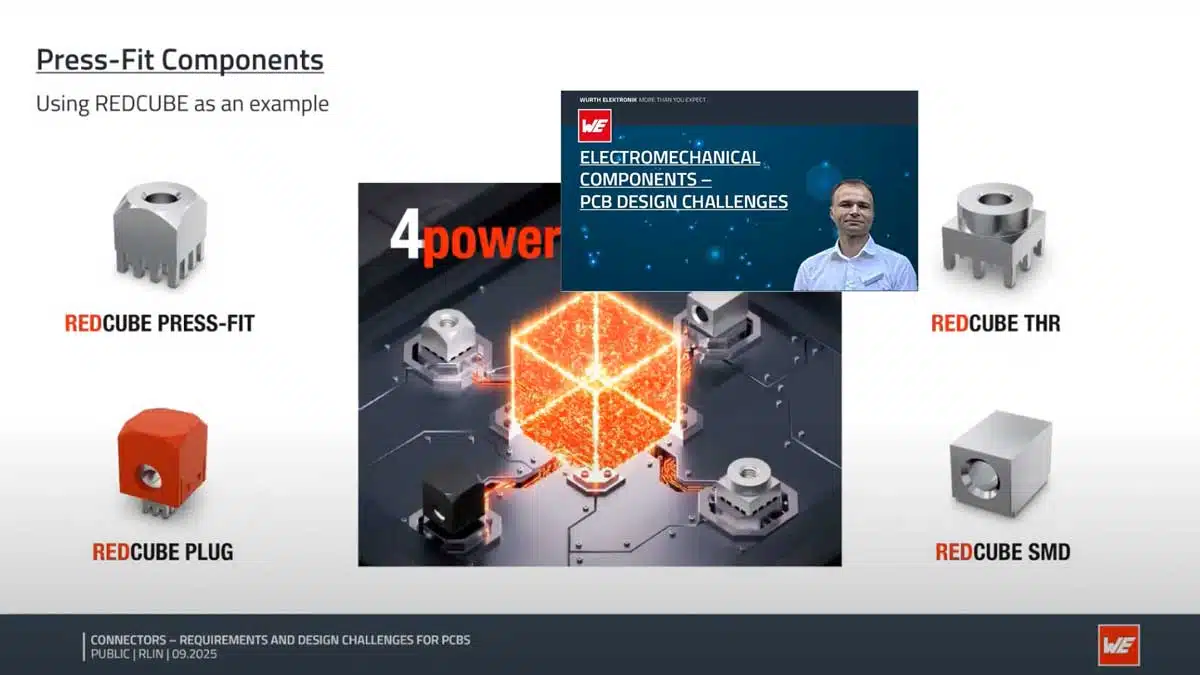
This presentation by René Linde, Field Application Engineer at Würth Elektronik published by All About Circuits discusses PCB design challenges of connector and interconnection technologies.

The presentation explores the mechanical, electrical, and design challenges associated with these components, offering insights into best practices for layout, testing, and integration.

RelatedPosts

Qi2 Wireless Charging: Inductors, Capacitors and EMC Filters

Würth Elektronik Presents New Bidirectional Digital Isolators

Würth Elektronik Introduces Compact Flat-wire SMT Power Inductors for Automotive

Introduction

Modern PCB design increasingly relies on electromechanical components that offer high reliability, mechanical stability, and electrical performance.

Technologies such as press-fit terminals, SKEDD connectors, and SMA interfaces are reshaping how engineers approach solderless connections, impedance matching, and high-frequency signal integrity.

Press-fit contacts enable solder-free, mechanically stable connections directly to the PCB and are particularly suitable for current-carrying applications. Complementing this, SKEDD technology offers a tool-free plug-in solution with a 2.54 mm pitch that eliminates the need for soldering, simplifying assembly and enhancing system reliability. Multiboard designs, whether board-to-board, wire-to-board, or board-to-wire, require precise interface planning. Changes to a connector can have immediate effects on other PCBs. Accurate 3D placement of boards and cables supports mechanical integration and facilitates alignment with the housing.

Key Points

  • Press-fit terminals provide gas-tight, solderless connections with superior mechanical and electrical reliability.
  • SKEDD connectors enable tool-free, reusable connections with minimal PCB deformation.
  • Impedance matching for SMA connectors requires precise taper geometry and simulation-driven layout optimization.
  • Clearance and creepage distances are critical for high-voltage PCB safety and must be carefully managed.
  • Mechanical reinforcement of SMD connectors can significantly improve push-pull force performance.

Press-Fit Technology and Cold Welding

Press-fit terminals, such as RedCube, utilize a cold welding mechanism where the pin is forcibly inserted into a plated via. This creates a gas-tight bond between brass and copper, eliminating the need for soldering. The optimal via diameter post-plating is approximately 1.475 mm, with copper thickness between 30–40 μm.

ParameterRecommended Value
Drill Hole Diameter1.66 mm
Copper Plating Thickness30–40 μm
Tin Layer Thickness2–15 μm
Final Via Diameter1.475 mm

Extraction force per pin can reach up to 100 N, depending on PCB thickness and surface finish. Cold welding ensures lower resistance than soldered joints and prevents oxidation.

SKEDD Connectors: Reusable Solderless Interfaces

Unlike press-fit, SKEDD connectors use elastic fork contacts that do not permanently deform the via. They support multiple mating cycles—up to 50 for debugging and 10 for permanent layouts. This makes them ideal for modular and serviceable designs.

Impedance Matching for SMA Connectors

High-frequency applications require precise impedance matching between PCB traces and SMA connectors. A curved line taper geometry is used to transition from 50 Ω to 25 Ω impedance, minimizing signal loss.

The taper is divided into segments of quarter-wavelength multiples:

$$ \lambda = \frac{c}{f \cdot \sqrt{\varepsilon_r}} $$

Where:

  • λ = Wavelength
  • c = Speed of light
  • f = Frequency
  • εr = Relative permittivity

Simulation-driven layout optimization using Altium Designer’s DXF import ensures accurate geometry replication. Modified layouts show reduced insertion loss and improved VSWR across 6–14 GHz.

Clearance and Creepage in High-Voltage Design

To prevent arcing and breakdown, clearance (air gap) and creepage (surface path) must be optimized. Slots and grooves in the PCB increase effective distances. Pollution degree and altitude influence required spacing.

Pollution DegreeMinimum Clearance (mm)Minimum Creepage (mm)
10.61.0
21.02.5
31.54.0

Use of insulating barriers and strategic cutouts can extend creepage paths and improve safety margins.

Mechanical Reinforcement of SMD Connectors

Push-pull force testing reveals that standard SMD layouts offer limited mechanical stability. Modified layouts such as the “Mickey Mouse” footprint or via-reinforced pads significantly improve performance.

Layout TypePush Force (kg)Pull Force (kg)
THT Datasheet7550
SMD Standard2011
Mickey Mouse3720
SMD with Vias3519

Adhesive reinforcement can further increase pull resistance, though solder joint integrity remains the limiting factor.

Multiboard Integration and 3D Alignment

Multiboard systems require precise 3D alignment and connector planning. Using nominal models in Altium Designer, engineers can simulate mechanical fit and ensure housing compatibility. Spacer and basket connectors facilitate modular stacking.

Conclusion

Electromechanical components are no longer passive elements—they define the mechanical, electrical, and thermal boundaries of modern PCB design. By mastering press-fit techniques, impedance matching, and mechanical reinforcement, engineers can build robust, scalable systems. Simulation, measurement, and layout optimization are essential tools in this evolving landscape. As technologies like SKEDD and RedCube mature, they offer compelling alternatives to traditional soldering, paving the way for more efficient and reliable electronics.


Related

Source: All About Circuits, Wuerth Elektronik

Recent Posts

Passive Components Enable Safe and Reliable ADAS Architectures

28.5.2026
57

Current Sense Transformer Datasheet and Design‑in Guide

27.5.2026
56

Designing a USB Type‑C Flyback Planar Transformer with Frenetic’s Planar Tool

27.5.2026
29

How Long-Term Storage Causes Aging in Electronic Components

26.5.2026
108

Mechanical SSC Testing as a Structural Diagnostic Tool for Tantalum Capacitor Anodes

25.5.2026
49

GDT Gas Discharge Tubes: Surge Protection Fundamentals, Selection, and Design‑in Tips

25.5.2026
55

Designing a Custom Core Transformer for 10 kW LLC Data Center Power Stages

22.5.2026
61

Magnetics Design in High‑Frequency GaN Converters

22.5.2026
58

Hirose Expands Compact High‑Voltage EV connectors

21.5.2026
30

Upcoming Events

Jun 2
16:00 - 17:00 CEST

Calculation, Simulation and Measurement of 800V EMC Filters

Jun 16
16:00 - 17:00 CEST

EMC with EMC – EMC‑compliant design with electromechanical connectors

View Calendar

Popular Posts

  • Buck Converter Design and Calculation

    0 shares
    Share 0 Tweet 0
  • Boost Converter Design and Calculation

    0 shares
    Share 0 Tweet 0
  • Flyback Converter Design and Calculation

    0 shares
    Share 0 Tweet 0
  • MLCC and Ceramic Capacitors

    0 shares
    Share 0 Tweet 0
  • LLC Resonant Converter Design and Calculation

    0 shares
    Share 0 Tweet 0
  • Capacitor Charging and Discharging

    0 shares
    Share 0 Tweet 0
  • What Electronics Engineer Needs to Know About Passive Low Pass Filters

    0 shares
    Share 0 Tweet 0
  • Dual Active Bridge (DAB) Topology

    0 shares
    Share 0 Tweet 0
  • Ripple Current and its Effects on the Performance of Capacitors

    3 shares
    Share 3 Tweet 0
  • SEPIC Converter Design and Calculation

    0 shares
    Share 0 Tweet 0

Newsletter Subscription


Passive Components Blog

© EPCI - Leading Passive Components Educational and Information Site

  • Home
  • Privacy Policy
  • EPCI Membership & Advertisement
  • About

No Result
View All Result
  • Home
  • Knowledge Blog
  • Dossiers
  • PCNS

© EPCI - Leading Passive Components Educational and Information Site

This website uses cookies. By continuing to use this website you are giving consent to cookies being used. Visit our Privacy and Cookie Policy.
Go to mobile version