






Passive Components Blog
No Result
View All Result
  • Home
  • NewsFilter
    • All
    • Aerospace & Defence
    • Antenna
    • Applications
    • Automotive
    • Capacitors
    • Circuit Protection Devices
    • electro-mechanical news
    • Filters
    • Fuses
    • Inductors
    • Industrial
    • Integrated Passives
    • inter-connect news
    • Market & Supply Chain
    • Market Insights
    • Medical
    • Modelling and Simulation
    • New Materials & Supply
    • New Technologies
    • Non-linear Passives
    • Oscillators
    • Passive Sensors News
    • Resistors
    • RF & Microwave
    • Telecommunication
    • Weekly Digest

    YAGEO Introduces High‑Current Y2/X1 Film Capacitors for Wide-bandgap Power Systems

    Amphenol Explanded Liquid Cooling Connectors for AI, ESS and EV Systems

    Hirose Introduced BGA connector for PCIe Gen6 for AI and Edge Computing

    YAGEO Introduces High Rel MLCCs Beyond MIL-Spec Limits

    Würth Elektronik Expanded Capacity for Validation and Services in Asia

    Samsung Introduces Ultra-High-Voltage 1500 V MLCCs for xEV Powertrains

    YAGEO Q1 2026 Results: AI Servers and Pricing Power Behind a Moderate Q2 Outlook

    TDK Introduces High‑Voltage Common‑Mode Chokes for Compact 1250 V DC Converters

    Vishay Extends Power Inductors for DC/DC with 1212 Compact Case

    Trending Tags

    • Ripple Current
    • RF
    • Leakage Current
    • Tantalum vs Ceramic
    • Snubber
    • Low ESR
    • Feedthrough
    • Derating
    • Dielectric Constant
    • New Products
    • Market Reports
  • VideoFilter
    • All
    • Antenna videos
    • Capacitor videos
    • Circuit Protection Video
    • Filter videos
    • Fuse videos
    • Inductor videos
    • Inter-Connect Video
    • Non-linear passives videos
    • Oscillator videos
    • Passive sensors videos
    • Resistor videos

    Transformer-Based Power-Line Harvester Magnetic Design

    Thermal Modeling of Magnetics

    Standard vs Planar LLC transformers Comparison for Battery Chargers

    How Modern Tools Model Magnetic Components for Power Electronics

    Advanced Loss Modeling for Planar Magnetics in the Frenetic Planar Tool

    2026 Power Magnetics Design Trends: Flyback, DAB and Planar

    Enabling Software‑Defined Vehicle Architectures: Automotive Ethernet and Zonal Smart Power

    Calculating Resistance Value of a Flyback RC Snubber 

    One‑Pulse Characterization of Nonlinear Power Inductors

    Trending Tags

    • Capacitors explained
    • Inductors explained
    • Resistors explained
    • Filters explained
    • Application Video Guidelines
    • EMC
    • New Products
    • Ripple Current
    • Simulation
    • Tantalum vs Ceramic
  • Knowledge Blog
  • DossiersNew
  • Suppliers
    • Who is Who
  • PCNS
    • PCNS 2025
    • PCNS 2023
    • PCNS 2021
    • PCNS 2019
    • PCNS 2017
  • Events
  • Home
  • NewsFilter
    • All
    • Aerospace & Defence
    • Antenna
    • Applications
    • Automotive
    • Capacitors
    • Circuit Protection Devices
    • electro-mechanical news
    • Filters
    • Fuses
    • Inductors
    • Industrial
    • Integrated Passives
    • inter-connect news
    • Market & Supply Chain
    • Market Insights
    • Medical
    • Modelling and Simulation
    • New Materials & Supply
    • New Technologies
    • Non-linear Passives
    • Oscillators
    • Passive Sensors News
    • Resistors
    • RF & Microwave
    • Telecommunication
    • Weekly Digest

    YAGEO Introduces High‑Current Y2/X1 Film Capacitors for Wide-bandgap Power Systems

    Amphenol Explanded Liquid Cooling Connectors for AI, ESS and EV Systems

    Hirose Introduced BGA connector for PCIe Gen6 for AI and Edge Computing

    YAGEO Introduces High Rel MLCCs Beyond MIL-Spec Limits

    Würth Elektronik Expanded Capacity for Validation and Services in Asia

    Samsung Introduces Ultra-High-Voltage 1500 V MLCCs for xEV Powertrains

    YAGEO Q1 2026 Results: AI Servers and Pricing Power Behind a Moderate Q2 Outlook

    TDK Introduces High‑Voltage Common‑Mode Chokes for Compact 1250 V DC Converters

    Vishay Extends Power Inductors for DC/DC with 1212 Compact Case

    Trending Tags

    • Ripple Current
    • RF
    • Leakage Current
    • Tantalum vs Ceramic
    • Snubber
    • Low ESR
    • Feedthrough
    • Derating
    • Dielectric Constant
    • New Products
    • Market Reports
  • VideoFilter
    • All
    • Antenna videos
    • Capacitor videos
    • Circuit Protection Video
    • Filter videos
    • Fuse videos
    • Inductor videos
    • Inter-Connect Video
    • Non-linear passives videos
    • Oscillator videos
    • Passive sensors videos
    • Resistor videos

    Transformer-Based Power-Line Harvester Magnetic Design

    Thermal Modeling of Magnetics

    Standard vs Planar LLC transformers Comparison for Battery Chargers

    How Modern Tools Model Magnetic Components for Power Electronics

    Advanced Loss Modeling for Planar Magnetics in the Frenetic Planar Tool

    2026 Power Magnetics Design Trends: Flyback, DAB and Planar

    Enabling Software‑Defined Vehicle Architectures: Automotive Ethernet and Zonal Smart Power

    Calculating Resistance Value of a Flyback RC Snubber 

    One‑Pulse Characterization of Nonlinear Power Inductors

    Trending Tags

    • Capacitors explained
    • Inductors explained
    • Resistors explained
    • Filters explained
    • Application Video Guidelines
    • EMC
    • New Products
    • Ripple Current
    • Simulation
    • Tantalum vs Ceramic
  • Knowledge Blog
  • DossiersNew
  • Suppliers
    • Who is Who
  • PCNS
    • PCNS 2025
    • PCNS 2023
    • PCNS 2021
    • PCNS 2019
    • PCNS 2017
  • Events
No Result
View All Result
Passive Components Blog
No Result
View All Result

How to Match the Right Connector with Protocol Requirements

6.11.2025
Reading Time: 3 mins read
A A
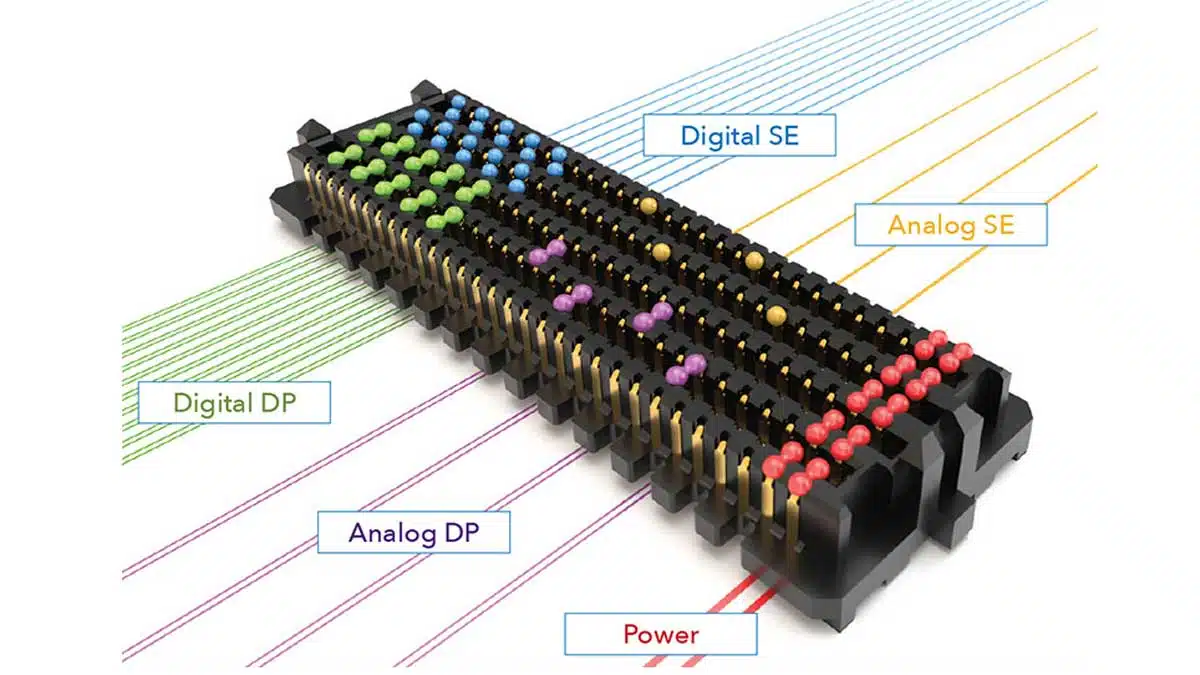
Image credit: Samtec

Image credit: Samtec

This article based on Samtec blog describe steps how to select the right connector to meet the industry standard protocols.

How to Pick the Right Connector for Your Protocol Requirements

Selecting the proper connector for modern electronic designs is more than matching physical dimensions—it’s about understanding the protocol landscape and ensuring signal performance, reliability, and future scalability.

RelatedPosts

Samtec AcceleRate Slim ARC6 Cable Assemblies with New Signaling Options

Samtec ANSI/VITA 90 Connectors: Rugged Small Form Factor Standard

Key Interconnect Technologies for 2025

Step 1: Know Your Protocol’s Signal & Performance Demands

Begin with the protocol at the heart of your system. Each communication standard—such as PCI Express®, Ethernet, USB, or SAS/SATA—dictates unique data rates, signaling types, and integrity thresholds. Make sure to answer:

  • What is the maximum data rate your protocol needs (e.g., 28 Gbps, 56 Gbps, 112 Gbps PAM4)?
  • Are there specific impedance and crosstalk constraints?

Step 2: Evaluate Connector Signal Integrity Capabilities

A connector’s signal integrity will directly impact protocol reliability. Look for products with proven test results, modeling data, and validation for your target protocol. Compatible connectors should support your bandwidth and maintain low loss and minimal distortion across real-world environments.

Step 3: Demand Open Pin Field Flexibility

Many high-speed connectors feature open pin fields, enabling designers to define custom differential pair arrangements, ground placement, and power distribution. This flexibility is critical for:

  • Supporting multiple protocols (present or future) on the same hardware.
  • Optimizing signal routing for EMC and noise reduction.

Step 4: Consider Mechanical & Thermal Constraints

Protocol compliance can only be maintained if the connector matches your application’s mechanical and environmental needs. Consider:

  • Required stack height or board-to-board spacing.
  • Form factor limitations in compact or ruggedized designs.
  • Temperature ratings for mission-critical or industrial systems.

Step 5: Validate with Documentation and Manufacturer Support

Choose connector suppliers who provide access to protocol-specific test data, signal integrity simulation models, and design guides. This accelerates design cycles and boosts confidence in compliance and long-term reliability.

Step 6: Future-Proof Your Design for Multiple Protocols

Modern systems often require support for more than one standard. Select connector platforms that are protocol agnostic, allowing easy upgrades or changes with minimal redesign. This approach enables:

  • Smoother transitions to new generations (e.g., PCIe Gen 4 to Gen 5).
  • Integration across different architectures or system requirements.
  • Scalability as bandwidth and signaling demands grow.

Key Takeaways for Protocol-Focused Connector Selection:

  • Start with your protocol’s performance needs—signal speed and integrity set the baseline.
  • Seek open pin field designs for maximum flexibility.
  • Validate mechanical and environmental compatibility for reliable operation.
  • Leverage documentation and supplier resources for simplified testing and compliance.
  • Plan for scalability by selecting protocol-agnostic connectors supporting future upgrades.

By following these steps, engineers can confidently select connectors that propel system performance, meet strict protocol requirements, and adapt to future communication challenges.


Related

Source: Samtec

Recent Posts

Amphenol Explanded Liquid Cooling Connectors for AI, ESS and EV Systems

17.4.2026
2

Hirose Introduced BGA connector for PCIe Gen6 for AI and Edge Computing

17.4.2026
4

Molex Completes Acquisition of Smiths Interconnect, Expanding Portfolio of High-Reliability Connectivity Solutions

1.4.2026
16

Binder Introduces Triangular Moulding for M16 and M12 Cable Connectors

31.3.2026
10

Bourns Expands its Modular Contacts for Power-Dense Systems

19.3.2026
13

Samtec AcceleRate Slim ARC6 Cable Assemblies with New Signaling Options

19.3.2026
27

Hirose Electric to Establish Automotive Connector Plant in India

19.3.2026
29

Binder Extends NCC Circular Connectors for Harsh Environments

13.3.2026
7

Samtec ANSI/VITA 90 Connectors: Rugged Small Form Factor Standard

5.3.2026
29

Upcoming Events

Apr 21
16:00 - 17:00 CEST

Heatsink Solutions: Thermal Management in electronic devices

Apr 22
17:00 - 17:30 CEST

Magnetics in a high frequency GaN era

Apr 22
17:00 - 18:00 CEST

Derating Tantalum, Film, and Ceramic Capacitors

View Calendar

Popular Posts

  • Buck Converter Design and Calculation

    0 shares
    Share 0 Tweet 0
  • Boost Converter Design and Calculation

    0 shares
    Share 0 Tweet 0
  • Flyback Converter Design and Calculation

    0 shares
    Share 0 Tweet 0
  • LLC Resonant Converter Design and Calculation

    0 shares
    Share 0 Tweet 0
  • Dual Active Bridge (DAB) Topology

    0 shares
    Share 0 Tweet 0
  • MLCC and Ceramic Capacitors

    0 shares
    Share 0 Tweet 0
  • Capacitor Charging and Discharging

    0 shares
    Share 0 Tweet 0
  • Plastic Materials Dielectric Constant and DF

    4 shares
    Share 4 Tweet 0
  • Ripple Current and its Effects on the Performance of Capacitors

    3 shares
    Share 3 Tweet 0
  • MLCC Case Sizes Standards Explained

    0 shares
    Share 0 Tweet 0

Newsletter Subscription


Passive Components Blog

© EPCI - Leading Passive Components Educational and Information Site

  • Home
  • Privacy Policy
  • EPCI Membership & Advertisement
  • About

No Result
View All Result
  • Home
  • Knowledge Blog
  • PCNS

© EPCI - Leading Passive Components Educational and Information Site

This website uses cookies. By continuing to use this website you are giving consent to cookies being used. Visit our Privacy and Cookie Policy.
Go to mobile version