















Passive Components Blog
No Result
View All Result
  • Home
  • NewsFilter
    • All
    • Aerospace & Defence
    • Antenna
    • Applications
    • Automotive
    • Capacitors
    • Circuit Protection Devices
    • electro-mechanical news
    • Filters
    • Fuses
    • Inductors
    • Industrial
    • Integrated Passives
    • inter-connect news
    • Market & Supply Chain
    • Market Insights
    • Medical
    • Modelling and Simulation
    • New Materials & Supply
    • New Technologies
    • Non-linear Passives
    • Oscillators
    • Passive Sensors News
    • Resistors
    • RF & Microwave
    • Telecommunication
    • Weekly Digest

    Murata Publishes Power Delivery Guide for AI Servers

    Selecting Current Sense Transformers with Würth Elektronik REDEXPERT

    Mechanical Drift Indicator of Tantalum Capacitor Anodes Degradation under Reverse Bias

    Enabling Software‑Defined Vehicle Architectures: Automotive Ethernet and Zonal Smart Power

    Calculating Resistance Value of a Flyback RC Snubber 

    Wk 5 Electronics Supply Chain Digest

    Top 10 Connector Vendors by Product Type

    Bourns Releases High‑Q Air Coil Inductors for RF Aplications

    CMSE 2026 Announces Call for Presentations on High-Reliability Military and Space Electronics

    Trending Tags

    • Ripple Current
    • RF
    • Leakage Current
    • Tantalum vs Ceramic
    • Snubber
    • Low ESR
    • Feedthrough
    • Derating
    • Dielectric Constant
    • New Products
    • Market Reports
  • VideoFilter
    • All
    • Antenna videos
    • Capacitor videos
    • Circuit Protection Video
    • Filter videos
    • Fuse videos
    • Inductor videos
    • Inter-Connect Video
    • Non-linear passives videos
    • Oscillator videos
    • Passive sensors videos
    • Resistor videos

    Enabling Software‑Defined Vehicle Architectures: Automotive Ethernet and Zonal Smart Power

    Calculating Resistance Value of a Flyback RC Snubber 

    One‑Pulse Characterization of Nonlinear Power Inductors

    Thermistor Linearization Challenges

    Coaxial Connectors and How to Connect with PCB

    PCB Manufacturing, Test Methods, Quality and Reliability

    Transformer Behavior – Current Transfer and Hidden Feedback

    Choosing the Right Capacitor: The Importance of Accurate Measurements

    RF Inductors: Selection and Design Challenges for High-Frequency Circuits

    Trending Tags

    • Capacitors explained
    • Inductors explained
    • Resistors explained
    • Filters explained
    • Application Video Guidelines
    • EMC
    • New Products
    • Ripple Current
    • Simulation
    • Tantalum vs Ceramic
  • Knowledge Blog
  • DossiersNew
  • Suppliers
    • Who is Who
  • PCNS
    • PCNS 2025
    • PCNS 2023
    • PCNS 2021
    • PCNS 2019
    • PCNS 2017
  • Events
  • Home
  • NewsFilter
    • All
    • Aerospace & Defence
    • Antenna
    • Applications
    • Automotive
    • Capacitors
    • Circuit Protection Devices
    • electro-mechanical news
    • Filters
    • Fuses
    • Inductors
    • Industrial
    • Integrated Passives
    • inter-connect news
    • Market & Supply Chain
    • Market Insights
    • Medical
    • Modelling and Simulation
    • New Materials & Supply
    • New Technologies
    • Non-linear Passives
    • Oscillators
    • Passive Sensors News
    • Resistors
    • RF & Microwave
    • Telecommunication
    • Weekly Digest

    Murata Publishes Power Delivery Guide for AI Servers

    Selecting Current Sense Transformers with Würth Elektronik REDEXPERT

    Mechanical Drift Indicator of Tantalum Capacitor Anodes Degradation under Reverse Bias

    Enabling Software‑Defined Vehicle Architectures: Automotive Ethernet and Zonal Smart Power

    Calculating Resistance Value of a Flyback RC Snubber 

    Wk 5 Electronics Supply Chain Digest

    Top 10 Connector Vendors by Product Type

    Bourns Releases High‑Q Air Coil Inductors for RF Aplications

    CMSE 2026 Announces Call for Presentations on High-Reliability Military and Space Electronics

    Trending Tags

    • Ripple Current
    • RF
    • Leakage Current
    • Tantalum vs Ceramic
    • Snubber
    • Low ESR
    • Feedthrough
    • Derating
    • Dielectric Constant
    • New Products
    • Market Reports
  • VideoFilter
    • All
    • Antenna videos
    • Capacitor videos
    • Circuit Protection Video
    • Filter videos
    • Fuse videos
    • Inductor videos
    • Inter-Connect Video
    • Non-linear passives videos
    • Oscillator videos
    • Passive sensors videos
    • Resistor videos

    Enabling Software‑Defined Vehicle Architectures: Automotive Ethernet and Zonal Smart Power

    Calculating Resistance Value of a Flyback RC Snubber 

    One‑Pulse Characterization of Nonlinear Power Inductors

    Thermistor Linearization Challenges

    Coaxial Connectors and How to Connect with PCB

    PCB Manufacturing, Test Methods, Quality and Reliability

    Transformer Behavior – Current Transfer and Hidden Feedback

    Choosing the Right Capacitor: The Importance of Accurate Measurements

    RF Inductors: Selection and Design Challenges for High-Frequency Circuits

    Trending Tags

    • Capacitors explained
    • Inductors explained
    • Resistors explained
    • Filters explained
    • Application Video Guidelines
    • EMC
    • New Products
    • Ripple Current
    • Simulation
    • Tantalum vs Ceramic
  • Knowledge Blog
  • DossiersNew
  • Suppliers
    • Who is Who
  • PCNS
    • PCNS 2025
    • PCNS 2023
    • PCNS 2021
    • PCNS 2019
    • PCNS 2017
  • Events
No Result
View All Result
Passive Components Blog
No Result
View All Result

Consumer MLCC Prices to Drop in 2H22 as Demand Continues to Weaken, Says TrendForce

29.5.2024
Reading Time: 5 mins read
A A

TrendForce forecasts that prices of consumer MLCCs ceramic capacitors will fall further by 3-6% on average in 2H22 due to weaker demand.

With the course of the COVID-19 pandemic constantly changing, China is sticking with its “Dynamic Zero-COVID Policy” and has been slow to lift the lockdown on its cities that have been recently affected by the outbreaks of the disease. Hence, the manufacturing industries of the major Chinese cities are facing delays in the resumption of normal operation, and a production gap has emerged in 2Q22.

RelatedPosts

TrendForce Predicts MLCC Shipments to Grow 7% in Q2 2024 Due to Strong AI Server Demand

Trendforce Predicts Modest Growth of MLCCs Through 2024

Potential Worsening of Pandemic in the Philippines May Hinder Production of Major MLCC Manufacturers Murata/Samsung, Says TrendForce

For the electronics ODMs, this production gap will be difficult to bridge in 2H22. Additionally, the ongoing global inflation is keeping prices of goods at a very high level, and this trend will dampen the peak-season demand surge during the second half of the year. The effect of the inflationary pressure has been especially noticeable in the demand for consumer electronics such as smartphones, notebook computers, and tablet computers. This, in turn, is also impacting the MLCC market in terms of demand and inventory. Currently, the general inventory level has risen above 90 days for MLCCs of all sizes.

On the other hand, demand remains fairly strong in application segments such as high-performance computing solutions (which include servers), networking equipment, industrial automation solutions, and energy storage systems. Furthermore, IDMs in the semiconductor industry will be adjusting the allocation of production capacity as the market for consumer electronics continues to experience a slowdown in 2H22. As a result, the undersupply situation for certain ICs will ease. Moreover, demand will be propped up in the high-end segment of the MLCC market and other application segments (e.g., automotive electronics and industrial equipment). All in all, thanks to the demand related to automotive electronics, servers, networking equipment, etc., TrendForce forecasts that the annual total MLCC shipments will increase by 2% YoY to around 2.58 trillion pieces for 2022.

Shipments and Prices Have Fallen for Consumer-Spec MLCCs, While Quotes for Automotive- and Industrial-Spec MLCCs Have Held Steady

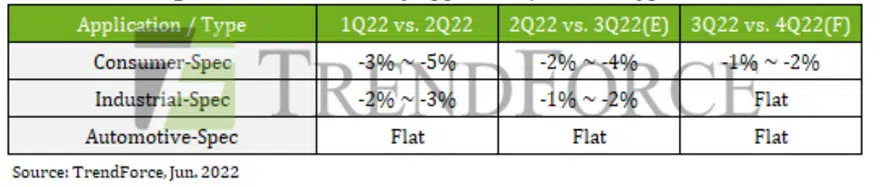
According to TrendForce’s research, prices of consumer-spec MLCCs registered drops of 5-10% on average during the period from 1Q21 to 1Q22. To further spur demand, MLCC suppliers have lowered prices further by 3-5% in 2Q22. In fact, the price has dropped to the level of material cost for some low-end consumer-spec MLCCs. In the previous market cycles for MLCCs, the inflection point in the supply-demand dynamics tended to appear following continuous climb or fall in both prices and shipments. For instance, prices and shipments were on an upward trajectory from 2H20 to 2021. And as of now, prices and shipments have been on a downward slide for two consecutive quarters. Looking ahead, there will be no easing of the downward pressure, so quotes for consumer-spec MLCCs are projected to register declines of 3-6% during 2H22.

With regard to industrial-spec MLCCs for niche applications, the overall demand for these products will pick up as buyers experience a loosening of supply for some semiconductor chips. TrendForce currently projects that prices of industrial-spec MLCCs will either register more moderate declines of 1-2% during 2H22 or stay mostly flat for the period. Turning to automotive-spec MLCCs, prices and shipments will hold steady because quote offerings and contract negotiations are conducted on an annual basis for this product category.

MLCC Suppliers in Japan, South Korea, and Taiwan Expand Offerings so as to Limit Impacts Related to Demand Fluctuations in Consumer Electronics Market

Japanese MLCC suppliers Murata and TDK now control almost 80% market share for automotive MLCCs. Besides raising production capacity for automotive offerings, these two suppliers are also strengthening service offerings for various related applications. For instance, they are boosting engagement with their customers through collaborations on product design and advancing the development of service offerings to the modular level. In the fields of automotive powertrain systems and ADAS, Murata and TDK have begun to provide solutions and services for image sensor modules, intelligent parking assist (IPA) modules, etc.

South Korea’s Samsung has successfully completed the qualification process for its automotive offerings this year. Moving into 3Q22, Samsung will gradually raise production capacity for automotive offerings at its plant in Tianjin. As for Taiwan’s YAGEO, the new production lines at its base in Kaohsiung are expected to commence pilot production in 4Q22. Much of the additional production capacity that YAGEO will be taking on is for high-voltage MLCCs and large-sized 22u automotive MLCCs (e.g., the 0805 and 1210 products). The new production lines will enter the mass production stage near the end of 1Q23 with the initial total production capacity reaching 8-10 billion pieces per month. YAGEO is also diversifying its services and solutions in order to expand into high-end application segments such as military technologies, networking equipment, automotive electronics, medical devices, etc. Examples besides MLCCs include resistors, inductors, and antenna modules.

TrendForce’s latest investigation on the COVID-19 lockdowns in China finds that the manufacturing industries residing in the eastern part of the country are starting to recover. Looking specifically at Shanghai, the transportation of goods out of its seaports and airports is gradually returning to normal. Therefore, ODMs’ production sites that are located within the region will be able to again ramp up shipments of finished products. Furthermore, the issue of component mismatch will ease significantly as the logistics system, on the whole, is returning to normal operation. The improvement in logistics will thus inject growth momentum into shipments of finished products in 3Q22. On another hand, several major variables will be influencing the MLCC market during 2H22. These include geopolitical tensions, the maintenance of the zero-COVID policy by the Chinese government, and the potential of inflation turning to stagflation.
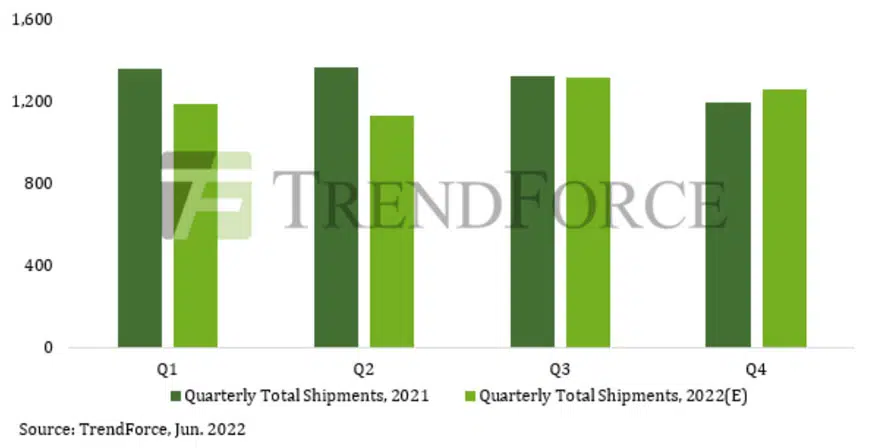
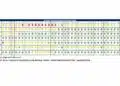
MLCC quarterly total shipments top 10 manufacturers 2021 vs 2022; source: TrendForce
MLCC quarterly MLCC price changes by application and type; source: TrendForce

Related

Source: TrendForce

Recent Posts

Murata Publishes Power Delivery Guide for AI Servers

4.2.2026
16

Mechanical Drift Indicator of Tantalum Capacitor Anodes Degradation under Reverse Bias

3.2.2026
17

Enabling Software‑Defined Vehicle Architectures: Automotive Ethernet and Zonal Smart Power

2.2.2026
18

Top 10 Connector Vendors by Product Type

29.1.2026
64

CMSE 2026 Announces Call for Presentations on High-Reliability Military and Space Electronics

28.1.2026
47

ESA Call for Papers 6th Space Passive Component Days – SPCD 2026

28.1.2026
42

Component Distribution Supply Chain January 2026

28.1.2026
74

Binder Unveils M8 Flange Solder Connectors for Flexible Cabling

28.1.2026
17

Stackpole Releases AlN High‑Power Thick Film Chip Resistors

26.1.2026
36

Upcoming Events

Feb 24
16:00 - 17:00 CET

Designing Qi2 Wireless Power Systems: Practical Development and EMC Optimization

Mar 3
16:00 - 17:00 CET

Cybersecurity at the Eleventh Hour – from RED to CRA – Information and Discussion

Mar 21
All day

PSMA Capacitor Workshop 2026

View Calendar

Popular Posts

  • Buck Converter Design and Calculation

    0 shares
    Share 0 Tweet 0
  • Boost Converter Design and Calculation

    0 shares
    Share 0 Tweet 0
  • LLC Resonant Converter Design and Calculation

    0 shares
    Share 0 Tweet 0
  • Flyback Converter Design and Calculation

    0 shares
    Share 0 Tweet 0
  • Ripple Current and its Effects on the Performance of Capacitors

    3 shares
    Share 3 Tweet 0
  • How Metal Prices Are Driving Passive Component Price Hikes

    0 shares
    Share 0 Tweet 0
  • MLCC and Ceramic Capacitors

    0 shares
    Share 0 Tweet 0
  • Dual Active Bridge (DAB) Topology

    0 shares
    Share 0 Tweet 0
  • What is a Dielectric Constant and DF of Plastic Materials?

    4 shares
    Share 4 Tweet 0
  • Degradation of Capacitors and its Failure Mechanisms

    0 shares
    Share 0 Tweet 0

Newsletter Subscription


Passive Components Blog

© EPCI - Leading Passive Components Educational and Information Site

  • Home
  • Privacy Policy
  • EPCI Membership & Advertisement
  • About

No Result
View All Result
  • Home
  • Knowledge Blog
  • PCNS

© EPCI - Leading Passive Components Educational and Information Site

This website uses cookies. By continuing to use this website you are giving consent to cookies being used. Visit our Privacy and Cookie Policy.
Go to mobile version