









Passive Components Blog
No Result
View All Result
  • Home
  • NewsFilter
    • All
    • Aerospace & Defence
    • Antenna
    • Applications
    • Automotive
    • Capacitors
    • Circuit Protection Devices
    • electro-mechanical news
    • Filters
    • Fuses
    • Inductors
    • Industrial
    • Integrated Passives
    • inter-connect news
    • Market & Supply Chain
    • Market Insights
    • Medical
    • Modelling and Simulation
    • New Materials & Supply
    • New Technologies
    • Non-linear Passives
    • Oscillators
    • Passive Sensors News
    • Resistors
    • RF & Microwave
    • Telecommunication
    • Weekly Digest

    Binder Hybrid Connector Simplifies One Cable Automation

    Tapped Inductor Buck Converter Fundamentals

    TAIYO YUDEN Releases Mini Metal Power Inductors

    Molecular Memristor Shows Record 145 kH Emergent Inductance

    Planar vs Conventional Transformer: When it Make Sense

    Researchers Propose Next‑Gen Compact Memory Using Ultra-thin Ferroelectric Capacitors

    Nichicon ADN Automotive Hybrid Aluminum Capacitors Now Available in EMEA

    Wk 19 Electronics Supply Chain Digest

    Electrocaloric Multilayer Capacitors: Towards Quiet, Solid‑State Cooling Around Room Temperature

    Trending Tags

    • Ripple Current
    • RF
    • Leakage Current
    • Tantalum vs Ceramic
    • Snubber
    • Low ESR
    • Feedthrough
    • Derating
    • Dielectric Constant
    • New Products
    • Market Reports
  • VideoFilter
    • All
    • Antenna videos
    • Capacitor videos
    • Circuit Protection Video
    • Filter videos
    • Fuse videos
    • Inductor videos
    • Inter-Connect Video
    • Non-linear passives videos
    • Oscillator videos
    • Passive sensors videos
    • Resistor videos

    Tapped Inductor Buck Converter Fundamentals

    Planar vs Conventional Transformer: When it Make Sense

    Modeling Fringing Field Losses in Inductors & Transformers

    Why Power Inductors Use a Ferrite Core With an Air Gap

    Transformer-Based Power-Line Harvester Magnetic Design

    Thermal Modeling of Magnetics

    Standard vs Planar LLC transformers Comparison for Battery Chargers

    How Modern Tools Model Magnetic Components for Power Electronics

    Advanced Loss Modeling for Planar Magnetics in the Frenetic Planar Tool

    Trending Tags

    • Capacitors explained
    • Inductors explained
    • Resistors explained
    • Filters explained
    • Application Video Guidelines
    • EMC
    • New Products
    • Ripple Current
    • Simulation
    • Tantalum vs Ceramic
  • Knowledge Blog
  • DossiersNew
  • Suppliers
    • Who is Who
  • PCNS
    • PCNS 2025
    • PCNS 2023
    • PCNS 2021
    • PCNS 2019
    • PCNS 2017
  • Events
  • Home
  • NewsFilter
    • All
    • Aerospace & Defence
    • Antenna
    • Applications
    • Automotive
    • Capacitors
    • Circuit Protection Devices
    • electro-mechanical news
    • Filters
    • Fuses
    • Inductors
    • Industrial
    • Integrated Passives
    • inter-connect news
    • Market & Supply Chain
    • Market Insights
    • Medical
    • Modelling and Simulation
    • New Materials & Supply
    • New Technologies
    • Non-linear Passives
    • Oscillators
    • Passive Sensors News
    • Resistors
    • RF & Microwave
    • Telecommunication
    • Weekly Digest

    Binder Hybrid Connector Simplifies One Cable Automation

    Tapped Inductor Buck Converter Fundamentals

    TAIYO YUDEN Releases Mini Metal Power Inductors

    Molecular Memristor Shows Record 145 kH Emergent Inductance

    Planar vs Conventional Transformer: When it Make Sense

    Researchers Propose Next‑Gen Compact Memory Using Ultra-thin Ferroelectric Capacitors

    Nichicon ADN Automotive Hybrid Aluminum Capacitors Now Available in EMEA

    Wk 19 Electronics Supply Chain Digest

    Electrocaloric Multilayer Capacitors: Towards Quiet, Solid‑State Cooling Around Room Temperature

    Trending Tags

    • Ripple Current
    • RF
    • Leakage Current
    • Tantalum vs Ceramic
    • Snubber
    • Low ESR
    • Feedthrough
    • Derating
    • Dielectric Constant
    • New Products
    • Market Reports
  • VideoFilter
    • All
    • Antenna videos
    • Capacitor videos
    • Circuit Protection Video
    • Filter videos
    • Fuse videos
    • Inductor videos
    • Inter-Connect Video
    • Non-linear passives videos
    • Oscillator videos
    • Passive sensors videos
    • Resistor videos

    Tapped Inductor Buck Converter Fundamentals

    Planar vs Conventional Transformer: When it Make Sense

    Modeling Fringing Field Losses in Inductors & Transformers

    Why Power Inductors Use a Ferrite Core With an Air Gap

    Transformer-Based Power-Line Harvester Magnetic Design

    Thermal Modeling of Magnetics

    Standard vs Planar LLC transformers Comparison for Battery Chargers

    How Modern Tools Model Magnetic Components for Power Electronics

    Advanced Loss Modeling for Planar Magnetics in the Frenetic Planar Tool

    Trending Tags

    • Capacitors explained
    • Inductors explained
    • Resistors explained
    • Filters explained
    • Application Video Guidelines
    • EMC
    • New Products
    • Ripple Current
    • Simulation
    • Tantalum vs Ceramic
  • Knowledge Blog
  • DossiersNew
  • Suppliers
    • Who is Who
  • PCNS
    • PCNS 2025
    • PCNS 2023
    • PCNS 2021
    • PCNS 2019
    • PCNS 2017
  • Events
No Result
View All Result
Passive Components Blog
No Result
View All Result

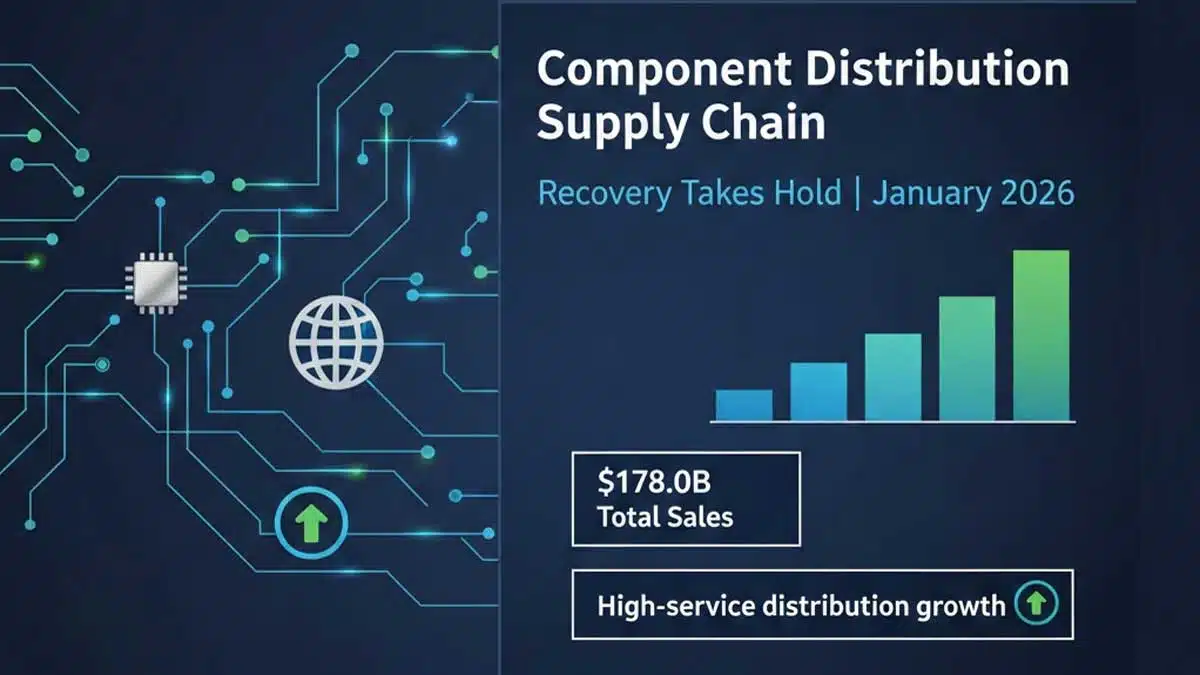
Component Distribution Supply Chain January 2026

28.1.2026
Reading Time: 4 mins read
A A

Edgewater researchers report that January 26 component distribution recovery takes hold as orders inflect; outlook is improving.

What’s Changed/What’s New?

  1. Shipments and orders have been increasing since October, particularly in the West, which is driving a positive outlook for the fourth quarter. B2B orders have grown by approximately 1.1 times, visibility has improved, and lead times have increased.
  2. The distribution outlook for 2026 has been revised upwards to a high-single-digit growth rate, driven by AI/DC, military/aerospace, and improving industrial demand.
  3. The first-quarter outlook is seasonal to above-seasonal in the West (Americas and Europe), with quarterly growth projected to be between 3% and 5% and a year-over-year growth rate of approximately 10%. This supports the momentum of the early cycle.
  4. The distribution inventory mix is still challenging. The company is relying on in-demand SKUs as lead times extend, while slower-moving semi-conductors remain elevated.
  5. Arrow’s performance in Asia-Pacific is expected to improve from the consolidation of Analog Devices starting in the first quarter. This is expected to generate approximately $500 million in annualized revenue by 2026, although this is partially offset by the continued shift of direct-to-consumer sales from TI.
  6. The shift of AI-related builds from the United States to Mexico is expected to benefit Arrow, potentially supporting the recent performance of Arrow in the Americas.
  7. TE is shifting some automotive sales to distribution, which is estimated to create approximately $200 million to $300 million in incremental channel opportunities. Arrow and Avnet are positioned to benefit from this shift. Supply Chain Services programs are regaining traction due to the disruption caused by Nexperia, which could serve as a catalyst.
  8. The high-service distribution segment continues to outperform the broadline segment, often driven by inventory availability. Private distributors are outpacing the growth of public distributors. Farnell’s synergies with Avnet’s core business are gaining traction, and their performance is improving.

Top 3 Channel Comments:

We haven’t felt as optimistic about the market outlook in a while. B2B has improved to 1.1 times, the backlog is healthy, and we are projecting roughly 10% growth in 2026.

RelatedPosts

Wk 19 Electronics Supply Chain Digest

Wk 18 Electronics Supply Chain Digest

Wk 17 Electronics Supply Chain Digest

In recent quarterly reports, Arrow and Avnet expressed more positive sentiments, stating that the recovery is on firmer footing. Both companies cited better-than-expected fourth-quarter bookings, improving backlogs, and B2B orders around 1.1 times, with quarterly growth projected in the West and high-service distribution growth for the entire year.

Distribution inventory is improving, but not as quickly as expected due to mix issues. The inventory available does not match customer demand. Although the drop in orders is still elevated, it is becoming increasingly difficult to fulfill them within the quarter as supplier lead times have increased to approximately 12 weeks.


Distribution Background Information:

Sales by HQ Geography
202120222023Y/Y
Americas$67.0$74.9$71.9-4%
Taiwan$60.9$55.9$54.1-3%
China$30.8$28.8$23.8-17%
Japan$20.9$21.6$21.70%
Europe$4.5$4.9$5.03%
Singapore$1.1$1.1$0.5-56%
South Korea$0.6$0.8$1.031%
Total$188.1$196.4$178.0-9%
Source: ECIA Top 50 Authorized Distributor Report 2024 Global Edition
Sales by Components2020202120222023Y/Y
Semis$114.1$148.0$147.8$139.9-5%
Interconnect$11.8$14.3$13.7$11.7-14%
Passives$8.2$10.0$9.6$9.60%
Electro-Mech$5.7$7.0$7.0$7.57%
Computer/System$1.6$1.9$5.8$2.8-51%
Power & Batteries$1.3$1.7$2.1$1.6-23%
Other$4.3$5.5$2.1$5.0141%
Total$147.1$188.1$196.4$178.0-9%
Source: ECIA Top 50 Authorized Distributor Report 2024 Global Edition

Conclusion

Macro data points generally align with our IP&E and semi-work, with some nuanced channel implications. Distributors seem well-positioned to capitalize on the cyclical upturn, pockets of TAM-to-DTAM conversion, and renewed momentum in supply-chain services.

Rising lead times and recurring supply chain disruptions are driving greater demand for planning and fulfillment support. However, near-term inventory mix challenges and heightened competition are expected to persist, potentially dampening margin recovery beyond opportunistic upside tied to memory shortages.

Overall, we remain constructive on the sales recovery, but we have a more measured view of the pace and magnitude of profit improvement for component distributors.

Full report available from: Dennis Reed, Sr. Research Analyst, Edgewater Research

Related

Source: Edgewater Research

Recent Posts

European Components Distribution Shows Strong Q1 2026 Growth Amid Geopolitical Uncertainty

7.5.2026
71

DigiKey Adds 31k New In‑Stock Parts in Q1 2026

29.4.2026
16

April 2026 Interconnect, Passives and Electromechanical Components Market Insights

22.4.2026
141

Würth Elektronik Expanded Capacity for Validation and Services in Asia

16.4.2026
31

YAGEO Q1 2026 Results: AI Servers and Pricing Power Behind a Moderate Q2 Outlook

16.4.2026
141

ECIA March 2026 Industry Pulse Points to Best Sales Climate in Five Years

13.4.2026
85

TDK and Nippon Chemical Launch Joint Venture for MLCC Materials

7.4.2026
75

March 2026 Interconnect, Passives and Electromechanical Components Market Insights

2.4.2026
139

Molex Completes Acquisition of Smiths Interconnect, Expanding Portfolio of High-Reliability Connectivity Solutions

1.4.2026
19

Upcoming Events

May 13
17:00 - 17:30 CEST

Winding Loss Modeling for Toroidal Magnetics – Including Gapped Cores

May 19
16:00 - 17:00 CEST

Designing Qi2 Wireless Power Systems: Practical Development and EMC Optimization

Jun 2
16:00 - 17:00 CEST

Calculation, Simulation and Measurement of 800V EMC Filters

View Calendar

Popular Posts

  • Buck Converter Design and Calculation

    0 shares
    Share 0 Tweet 0
  • Boost Converter Design and Calculation

    0 shares
    Share 0 Tweet 0
  • Flyback Converter Design and Calculation

    0 shares
    Share 0 Tweet 0
  • LLC Resonant Converter Design and Calculation

    0 shares
    Share 0 Tweet 0
  • MLCC and Ceramic Capacitors

    0 shares
    Share 0 Tweet 0
  • Dual Active Bridge (DAB) Topology

    0 shares
    Share 0 Tweet 0
  • What Electronics Engineer Needs to Know About Passive Low Pass Filters

    0 shares
    Share 0 Tweet 0
  • Capacitor Charging and Discharging

    0 shares
    Share 0 Tweet 0
  • Ripple Current and its Effects on the Performance of Capacitors

    3 shares
    Share 3 Tweet 0
  • MLCC Case Sizes Standards Explained

    0 shares
    Share 0 Tweet 0

Newsletter Subscription


Passive Components Blog

© EPCI - Leading Passive Components Educational and Information Site

  • Home
  • Privacy Policy
  • EPCI Membership & Advertisement
  • About

No Result
View All Result
  • Home
  • Knowledge Blog
  • PCNS

© EPCI - Leading Passive Components Educational and Information Site

This website uses cookies. By continuing to use this website you are giving consent to cookies being used. Visit our Privacy and Cookie Policy.
Go to mobile version