




Passive Components Blog
No Result
View All Result
  • Home
  • NewsFilter
    • All
    • Aerospace & Defence
    • Antenna
    • Applications
    • Automotive
    • Capacitors
    • Circuit Protection Devices
    • electro-mechanical news
    • Filters
    • Fuses
    • Inductors
    • Industrial
    • Integrated Passives
    • inter-connect news
    • Market & Supply Chain
    • Market Insights
    • Medical
    • Modelling and Simulation
    • New Materials & Supply
    • New Technologies
    • Non-linear Passives
    • Oscillators
    • Passive Sensors News
    • Resistors
    • RF & Microwave
    • Telecommunication
    • Weekly Digest

    Two‑capacitor paradox explained for engineers

    YAGEO Releases Compact RJ45 Connector for Multi‑Gigabit Ethernet

    Circuit Protection Technology Annual Dossier

    ESA SPCD 26 Registration Open

    Capacitances of Nonlinear MLCCs: What Datasheets Don’t Tell You

    Stackpole Releases Automotive Wide‑Termination Resistors

    How a Digital Structural Twin Can Predict Tantalum Capacitor Reliability

    SCHURTER Buys Biaodi to Boost High-Voltage Protection Portfolio

    Binder Hybrid Connector Simplifies One Cable Automation

    Trending Tags

    • Ripple Current
    • RF
    • Leakage Current
    • Tantalum vs Ceramic
    • Snubber
    • Low ESR
    • Feedthrough
    • Derating
    • Dielectric Constant
    • New Products
    • Market Reports
  • VideoFilter
    • All
    • Antenna videos
    • Capacitor videos
    • Circuit Protection Video
    • Filter videos
    • Fuse videos
    • Inductor videos
    • Inter-Connect Video
    • Non-linear passives videos
    • Oscillator videos
    • Passive sensors videos
    • Resistor videos

    Two‑capacitor paradox explained for engineers

    Capacitances of Nonlinear MLCCs: What Datasheets Don’t Tell You

    Tapped Inductor Buck Converter Fundamentals

    Planar vs Conventional Transformer: When it Make Sense

    Modeling Fringing Field Losses in Inductors & Transformers

    Why Power Inductors Use a Ferrite Core With an Air Gap

    Transformer-Based Power-Line Harvester Magnetic Design

    Thermal Modeling of Magnetics

    Standard vs Planar LLC transformers Comparison for Battery Chargers

    Trending Tags

    • Capacitors explained
    • Inductors explained
    • Resistors explained
    • Filters explained
    • Application Video Guidelines
    • EMC
    • New Products
    • Ripple Current
    • Simulation
    • Tantalum vs Ceramic
  • Knowledge Blog
  • DossiersNew
  • Suppliers
    • Who is Who
  • PCNS
    • PCNS 2025
    • PCNS 2023
    • PCNS 2021
    • PCNS 2019
    • PCNS 2017
  • Events
  • Home
  • NewsFilter
    • All
    • Aerospace & Defence
    • Antenna
    • Applications
    • Automotive
    • Capacitors
    • Circuit Protection Devices
    • electro-mechanical news
    • Filters
    • Fuses
    • Inductors
    • Industrial
    • Integrated Passives
    • inter-connect news
    • Market & Supply Chain
    • Market Insights
    • Medical
    • Modelling and Simulation
    • New Materials & Supply
    • New Technologies
    • Non-linear Passives
    • Oscillators
    • Passive Sensors News
    • Resistors
    • RF & Microwave
    • Telecommunication
    • Weekly Digest

    Two‑capacitor paradox explained for engineers

    YAGEO Releases Compact RJ45 Connector for Multi‑Gigabit Ethernet

    Circuit Protection Technology Annual Dossier

    ESA SPCD 26 Registration Open

    Capacitances of Nonlinear MLCCs: What Datasheets Don’t Tell You

    Stackpole Releases Automotive Wide‑Termination Resistors

    How a Digital Structural Twin Can Predict Tantalum Capacitor Reliability

    SCHURTER Buys Biaodi to Boost High-Voltage Protection Portfolio

    Binder Hybrid Connector Simplifies One Cable Automation

    Trending Tags

    • Ripple Current
    • RF
    • Leakage Current
    • Tantalum vs Ceramic
    • Snubber
    • Low ESR
    • Feedthrough
    • Derating
    • Dielectric Constant
    • New Products
    • Market Reports
  • VideoFilter
    • All
    • Antenna videos
    • Capacitor videos
    • Circuit Protection Video
    • Filter videos
    • Fuse videos
    • Inductor videos
    • Inter-Connect Video
    • Non-linear passives videos
    • Oscillator videos
    • Passive sensors videos
    • Resistor videos

    Two‑capacitor paradox explained for engineers

    Capacitances of Nonlinear MLCCs: What Datasheets Don’t Tell You

    Tapped Inductor Buck Converter Fundamentals

    Planar vs Conventional Transformer: When it Make Sense

    Modeling Fringing Field Losses in Inductors & Transformers

    Why Power Inductors Use a Ferrite Core With an Air Gap

    Transformer-Based Power-Line Harvester Magnetic Design

    Thermal Modeling of Magnetics

    Standard vs Planar LLC transformers Comparison for Battery Chargers

    Trending Tags

    • Capacitors explained
    • Inductors explained
    • Resistors explained
    • Filters explained
    • Application Video Guidelines
    • EMC
    • New Products
    • Ripple Current
    • Simulation
    • Tantalum vs Ceramic
  • Knowledge Blog
  • DossiersNew
  • Suppliers
    • Who is Who
  • PCNS
    • PCNS 2025
    • PCNS 2023
    • PCNS 2021
    • PCNS 2019
    • PCNS 2017
  • Events
No Result
View All Result
Passive Components Blog
No Result
View All Result

EMI Shielding Considerations with Connectors

9.4.2025
Reading Time: 4 mins read
A A

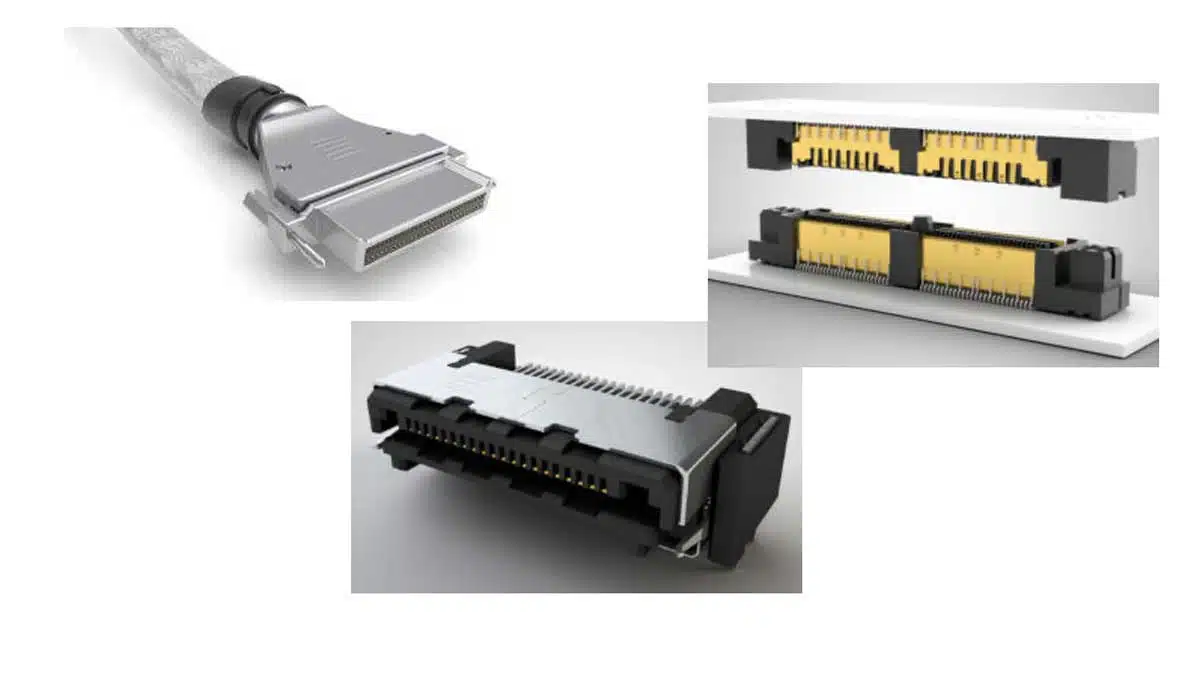
Samtec compiled a list of frequently asked questions about EMI shielding and connectors. 

Do shielded connectors and cable assemblies help reduce emissions and improve the immunity of electronic products?

RelatedPosts

Samtec AcceleRate Slim ARC6 Cable Assemblies with New Signaling Options

Samtec ANSI/VITA 90 Connectors: Rugged Small Form Factor Standard

Mastering Galvanic Isolation in Power Electronics: Methods, Standards, and Implementation

Yes, they can help, and in some cases, they can help dramatically. Signals with periodic switching, such as clock lines, are classic noise sources. If energy from this type of source couples to a cable that exits a shielded enclosure, the cable can radiate the coupled noise much like a cell phone antenna radiates (although not as efficiently).

Placing a shield over the cable (and terminating the shield properly) can dramatically reduce the radiated emissions. The situation is similar for a board-to-board connector inside an enclosure, except the radiated emission occurs inside the enclosure, so the radiated emission may or may not be visible during an EMI test.

Do Samtec connectors meet FCC Class B EMI Requirements?

No. Federal standards require EMI compliance testing of active electronic systems such as computers (FCC 47 CFR Part 15, EN55022, etc.). While passive components can impact the overall system-level EMI performance, it is not possible to directly test a connector, cable assembly, resistor, or bolt for EMI compliance. 

What are the best practices to reduce EMI when using a board-to-board (BTB) connector?

There are a few assumptions that need to be stated up front before we get into answering this question:

  • We are primarily interested in digital applications with kbps to Gbps data rates, not low-frequency analog (audio) applications.
  • We address open pin field connectors like the Samtec SEAM/SEAF or QSE/QTE products, not a coaxial RF connector configured for board-to-board applications.
  • The connectors are part of an overall interconnect system that can include printed circuit boards (PCBs).

Understanding the radiation mechanism or dominant EMI antennas in a board-to-board system is essential. One effective analogy is to consider the PCB ground planes as elements of a microstrip patch antenna.

Any longitudinal voltage potential developed across the connector appears as a voltage source that drives the PCB ground planes, not unlike a feed element driving a microstrip patch antenna. This is a useful low-frequency (50 MHz to 100 MHz+) approximation; the radiating system is more complex at higher frequencies, but the best practices remain the same.

To minimize the longitudinal voltage potential across a connector, we need to minimize the self-partial inductance of the signal return path. To make sure we’re on the same page, here are three terminology clarifications:

  • Loop inductance is the only inductance that is “real” or can be measured.
  • Self-partial inductance is a useful mathematical construct; it can be calculated but not directly measured.
  • “Self” means we are interested in the magnetic flux developed from only one conductor of the loop.
  • “Partial” means we are looking at only a portion of the path, specifically the portion between the PCBs.

To minimize the self-partial inductance across the connector, here are some general principles to follow:

  • A short board-to-board stack height is better than a taller one.
  • Minimize the connector’s loop area by integrating ground pins into the signal pin field (1:1).
  • Use broad, flat conductors for signal return; dedicated planes are superior to pins for signal return.
  • Make the characteristic impedance of the signal and ground pattern as low as possible.

If EMI were the only issue, the board-to-board connector should have a very low characteristic impedance (< 1Ω). Planar distribution for signal and return currents would have the lowest self-partial inductance across the connector and the lowest EMI. This is not a practical guideline as data transmission requirements dictate a close match to the system impedance (typically 50Ω).

The same physics that applies to EMI reduction in board-to-board connectors also applies to PCBs. Disruptions in the signal return path, such as splits in the ground plane, drastically increase the self-partial inductance of the return path, which can lead to EMI problems.

The best EMI strategy for electronics considers multiple areas such as PCB design (stack up and circuit layout), connector selection, signal return management (grounding), power filtering (decoupling/PI design), and logic selection with an emphasis on spread spectrum clocking and edge shaping.

Related

Source: Samtec

Recent Posts

Two‑capacitor paradox explained for engineers

18.5.2026
6

YAGEO Releases Compact RJ45 Connector for Multi‑Gigabit Ethernet

18.5.2026
5

Capacitances of Nonlinear MLCCs: What Datasheets Don’t Tell You

14.5.2026
70

How a Digital Structural Twin Can Predict Tantalum Capacitor Reliability

14.5.2026
47

Binder Hybrid Connector Simplifies One Cable Automation

13.5.2026
16

Tapped Inductor Buck Converter Fundamentals

13.5.2026
34

Molecular Memristor Shows Record 145 kH Emergent Inductance

12.5.2026
40

Planar vs Conventional Transformer: When it Make Sense

11.5.2026
68

Energy Localization in Tantalum Anode Formation: A Structural Perspective

4.5.2026
53

Upcoming Events

May 19
16:00 - 17:00 CEST

Designing Qi2 Wireless Power Systems: Practical Development and EMC Optimization

Jun 2
16:00 - 17:00 CEST

Calculation, Simulation and Measurement of 800V EMC Filters

Jun 16
16:00 - 17:00 CEST

EMC with EMC – EMC‑compliant design with electromechanical connectors

View Calendar

Popular Posts

  • Buck Converter Design and Calculation

    0 shares
    Share 0 Tweet 0
  • Boost Converter Design and Calculation

    0 shares
    Share 0 Tweet 0
  • Flyback Converter Design and Calculation

    0 shares
    Share 0 Tweet 0
  • LLC Resonant Converter Design and Calculation

    0 shares
    Share 0 Tweet 0
  • MLCC and Ceramic Capacitors

    0 shares
    Share 0 Tweet 0
  • Capacitor Charging and Discharging

    0 shares
    Share 0 Tweet 0
  • What Electronics Engineer Needs to Know About Passive Low Pass Filters

    0 shares
    Share 0 Tweet 0
  • Dual Active Bridge (DAB) Topology

    0 shares
    Share 0 Tweet 0
  • Ripple Current and its Effects on the Performance of Capacitors

    3 shares
    Share 3 Tweet 0
  • MLCC Case Sizes Standards Explained

    0 shares
    Share 0 Tweet 0

Newsletter Subscription


Passive Components Blog

© EPCI - Leading Passive Components Educational and Information Site

  • Home
  • Privacy Policy
  • EPCI Membership & Advertisement
  • About

No Result
View All Result
  • Home
  • Knowledge Blog
  • PCNS

© EPCI - Leading Passive Components Educational and Information Site

This website uses cookies. By continuing to use this website you are giving consent to cookies being used. Visit our Privacy and Cookie Policy.
Go to mobile version