




Researchers from RIKEN Pioneering Research Institute, Nagoya University, and Tohoku University demonstrated in article published by Nature that a molecular Mott insulator can function as a memristor exhibiting colossal emergent inductance values of 100,000–150,000 Henries, opening new pathways for coil-free passive electronic components in neuromorphic and low-frequency circuit applications.
Introduction
Memristors are nonlinear passive electronic components whose resistance depends on the history of charge flow through them. This memory effect produces a characteristic pinched hysteresis loop in the current-voltage response under periodic driving. While memristors have been extensively studied for non-volatile memory and neuromorphic computing, their dynamical electrodynamic properties—particularly their ability to generate inductance—remain largely unexplored.
The research team investigated the quasi-one-dimensional halogen-bridged metal complex (where chxn stands for cyclohexanediamine), a molecular Mott insulator known for exhibiting negative differential resistance and self-oscillation behavior when connected to a capacitor. Previous interpretations treated this system as a simple relaxation oscillator without considering inductive elements. However, the authors hypothesized that the unusually low oscillation frequency and large insulating resistance might indicate an emergent colossal inductive response linked to memristive behavior.
This study builds on the team’s previous work demonstrating emergent inductance in another molecular memristor, where they observed inductance values around 100 henries. The present investigation targets a material expected to exhibit even larger inductance due to its higher resistance and slower internal dynamics.
Key points
- The quasi-one-dimensional Mott insulator exhibits clear pinched hysteresis loops under AC bias, confirming its memristive character
- Impedance spectroscopy reveals a colossal emergent inductance reaching 145 kH at 90 K—many orders of magnitude larger than conventional coil-based inductors
- The inductive response appears only under finite bias voltage and is absent at zero bias, ruling out parasitic contributions from external circuit elements
- Two independent measurement methods (impedance spectroscopy and oscillation-frequency analysis) consistently confirm the magnitude and intrinsic nature of the inductance
- When combined with an external capacitor, the emergent inductance drives self-sustained oscillations without any discrete inductor coil
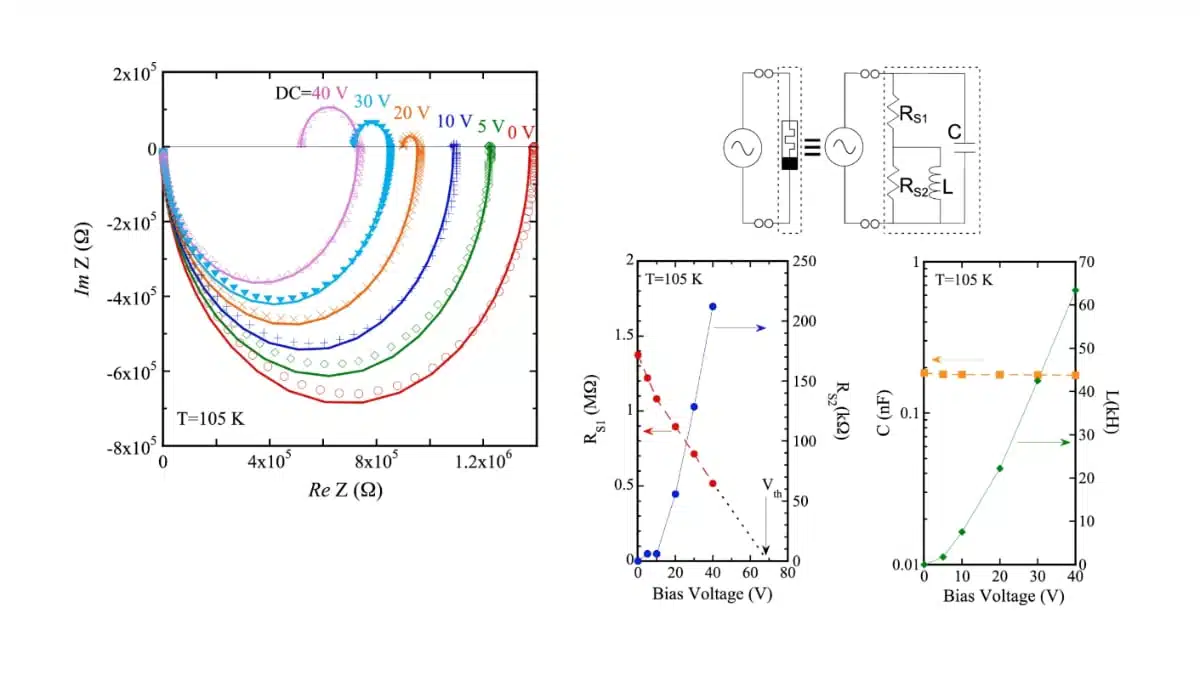
- The inductance increases with decreasing temperature and with increasing bias voltage, reaching approximately 63 kH at 40 V bias and 105 K
- These findings establish emergent inductance as a fundamental property of memristive systems, not limited to this specific material
Extended summary
Problem statement and motivation
Traditional electronic circuits rely on discrete inductors—typically wire coils wound around magnetic cores—to provide inductive reactance. These components are bulky, difficult to miniaturize, and typically offer inductance values in the microhenry to millihenry range. The discovery of materials that can intrinsically generate enormous inductance values without physical coils would represent a major advance for low-frequency filtering, timing circuits, and neuromorphic computing applications.
Memristors have been primarily studied for their resistive-switching behavior and hysteretic current-voltage characteristics. The pinched hysteresis loop observed in memristors under AC excitation indicates that their resistance depends on the history of charge flow. However, the dynamical electromagnetic properties of these hysteretic systems—particularly whether they can function as sources of inductance—have received little attention.
The quasi-one-dimensional halogen-bridged nickel complex was selected as an ideal candidate material because it exhibits negative differential resistance and has been shown to support self-sustained oscillations when shunted by a capacitor. Earlier studies interpreted these oscillations using a relaxation oscillator model without invoking any inductive element. The research team hypothesized that the material’s large insulating resistance and slow internal dynamics might instead give rise to a colossal emergent inductance that could explain the oscillatory behavior within a memristive framework.
Experimental methods and setup
Single crystals of were synthesized electrochemically from a methanol solution containing nickel cyclohexanediamine bromide and tetramethylammonium bromide. The resulting black needle-like crystals measured approximately 1.3 × 1.0 × 0.9 mm³.
Three complementary experimental techniques were employed. First, AC current-voltage characteristics (Lissajous curves) were obtained by applying sinusoidal AC current with peak amplitude of 200 microamperes along the chain axis while measuring the resulting voltage across the sample. These measurements were performed at frequencies ranging from 0.1 Hz to 500 Hz and temperatures from 105 K to 135 K.
Second, impedance spectroscopy measurements were conducted using a frequency response analyzer with dielectric interface. A sinusoidal AC voltage of 3 V was applied across a frequency range from 10 millihertz to 67.2 kilohertz, with DC bias voltages varied from 0 to 40 V. The resulting Cole-Cole plots were analyzed using equivalent circuit models to extract resistance, capacitance, and inductance parameters.
Third, self-sustained oscillation measurements were performed by connecting external capacitors (4.9 microfarads and 10 microfarads) in parallel with the sample and applying DC bias current while monitoring the oscillating voltage.
Main experimental results
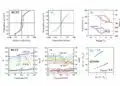
The Lissajous curve measurements revealed clear pinched hysteresis loops at low frequencies (0.1–0.5 Hz) accompanied by regions of negative differential resistance. At the lowest temperature studied (105 K), the hysteresis loop exhibited pronounced asymmetry with the current-voltage relationship showing a clear NDR region where the differential resistance becomes negative. As frequency increased, the NDR feature gradually disappeared and the loops collapsed into nearly linear traces. At even higher frequencies (200 Hz and above), the curves evolved into counterclockwise ellipses indicating capacitive reactance.
The temperature dependence showed that increasing temperature caused the pinched hysteresis loops to shrink and eventually disappear, with the system transitioning to linear ohmic behavior above 135 K. This behavior is consistent with the negative temperature coefficient of resistance characteristic of the material.
The impedance spectroscopy measurements provided quantitative access to the reactive components of the system. The Cole-Cole plots at zero DC bias exhibited only a negative semicircle corresponding to capacitive reactance. However, upon applying finite DC bias voltage, a positive semicircle emerged in the upper half-plane, indicating the appearance of inductive reactance. This bias-dependent emergence of inductance is a crucial observation that excludes parasitic contributions from leads or external components.
The equivalent circuit analysis yielded capacitance values of approximately 0.1 nanofarad that remained nearly constant across all bias voltages and temperatures. In stark contrast, the inductance increased dramatically with bias voltage, reaching approximately 63 kH at 40 V bias and 105 K. The temperature dependence at fixed bias (40 V) showed the inductance increasing with decreasing temperature, reaching a maximum value of approximately 145 kH at 90 K.
The self-sustained oscillation measurements independently confirmed the colossal inductance. Oscillations appeared when the DC bias current exceeded approximately 160 microamperes, which agrees well with the threshold current for entering the NDR regime observed in the Lissajous curves. The oscillation frequency showed the expected dependence on the external capacitance value.
Using the standard LC resonance relation:
the inductance was estimated from the measured oscillation frequencies. The values obtained ranged from tens to over a hundred kilohenries and increased with decreasing temperature, in excellent quantitative agreement with the impedance spectroscopy results. This close agreement between two completely independent measurement techniques strongly supports the conclusion that the observed inductance is intrinsic to the material and not a measurement artifact.
Physical interpretation and implications
The emergence of colossal inductance is intimately linked to the memristive hysteresis represented by the pinched hysteresis loop. The inductive response does not simply originate from static negative differential resistance, but rather from the dynamic hysteresis that occurs when the system is driven into a closed-loop regime under finite bias.
The extraordinarily large magnitude of the inductance can be qualitatively understood as resulting from the long relaxation times inherent to the memristive hysteresis, further enhanced by the large resistance in the insulating state and by in-gap electronic states that slow carrier dynamics. The slow internal dynamics of the correlated electronic state in this quasi-one-dimensional Mott insulator give rise to the low-frequency response characteristic of the system.
The research reinterprets the self-sustained oscillations in this material within a unified memristive framework. While earlier work treated the system as a simple relaxation oscillator based on resistance switching, the present results show that the emergent inductance associated with the memristive pinched hysteresis loop plays a crucial role in stabilizing the dynamics and establishing a robust limit cycle. The inductance provides an effective inertia for the current that prevents runaway behavior in the NDR regime and enables reproducible self-sustained oscillations.
The intrinsic capacitance of the material is relatively small (approximately 0.1 nanofarad), which would correspond to a characteristic frequency around 50 Hz for an inductance of 100 kH. This frequency lies outside the regime where NDR and pronounced pinched hysteresis loops are observed, leading to damped oscillations. Introducing a sufficiently large external capacitor shifts the oscillation frequency into the NDR-sustaining regime, thereby stabilizing self-oscillation. The memristive oscillation thus arises from the cooperative interplay of emergent inductance and negative differential resistance, with the capacitance primarily determining the oscillation timescale.
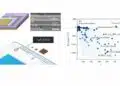
The linkage between pinched hysteresis loops and inductive behavior suggests that emergent inductance may be a universal feature of memristive systems. Similar but smaller inductive responses have been observed in other molecular memristors, and emergent inductance has been reported in correlated oxide and magnetic systems such as calcium ruthenate, gadolinium ruthenium aluminum compounds, and yttrium manganese tin compounds. Although those earlier studies did not explicitly invoke the memristor concept, their observed responses strongly resemble memristive inductance. This points to a unifying principle: across diverse materials, slow internal dynamics coupled with hysteretic current-voltage behavior can manifest as colossal effective inductance.
Conclusion
This work demonstrates that the quasi-one-dimensional Mott insulator functions as a molecular memristor exhibiting clear pinched hysteresis loops under AC bias. The memristive behavior gives rise to a colossal emergent inductance of 100,000–150,000 henries that appears only under finite bias and has been independently confirmed by impedance spectroscopy and oscillation-frequency analysis.
The inductive response is intrinsic to the memristive dynamics of the correlated molecular system and cannot be explained by conventional circuit elements or parasitic effects. The interplay between emergent inductance and negative differential resistance enables self-sustained oscillations without any discrete inductor, providing a unified physical picture that goes beyond conventional relaxation oscillator models.
These findings establish emergent inductance as a fundamental electrodynamic property of memristive systems and reveal new functionality in correlated molecular materials. The results highlight how slow internal dynamics and hysteretic transport in solid-state systems can generate unconventional circuit responses that may enable coil-free low-frequency functionalities in electronic and neuromorphic applications. Future work should focus on understanding the microscopic origin of memristive inductance, potentially linked to doublon-holon dynamics or nonequilibrium Mott transitions under bias.
References
- Oshima, Y., Usami, R., Moriya, T., Takenobu, T., & Takaishi, S. (2026). Colossal emergent inductance in a molecular memristor. Scientific Reports, 16, 13023. https://www.nature.com/articles/s41598-026-48808-5