







Passive Components Blog
No Result
View All Result
  • Home
  • NewsFilter
    • All
    • Aerospace & Defence
    • Antenna
    • Applications
    • Automotive
    • Capacitors
    • Circuit Protection Devices
    • electro-mechanical news
    • Filters
    • Fuses
    • Inductors
    • Industrial
    • Integrated Passives
    • inter-connect news
    • Market & Supply Chain
    • Market Insights
    • Medical
    • Modelling and Simulation
    • New Materials & Supply
    • New Technologies
    • Non-linear Passives
    • Oscillators
    • Passive Sensors News
    • Resistors
    • RF & Microwave
    • Telecommunication
    • Weekly Digest

    Exxelia to Exhibit at APEC 2026 in San Antonio, Texas

    Würth Elektronik Presents Differential Pressure Sensor for HVAC and Medical

    Thermal Modeling of Magnetics

    ESA SPCD 26 Call for Papers Extended to 30th March

    Wk 11 Electronics Supply Chain Digest

    Binder Extends NCC Circular Connectors for Harsh Environments

    Standard vs Planar LLC transformers Comparison for Battery Chargers

    Würth Elektronik and Grinn Launch Edge AI Cooperation

    Bourns Expanded Semi-Shielded Low Profile Automotive Power Inductor

    Trending Tags

    • Ripple Current
    • RF
    • Leakage Current
    • Tantalum vs Ceramic
    • Snubber
    • Low ESR
    • Feedthrough
    • Derating
    • Dielectric Constant
    • New Products
    • Market Reports
  • VideoFilter
    • All
    • Antenna videos
    • Capacitor videos
    • Circuit Protection Video
    • Filter videos
    • Fuse videos
    • Inductor videos
    • Inter-Connect Video
    • Non-linear passives videos
    • Oscillator videos
    • Passive sensors videos
    • Resistor videos

    Thermal Modeling of Magnetics

    Standard vs Planar LLC transformers Comparison for Battery Chargers

    How Modern Tools Model Magnetic Components for Power Electronics

    Advanced Loss Modeling for Planar Magnetics in the Frenetic Planar Tool

    2026 Power Magnetics Design Trends: Flyback, DAB and Planar

    Enabling Software‑Defined Vehicle Architectures: Automotive Ethernet and Zonal Smart Power

    Calculating Resistance Value of a Flyback RC Snubber 

    One‑Pulse Characterization of Nonlinear Power Inductors

    Thermistor Linearization Challenges

    Trending Tags

    • Capacitors explained
    • Inductors explained
    • Resistors explained
    • Filters explained
    • Application Video Guidelines
    • EMC
    • New Products
    • Ripple Current
    • Simulation
    • Tantalum vs Ceramic
  • Knowledge Blog
  • DossiersNew
  • Suppliers
    • Who is Who
  • PCNS
    • PCNS 2025
    • PCNS 2023
    • PCNS 2021
    • PCNS 2019
    • PCNS 2017
  • Events
  • Home
  • NewsFilter
    • All
    • Aerospace & Defence
    • Antenna
    • Applications
    • Automotive
    • Capacitors
    • Circuit Protection Devices
    • electro-mechanical news
    • Filters
    • Fuses
    • Inductors
    • Industrial
    • Integrated Passives
    • inter-connect news
    • Market & Supply Chain
    • Market Insights
    • Medical
    • Modelling and Simulation
    • New Materials & Supply
    • New Technologies
    • Non-linear Passives
    • Oscillators
    • Passive Sensors News
    • Resistors
    • RF & Microwave
    • Telecommunication
    • Weekly Digest

    Exxelia to Exhibit at APEC 2026 in San Antonio, Texas

    Würth Elektronik Presents Differential Pressure Sensor for HVAC and Medical

    Thermal Modeling of Magnetics

    ESA SPCD 26 Call for Papers Extended to 30th March

    Wk 11 Electronics Supply Chain Digest

    Binder Extends NCC Circular Connectors for Harsh Environments

    Standard vs Planar LLC transformers Comparison for Battery Chargers

    Würth Elektronik and Grinn Launch Edge AI Cooperation

    Bourns Expanded Semi-Shielded Low Profile Automotive Power Inductor

    Trending Tags

    • Ripple Current
    • RF
    • Leakage Current
    • Tantalum vs Ceramic
    • Snubber
    • Low ESR
    • Feedthrough
    • Derating
    • Dielectric Constant
    • New Products
    • Market Reports
  • VideoFilter
    • All
    • Antenna videos
    • Capacitor videos
    • Circuit Protection Video
    • Filter videos
    • Fuse videos
    • Inductor videos
    • Inter-Connect Video
    • Non-linear passives videos
    • Oscillator videos
    • Passive sensors videos
    • Resistor videos

    Thermal Modeling of Magnetics

    Standard vs Planar LLC transformers Comparison for Battery Chargers

    How Modern Tools Model Magnetic Components for Power Electronics

    Advanced Loss Modeling for Planar Magnetics in the Frenetic Planar Tool

    2026 Power Magnetics Design Trends: Flyback, DAB and Planar

    Enabling Software‑Defined Vehicle Architectures: Automotive Ethernet and Zonal Smart Power

    Calculating Resistance Value of a Flyback RC Snubber 

    One‑Pulse Characterization of Nonlinear Power Inductors

    Thermistor Linearization Challenges

    Trending Tags

    • Capacitors explained
    • Inductors explained
    • Resistors explained
    • Filters explained
    • Application Video Guidelines
    • EMC
    • New Products
    • Ripple Current
    • Simulation
    • Tantalum vs Ceramic
  • Knowledge Blog
  • DossiersNew
  • Suppliers
    • Who is Who
  • PCNS
    • PCNS 2025
    • PCNS 2023
    • PCNS 2021
    • PCNS 2019
    • PCNS 2017
  • Events
No Result
View All Result
Passive Components Blog
No Result
View All Result

FastCAP Ultracapacitor for Extreme Environment Applications

27.2.2018
Reading Time: 3 mins read
A A

source: electronics 360 news

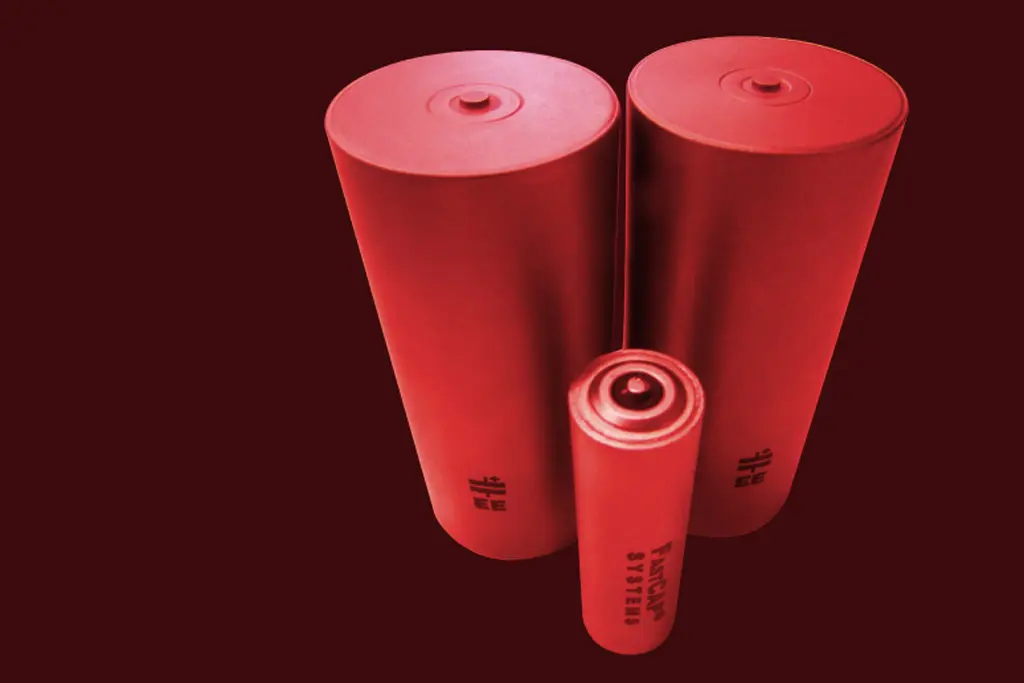
FastCap has created a unique ultracapacitor utilizing carbon nanotubes and a unique electrolyte that extends the temperature range beyond other capacitors, allowing for use in extreme environments from -55 to +100degC and -40 to +150degC operation ranges.

RelatedPosts

Exxelia to Exhibit at APEC 2026 in San Antonio, Texas

Würth Elektronik Presents Differential Pressure Sensor for HVAC and Medical

Thermal Modeling of Magnetics

Powering electronics is a task often accomplished with a battery or power supply. Power must be reliable in all the environments a device is expected to operate. This is a particularly important issue in extreme environments — such as deep underground or near a furnace — where ordinary methods simply don’t work.

Standard battery chemistries like alkaline struggle with very high and low temperatures. Alkaline batteries contain water that freezes or boils, as well as plastic parts that melt. Lithium batteries are a better choice for extreme environments, but they still have limitations. Lithium-thionyl chloride batteries are common for extreme temperatures. While these batteries have a high energy density, they lack the wattage required for many applications. To solve this current limitation, batteries are often wired in series or parallel — or in some combination of the two — with diminishing returns and more bulk as more batteries are added.

FastCap has created a unique ultracapacitor utilizing carbon nanotubes and a unique electrolyte that extends the temperature range beyond other capacitors, allowing for use in extreme environments. Source: FastCap SystemsUltracapacitors store energy in a different way than batteries do, which enables them to do things batteries simply can’t. Capacitors are different from batteries because they have lower energy densities but can rapidly provide the power stored. Capacitors are also different from batteries in that they are quick to recharge. Ultracapacitors can store more power than a regular capacitor, which makes them ideal for some applications that traditionally use batteries.

Like batteries, not all capacitors are created equal. FastCap has created a unique ultracapacitor utilizing carbon nanotubes and a unique electrolyte that extends the temperature range beyond other capacitors, allowing for use in extreme environments. Originally this technology was developed for the oil and gas industry and is used in drill heads for communication, where extreme heat is commonplace. In this industry batteries cannot supply power in increasing temperatures, meaning that eventually operators were drilling blind. The FastCap ultracapacitor solved this issue and allows communication at deeper depths than an equivalent battery technology.

While originally developed for energy exploration, a power source that works from minus 40 to 100 degrees Celsius has many other applications. Propulsion technology is a good example where temperature extremes are experienced. Rocket and jet engines go through a range of extreme temperatures, where high temperatures of combustion require equipment that can keep up. Propulsion technology requires high reliability when a failure can cause a catastrophic event. For example, actuators that physically move surfaces to control the engine require significant power. In this application, a battery may not have the necessary current and weight is always an issue. The ultracapacitor has the ability to store power and provide the necessary current for the actuators, all while in a temperature range that competing technology can’t operate in.

Ultracapacitors are an ideal solution when the power required is periodic pulses of high current. This type of requirement is also typical of many wireless, IoT and sensor devices that send back data in a burst. Data collection devices used in inhospitable environments — such as those used to measure geologic events or in a factory setting such as an oven or furnace — lend themselves well to the FastCap ultracapacitor. In these applications, the ultracapacitor can provide the power necessary to take a measurement and send it to the receiver or datalogger.

FastCap’s extreme environment ultracapacitors are hermetically sealed and come in sizes that mimic standard size batteries like AA and D cell sizes. They provide power with voltages from 1 V, 1.5 V or 2 V, with stainless steel terminals. In addition to the extreme temperature range, the ultracapacitors are resistant to both shock and vibration, making them excellent for rugged and extreme power needs.


Related

Recent Posts

Exxelia to Exhibit at APEC 2026 in San Antonio, Texas

17.3.2026
22

Würth Elektronik Presents Differential Pressure Sensor for HVAC and Medical

17.3.2026
7

ESA SPCD 26 Call for Papers Extended to 30th March

16.3.2026
80

Binder Extends NCC Circular Connectors for Harsh Environments

13.3.2026
2

Standard vs Planar LLC transformers Comparison for Battery Chargers

13.3.2026
24

Bourns Expanded Semi-Shielded Low Profile Automotive Power Inductor

12.3.2026
16

Peak Nano to Develop Fusion Grade High Energy Film Capacitors

11.3.2026
32

Murata New Vibration Sensor Targets High‑Frequency Predictive Maintenance

10.3.2026
32

Panasonic Expands Automotive PP Film Capacitors Voltage Range

9.3.2026
29

Upcoming Events

Mar 19
13:00 - 14:00 CDT

Smart Consideration of Inductor Thermal Performance

Mar 21
All day

PSMA Capacitor Workshop 2026

Mar 24
9:00 - 10:00 CET

Power protection in the digital age – eFuse and hot-swap strategies for modern data center design

View Calendar

Popular Posts

  • Buck Converter Design and Calculation

    0 shares
    Share 0 Tweet 0
  • Boost Converter Design and Calculation

    0 shares
    Share 0 Tweet 0
  • Flyback Converter Design and Calculation

    0 shares
    Share 0 Tweet 0
  • LLC Resonant Converter Design and Calculation

    0 shares
    Share 0 Tweet 0
  • MLCC Manufacturers Consider Price Increase as AI Demand Outpaces Supply

    0 shares
    Share 0 Tweet 0
  • Dual Active Bridge (DAB) Topology

    0 shares
    Share 0 Tweet 0
  • Ripple Current and its Effects on the Performance of Capacitors

    3 shares
    Share 3 Tweet 0
  • MLCC and Ceramic Capacitors

    0 shares
    Share 0 Tweet 0
  • MLCC Case Sizes Standards Explained

    0 shares
    Share 0 Tweet 0
  • 3-Phase EMI Filter Design, Simulation, Calculation and Test

    0 shares
    Share 0 Tweet 0

Newsletter Subscription


Passive Components Blog

© EPCI - Leading Passive Components Educational and Information Site

  • Home
  • Privacy Policy
  • EPCI Membership & Advertisement
  • About

No Result
View All Result
  • Home
  • Knowledge Blog
  • PCNS

© EPCI - Leading Passive Components Educational and Information Site

This website uses cookies. By continuing to use this website you are giving consent to cookies being used. Visit our Privacy and Cookie Policy.
Go to mobile version