














Passive Components Blog
No Result
View All Result
  • Home
  • NewsFilter
    • All
    • Aerospace & Defence
    • Antenna
    • Applications
    • Automotive
    • Capacitors
    • Circuit Protection Devices
    • electro-mechanical news
    • Filters
    • Fuses
    • Inductors
    • Industrial
    • Integrated Passives
    • inter-connect news
    • Market & Supply Chain
    • Market Insights
    • Medical
    • Modelling and Simulation
    • New Materials & Supply
    • New Technologies
    • Non-linear Passives
    • Oscillators
    • Passive Sensors News
    • Resistors
    • RF & Microwave
    • Telecommunication
    • Weekly Digest

    Miniaturization of Tantalum Capacitors: Structural Limit Under Constant Rating

    Heatsink Design and Thermal Interface Materials for Reliable Electronics

    Murata New MLCC Bulk Case Packaging Cuts Packaging Material by 99%

    Wk 17 Electronics Supply Chain Digest

    Exxelia Introduces SMD High‑Voltage Mica Capacitors

    Modelithics Releases COMPLETE v26.1 for Keysight ADS

    April 2026 Interconnect, Passives and Electromechanical Components Market Insights

    SPICE Simulation of Non-Linear Resistors: Vishay’s Thermistor and PPTC Modelling Ecosystem

    KYOCERA AVX Introduces Traction‑Grade DC Link Film Capacitors

    Trending Tags

    • Ripple Current
    • RF
    • Leakage Current
    • Tantalum vs Ceramic
    • Snubber
    • Low ESR
    • Feedthrough
    • Derating
    • Dielectric Constant
    • New Products
    • Market Reports
  • VideoFilter
    • All
    • Antenna videos
    • Capacitor videos
    • Circuit Protection Video
    • Filter videos
    • Fuse videos
    • Inductor videos
    • Inter-Connect Video
    • Non-linear passives videos
    • Oscillator videos
    • Passive sensors videos
    • Resistor videos

    Why Power Inductors Use a Ferrite Core With an Air Gap

    Transformer-Based Power-Line Harvester Magnetic Design

    Thermal Modeling of Magnetics

    Standard vs Planar LLC transformers Comparison for Battery Chargers

    How Modern Tools Model Magnetic Components for Power Electronics

    Advanced Loss Modeling for Planar Magnetics in the Frenetic Planar Tool

    2026 Power Magnetics Design Trends: Flyback, DAB and Planar

    Enabling Software‑Defined Vehicle Architectures: Automotive Ethernet and Zonal Smart Power

    Calculating Resistance Value of a Flyback RC Snubber 

    Trending Tags

    • Capacitors explained
    • Inductors explained
    • Resistors explained
    • Filters explained
    • Application Video Guidelines
    • EMC
    • New Products
    • Ripple Current
    • Simulation
    • Tantalum vs Ceramic
  • Knowledge Blog
  • DossiersNew
  • Suppliers
    • Who is Who
  • PCNS
    • PCNS 2025
    • PCNS 2023
    • PCNS 2021
    • PCNS 2019
    • PCNS 2017
  • Events
  • Home
  • NewsFilter
    • All
    • Aerospace & Defence
    • Antenna
    • Applications
    • Automotive
    • Capacitors
    • Circuit Protection Devices
    • electro-mechanical news
    • Filters
    • Fuses
    • Inductors
    • Industrial
    • Integrated Passives
    • inter-connect news
    • Market & Supply Chain
    • Market Insights
    • Medical
    • Modelling and Simulation
    • New Materials & Supply
    • New Technologies
    • Non-linear Passives
    • Oscillators
    • Passive Sensors News
    • Resistors
    • RF & Microwave
    • Telecommunication
    • Weekly Digest

    Miniaturization of Tantalum Capacitors: Structural Limit Under Constant Rating

    Heatsink Design and Thermal Interface Materials for Reliable Electronics

    Murata New MLCC Bulk Case Packaging Cuts Packaging Material by 99%

    Wk 17 Electronics Supply Chain Digest

    Exxelia Introduces SMD High‑Voltage Mica Capacitors

    Modelithics Releases COMPLETE v26.1 for Keysight ADS

    April 2026 Interconnect, Passives and Electromechanical Components Market Insights

    SPICE Simulation of Non-Linear Resistors: Vishay’s Thermistor and PPTC Modelling Ecosystem

    KYOCERA AVX Introduces Traction‑Grade DC Link Film Capacitors

    Trending Tags

    • Ripple Current
    • RF
    • Leakage Current
    • Tantalum vs Ceramic
    • Snubber
    • Low ESR
    • Feedthrough
    • Derating
    • Dielectric Constant
    • New Products
    • Market Reports
  • VideoFilter
    • All
    • Antenna videos
    • Capacitor videos
    • Circuit Protection Video
    • Filter videos
    • Fuse videos
    • Inductor videos
    • Inter-Connect Video
    • Non-linear passives videos
    • Oscillator videos
    • Passive sensors videos
    • Resistor videos

    Why Power Inductors Use a Ferrite Core With an Air Gap

    Transformer-Based Power-Line Harvester Magnetic Design

    Thermal Modeling of Magnetics

    Standard vs Planar LLC transformers Comparison for Battery Chargers

    How Modern Tools Model Magnetic Components for Power Electronics

    Advanced Loss Modeling for Planar Magnetics in the Frenetic Planar Tool

    2026 Power Magnetics Design Trends: Flyback, DAB and Planar

    Enabling Software‑Defined Vehicle Architectures: Automotive Ethernet and Zonal Smart Power

    Calculating Resistance Value of a Flyback RC Snubber 

    Trending Tags

    • Capacitors explained
    • Inductors explained
    • Resistors explained
    • Filters explained
    • Application Video Guidelines
    • EMC
    • New Products
    • Ripple Current
    • Simulation
    • Tantalum vs Ceramic
  • Knowledge Blog
  • DossiersNew
  • Suppliers
    • Who is Who
  • PCNS
    • PCNS 2025
    • PCNS 2023
    • PCNS 2021
    • PCNS 2019
    • PCNS 2017
  • Events
No Result
View All Result
Passive Components Blog
No Result
View All Result

High Density Carbon Tube Filter Capacitor

7.8.2024
Reading Time: 3 mins read
A A

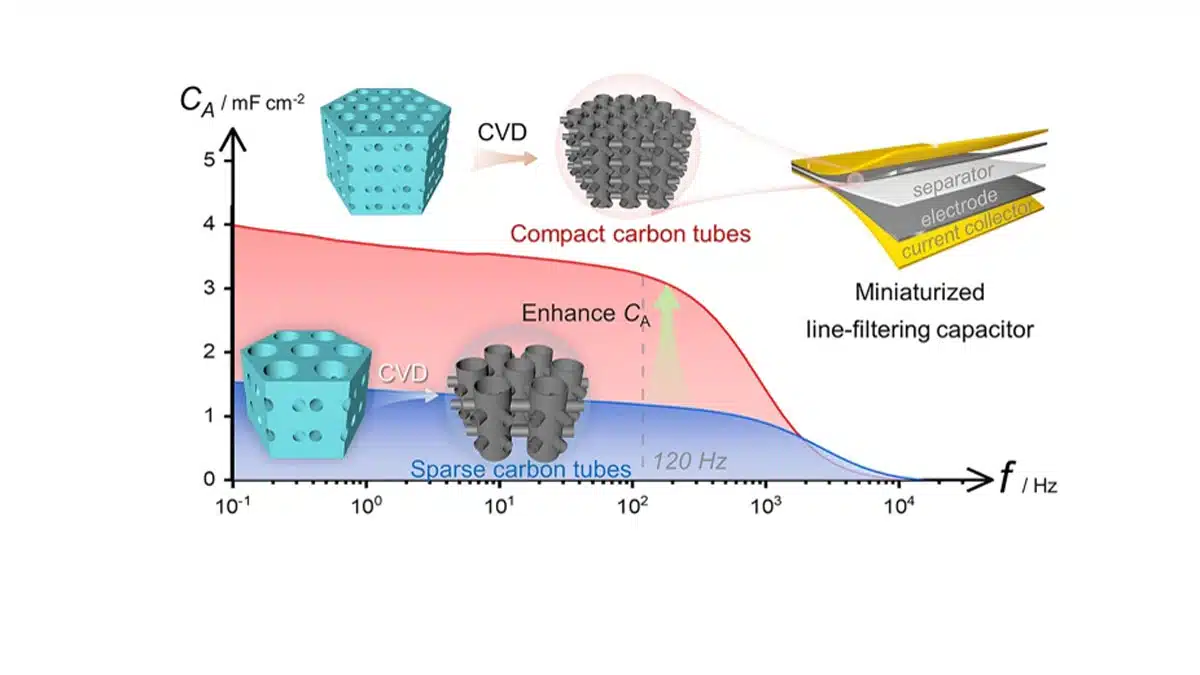
A research team led by Prof. MENG Guowen and Prof. HAN Fangming from the Hefei Institutes of Physical Science (HFIPS) of the Chinese Academy of Sciences (CAS), along with Prof. WEI Bingqing from the University of Delaware and Prof. LI Xiaoyan from Tsinghua University, constructed high-density three-dimensional carbon tube nanoarray electrodes for use in line-filtering capacitors, showcasing immense potential as high-performance miniaturized filter devices.

The research results were published in Nano-Micro Letters recently.

RelatedPosts

Miniaturization of Tantalum Capacitors: Structural Limit Under Constant Rating

Heatsink Design and Thermal Interface Materials for Reliable Electronics

Murata New MLCC Bulk Case Packaging Cuts Packaging Material by 99%

Filter capacitors are essential for turning fluctuating voltage signals into steady direct current. Aluminum electrolytic capacitors (AECs) are commonly used but are quite large and have limited capacitance, which makes it hard to shrink modern electronics. Electric double-layer supercapacitors (EDLCs) have much higher energy density, making them a promising alternative for smaller filter capacitor applications. However, traditional carbon-based EDLCs have slow ion transport, making it difficult for them to achieve both high energy density and quick frequency response needed for line-filtering.

In this research, they conducted a systematic study aimed at precisely manipulating the pore structure of three-dimensional interconnected porous anodized aluminum oxide (3D-AAO) templates. They achieved a remarkable feat by continuously tuning the vertical pore diameter of 3D-AAO from 70 to 250 nm and the inter-pore spacing from 100 to 450 nm. Leveraging these tunable templates, they fabricated 3D compactly arranged carbon tube (3D-CACT) nanoarray electrodes via chemical vapor deposition. Specific surface area tests revealed that reducing both the pore diameter and inter-spacing significantly augmented the electrode’s surface area.

The resultant 3D-CACT electrode-based device exhibited exceptional frequency response performance characterized by a phase angle of -80.2° at 120 Hz, an ultra-low equivalent series resistance of less than 0.07 Ω cm2, and a rapid resistance-capacitance time constant of 0.25 ms. Notably, its specific areal capacitance at 120 Hz reached 3.23 mF cm-2, far surpassing that of commercial AECs (~0.08 mF cm-2) and previously reported aqueous sandwich-type line-filtering EDLCs. This underscores the 3D-CACT nanoarray’s ability to facilitate efficient ion transport and offer abundant charge adsorption sites.

Furthermore, researchers demonstrated the scalability of their approach by connecting six and ten sets of identical 3D-CACT-based EDLCs in series, successfully extending the capacitors’ operating voltage while preserving their rapid frequency response and low loss characteristics. To showcase the practicality of their invention, they employed ten series-connected devices as filters, effectively converting various alternating current inputs (including sinusoidal, square, triangular, noisy waves, and pulsed signals from a rotating triboelectric nanogenerator) into smooth direct current signals, with filtering performance comparable to commercial AECs.

“The high-density 3D-CT nanoarray electrodes offer promising solutions for high-performance filter capacitors, advancing miniaturized power systems and electronics,” said Prof. MENG, “and the structure-tunable template-assisted method enables the size customization of nanomaterials and promote innovative integrable microdevices development.”

Read the original article:

High Density 3D Carbon Tube Nanoarray Electrode Boosting the Capacitance of Filter Capacitor, DOI: 10.1007/s40820-024-01458-6 
Related

Source: Nano-Micro Letters Journal

Recent Posts

Miniaturization of Tantalum Capacitors: Structural Limit Under Constant Rating

27.4.2026
19

Heatsink Design and Thermal Interface Materials for Reliable Electronics

27.4.2026
5

Murata New MLCC Bulk Case Packaging Cuts Packaging Material by 99%

27.4.2026
27

Exxelia Introduces SMD High‑Voltage Mica Capacitors

28.4.2026
11

Modelithics Releases COMPLETE v26.1 for Keysight ADS

23.4.2026
11

April 2026 Interconnect, Passives and Electromechanical Components Market Insights

22.4.2026
57

KYOCERA AVX Introduces Traction‑Grade DC Link Film Capacitors

21.4.2026
41

When More Capacitance Hurts Reliability: The Role of the Metallic Skeleton in Tantalum Anodes

20.4.2026
43

Why Power Inductors Use a Ferrite Core With an Air Gap

20.4.2026
51

Upcoming Events

Apr 29
10:00 - 11:00 CDT

SEPIC Design Done Right

Apr 30
10:00 - 11:00 CDT

Programming Embedded Systems

May 5
16:00 - 17:00 CEST

Understanding and Selecting Capacitors – Fundamentals, Technologies and Latest Trends

View Calendar

Popular Posts

  • Buck Converter Design and Calculation

    0 shares
    Share 0 Tweet 0
  • Boost Converter Design and Calculation

    0 shares
    Share 0 Tweet 0
  • Flyback Converter Design and Calculation

    0 shares
    Share 0 Tweet 0
  • LLC Resonant Converter Design and Calculation

    0 shares
    Share 0 Tweet 0
  • MLCC and Ceramic Capacitors

    0 shares
    Share 0 Tweet 0
  • Dual Active Bridge (DAB) Topology

    0 shares
    Share 0 Tweet 0
  • Capacitor Charging and Discharging

    0 shares
    Share 0 Tweet 0
  • What Electronics Engineer Needs to Know About Passive Low Pass Filters

    0 shares
    Share 0 Tweet 0
  • MLCC Case Sizes Standards Explained

    0 shares
    Share 0 Tweet 0
  • Ripple Current and its Effects on the Performance of Capacitors

    3 shares
    Share 3 Tweet 0

Newsletter Subscription


Passive Components Blog

© EPCI - Leading Passive Components Educational and Information Site

  • Home
  • Privacy Policy
  • EPCI Membership & Advertisement
  • About

No Result
View All Result
  • Home
  • Knowledge Blog
  • PCNS

© EPCI - Leading Passive Components Educational and Information Site

This website uses cookies. By continuing to use this website you are giving consent to cookies being used. Visit our Privacy and Cookie Policy.
Go to mobile version