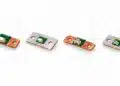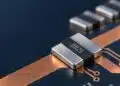
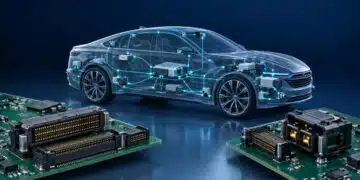

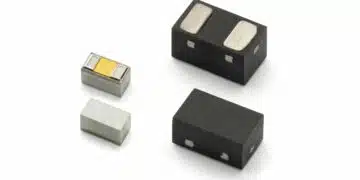



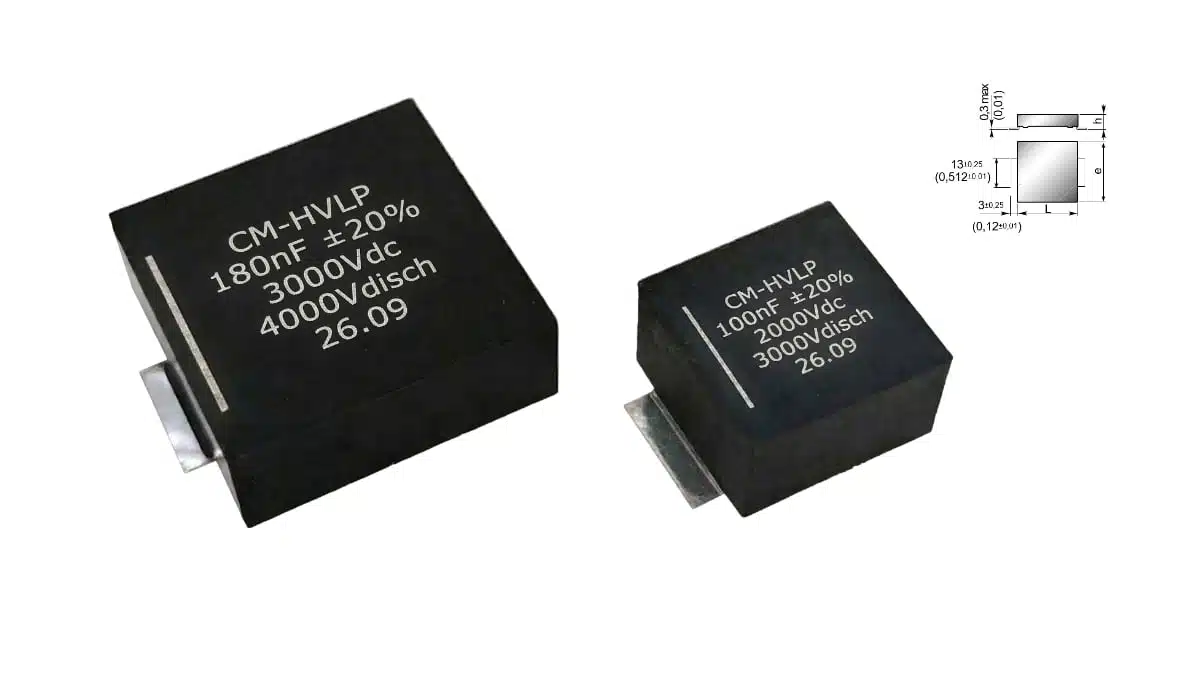
Exxelia’s CM‑HVLP series introduces a new generation of SMD high‑voltage reconstituted mica capacitors for designers who need both pulse handling and filtering performance in space‑constrained electronics.
These Exxelia MICA capacitor components target applications where high dV/dt, repetitive charge/discharge cycles and long‑term stability are critical, while keeping the footprint compatible with dense layouts in high‑reliability systems.
Key features and benefits
- High‑voltage capability in SMD format – Designed for discharge voltages from 2.5 kV to 5 kV and DC operation from 1.5 kV to 4 kV according to the manufacturer datasheet, enabling compact high‑voltage stages without through‑hole parts.
- Reconstituted mica dielectric – Intrinsically stable dielectric with virtually no capacitance drift under voltage, supporting precise and repeatable behavior over the full operating range.
- Pulse and filtering in one part – Optimized to work both in high‑energy pulse discharge circuits and in high‑voltage filtering, allowing designers to consolidate functions and reduce bill‑of‑materials variants.
- Low ESL and low ESR construction – Very low equivalent series inductance supports fast current edges, while low equivalent series resistance helps to manage losses and self‑heating during repetitive pulses.
- High energy density – The combination of mica technology and compact geometry increases stored energy per board area, which is particularly attractive in power conversion and pulsed power modules.
- Wide temperature range – Specified from −55 °C to +125 °C, suitable for harsh environment electronics where both cold‑start and elevated operating temperatures must be covered with margin.
- Mechanically robust for harsh environments – Qualified with severe shock and vibration profiles following stringent MIL‑based procedures, supporting use in flight hardware, defense equipment and other mission‑critical assemblies.
- Long endurance life‑test – Components are tested under extended endurance conditions to validate long‑term stability of capacitance, losses and insulation in demanding duty cycles.
- Space heritage – Developed on the basis of Exxelia’s space‑qualified mica families, providing a continuity path for projects that require space‑proven technology and documentation.
- Low‑profile 8080 footprint – SMD outline of 20 × 20 mm simplifies PCB integration where component height and board real estate are constrained.
For engineers, this combination essentially brings “through‑hole‑like” high‑voltage and pulse robustness into a board‑friendly SMD package, simplifying assembly in modern high‑density designs.
Typical applications
The CM‑HVLP series is aimed at advanced electronic architectures where high voltage, compactness and reliability must be balanced carefully.
- High‑voltage pulse generators and charge/discharge circuits in test, measurement and pulsed power equipment.
- High‑voltage DC filtering in power conversion stages, such as front‑end filters or intermediate DC links where SMD assembly is preferred.
- Space and New Space platforms requiring compact, robust capacitors for DC conditioning, pulsed loads and high‑voltage bias networks.
- Defense and aerospace electronics, including avionics and mission equipment that must tolerate vibration, shock and wide temperature swings.
- Medical equipment with high‑voltage sections, for example imaging, therapy or excitation circuits where predictable pulse behavior and insulation are essential.
- Industrial and scientific instruments with repetitive high‑voltage excitation or fast switching, where low ESL and low ESR support clean pulse edges and controlled losses.
In many of these systems, SMD high‑voltage mica capacitors can help reduce the mix of discrete technologies (such as mixing film, ceramic and through‑hole mica) while keeping the required electrical margins.
| Application focus | Suggested CM‑HVLP choice |
|---|---|
| Very high peak voltage | Lower C values at upper discharge voltage range |
| Energy‑dense pulse storage | Higher C values at mid‑to‑high discharge voltage range |
| DC filtering | Values sized for required capacitance at DC rating |
| Tight leakage requirements | Parts with highest insulation resistance at needed C |
Technical highlights
The following table summarizes the main electrical and environmental parameters of the CM‑HVLP series according to the manufacturer information.
CM‑HVLP main characteristics
| Parameter | Value / range (typical) |
|---|---|
| Capacitance range | 10 nF to 750 nF |
| Discharge voltage range | 2 500 V to 5 000 V (pulse/discharge) |
| DC voltage range | 1 500 V DC to 4 000 V DC |
| Dissipation factor (tan δ) | ≤ 50 × 10⁻⁴ at 1 kHz |
| Operating temperature range | −55 °C to +125 °C |
| Insulation resistance (C ≤ 0.22 µF) | ≥ 25 000 MΩ at 500 V |
| Insulation resistance (C ≥ 0.22 µF) | ≥ 5 000 MΩ·µF at 500 V |
| Dielectric withstanding voltage | According to manufacturer datasheet (DC test) |
| Insulation between leads and case | ≥ 25 000 MΩ at 500 V |
| Package format | 8080 SMD, 20 × 20 mm footprint |
A low dissipation factor at 1 kHz indicates low dielectric losses, which reduces self‑heating during AC ripple and repeated pulses. High insulation resistance and specified insulation between leads and case help maintain leakage currents at very low levels, important in precision high‑voltage stages and for safety margins.
The mica dielectric itself is known for excellent stability over temperature and voltage, which means the capacitance and loss characteristics remain close to nominal across the whole operating range, easing worst‑case design and tolerance analysis.
Miniaturization and low‑profile SMD integration
One key aspect of CM‑HVLP is the focus on miniaturization without sacrificing voltage strength or pulse capability. The 8080 SMD outline with 20 × 20 mm footprint is intended for dense boards where vertical clearance and planar area are constrained, such as compact power modules or tightly packaged avionics LRUs.
Compared with traditional through‑hole high‑voltage mica capacitors, SMD mounting offers several practical advantages:
- Automatic placement and reflow processes instead of manual insertion and soldering.
- Better control of parasitic inductance due to shorter lead paths and optimized pad geometries.
- Easier mechanical modeling of the board assembly, particularly for vibration environments, because the body is closer to the PCB and can be supported by underfill or mechanical fixtures if needed.
For procurement teams, using a single SMD high‑voltage platform across multiple programs can also simplify logistics and reduce the number of packaging and assembly variants.
Space Herritage, reliability, standards and testing approach
Exxelia positions the CM‑HVLP series within a framework of stringent reliability practices derived from long experience with space‑qualified MICA families. Tests are performed according to demanding MIL‑based standards addressing mechanical, thermal and endurance conditions.
Key reliability‑related practices include:
- Severe mechanical shock and vibration testing to demonstrate resistance to launch, flight and other harsh profiles.
- Temperature cycling between −55 °C and +125 °C to validate behavior during repeated cold and hot transitions.
- Long endurance life tests to check stability of capacitance, dissipation factor and insulation under realistic operating stresses over time.
For engineers working on qualification‑driven programs, this test pedigree can reduce the effort required to justify the choice of capacitor technology, especially when design authorities demand traceability to heritage and proven standards.
Design‑in notes for engineers
From a design‑in perspective, CM‑HVLP capacitors behave like robust high‑voltage mica components but packaged for SMD assembly. A few points can help integrate them effectively.
- Check pulse and dV/dt ratings early – For repetitive pulse applications, verify the maximum permissible dV/dt and peak current for each candidate value in the datasheet; this is crucial for long‑term reliability in charge/discharge circuits.
- Account for discharge vs DC ratings – Ensure that both the specified discharge voltage and DC operating voltage meet or exceed your worst‑case conditions, including overshoot, transients and derating margins.
- Consider thermal environment – Even with low ESR and low tan δ, repetitive high‑energy pulses generate heat; combine electrical loss estimates with local ambient and cooling assumptions to confirm that hotspot temperatures stay within the −55 °C to +125 °C range.
- Layout for low inductance paths – To fully benefit from low ESL construction, keep connections between capacitor pads, switches and loads as short and wide as practical, minimizing loop area in pulse current paths.
- Pay attention to creepage and clearance – The capacitor itself offers high insulation resistance and specified isolation between leads and case, but on the PCB the pad spacing, copper geometry and conformal coating must also respect system‑level safety and insulation rules.
- Assess mechanical fixing if vibration is severe – In very high vibration profiles, consider underfill, mechanical brackets or other reinforcement consistent with the component’s SMD design and the manufacturer’s recommendations.
- Review screening and test options – For space, defense or medical projects, ask about available screening flows, lot acceptance testing and documentation packages aligned with your program standards.
In practice, a typical design workflow might be:
- Determine required capacitance and energy per pulse, then derive target voltage rating including safety margin.
- Select candidate CM‑HVLP values from the capacitance and voltage ranges, verifying that both discharge and DC ratings exceed worst‑case conditions.
- Evaluate thermal and mechanical constraints on the PCB, checking that the 8080 footprint and component height fit mechanical envelopes.
- Validate performance in a prototype under realistic pulse and temperature conditions, then update derating and stress analyses as needed.
This approach helps maximize the benefit of the technology while keeping qualification and reliability documentation aligned with project expectations.
The new SMD high-voltage mica capacitors will be officially presented during the Components for Military & Space Electronics (CMSE) 2026, taking place April 28–30, 2026, in Los Angeles, USA. Visitors will be able to discover the technology on the Exxelia booth B13, where the company will showcase its latest developments in high-reliability passive components for demanding environments.
Source
This article is based on an Exxelia manufacturer press release on the CM‑HVLP SMD high‑voltage reconstituted mica capacitor series and related official product information, with additional commentary for design‑in and application context.