

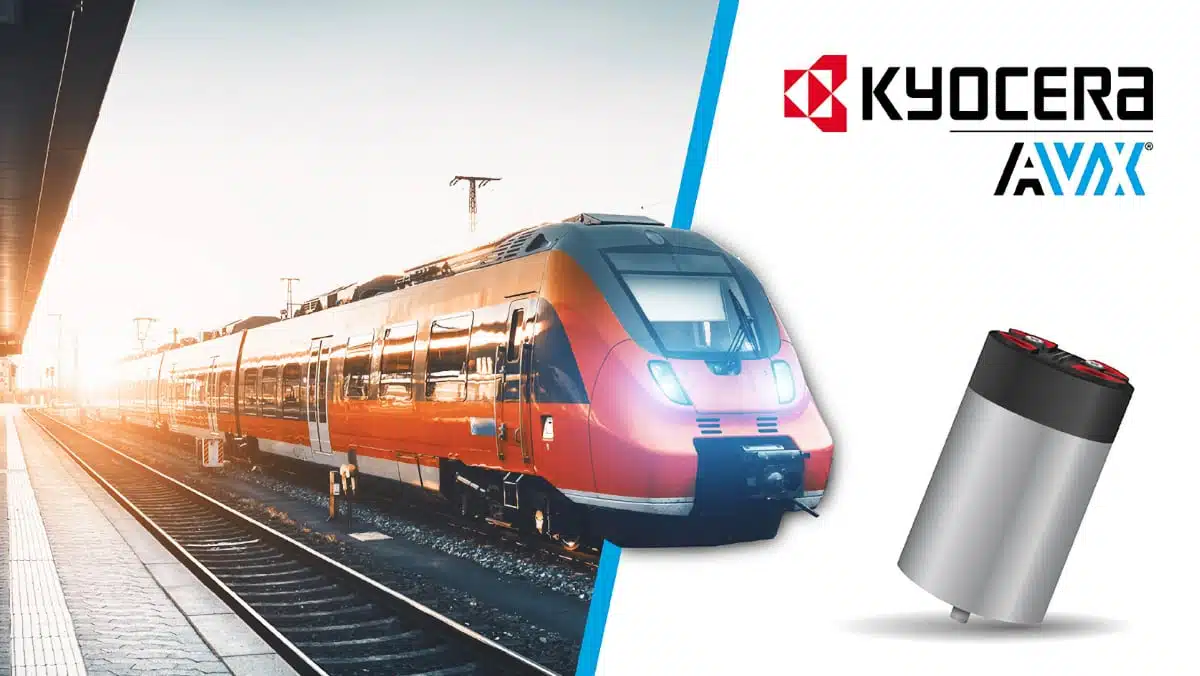
Kyocera AVX has introduced the FFLK series traction‑grade DC-link filtering film capacitors for high‑power drives and traction inverters in electric vehicles and industrial machinery.
These KYOCERA AVX cylindrical can film capacitors target design teams that need higher ripple current, long lifetime and safer failure behavior than aluminum electrolytics in compact packages.
Key features and benefits
High‑power DC filtering performance
- Cylindrical aluminum can film capacitors optimized for DC link and DC filtering in traction inverters and industrial motor drives.
- Wide voltage range according to series variant, spanning approximately 900–3,800 VDC to cover typical traction DC bus levels from low to medium voltage.
- Capacitance range from 25 µF up to 3,020 µF with 10% tolerance, allowing designers to scale from smaller auxiliary drives to large traction inverters without changing platform.
- High volumetric efficiency enables shorter cans or smaller diameters compared with many legacy film and aluminum electrolytic solutions at similar ratings.
Traction‑grade robustness
- Designed for harsh environments with high power, elevated temperatures, and strong mechanical shock and vibration as encountered in traction and industrial drive systems.
- Qualified for railway and power electronics use and compliant with relevant IEC, UL and EN standards, along with RoHS environmental requirements.
- 100,000‑hour lifetime rating when operated within specified voltage, temperature and hot‑spot limits, which supports demanding service life targets in rolling stock and industrial automation.
Self‑healing dielectric for safer failure behavior
- Uses Kyocera AVX’s patented metallized polypropylene film with controlled self‑healing behavior developed to localize and neutralize dielectric breakdowns.
- During a localized breakdown, adjacent electrode material is vaporized and the defect is isolated, preventing a permanent short circuit.
- Normal capacitor operation continues after a self‑healing event, with only a gradual capacitance decrease over time, which is preferable to sudden catastrophic failure in traction systems.
Mechanical and connection options
- Cylindrical aluminum cans from roughly 130 mm to 340 mm height and 85 mm to 116 mm diameter, supporting a range of power levels and available mounting space.
- Available with dry segmented metallized polypropylene film or wet metallized polypropylene film (without free oil) depending on required voltage and current levels.
- Electrical terminations include female M6 or M10 connectors and male M8 or M20 connectors to interface with busbars or cable lugs.
- Integrated mechanical mounting bolt simplifies secure fixation to chassis and heatsinks in high‑vibration environments.
System‑level benefits vs aluminum electrolytics
- Much higher allowed surge voltage, lower ESR and very high RMS current capability compared with aluminum electrolytic capacitors in comparable DC link roles.
- Longer lifetime and reduced maintenance in traction and industrial applications where repeated thermal cycling and ripple current stress are critical.
- Potential for downsizing capacitor banks, reducing system volume and weight while meeting the same ripple and lifetime requirements.
Typical applications
FFLK series capacitors are intended for DC link filtering tasks in high‑power converter systems where long lifetime, mechanical robustness and predictable failure behavior are critical.
Traction and transportation
- EV and hybrid traction inverters on the main DC bus, including automotive and heavy‑duty commercial vehicles.
- Auxiliary inverters and converters for on‑board power systems in rail vehicles and light rail.
- DC link filtering in propulsion systems for electric buses and off‑highway machinery.
Industrial drives and power conversion
- DC link capacitors in medium‑power variable frequency drives (VFDs) and servo drives for industrial motors.
- DC filtering in high‑power rectifiers, front‑end converters and active front‑end (AFE) systems for factory automation.
- Energy storage and DC bus stabilization in UPS, industrial battery systems and DC microgrids.
Other demanding environments
- Power conversion stages in renewable energy equipment such as wind turbine converters and high‑power solar inverters, where vibration and harsh climates are present.
- High‑reliability power supplies and converters in industrial, transportation and heavy equipment markets that require long‑term stable capacitance and low failure risk.
Technical highlights
The FFLK family combines a traction‑grade film dielectric with a mechanical platform suited to cabinet‑mount power electronics.
Electrical and environmental ratings
- DC voltage range:
- Dry segmented metallized polypropylene versions: approximately 900–1,900 VDC according to manufacturer datasheet.
- Wet metallized polypropylene versions without free oil: approximately 2,000–3,800 VDC according to manufacturer datasheet.
- Capacitance range: 25 µF to 3,020 µF, 10% tolerance.
- Operating temperature: −40 °C to +95 °C ambient, with a specified maximum hot‑spot temperature of 70 °C for lifetime calculations.
- Lifetime: 100,000 hours when operated within rated voltage and temperature limits.
- Standards: compliant with IEC, UL, EN and RoHS requirements relevant to power electronics, railway, environmental testing and flammability.
In practice, the combination of wide operating temperature range and long specified lifetime allows these capacitors to be placed close to power semiconductors and busbars, even in cabinets with elevated ambient temperatures, provided hot‑spot limits are respected through thermal design.
Main mechanical options
| Parameter | Range / option |
|---|---|
| Case height | About 130 mm to 340 mm |
| Case diameter | About 85 mm to 116 mm |
| Case material | Cylindrical aluminum can |
| Enclosure material | UL94 V‑0 self‑extinguishing thermoplastic |
| Terminals | Female M6 / M10; male M8 / M20 |
| Mounting | Integrated mechanical mounting bolt |
The UL94 V‑0 plastic components around the aluminum can support flame‑retardant designs and ease safety approvals in traction and industrial markets.
Dielectric technology
- Metallized polypropylene film specifically developed and patented by Kyocera AVX for power film capacitors.
- Controlled self‑healing improves over the intrinsic self‑healing behavior of generic metallized film by optimizing how energy is dissipated around a defect.
- The self‑healing mechanism helps maintain insulation integrity in the presence of repetitive surge events and partial discharges, which are common in traction environments with long cable harnesses and fast switching devices.
Design‑in notes for engineers
Electrolytic replacement and bank optimization
- When replacing aluminum electrolytics, consider that FFLK capacitors offer much lower ESR and higher ripple current capability, which may allow you to reduce the number of capacitors in parallel for the same ripple rating.
- Check surge voltage and transient profiles on the DC bus; the higher surge capability of FFLK devices can improve robustness against line disturbances and switching transients.
- Evaluate total cost of ownership rather than unit price only, as the longer lifetime and smaller bank size can offset higher single‑piece cost compared with electrolytics.
Voltage and dielectric selection
- Use the dry segmented metallized polypropylene variants in applications where the required DC voltage is within the roughly 900–1,900 VDC range and where extremely low loss and high ripple current are priorities.
- Select the wet metallized polypropylene versions for higher DC bus voltages up to approximately 3,800 VDC according to datasheet, such as multi‑level traction inverters or medium‑voltage converter stages.
- Always maintain appropriate margin between maximum DC bus voltage (including worst‑case transients) and capacitor rated voltage, in line with the manufacturer guidance.
Thermal management and lifetime
- Place the capacitors where airflow or conduction paths to a heatsink keep the internal hot‑spot at or below 70 °C under worst‑case ripple and ambient conditions to achieve the rated 100,000‑hour lifetime.
- When operating above typical ambient temperatures, re‑calculate lifetime using the manufacturer’s thermal and lifetime curves from the datasheet.
- Monitor RMS ripple current and switching frequency; although FFLK devices support very high RMS currents, exceeding thermal limits will reduce lifetime.
Mechanical integration and EMC
- Use the integrated mounting bolt to provide a low‑impedance mechanical and thermal path to the chassis, which also helps with vibration robustness in traction and rail vehicles.
- Choose the connector type (female versus male threaded terminals) to match busbar or cable layout, minimizing loop inductance in the DC link.
- When placed near fast‑switching SiC or IGBT modules, keep busbar lengths short and consider snubber components if needed; the low inductance and low ESR of FFLK capacitors help reduce overvoltage spikes and EMI.
Standards and safety
- For railway and traction projects, align the chosen FFLK part numbers with applicable IEC and EN standards referenced in the datasheet and system‑level safety documentation.
- The UL94 V‑0 plastic, combined with controlled self‑healing, supports designs targeting stringent safety and fire behavior requirements in transport and industrial cabinets.
Source
The information in this article is based on the official Kyocera AVX press release and associated FFLK series technical documentation from the manufacturer, interpreted and summarized for design and component engineers.