












Passive Components Blog
No Result
View All Result
  • Home
  • NewsFilter
    • All
    • Aerospace & Defence
    • Antenna
    • Applications
    • Automotive
    • Capacitors
    • Circuit Protection Devices
    • electro-mechanical news
    • Filters
    • Fuses
    • Inductors
    • Industrial
    • Integrated Passives
    • inter-connect news
    • Market & Supply Chain
    • Market Insights
    • Medical
    • Modelling and Simulation
    • New Materials & Supply
    • New Technologies
    • Non-linear Passives
    • Oscillators
    • Passive Sensors News
    • Resistors
    • RF & Microwave
    • Telecommunication
    • Weekly Digest

    Top 10 Connector Vendors by Product Type

    Bourns Releases High‑Q Air Coil Inductors for RF Aplications

    CMSE 2026 Announces Call for Presentations on High-Reliability Military and Space Electronics

    ESA Call for Papers 6th Space Passive Component Days – SPCD 2026

    Würth Elektronik Offers Halogen‑Free EMC Gaskets for Displays and Housings

    Component Distribution Supply Chain January 2026

    Binder Unveils M8 Flange Solder Connectors for Flexible Cabling

    Power Electronics Tools for Passives and Magnetic Designs

    Modelithics Releases Component Model Library for SIMULIA CST Studio Suite

    Trending Tags

    • Ripple Current
    • RF
    • Leakage Current
    • Tantalum vs Ceramic
    • Snubber
    • Low ESR
    • Feedthrough
    • Derating
    • Dielectric Constant
    • New Products
    • Market Reports
  • VideoFilter
    • All
    • Antenna videos
    • Capacitor videos
    • Circuit Protection Video
    • Filter videos
    • Fuse videos
    • Inductor videos
    • Inter-Connect Video
    • Non-linear passives videos
    • Oscillator videos
    • Passive sensors videos
    • Resistor videos

    One‑Pulse Characterization of Nonlinear Power Inductors

    Thermistor Linearization Challenges

    Coaxial Connectors and How to Connect with PCB

    PCB Manufacturing, Test Methods, Quality and Reliability

    Transformer Behavior – Current Transfer and Hidden Feedback

    Choosing the Right Capacitor: The Importance of Accurate Measurements

    RF Inductors: Selection and Design Challenges for High-Frequency Circuits

    Transformer Safety IEC 61558 Standard

    3-Phase EMI Filter Design, Simulation, Calculation and Test

    Trending Tags

    • Capacitors explained
    • Inductors explained
    • Resistors explained
    • Filters explained
    • Application Video Guidelines
    • EMC
    • New Products
    • Ripple Current
    • Simulation
    • Tantalum vs Ceramic
  • Knowledge Blog
  • DossiersNew
  • Suppliers
    • Who is Who
  • PCNS
    • PCNS 2025
    • PCNS 2023
    • PCNS 2021
    • PCNS 2019
    • PCNS 2017
  • Events
  • Home
  • NewsFilter
    • All
    • Aerospace & Defence
    • Antenna
    • Applications
    • Automotive
    • Capacitors
    • Circuit Protection Devices
    • electro-mechanical news
    • Filters
    • Fuses
    • Inductors
    • Industrial
    • Integrated Passives
    • inter-connect news
    • Market & Supply Chain
    • Market Insights
    • Medical
    • Modelling and Simulation
    • New Materials & Supply
    • New Technologies
    • Non-linear Passives
    • Oscillators
    • Passive Sensors News
    • Resistors
    • RF & Microwave
    • Telecommunication
    • Weekly Digest

    Top 10 Connector Vendors by Product Type

    Bourns Releases High‑Q Air Coil Inductors for RF Aplications

    CMSE 2026 Announces Call for Presentations on High-Reliability Military and Space Electronics

    ESA Call for Papers 6th Space Passive Component Days – SPCD 2026

    Würth Elektronik Offers Halogen‑Free EMC Gaskets for Displays and Housings

    Component Distribution Supply Chain January 2026

    Binder Unveils M8 Flange Solder Connectors for Flexible Cabling

    Power Electronics Tools for Passives and Magnetic Designs

    Modelithics Releases Component Model Library for SIMULIA CST Studio Suite

    Trending Tags

    • Ripple Current
    • RF
    • Leakage Current
    • Tantalum vs Ceramic
    • Snubber
    • Low ESR
    • Feedthrough
    • Derating
    • Dielectric Constant
    • New Products
    • Market Reports
  • VideoFilter
    • All
    • Antenna videos
    • Capacitor videos
    • Circuit Protection Video
    • Filter videos
    • Fuse videos
    • Inductor videos
    • Inter-Connect Video
    • Non-linear passives videos
    • Oscillator videos
    • Passive sensors videos
    • Resistor videos

    One‑Pulse Characterization of Nonlinear Power Inductors

    Thermistor Linearization Challenges

    Coaxial Connectors and How to Connect with PCB

    PCB Manufacturing, Test Methods, Quality and Reliability

    Transformer Behavior – Current Transfer and Hidden Feedback

    Choosing the Right Capacitor: The Importance of Accurate Measurements

    RF Inductors: Selection and Design Challenges for High-Frequency Circuits

    Transformer Safety IEC 61558 Standard

    3-Phase EMI Filter Design, Simulation, Calculation and Test

    Trending Tags

    • Capacitors explained
    • Inductors explained
    • Resistors explained
    • Filters explained
    • Application Video Guidelines
    • EMC
    • New Products
    • Ripple Current
    • Simulation
    • Tantalum vs Ceramic
  • Knowledge Blog
  • DossiersNew
  • Suppliers
    • Who is Who
  • PCNS
    • PCNS 2025
    • PCNS 2023
    • PCNS 2021
    • PCNS 2019
    • PCNS 2017
  • Events
No Result
View All Result
Passive Components Blog
No Result
View All Result

Hybrid dc-dc converter stirs switched capacitor into buck step-down

24.8.2022
Reading Time: 2 mins read
A A

source: Electronics Weekly article

Analogue Devices has combined switched capacitor and inductive buck conversion in the same topology to reduce the size of step-down dc-dc converters.

RelatedPosts

Top 10 Connector Vendors by Product Type

Bourns Releases High‑Q Air Coil Inductors for RF Aplications

CMSE 2026 Announces Call for Presentations on High-Reliability Military and Space Electronics

Called LTC7821, this is “industry first hybrid step-down synchronous controller that merges a switched capacitor circuit with a synchronous step-down controller, enabling up to a 50% reduction in DC/DC converter solution size compared to traditional step-down solutions,” claims Analog. “This improvement is enabled by a thee times higher switching frequency without compromising efficiency. Alternatively, when operating at the same frequency, a LTC7821-based solution can provide up to 3% higher efficiency.”

The design appears to own a lot to the 500W LTC7820 fixed ratio dc-dc converter the firm launched in July last year.

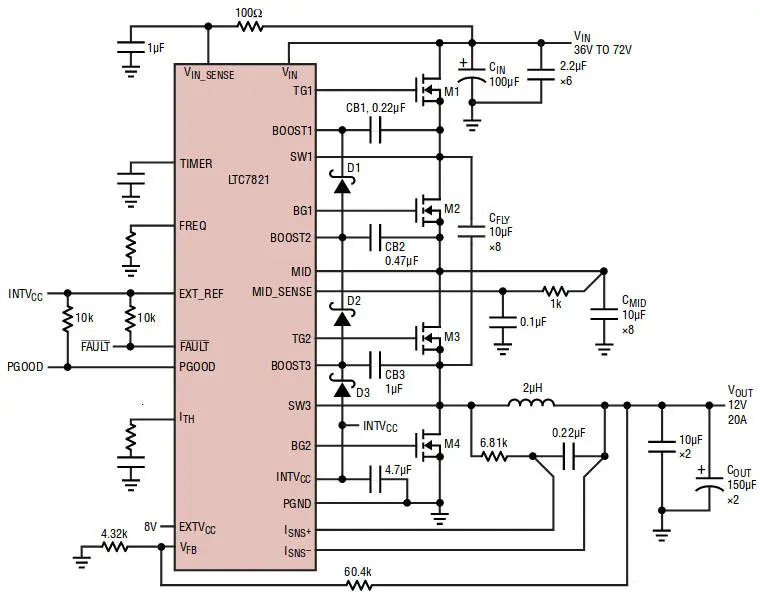
In the LTC7821 hybrid design, the mosfets switch in pairs (see featured image diagram) with M1 and M3 together, alternating with M2 and M4 together.

The first thing this does, through switching interaction between Cfly and Cmid, is to maintain Vin/2 on the top of Cmid – affectively the input to the buck converter.

However, switching timing is controlled by a current-mode loop monitoring the inductor:

  • M1 and M3 are turned on by a latch set by the main clock, then turned off when the inductor current hits a threshold resetting the latch. M2 and M4 are then turned on.
  • Peak inductor current is controlled by the output voltage error amplifier – relative to a 0.8V on-chip (or an optional external reference).
  • M2 and M4 are kept on until the inductor current starts to reverse or the beginning of the next clock cycle.
  • M3 and M4 operate in a manner similar to traditional buck converter, with M3 hard switching and M4 soft-switching at zero voltage.

Just as with the earlier LTC7820, the LTC1821 has a start-up mode in which Cfly and Cmid are pre-charged to Vin/2 before main switching is initiated to prevent huge currents flowing. The two chips also share a totem-pole scheme (see Schottky diode chain) which supplies boot-strap voltages to the internal n-channel mosfet drivers.

The chip operates over 10-72V (80V absolute max) producing outputs from 0.9 to 33.5V with current measured in 10s of amps – depending on the external components.
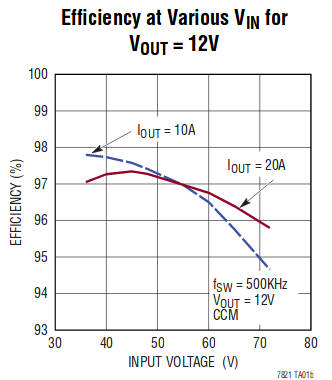
LTC7821-12Vout-efficiencyIn a typical 48V to 12V 20A application, said the firm, 97% efficiency is attainable at 500kHz: “The same efficiency can only be achieved in a traditional synchronous step-down converter by switching at one-third the operating frequency, resulting in the use of much larger magnetics and output filter components.”

Switching is fixed-frequency, programmable from 200kHz to 1.5MHz.

Mosfet drivers have 1Ω outputs – low enough to drive multiple mosfets in parallel, said Analogue, and the current mode control also allows multiple LTC7821s to current-share in multi-phase parallel configurations.

Other claims for the hybrid arrangement are low EMI and reduced MOSFET stress due to the soft-switched front end.

Non-isolated intermediate bus applications are expected in power distribution, datacoms, telecoms and 48V automotive systems.


Related

Recent Posts

Bourns Releases High‑Q Air Coil Inductors for RF Aplications

29.1.2026
3

CMSE 2026 Announces Call for Presentations on High-Reliability Military and Space Electronics

28.1.2026
16

ESA Call for Papers 6th Space Passive Component Days – SPCD 2026

28.1.2026
15

Binder Unveils M8 Flange Solder Connectors for Flexible Cabling

28.1.2026
11

Power Electronics Tools for Passives and Magnetic Designs

27.1.2026
33

Stackpole Releases AlN High‑Power Thick Film Chip Resistors

26.1.2026
17

Samsung Q4 2025 Results: MLCC focus for AI, Server and Automotive

26.1.2026
48

Würth Elektronik Developed a Custom Transformer for Active Hand Orthosis

26.1.2026
34

Capacitor Technology Dossier

26.1.2026
70

Upcoming Events

Feb 24
16:00 - 17:00 CET

Designing Qi2 Wireless Power Systems: Practical Development and EMC Optimization

Mar 3
16:00 - 17:00 CET

Cybersecurity at the Eleventh Hour – from RED to CRA – Information and Discussion

Mar 21
All day

PSMA Capacitor Workshop 2026

View Calendar

Popular Posts

  • Buck Converter Design and Calculation

    0 shares
    Share 0 Tweet 0
  • Boost Converter Design and Calculation

    0 shares
    Share 0 Tweet 0
  • LLC Resonant Converter Design and Calculation

    0 shares
    Share 0 Tweet 0
  • Flyback Converter Design and Calculation

    0 shares
    Share 0 Tweet 0
  • Ripple Current and its Effects on the Performance of Capacitors

    3 shares
    Share 3 Tweet 0
  • How Metal Prices Are Driving Passive Component Price Hikes

    0 shares
    Share 0 Tweet 0
  • MLCC and Ceramic Capacitors

    0 shares
    Share 0 Tweet 0
  • Dual Active Bridge (DAB) Topology

    0 shares
    Share 0 Tweet 0
  • Degradation of Capacitors and its Failure Mechanisms

    0 shares
    Share 0 Tweet 0
  • What is a Dielectric Constant and DF of Plastic Materials?

    4 shares
    Share 4 Tweet 0

Newsletter Subscription


Passive Components Blog

© EPCI - Leading Passive Components Educational and Information Site

  • Home
  • Privacy Policy
  • EPCI Membership & Advertisement
  • About

No Result
View All Result
  • Home
  • Knowledge Blog
  • PCNS

© EPCI - Leading Passive Components Educational and Information Site

This website uses cookies. By continuing to use this website you are giving consent to cookies being used. Visit our Privacy and Cookie Policy.
Go to mobile version