



Passive Components Blog
No Result
View All Result
  • Home
  • NewsFilter
    • All
    • Aerospace & Defence
    • Antenna
    • Applications
    • Automotive
    • Capacitors
    • Circuit Protection Devices
    • electro-mechanical news
    • Filters
    • Fuses
    • Inductors
    • Industrial
    • Integrated Passives
    • inter-connect news
    • Market & Supply Chain
    • Market Insights
    • Medical
    • Modelling and Simulation
    • New Materials & Supply
    • New Technologies
    • Non-linear Passives
    • Oscillators
    • Passive Sensors News
    • Resistors
    • RF & Microwave
    • Telecommunication
    • Weekly Digest

    Binder Extends NCC Circular Connectors for Harsh Environments

    Standard vs Planar LLC transformers Comparison for Battery Chargers

    Würth Elektronik and Grinn Launch Edge AI Cooperation

    Bourns Expanded Semi-Shielded Low Profile Automotive Power Inductor

    Peak Nano to Develop Fusion Grade High Energy Film Capacitors

    Murata New Vibration Sensor Targets High‑Frequency Predictive Maintenance

    Kyocera Releases 30fs Jitter Differential Clock Oscillator

    Panasonic Expands Automotive PP Film Capacitors Voltage Range

    Panasonic Extends Automotive Power Inductor Line

    Trending Tags

    • Ripple Current
    • RF
    • Leakage Current
    • Tantalum vs Ceramic
    • Snubber
    • Low ESR
    • Feedthrough
    • Derating
    • Dielectric Constant
    • New Products
    • Market Reports
  • VideoFilter
    • All
    • Antenna videos
    • Capacitor videos
    • Circuit Protection Video
    • Filter videos
    • Fuse videos
    • Inductor videos
    • Inter-Connect Video
    • Non-linear passives videos
    • Oscillator videos
    • Passive sensors videos
    • Resistor videos

    Standard vs Planar LLC transformers Comparison for Battery Chargers

    How Modern Tools Model Magnetic Components for Power Electronics

    Advanced Loss Modeling for Planar Magnetics in the Frenetic Planar Tool

    2026 Power Magnetics Design Trends: Flyback, DAB and Planar

    Enabling Software‑Defined Vehicle Architectures: Automotive Ethernet and Zonal Smart Power

    Calculating Resistance Value of a Flyback RC Snubber 

    One‑Pulse Characterization of Nonlinear Power Inductors

    Thermistor Linearization Challenges

    Coaxial Connectors and How to Connect with PCB

    Trending Tags

    • Capacitors explained
    • Inductors explained
    • Resistors explained
    • Filters explained
    • Application Video Guidelines
    • EMC
    • New Products
    • Ripple Current
    • Simulation
    • Tantalum vs Ceramic
  • Knowledge Blog
  • DossiersNew
  • Suppliers
    • Who is Who
  • PCNS
    • PCNS 2025
    • PCNS 2023
    • PCNS 2021
    • PCNS 2019
    • PCNS 2017
  • Events
  • Home
  • NewsFilter
    • All
    • Aerospace & Defence
    • Antenna
    • Applications
    • Automotive
    • Capacitors
    • Circuit Protection Devices
    • electro-mechanical news
    • Filters
    • Fuses
    • Inductors
    • Industrial
    • Integrated Passives
    • inter-connect news
    • Market & Supply Chain
    • Market Insights
    • Medical
    • Modelling and Simulation
    • New Materials & Supply
    • New Technologies
    • Non-linear Passives
    • Oscillators
    • Passive Sensors News
    • Resistors
    • RF & Microwave
    • Telecommunication
    • Weekly Digest

    Binder Extends NCC Circular Connectors for Harsh Environments

    Standard vs Planar LLC transformers Comparison for Battery Chargers

    Würth Elektronik and Grinn Launch Edge AI Cooperation

    Bourns Expanded Semi-Shielded Low Profile Automotive Power Inductor

    Peak Nano to Develop Fusion Grade High Energy Film Capacitors

    Murata New Vibration Sensor Targets High‑Frequency Predictive Maintenance

    Kyocera Releases 30fs Jitter Differential Clock Oscillator

    Panasonic Expands Automotive PP Film Capacitors Voltage Range

    Panasonic Extends Automotive Power Inductor Line

    Trending Tags

    • Ripple Current
    • RF
    • Leakage Current
    • Tantalum vs Ceramic
    • Snubber
    • Low ESR
    • Feedthrough
    • Derating
    • Dielectric Constant
    • New Products
    • Market Reports
  • VideoFilter
    • All
    • Antenna videos
    • Capacitor videos
    • Circuit Protection Video
    • Filter videos
    • Fuse videos
    • Inductor videos
    • Inter-Connect Video
    • Non-linear passives videos
    • Oscillator videos
    • Passive sensors videos
    • Resistor videos

    Standard vs Planar LLC transformers Comparison for Battery Chargers

    How Modern Tools Model Magnetic Components for Power Electronics

    Advanced Loss Modeling for Planar Magnetics in the Frenetic Planar Tool

    2026 Power Magnetics Design Trends: Flyback, DAB and Planar

    Enabling Software‑Defined Vehicle Architectures: Automotive Ethernet and Zonal Smart Power

    Calculating Resistance Value of a Flyback RC Snubber 

    One‑Pulse Characterization of Nonlinear Power Inductors

    Thermistor Linearization Challenges

    Coaxial Connectors and How to Connect with PCB

    Trending Tags

    • Capacitors explained
    • Inductors explained
    • Resistors explained
    • Filters explained
    • Application Video Guidelines
    • EMC
    • New Products
    • Ripple Current
    • Simulation
    • Tantalum vs Ceramic
  • Knowledge Blog
  • DossiersNew
  • Suppliers
    • Who is Who
  • PCNS
    • PCNS 2025
    • PCNS 2023
    • PCNS 2021
    • PCNS 2019
    • PCNS 2017
  • Events
No Result
View All Result
Passive Components Blog
No Result
View All Result

KEMET’s New KC-LINK™ SMD Ceramic Capacitors Series Offers Industry Leading Performance for Fast Switching Wide Bandgap Semiconductor Applications

27.11.2019
Reading Time: 2 mins read
A A

Source: Kemet news

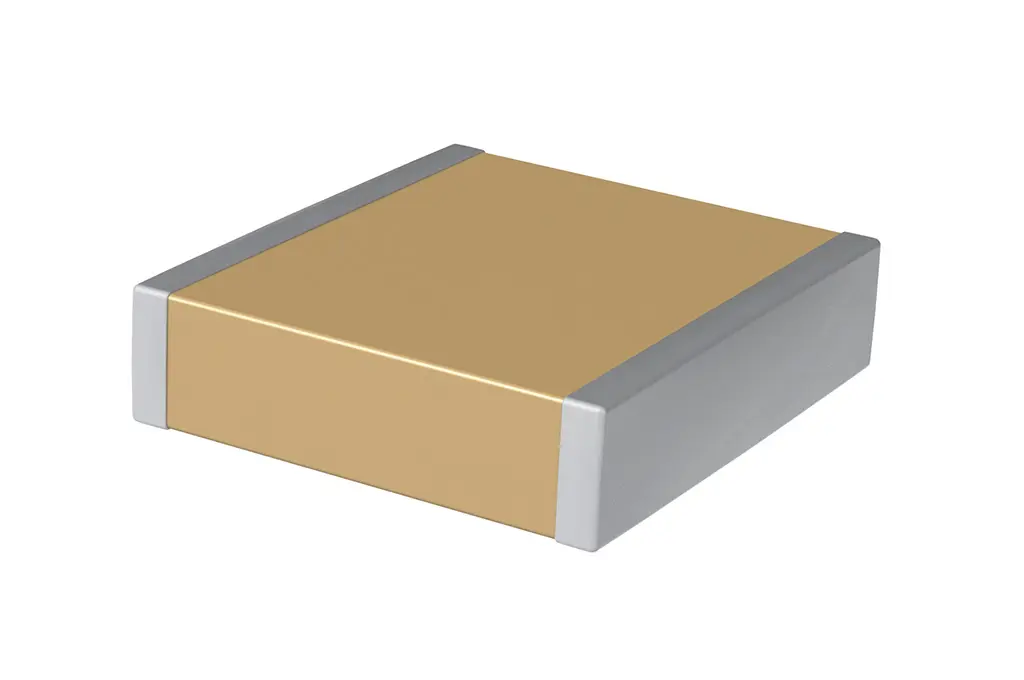
FORT LAUDERDALE, — KEMET Corporation, a leading global supplier of electronic components, has announced a complete capacitance and voltage offering for the KC-LINK™ ceramic surface mount capacitors in the EIA 3640 case size.

RelatedPosts

Integrated Bulk Acoustic Wave (BAW) Technology Explained – Texas Instruments and Mouser Electronics EE Journal Chalk Talk Video

Würth Elektronik Introduces Robust, Resilient, Mountable Radio Interference Suppression Choke

What is RFID? How RFID works? RFID Explained in Detail

The very high ripple current capabilities make KC-LINK capacitors ideal for use with fast-switching wide bandgap (WBG) semiconductors, which enables power converters to operate at higher voltages, temperatures and frequencies, and achieve higher efficiency levels and greater power density. The devices are suitable for use in DC-Link, snubber and resonant applications.

KC-LINK capacitors are available with capacitance values ranging from 4.7nF to 220nF and voltage ranges of 500V to 1700V. These devices utilize KEMET’s robust Class I C0G Base Metal Electrode (BME) dielectric technology giving them superior capacitance stability over temperature and voltage, combined with high ripple current capability. Furthermore, the capacitors exhibit extremely low equivalent series resistance (ESR) and equivalent series inductance (ESL). With an operating temperature range of -55°C to +150°C, KEMET’s KC-LINK capacitors can be mounted near fast-switching semiconductors in high density power applications.

“Designers are increasingly looking for capacitor solutions capable of withstanding high temperatures and high voltages with stable capacitance as well as high ripple current capability over these operating conditions,” said Dr. John Bultitude, Vice President and Technical Fellow at KEMET.

“KC-LINK provides a solution meeting all of these requirements in a single surface mount component. These components will allow designers to increase power efficiency and density in applications such as 5G telecommunications base stations and on board electric vehicles.

KC-LINK capacitors are also ideal for resonant converters and wireless chargers in applications such as cloud computing and charging electric vehicles. These often require very low capacitance shift over operating conditions. The high mechanical robustness allows the capacitor to be mounted without the use of lead frames. This provides extremely low equivalent series inductance (ESL) increasing the operating frequency range allowing for further miniaturization. Available in both commercial and automotive (AEC-Q200) grades, this series is Pb-Free, RoHS and REACH compliant.

To further increase power density, KEMET has developed KONNEKT™ which utilizes an innovative Transient Liquid Phase Sintering (TLPS) technology to create a leadless multi-chip solution. When combined with KEMET’s KC-LINK, KONNEKT enables a low-loss, low inductance package capable of handling extremely high ripple currents in the hundreds of kilohertz.

For more information, visit www.kemet.com/KC-LINK.
 

Related

Recent Posts

Binder Extends NCC Circular Connectors for Harsh Environments

13.3.2026
1

Standard vs Planar LLC transformers Comparison for Battery Chargers

13.3.2026
5

Würth Elektronik and Grinn Launch Edge AI Cooperation

13.3.2026
3

Bourns Expanded Semi-Shielded Low Profile Automotive Power Inductor

12.3.2026
9

Peak Nano to Develop Fusion Grade High Energy Film Capacitors

11.3.2026
24

Murata New Vibration Sensor Targets High‑Frequency Predictive Maintenance

10.3.2026
15

Kyocera Releases 30fs Jitter Differential Clock Oscillator

10.3.2026
12

Panasonic Expands Automotive PP Film Capacitors Voltage Range

9.3.2026
22

Panasonic Extends Automotive Power Inductor Line

9.3.2026
25

Upcoming Events

Mar 19
13:00 - 14:00 CDT

Smart Consideration of Inductor Thermal Performance

Mar 21
All day

PSMA Capacitor Workshop 2026

Apr 21
16:00 - 17:00 CEST

Heatsink Solutions: Thermal Management in electronic devices

View Calendar

Popular Posts

  • Buck Converter Design and Calculation

    0 shares
    Share 0 Tweet 0
  • Boost Converter Design and Calculation

    0 shares
    Share 0 Tweet 0
  • Flyback Converter Design and Calculation

    0 shares
    Share 0 Tweet 0
  • LLC Resonant Converter Design and Calculation

    0 shares
    Share 0 Tweet 0
  • MLCC Manufacturers Consider Price Increase as AI Demand Outpaces Supply

    0 shares
    Share 0 Tweet 0
  • Dual Active Bridge (DAB) Topology

    0 shares
    Share 0 Tweet 0
  • Ripple Current and its Effects on the Performance of Capacitors

    3 shares
    Share 3 Tweet 0
  • MLCC and Ceramic Capacitors

    0 shares
    Share 0 Tweet 0
  • MLCC Case Sizes Standards Explained

    0 shares
    Share 0 Tweet 0
  • What is a Dielectric Constant and DF of Plastic Materials?

    4 shares
    Share 4 Tweet 0

Newsletter Subscription


Passive Components Blog

© EPCI - Leading Passive Components Educational and Information Site

  • Home
  • Privacy Policy
  • EPCI Membership & Advertisement
  • About

No Result
View All Result
  • Home
  • Knowledge Blog
  • PCNS

© EPCI - Leading Passive Components Educational and Information Site

This website uses cookies. By continuing to use this website you are giving consent to cookies being used. Visit our Privacy and Cookie Policy.
Go to mobile version