




Passive Components Blog
No Result
View All Result
  • Home
  • NewsFilter
    • All
    • Aerospace & Defence
    • Antenna
    • Applications
    • Automotive
    • Capacitors
    • Circuit Protection Devices
    • electro-mechanical news
    • Filters
    • Fuses
    • Inductors
    • Industrial
    • Integrated Passives
    • inter-connect news
    • Market & Supply Chain
    • Market Insights
    • Medical
    • Modelling and Simulation
    • New Materials & Supply
    • New Technologies
    • Non-linear Passives
    • Oscillators
    • Passive Sensors News
    • Resistors
    • RF & Microwave
    • Telecommunication
    • Weekly Digest

    Panasonic High Precision Chip Resistors Bridge Gap Between Thin and Thick Technology

    ROHM Extends 2012 Shunt Resistors Power Rating up to 1.25 W

    January 2026 Interconnect, Passives and Electromechanical Components Market Insights

    Passive Components in Quantum Computing

    0603 Automotive Chip Varistors as TVS Diode Replacements, TDK Tech Note

    Miniaturization of MLCCs and Electrolytics, KAVX Tech Chat

    Exxelia Offers Custom Naval Transformers and Inductors

    Researchers Demonstrated 32nm Aluminum Vacuum Gap Capacitor

    Conductive Polymer Capacitor Market and Design‑In Guide to 2035

    Trending Tags

    • Ripple Current
    • RF
    • Leakage Current
    • Tantalum vs Ceramic
    • Snubber
    • Low ESR
    • Feedthrough
    • Derating
    • Dielectric Constant
    • New Products
    • Market Reports
  • VideoFilter
    • All
    • Antenna videos
    • Capacitor videos
    • Circuit Protection Video
    • Filter videos
    • Fuse videos
    • Inductor videos
    • Inter-Connect Video
    • Non-linear passives videos
    • Oscillator videos
    • Passive sensors videos
    • Resistor videos

    One‑Pulse Characterization of Nonlinear Power Inductors

    Thermistor Linearization Challenges

    Coaxial Connectors and How to Connect with PCB

    PCB Manufacturing, Test Methods, Quality and Reliability

    Transformer Behavior – Current Transfer and Hidden Feedback

    Choosing the Right Capacitor: The Importance of Accurate Measurements

    RF Inductors: Selection and Design Challenges for High-Frequency Circuits

    Transformer Safety IEC 61558 Standard

    3-Phase EMI Filter Design, Simulation, Calculation and Test

    Trending Tags

    • Capacitors explained
    • Inductors explained
    • Resistors explained
    • Filters explained
    • Application Video Guidelines
    • EMC
    • New Products
    • Ripple Current
    • Simulation
    • Tantalum vs Ceramic
  • Knowledge Blog
  • Suppliers
    • Who is Who
  • PCNS
    • PCNS 2025
    • PCNS 2023
    • PCNS 2021
    • PCNS 2019
    • PCNS 2017
  • Events
  • Home
  • NewsFilter
    • All
    • Aerospace & Defence
    • Antenna
    • Applications
    • Automotive
    • Capacitors
    • Circuit Protection Devices
    • electro-mechanical news
    • Filters
    • Fuses
    • Inductors
    • Industrial
    • Integrated Passives
    • inter-connect news
    • Market & Supply Chain
    • Market Insights
    • Medical
    • Modelling and Simulation
    • New Materials & Supply
    • New Technologies
    • Non-linear Passives
    • Oscillators
    • Passive Sensors News
    • Resistors
    • RF & Microwave
    • Telecommunication
    • Weekly Digest

    Panasonic High Precision Chip Resistors Bridge Gap Between Thin and Thick Technology

    ROHM Extends 2012 Shunt Resistors Power Rating up to 1.25 W

    January 2026 Interconnect, Passives and Electromechanical Components Market Insights

    Passive Components in Quantum Computing

    0603 Automotive Chip Varistors as TVS Diode Replacements, TDK Tech Note

    Miniaturization of MLCCs and Electrolytics, KAVX Tech Chat

    Exxelia Offers Custom Naval Transformers and Inductors

    Researchers Demonstrated 32nm Aluminum Vacuum Gap Capacitor

    Conductive Polymer Capacitor Market and Design‑In Guide to 2035

    Trending Tags

    • Ripple Current
    • RF
    • Leakage Current
    • Tantalum vs Ceramic
    • Snubber
    • Low ESR
    • Feedthrough
    • Derating
    • Dielectric Constant
    • New Products
    • Market Reports
  • VideoFilter
    • All
    • Antenna videos
    • Capacitor videos
    • Circuit Protection Video
    • Filter videos
    • Fuse videos
    • Inductor videos
    • Inter-Connect Video
    • Non-linear passives videos
    • Oscillator videos
    • Passive sensors videos
    • Resistor videos

    One‑Pulse Characterization of Nonlinear Power Inductors

    Thermistor Linearization Challenges

    Coaxial Connectors and How to Connect with PCB

    PCB Manufacturing, Test Methods, Quality and Reliability

    Transformer Behavior – Current Transfer and Hidden Feedback

    Choosing the Right Capacitor: The Importance of Accurate Measurements

    RF Inductors: Selection and Design Challenges for High-Frequency Circuits

    Transformer Safety IEC 61558 Standard

    3-Phase EMI Filter Design, Simulation, Calculation and Test

    Trending Tags

    • Capacitors explained
    • Inductors explained
    • Resistors explained
    • Filters explained
    • Application Video Guidelines
    • EMC
    • New Products
    • Ripple Current
    • Simulation
    • Tantalum vs Ceramic
  • Knowledge Blog
  • Suppliers
    • Who is Who
  • PCNS
    • PCNS 2025
    • PCNS 2023
    • PCNS 2021
    • PCNS 2019
    • PCNS 2017
  • Events
No Result
View All Result
Passive Components Blog
No Result
View All Result

KYOCERA Releases Shielded Board-to-Board Connectors for Reliable EMI Protection

13.10.2025
Reading Time: 3 mins read
A A

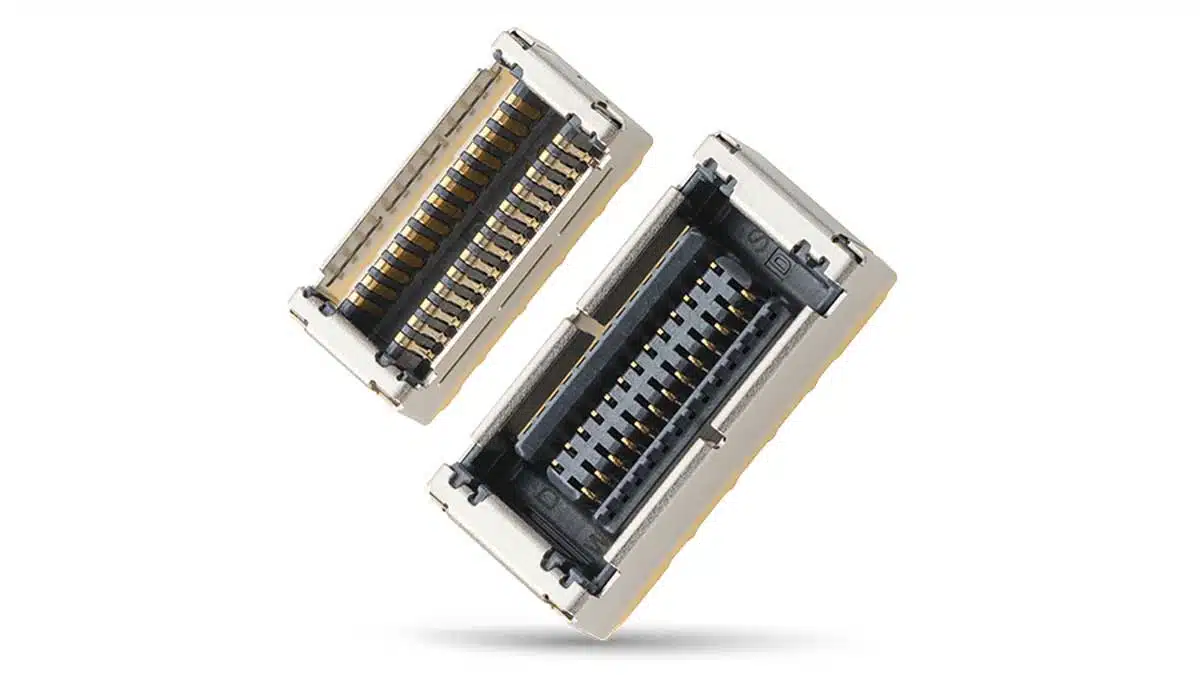
Kyocera Launches 5908 Series: Fully Shielded Board-to-Board Connectors for High-Speed, EMI-Resilient Applications.

Kyocera Corporation has introduced the 5908 Series, a new generation of board-to-board connectors designed to meet the rigorous demands of high-speed data transmission and electromagnetic compatibility (EMC).

RelatedPosts

Miniaturization of MLCCs and Electrolytics, KAVX Tech Chat

Conductive Polymer Capacitor Market and Design‑In Guide to 2035

Kyocera Releases Ultra-Compact Low Voltage Clock Oscillators

This is the first Kyocera connector series to feature a fully shielded structure, offering superior EMI suppression and mechanical robustness for next-generation electronic devices.

The Need for Shielded High-Speed Interconnects

As mobile, wearable, and automotive electronics evolve, the demand for compact, high-speed, and noise-resistant connectors has intensified. Devices such as smartphones, smartwatches, and infotainment systems now rely on high-frequency protocols like PCI Express Gen.3 and USB 3.2 Gen.2. However, these protocols are highly susceptible to electromagnetic interference (EMI), which can degrade signal integrity and system performance.

Kyocera’s 5908 Series directly addresses these challenges by integrating a double-layered shielding mechanism that isolates signal paths and minimizes radiated emissions.

Key Features at a Glance

FeatureDescription
ShieldingFully shielded plug and receptacle with conductive metal shell
Transmission SpeedSupports PCIe Gen.3 (8Gbps) and USB 3.2 Gen.2 (10Gbps)
Locking MechanismConvex-concave interlock increases retention force by 30%
Assembly DesignR-shaped profile improves alignment and workability
Operating Temperature-40℃ to +125℃

Technical Architecture: Shielding and Signal Integrity

The 5908 Series employs a double-shielded structure where both the plug and receptacle are encased in conductive metal. Upon mating, a continuous shielded enclosure is formed, effectively creating a Faraday cage that suppresses both radiated and conducted EMI.

This configuration stabilizes impedance and minimizes signal reflection, ensuring high signal-to-noise ratio (SNR).

Mechanical Design: Locking and Assembly Enhancements

The connector features a convex-concave locking mechanism that increases retention force by approximately 30% compared to previous Kyocera models. This ensures secure mating even in high-vibration environments such as automotive dashboards or industrial control units.

Additionally, the R-shaped profile on both plug and receptacle sides improves insertion guidance and reduces the risk of misalignment during automated assembly.

Product Specifications

ParameterSpecification
Series Name5908 Series
Pitch0.4 mm
Width4.2 mm
Stacking Height2.0 mm
Number of Positions20 to 50
Operating Temperature-40℃ to +125℃
Shielding TypeDouble-sided conductive metal shell
ComplianceRoHS, REACH

Application Areas

  • Smartphones and tablets
  • Wearable electronics (e.g., smartwatches, fitness trackers)
  • Automotive infotainment and ADAS modules
  • Industrial control systems and robotics
  • Medical diagnostic equipment

Related

Source: KYOCERA AVX

Recent Posts

Panasonic High Precision Chip Resistors Bridge Gap Between Thin and Thick Technology

23.1.2026
1

ROHM Extends 2012 Shunt Resistors Power Rating up to 1.25 W

23.1.2026
4

Passive Components in Quantum Computing

22.1.2026
38

0603 Automotive Chip Varistors as TVS Diode Replacements, TDK Tech Note

21.1.2026
15

Conductive Polymer Capacitor Market and Design‑In Guide to 2035

20.1.2026
91

TDK Releases High Performance 105C DC Link Film Capacitors

19.1.2026
53

YAGEO Offers Automotive MOVs for EV and AI power

19.1.2026
28

Vishay Extends Aluminum Capacitors Rating Up to 600 V for DC Links

15.1.2026
36

Würth Elektronik Introduces Product Navigator for Passive Components

14.1.2026
78

Upcoming Events

Jan 27
16:00 - 17:00 CET

Simplifying Vehicle Development with Automotive Ethernet and Zonal Smart Switch Technologies

Feb 24
16:00 - 17:00 CET

Designing Qi2 Wireless Power Systems: Practical Development and EMC Optimization

Mar 21
All day

PSMA Capacitor Workshop 2026

View Calendar

Popular Posts

  • Buck Converter Design and Calculation

    0 shares
    Share 0 Tweet 0
  • Boost Converter Design and Calculation

    0 shares
    Share 0 Tweet 0
  • LLC Resonant Converter Design and Calculation

    0 shares
    Share 0 Tweet 0
  • Flyback Converter Design and Calculation

    0 shares
    Share 0 Tweet 0
  • Ripple Current and its Effects on the Performance of Capacitors

    3 shares
    Share 3 Tweet 0
  • How Metal Prices Are Driving Passive Component Price Hikes

    0 shares
    Share 0 Tweet 0
  • MLCC and Ceramic Capacitors

    0 shares
    Share 0 Tweet 0
  • Dual Active Bridge (DAB) Topology

    0 shares
    Share 0 Tweet 0
  • What is a Dielectric Constant and DF of Plastic Materials?

    4 shares
    Share 4 Tweet 0
  • Degradation of Capacitors and its Failure Mechanisms

    0 shares
    Share 0 Tweet 0

Newsletter Subscription


Passive Components Blog

© EPCI - Leading Passive Components Educational and Information Site

  • Home
  • Privacy Policy
  • EPCI Membership & Advertisement
  • About

No Result
View All Result
  • Home
  • Knowledge Blog
  • PCNS

© EPCI - Leading Passive Components Educational and Information Site

This website uses cookies. By continuing to use this website you are giving consent to cookies being used. Visit our Privacy and Cookie Policy.
Go to mobile version