




Passive Components Blog
No Result
View All Result
  • Home
  • NewsFilter
    • All
    • Aerospace & Defence
    • Antenna
    • Applications
    • Automotive
    • Capacitors
    • Circuit Protection Devices
    • electro-mechanical news
    • Filters
    • Fuses
    • Inductors
    • Industrial
    • Integrated Passives
    • inter-connect news
    • Market & Supply Chain
    • Market Insights
    • Medical
    • Modelling and Simulation
    • New Materials & Supply
    • New Technologies
    • Non-linear Passives
    • Oscillators
    • Passive Sensors News
    • Resistors
    • RF & Microwave
    • Telecommunication
    • Weekly Digest

    Evans Group Unifies Four High-Rel Capacitor Leaders

    Skeleton Releases Graphene‑Based UPS for AI Data Centers

    Designing 800 V DC EMC Filters: Calculation, Simulation and Measurement

    TDK Releases DC-link Film Capacitors with Ultra-low Inductance for SiC Power Converters

    Murata Introduces World First 2.2uF 100V Soft‑Term MLCC in 0805 Size for Automotive

    Murata and Xona Partner on LEO Satellite Navigation for Industrial Applications

    Bourns Offers Custom Magnetics for 3‑Phase Flying Capacitor Inverters

    YAGEO Releases Cost Efficient Pt‑RTD Sensors with Ni wires

    Nvidia Vera Rubin: Why One AI Rack Needs So Many More MLCC Capacitors

    Trending Tags

    • Ripple Current
    • RF
    • Leakage Current
    • Tantalum vs Ceramic
    • Snubber
    • Low ESR
    • Feedthrough
    • Derating
    • Dielectric Constant
    • New Products
    • Market Reports
  • VideoFilter
    • All
    • Antenna videos
    • Capacitor videos
    • Circuit Protection Video
    • Filter videos
    • Fuse videos
    • Inductor videos
    • Inter-Connect Video
    • Non-linear passives videos
    • Oscillator videos
    • Passive sensors videos
    • Resistor videos

    Designing 800 V DC EMC Filters: Calculation, Simulation and Measurement

    Current Sense Transformer Datasheet and Design‑in Guide

    Designing a USB Type‑C Flyback Planar Transformer with Frenetic’s Planar Tool

    Magnetics Design in High‑Frequency GaN Converters

    Qi2 Wireless Charging: Inductors, Capacitors and EMC Filters

    Two‑capacitor paradox explained for engineers

    Capacitances of Nonlinear MLCCs: What Datasheets Don’t Tell You

    Tapped Inductor Buck Converter Fundamentals

    Planar vs Conventional Transformer: When it Make Sense

    Trending Tags

    • Capacitors explained
    • Inductors explained
    • Resistors explained
    • Filters explained
    • Application Video Guidelines
    • EMC
    • New Products
    • Ripple Current
    • Simulation
    • Tantalum vs Ceramic
  • Knowledge Blog
  • DossiersNew
  • Suppliers
    • Who is Who
  • PCNS
    • PCNS 2025
    • PCNS 2023
    • PCNS 2021
    • PCNS 2019
    • PCNS 2017
  • Events
  • Home
  • NewsFilter
    • All
    • Aerospace & Defence
    • Antenna
    • Applications
    • Automotive
    • Capacitors
    • Circuit Protection Devices
    • electro-mechanical news
    • Filters
    • Fuses
    • Inductors
    • Industrial
    • Integrated Passives
    • inter-connect news
    • Market & Supply Chain
    • Market Insights
    • Medical
    • Modelling and Simulation
    • New Materials & Supply
    • New Technologies
    • Non-linear Passives
    • Oscillators
    • Passive Sensors News
    • Resistors
    • RF & Microwave
    • Telecommunication
    • Weekly Digest

    Evans Group Unifies Four High-Rel Capacitor Leaders

    Skeleton Releases Graphene‑Based UPS for AI Data Centers

    Designing 800 V DC EMC Filters: Calculation, Simulation and Measurement

    TDK Releases DC-link Film Capacitors with Ultra-low Inductance for SiC Power Converters

    Murata Introduces World First 2.2uF 100V Soft‑Term MLCC in 0805 Size for Automotive

    Murata and Xona Partner on LEO Satellite Navigation for Industrial Applications

    Bourns Offers Custom Magnetics for 3‑Phase Flying Capacitor Inverters

    YAGEO Releases Cost Efficient Pt‑RTD Sensors with Ni wires

    Nvidia Vera Rubin: Why One AI Rack Needs So Many More MLCC Capacitors

    Trending Tags

    • Ripple Current
    • RF
    • Leakage Current
    • Tantalum vs Ceramic
    • Snubber
    • Low ESR
    • Feedthrough
    • Derating
    • Dielectric Constant
    • New Products
    • Market Reports
  • VideoFilter
    • All
    • Antenna videos
    • Capacitor videos
    • Circuit Protection Video
    • Filter videos
    • Fuse videos
    • Inductor videos
    • Inter-Connect Video
    • Non-linear passives videos
    • Oscillator videos
    • Passive sensors videos
    • Resistor videos

    Designing 800 V DC EMC Filters: Calculation, Simulation and Measurement

    Current Sense Transformer Datasheet and Design‑in Guide

    Designing a USB Type‑C Flyback Planar Transformer with Frenetic’s Planar Tool

    Magnetics Design in High‑Frequency GaN Converters

    Qi2 Wireless Charging: Inductors, Capacitors and EMC Filters

    Two‑capacitor paradox explained for engineers

    Capacitances of Nonlinear MLCCs: What Datasheets Don’t Tell You

    Tapped Inductor Buck Converter Fundamentals

    Planar vs Conventional Transformer: When it Make Sense

    Trending Tags

    • Capacitors explained
    • Inductors explained
    • Resistors explained
    • Filters explained
    • Application Video Guidelines
    • EMC
    • New Products
    • Ripple Current
    • Simulation
    • Tantalum vs Ceramic
  • Knowledge Blog
  • DossiersNew
  • Suppliers
    • Who is Who
  • PCNS
    • PCNS 2025
    • PCNS 2023
    • PCNS 2021
    • PCNS 2019
    • PCNS 2017
  • Events
No Result
View All Result
Passive Components Blog
No Result
View All Result

Kyocera Offers Small SAW Filters for IoT RF Modules

23.2.2026
Reading Time: 7 mins read
A A

Kyocera has introduced a family of compact SAW (Surface Acoustic Wave) filters optimized for low‑power wireless communication in IoT devices such as smart meters and compact wireless modules.

These devices target popular ISM and sub‑GHz bands, helping designers meet coexistence, size and power constraints in dense RF environments. For engineers, the series offers a way to shrink RF front‑ends while maintaining selectivity and robust operation over a wide temperature range.

RelatedPosts

KYOCERA 10 µF 0201 MLCC Brings High‑Capacitance into Mobile Designs

KYOCERA AVX Extends MLV Varistors for 48V Automotive Protection

Kyocera Developed Multilayer Ceramic Core Substrate for AI Packages

Role of SAW filters in IoT RF front‑ends

In typical IoT nodes, especially smart meters and similar infrastructure devices, the RF front‑end must handle narrowband communication in crowded spectrum, often next to cellular, Wi‑Fi or other ISM services. SAW band‑pass filters provide the necessary channel selectivity between the antenna and the transceiver or PA/LNA. They attenuate out‑of‑band interferers, improve receiver sensitivity and ease EMC compliance, all in a small SMD package that fits densely populated RF PCBs.

Kyocera’s small SAW filters for IoT are designed specifically for these compact RF sections, where PCB area and height are limited but stable RF characteristics over temperature and time are still required.

Key features and benefits

Kyocera’s IoT‑oriented SAW filters emphasize a combination of compact size, RF performance and robust environmental characteristics suitable for long‑life field installations.

Key characteristics include:

  • Small surface‑mount packages suitable for high‑density IoT modules and smart meter RF boards.
  • Center frequencies matched to common IoT bands as specified in the manufacturer datasheet (e.g. sub‑GHz smart‑metering bands and 2.4 GHz‑class ISM, depending on the specific part number).
  • Low insertion loss to maintain receiver sensitivity and minimize PA output power, supporting low‑power operation and extended battery life.
  • High out‑of‑band attenuation to suppress adjacent‑channel and blocker signals, improving coexistence with nearby wireless standards.
  • Temperature‑stable filter characteristics according to the specified operating temperature range and technology used (including temperature‑compensated SAW structures on selected parts).
  • Surface‑mount construction compatible with standard lead‑free reflow soldering and automated assembly.

For purchasing and component engineering, the combination of standardized SMD outlines and clearly specified RF characteristics simplifies second‑source evaluation and long‑term lifecycle planning.

Typical applications

Kyocera positions these small SAW filters primarily for IoT and smart infrastructure devices where compact RF modules are embedded into constrained housings.

Typical end‑equipment includes:

  • Smart meters for electricity, gas and water, including RF boards integrated into metering heads or communication modules.
  • Industrial IoT nodes using licensed or unlicensed narrowband RF links for telemetry and remote monitoring.
  • Compact RF modules and communication plug‑ins that OEMs integrate into larger host systems (appliances, building automation, industrial controllers).
  • Other battery‑powered sensors and actuators requiring robust sub‑GHz or ISM‑band connectivity in crowded RF environments.

In these designs, the SAW filter is usually placed between the antenna matching network and the RF transceiver or LNA/PA, providing band selection and protecting the receiver from out‑of‑band power.

Technical highlights

From a circuit‑design perspective, the important parameters of these SAW filters are their center frequency, bandwidth, insertion loss, return loss, attenuation profile and power handling, all of which are defined per part number in the Kyocera datasheet.

Relevant technical aspects include:

  • Package dimensions and land patterns designed for compact RF PCBs in IoT modules; exact sizes are according to the manufacturer datasheet for the selected part number.
  • Defined passband frequency range and nominal center frequency matched to the target regional IoT standard.
  • Specified maximum insertion loss in the passband, which directly impacts link budget. Lower insertion loss means less margin consumed by the filter and potentially lower transmit power for the same range.
  • Out‑of‑band attenuation curves around the passband, which define how well the filter rejects interferers from neighboring services. This affects coexistence performance in multi‑standard environments.
  • Operating temperature range and temperature dependence of center frequency and insertion loss, important for outdoor smart meters or industrial deployments subject to wide thermal swings.

Engineers should always refer to the official Kyocera datasheet for exact numeric values (frequency masks, insertion loss, attenuation at specific offsets and power ratings) when completing RF budget and coexistence calculations.

Design‑in notes for engineers

To get the expected performance from these SAW filters in real hardware, RF layout and system‑level considerations are critical.

Practical design‑in guidelines include:

  • Place the SAW filter as close as possible to the RF transceiver or LNA/PA and to the antenna matching network, minimizing series line length and discontinuities.
  • Follow Kyocera’s recommended PCB land pattern, including ground via placement, to achieve the specified impedance environment.
  • Use controlled‑impedance microstrip or coplanar lines between antenna, filter and RF transceiver to avoid unintended reflections and bandwidth narrowing.
  • Take into account the filter’s group delay and insertion loss in the overall link budget and timing analysis, particularly for narrowband or time‑sensitive protocols.
  • Simulate the complete RF front‑end, including antenna, matching network and SAW filter S‑parameters provided by Kyocera, to validate coexistence and blocking performance.
  • Consider temperature behavior and mounting conditions (enclosure, nearby metal, shielding cans) to ensure that the filter meets specification in the final product environment.

For long‑life infrastructure deployments like smart meters, it is also advisable to review regional frequency bands (see below),

long‑term reliability data, environmental test results and any application notes that Kyocera provides for SAW filters in utility metering and similar applications.
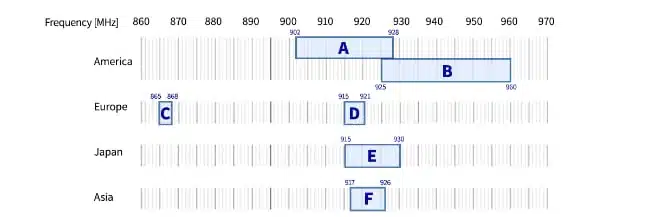
Smart Meter Frequencies by Region
Part NumberSizeBand RangeFrequencyTypeProduction Status
SF14-0915M5UUP11.4×1.1 mm902–928 MHzA, DStandardIn Mass Production
SF14-0915M5UUB11.4×1.1 mm902–928 MHzA, DLow LossIn Planning
SF14-0925M5UUP11.4×1.1 mm920–930 MHzE, FStandardIn Mass Production
SF14-0925M5UUC11.4×1.1 mm922–928 MHzE, FLow LossIn Mass Production
SF14-0869M5UUB11.4×1.1 mm863–870 MHzCLow LossIn Planning
SF14-0942M5UUB11.4×1.1 mm925–960 MHzBStandardIn Planning

Source

This article is based on technical information and product descriptions published by Kyocera for its small SAW filters for IoT devices, adapted and expanded for design and component engineers.
References

  1. Small SAW Filters for IoT Devices – Kyocera Technical Information
  2. SAW Devices – Kyocera Product Overview

Related

Recent Posts

Designing 800 V DC EMC Filters: Calculation, Simulation and Measurement

4.6.2026
34

Murata Introduces World First 2.2uF 100V Soft‑Term MLCC in 0805 Size for Automotive

4.6.2026
16

Qi2 Wireless Charging: Inductors, Capacitors and EMC Filters

21.5.2026
45

Würth Elektronik Presents New Bidirectional Digital Isolators

20.5.2026
48

Würth Elektronik Introduces Compact Flat-wire SMT Power Inductors for Automotive

5.5.2026
86

KYOCERA AVX Extends MLV Varistors for 48V Automotive Protection

5.5.2026
46

Murata Introduces Crystal and NTC Set for Automotive UWB Timing

30.4.2026
52

Murata New MLCC Bulk Case Packaging Cuts Packaging Material by 99%

27.4.2026
174

KYOCERA AVX Introduces Traction‑Grade DC Link Film Capacitors

21.4.2026
80

Upcoming Events

Jun 16
16:00 - 17:00 CEST

EMC with EMC – EMC‑compliant design with electromechanical connectors

View Calendar

Popular Posts

  • Buck Converter Design and Calculation

    0 shares
    Share 0 Tweet 0
  • Boost Converter Design and Calculation

    0 shares
    Share 0 Tweet 0
  • MLCC and Ceramic Capacitors

    0 shares
    Share 0 Tweet 0
  • Flyback Converter Design and Calculation

    0 shares
    Share 0 Tweet 0
  • LLC Resonant Converter Design and Calculation

    0 shares
    Share 0 Tweet 0
  • Capacitor Charging and Discharging

    0 shares
    Share 0 Tweet 0
  • What Electronics Engineer Needs to Know About Passive Low Pass Filters

    0 shares
    Share 0 Tweet 0
  • Dual Active Bridge (DAB) Topology

    0 shares
    Share 0 Tweet 0
  • SEPIC Converter Design and Calculation

    0 shares
    Share 0 Tweet 0
  • Earthing Systems and IEC Classification Explained

    0 shares
    Share 0 Tweet 0

Newsletter Subscription


Passive Components Blog

© EPCI - Leading Passive Components Educational and Information Site

  • Home
  • Privacy Policy
  • EPCI Membership & Advertisement
  • About

No Result
View All Result
  • Home
  • Knowledge Blog
  • Dossiers
  • PCNS

© EPCI - Leading Passive Components Educational and Information Site

This website uses cookies. By continuing to use this website you are giving consent to cookies being used. Visit our Privacy and Cookie Policy.
Go to mobile version