










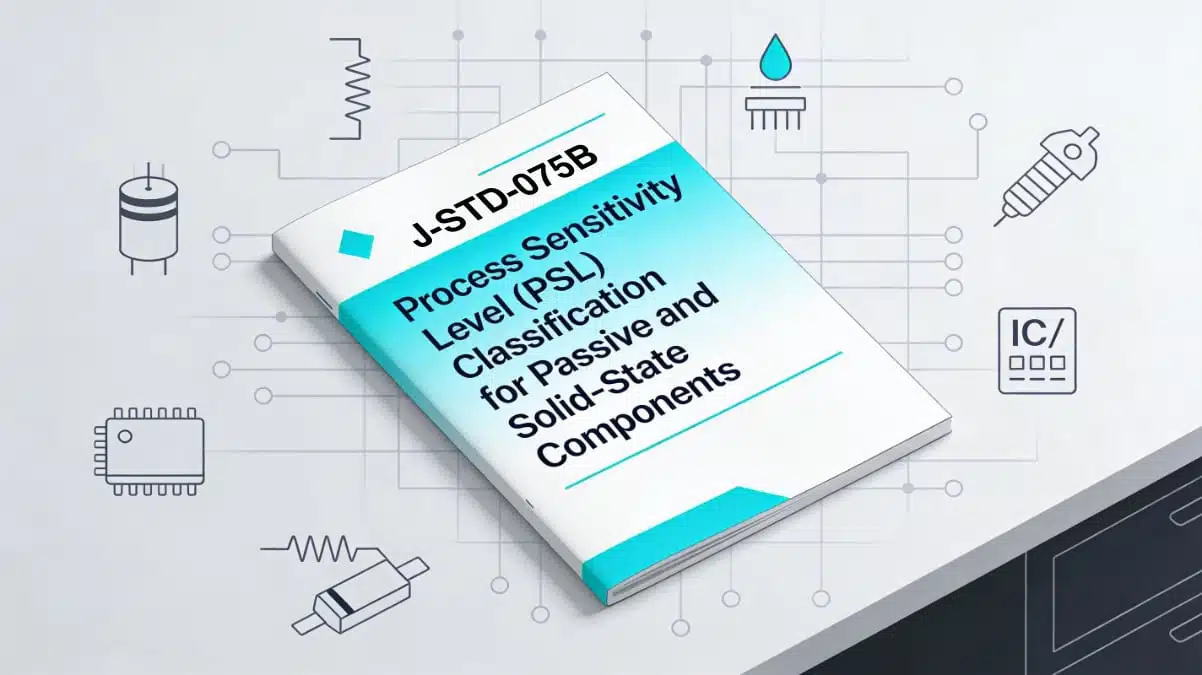
The global electronics industry has gained a significant update to one of its key assembly-process standards with the release of the new ECIA/IPC/JEDEC J‑STD‑075B “Classification of Passive and Solid State Devices for Assembly Processes”.
This latest revision strengthens the way manufacturers, OEMs, EMS providers and distributors communicate and manage process sensitivity of non‑IC components across the entire supply chain.
A Unified Language for Process Sensitivity
J‑STD‑075B defines a consistent Process Sensitivity Level (PSL) classification and labeling scheme for passive and solid-state devices. By assigning clear PSL ratings, the standard enables stakeholders to identify components with limitations in soldering temperature, cleaning chemistry, vacuum pick‑and‑place handling, X‑ray inspection dose and other critical process conditions before PCBA assembly. This unified language helps reduce miscommunication between component manufacturers and board assemblers and supports faster, more robust new product introduction.
Fully Aligned with MSL, J‑STD‑020 and J‑STD‑033
The PSL concept in J‑STD‑075B is designed to extend and remain fully consistent with the widely adopted Moisture Sensitivity Level (MSL) ratings used for ICs and other moisture/reflow‑sensitive devices. J‑STD‑075B is technically and procedurally consolidated with J‑STD‑020 and J‑STD‑033, allowing engineering and production teams to treat moisture, reflow and broader process sensitivities within one coherent framework. As a result, component labels, packaging information and assembly documentation can now present MSL and PSL side‑by‑side, simplifying risk assessment and shop‑floor procedures.
Why J‑STD‑075B Matters for the Electronics Supply Chain
The new revision arrives at a time when assemblies are becoming denser, soldering profiles more demanding and cleaning and inspection processes more aggressive. Components that might previously have been considered “robust by default” can now experience damage from elevated temperatures, harsh cleaners, mechanical handling or high‑dose X‑ray and CT inspection. J‑STD‑075B addresses this challenge by:
- Providing a standardized PSL rating scale for passive and solid‑state components.
- Defining process‑related tests and limits that underpin PSL classification.
- Aligning terminology, symbols and labeling conventions with existing MSL practices.
- Enabling clear communication of process limitations from component makers to EMS providers and OEMs.
By adopting J‑STD‑075B, companies can systematically identify sensitive components in their BOMs and ensure that these are handled and processed within specified limits.
Limited Awareness and Industry Uptake
Despite its importance, the industry awareness and uptake of J‑STD‑075 has so far remained limited. A majority of passive components are still not adequately classified or labeled with PSL information, which creates quality and reliability risks, especially in demanding automotive, aerospace, defense and industrial applications. This gap between available standards and actual practice underscores the need for stronger collaboration between component manufacturers and board assemblers to make PSL part of mainstream engineering and quality workflows.
A paper highlighting these risks and calling for wider implementation of J‑STD‑075 and PSL ratings by component manufacturers was presented by Thales at the PCNS 2025 conference. The paper, published on the Passive Components Blog, provides concrete examples of how missing or incomplete process sensitivity data can lead to hidden failure mechanisms and costly field returns, and explains how systematic adoption of J‑STD‑075 can close this gap. This new Revision B offers a timely opportunity for the industry to revisit its classification and labeling practices and move towards broader, more consistent implementation.
Benefits for Component Manufacturers
For component manufacturers, J‑STD‑075B offers a recognized industry framework to characterize and communicate process sensitivity for their portfolios. Rather than relying on ad‑hoc notes in datasheets, suppliers can:
- Classify products according to a common PSL system accepted by ECIA, IPC and JEDEC.
- Use standardized labels and documentation that downstream partners already understand.
- Reduce technical support load by pre‑emptively answering common process‑handling questions.
- Demonstrate compliance with state‑of‑the‑art industry practices in qualification and labeling.
Combined with greater industry awareness and demand from OEMs and EMS providers, this can help drive a virtuous cycle where PSL labeling becomes a differentiator and, eventually, an expected minimum.
Benefits for OEMs, EMS Providers and PCB Assemblers
On the assembly side, J‑STD‑075B helps engineering and manufacturing teams integrate process sensitivity considerations early in design and throughout production. Key advantages include:
- Faster DfM and DfA reviews through clear PSL ratings in component data and BOM tools.
- Improved process window definition for reflow, cleaning, handling and inspection steps.
- Reduced latent failure risk caused by over‑temperature, chemical attack or inspection damage.
- More effective training and work instructions, since PSL and MSL share a similar conceptual structure.
When combined with J‑STD‑020 and J‑STD‑033, J‑STD‑075B provides a more complete picture of process‑related risks across all components on the PCB, not only ICs. As more component manufacturers adopt PSL labeling, OEMs and EMS providers will be able to rely less on assumptions and more on structured, standard‑based process data.
Key Changes and Focus Areas in Revision B
While the full technical details reside in the standard itself, J‑STD‑075B generally aims to refine and extend the earlier Revision A to better reflect today’s assembly processes and component technologies. Typical areas of enhancement for such a revision include:
- Clarified or expanded PSL definitions and test conditions for modern soldering and cleaning processes.
- Better alignment of terminology and labeling conventions with the latest revisions of J‑STD‑020 and J‑STD‑033.
- Additional guidance on handling and inspection‑related sensitivities, including X‑ray and automated optical inspection.
- Examples and application notes that help both component suppliers and assemblers implement PSL classification consistently.
Organizations already using J‑STD‑075A are encouraged to review the new document and update their internal specifications, labels and procedures accordingly, treating Revision B as an opportunity to close any existing gaps in PSL adoption.
Enabling Data‑Driven Risk Management
As digital product lifecycle and smart‑factory systems become the norm, standardized attributes like PSL and MSL are increasingly consumed by PLM, ERP and MES platforms. J‑STD‑075B aligns naturally with this trend by providing structured, machine‑readable information that can be integrated into:
- Electronic component databases and BOM management systems.
- Automated design‑for‑manufacturing rule checks and risk assessments.
- Smart labeling, traceability and quality reporting tools on the shop floor.
When supported by broad industry uptake, PSL and MSL data can be used to automatically flag risk components, set process limits and enforce handling rules, turning the standard into a practical enabler of predictive, data‑driven quality management.
Availability of J‑STD‑075B
J‑STD‑075B “Classification of Passive and Solid State Devices for Assembly Processes” is now available from the three sponsoring organizations, ECIA, IPC and JEDEC, through their usual standards distribution channels and licensed resellers. Stakeholders across the electronics value chain – from component manufacturers and distributors to EMS providers and OEMs – are encouraged to obtain the new revision and plan their migration from earlier releases. Early adoption will help ensure consistent communication of PSL ratings and harmonized handling of process‑sensitive components across global supply chains, while also addressing the current awareness gap highlighted by recent industry studies and conference papers.
Source
This article is based on information provided in the official standard release materials and related documentation from the ECIA/IPC/JEDEC J‑STD‑075 standards family, complemented by independent industry analysis and conference contributions that discuss the risks of limited PSL adoption and the need for broader implementation.