



Passive Components Blog
No Result
View All Result
  • Home
  • NewsFilter
    • All
    • Aerospace & Defence
    • Antenna
    • Applications
    • Automotive
    • Capacitors
    • Circuit Protection Devices
    • electro-mechanical news
    • Filters
    • Fuses
    • Inductors
    • Industrial
    • Integrated Passives
    • inter-connect news
    • Market & Supply Chain
    • Market Insights
    • Medical
    • Modelling and Simulation
    • New Materials & Supply
    • New Technologies
    • Non-linear Passives
    • Oscillators
    • Passive Sensors News
    • Resistors
    • RF & Microwave
    • Telecommunication
    • Weekly Digest

    LeanBOM: Practical Cross‑Technology Capacitor Search by Real Working Conditions

    In the Age of AI, Every Watt Counts: Implications for Components

    Stackpole Extends Resistance Range of 2512 High‑Power Current Sense Resistors

    Wk 27 Electronics Supply Chain Digest

    Littelfuse Announced TVS Diodes for 48 V Automotive Systems

    Spectrum Controls Joins Modelithics Program to Offer High‑Fidelity RF Models for Resistors, Attenuators and Terminations

    RF Filters and Passive Components Enabling the 7 Missile RF Subsystems

    Ferrite versus Nanocrystalline Power Inductor Cores: Turns, Gap and Size

    YAGEO Presents NANOMET Soft Magnetic Cores for High‑Density Power Conversion

    Trending Tags

    • Ripple Current
    • RF
    • Leakage Current
    • Tantalum vs Ceramic
    • Snubber
    • Low ESR
    • Feedthrough
    • Derating
    • Dielectric Constant
    • New Products
    • Market Reports
  • VideoFilter
    • All
    • Antenna videos
    • Capacitor videos
    • Circuit Protection Video
    • Filter videos
    • Fuse videos
    • Inductor videos
    • Inter-Connect Video
    • Non-linear passives videos
    • Oscillator videos
    • Passive sensors videos
    • Resistor videos

    Ferrite versus Nanocrystalline Power Inductor Cores: Turns, Gap and Size

    KYOCERA AVX Presents Antenna Integrator Studio Tutorial for Antenna Placement and RF Design

    Power Design Simulation Tools for Faster Inductor Selection and Loss Optimization

    EMC‑Compliant PCB and Connector Design Guidelines

    Why Isolated DC/DC Power Supplies Fail Late, Würth Elektronik Podcast

    Designing 800 V DC EMC Filters: Calculation, Simulation and Measurement

    Current Sense Transformer Datasheet and Design‑in Guide

    Designing a USB Type‑C Flyback Planar Transformer with Frenetic’s Planar Tool

    Magnetics Design in High‑Frequency GaN Converters

    Trending Tags

    • Capacitors explained
    • Inductors explained
    • Resistors explained
    • Filters explained
    • Application Video Guidelines
    • EMC
    • New Products
    • Ripple Current
    • Simulation
    • Tantalum vs Ceramic
  • Knowledge Blog
  • Dossiers
    • AI Hardware Dossier
    • Power Converter Dossier
    • Automotive Dossier
    • Capacitor Dossier
    • Resistor Dossier
    • Inductor Dossier
    • Circuit Protection Dossier
  • Suppliers
    • Who is Who
  • PCNS
    • PCNS 2025
    • PCNS 2023
    • PCNS 2021
    • PCNS 2019
    • PCNS 2017
  • Events
  • Home
  • NewsFilter
    • All
    • Aerospace & Defence
    • Antenna
    • Applications
    • Automotive
    • Capacitors
    • Circuit Protection Devices
    • electro-mechanical news
    • Filters
    • Fuses
    • Inductors
    • Industrial
    • Integrated Passives
    • inter-connect news
    • Market & Supply Chain
    • Market Insights
    • Medical
    • Modelling and Simulation
    • New Materials & Supply
    • New Technologies
    • Non-linear Passives
    • Oscillators
    • Passive Sensors News
    • Resistors
    • RF & Microwave
    • Telecommunication
    • Weekly Digest

    LeanBOM: Practical Cross‑Technology Capacitor Search by Real Working Conditions

    In the Age of AI, Every Watt Counts: Implications for Components

    Stackpole Extends Resistance Range of 2512 High‑Power Current Sense Resistors

    Wk 27 Electronics Supply Chain Digest

    Littelfuse Announced TVS Diodes for 48 V Automotive Systems

    Spectrum Controls Joins Modelithics Program to Offer High‑Fidelity RF Models for Resistors, Attenuators and Terminations

    RF Filters and Passive Components Enabling the 7 Missile RF Subsystems

    Ferrite versus Nanocrystalline Power Inductor Cores: Turns, Gap and Size

    YAGEO Presents NANOMET Soft Magnetic Cores for High‑Density Power Conversion

    Trending Tags

    • Ripple Current
    • RF
    • Leakage Current
    • Tantalum vs Ceramic
    • Snubber
    • Low ESR
    • Feedthrough
    • Derating
    • Dielectric Constant
    • New Products
    • Market Reports
  • VideoFilter
    • All
    • Antenna videos
    • Capacitor videos
    • Circuit Protection Video
    • Filter videos
    • Fuse videos
    • Inductor videos
    • Inter-Connect Video
    • Non-linear passives videos
    • Oscillator videos
    • Passive sensors videos
    • Resistor videos

    Ferrite versus Nanocrystalline Power Inductor Cores: Turns, Gap and Size

    KYOCERA AVX Presents Antenna Integrator Studio Tutorial for Antenna Placement and RF Design

    Power Design Simulation Tools for Faster Inductor Selection and Loss Optimization

    EMC‑Compliant PCB and Connector Design Guidelines

    Why Isolated DC/DC Power Supplies Fail Late, Würth Elektronik Podcast

    Designing 800 V DC EMC Filters: Calculation, Simulation and Measurement

    Current Sense Transformer Datasheet and Design‑in Guide

    Designing a USB Type‑C Flyback Planar Transformer with Frenetic’s Planar Tool

    Magnetics Design in High‑Frequency GaN Converters

    Trending Tags

    • Capacitors explained
    • Inductors explained
    • Resistors explained
    • Filters explained
    • Application Video Guidelines
    • EMC
    • New Products
    • Ripple Current
    • Simulation
    • Tantalum vs Ceramic
  • Knowledge Blog
  • Dossiers
    • AI Hardware Dossier
    • Power Converter Dossier
    • Automotive Dossier
    • Capacitor Dossier
    • Resistor Dossier
    • Inductor Dossier
    • Circuit Protection Dossier
  • Suppliers
    • Who is Who
  • PCNS
    • PCNS 2025
    • PCNS 2023
    • PCNS 2021
    • PCNS 2019
    • PCNS 2017
  • Events
No Result
View All Result
Passive Components Blog
No Result
View All Result

Passive Components J-STD-075 Process Sensitivity Level Classification And Labeling

25.9.2025
Reading Time: 5 mins read
A A

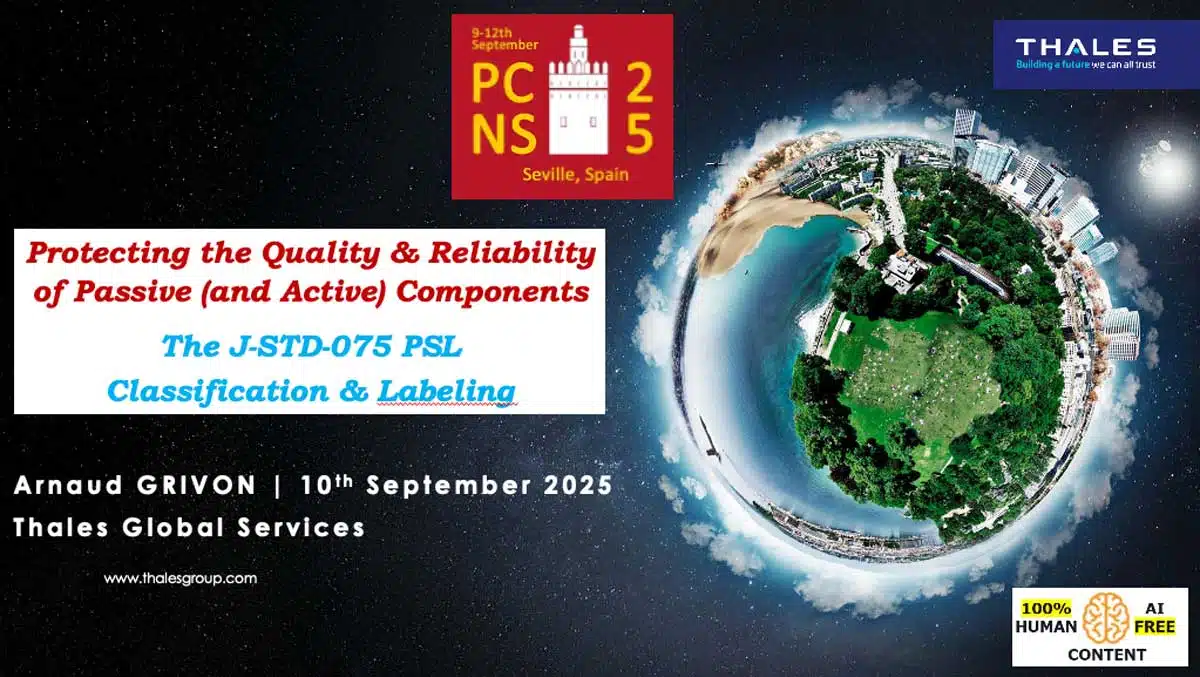
The paper “Protecting the Quality & Reliability of Passive (and Active) Components: the J-STD-075 PSL Classification & Labeling” was presented by Arnaud Grivon, Thales Global Services, Meudon, France at the 5th PCNS Passive Components Networking Symposium 9-12th September 2025, Seville, Spain as paper No. 2.3.

Introduction

Passive components, while generally lower in cost than active components, are often the most numerous elements on a printed circuit board assembly (PCBA) and present unique challenges in terms of quality and reliability.

RelatedPosts

Advances in the Environmental Performance of Polymer Capacitors

How to Manage Supercapacitors Leakage Current and Self Discharge 

Qualification of Commercial Supercapacitors for Space Applications

The transition to Pb-free soldering prompted by the RoHS directive exposed the thermal and process sensitivities of many passive components, such as capacitors, inductors, fuses, and connectors.

To address these sensitivities, standards like J-STD-020 (Moisture Sensitivity Level, MSL) and J-STD-075 (Process Sensitivity Level, PSL) have been developed. However, awareness and implementation of PSL classification remain limited, creating risks for high-reliability electronics.

Key Points

  • Passive components are highly numerous on PCBAs and vary widely in form factors and construction.
  • The shift to Pb-free soldering increased processing temperatures, exposing the thermal vulnerabilities of many passive components.
  • Moisture Sensitivity Level (MSL) classification per J-STD-020 is widely used, but passive components lack clear failure criteria.
  • Process Sensitivity Level (PSL) classification per J-STD-075 captures sensitivities to soldering, cleaning, and other PCBA processes.
  • Many passive components are not adequately classified or labeled, leading to quality and reliability risks.
  • Industry uptake of J-STD-075 remains low, despite its importance for preventing assembly failures and ensuring long-term reliability.

Extended Summary

In the early implementation of the RoHS directive and Pb-free soldering, many passive components were exposed to higher thermal stress and were found to be vulnerable to damage during reflow processes. Components such as aluminum capacitors, film capacitors, and tantalum capacitors, inductors, fuses, and crystals exhibited thermal and process sensitivities that limited the PCBA manufacturing window. Twenty years later, although materials and processes have improved, the problem persists, particularly because passive components are often not encapsulated like active devices and are more exposed to cleaning-induced risks.

Moisture-induced damage, such as the “popcorn effect,” was first recognized with non-hermetic plastic packages in the 1980s and 1990s. J-STD-020 (MSL classification) and J-STD-033 (handling and packing) were developed to mitigate these risks and are now standard practice worldwide. While MSL protocols were later extended to passive components, they provide no specific failure criteria for non-IC devices. As a result, some passive components carry MSL1 ratings without rigorous verification, leading to misleading classifications. Case studies of MnO2 tantalum capacitors and polymer resettable fuses demonstrate that unverified MSL1 ratings can result in cracking, delamination, or catastrophic failures.

In addition to moisture sensitivity, passive components frequently exhibit thermal and process vulnerabilities. J-STD-075, introduced in 2008 and revised in 2018, defines the Process Sensitivity Level (PSL) classification for both passive and solid-state components. It extends the MSL concept to sensitivities beyond moisture, including soldering, cleaning, and other PCBA processes. Components that cannot withstand three Pb-free reflow cycles or two wave soldering passes under J-STD-075 conditions must be classified with a PSL rating. However, many passive components, such as aluminum and film capacitors, still fail the base conditions and remain unlabeled, increasing the risk of assembly defects and field failures.

Cleaning sensitivities present further challenges. Passive components with open or delicate constructions—such as common-mode chokes, pressed-powder molded inductors, naked film capacitors, and wire-in-air fuses—can suffer adhesive degradation, corrosion, or internal damage when exposed to high-pressure cleaning or chemically aggressive agents. J-STD-075 encourages PSL labeling for cleaning sensitivities, although it does not define specific test protocols due to the wide variation in cleaning processes.

Finally, PSL classification also encompasses other process sensitivities such as vacuum picking and X-ray inspection for certain components. Despite the availability of standards, most passive component manufacturers have not fully implemented PSL labeling and classification. This lack of adoption reduces the ability of design and manufacturing teams to proactively manage risks, resulting in preventable quality and reliability issues.

Conclusion

Passive components, often overlooked in PCBA risk assessments, can pose significant quality and reliability challenges due to their moisture, thermal, and process sensitivities. While J-STD-020 and J-STD-075 provide comprehensive frameworks for managing these risks through MSL and PSL classifications, industry adoption—particularly of PSL labeling—remains insufficient. Greater awareness and implementation of these standards are critical to ensuring robust PCBA manufacturing and preventing costly field failures. This article calls for passive component manufacturers to embrace PSL classification as a key step toward improving electronic assembly reliability and supporting the digital continuity from design to manufacturing.
2_3_Thales_PCNS 2025 PaperDownload

Related

Source: PCNS

Recent Posts

LeanBOM: Practical Cross‑Technology Capacitor Search by Real Working Conditions

13.7.2026
7

In the Age of AI, Every Watt Counts: Implications for Components

13.7.2026
6

Stackpole Extends Resistance Range of 2512 High‑Power Current Sense Resistors

13.7.2026
6

Littelfuse Announced TVS Diodes for 48 V Automotive Systems

10.7.2026
15

Spectrum Controls Joins Modelithics Program to Offer High‑Fidelity RF Models for Resistors, Attenuators and Terminations

10.7.2026
16

RF Filters and Passive Components Enabling the 7 Missile RF Subsystems

9.7.2026
42

Ferrite versus Nanocrystalline Power Inductor Cores: Turns, Gap and Size

9.7.2026
68

YAGEO Presents NANOMET Soft Magnetic Cores for High‑Density Power Conversion

8.7.2026
91

Coilcraft Releases High-Current Ferrite Beads for CISPR 25 EMC compliance

8.7.2026
41

Upcoming Events

Jul 14
16:00 - 17:00 CEST

EMC Design Essentials: Mastering Varistors and Common Mode Chokes

Jul 21
16:00 - 17:00 CEST

Safety by design: X and Y Interference suppression capacitors for power line filters

Jul 28
8:00 - 11:00 CEST

Post Procurement Testing of EEE Components for LEO Space Applications

View Calendar

Popular Posts

  • Boost Converter Design and Calculation

    0 shares
    Share 0 Tweet 0
  • Buck Converter Design and Calculation

    0 shares
    Share 0 Tweet 0
  • Flyback Converter Design and Calculation

    0 shares
    Share 0 Tweet 0
  • LLC Resonant Converter Design and Calculation

    0 shares
    Share 0 Tweet 0
  • YAGEO Announces July 2026 Capacitor Price Increase

    0 shares
    Share 0 Tweet 0
  • MLCC and Ceramic Capacitors

    0 shares
    Share 0 Tweet 0
  • Earthing Systems and IEC Classification Explained

    0 shares
    Share 0 Tweet 0
  • Nvidia Vera Rubin: Why One AI Rack Needs So Many More MLCC Capacitors

    0 shares
    Share 0 Tweet 0
  • MLCCs in the Age of AI: Q2 2026 Market Tightness

    0 shares
    Share 0 Tweet 0
  • Dual Active Bridge (DAB) Topology

    0 shares
    Share 0 Tweet 0

Newsletter Subscription


Passive Components Blog

© EPCI - Leading Passive Components Educational and Information Site

  • Home
  • Privacy Policy
  • EPCI Membership & Advertisement
  • About

No Result
View All Result
  • Home
  • Knowledge Blog
  • Dossiers
  • PCNS

© EPCI - Leading Passive Components Educational and Information Site

This website uses cookies. By continuing to use this website you are giving consent to cookies being used. Visit our Privacy and Cookie Policy.
Go to mobile version