





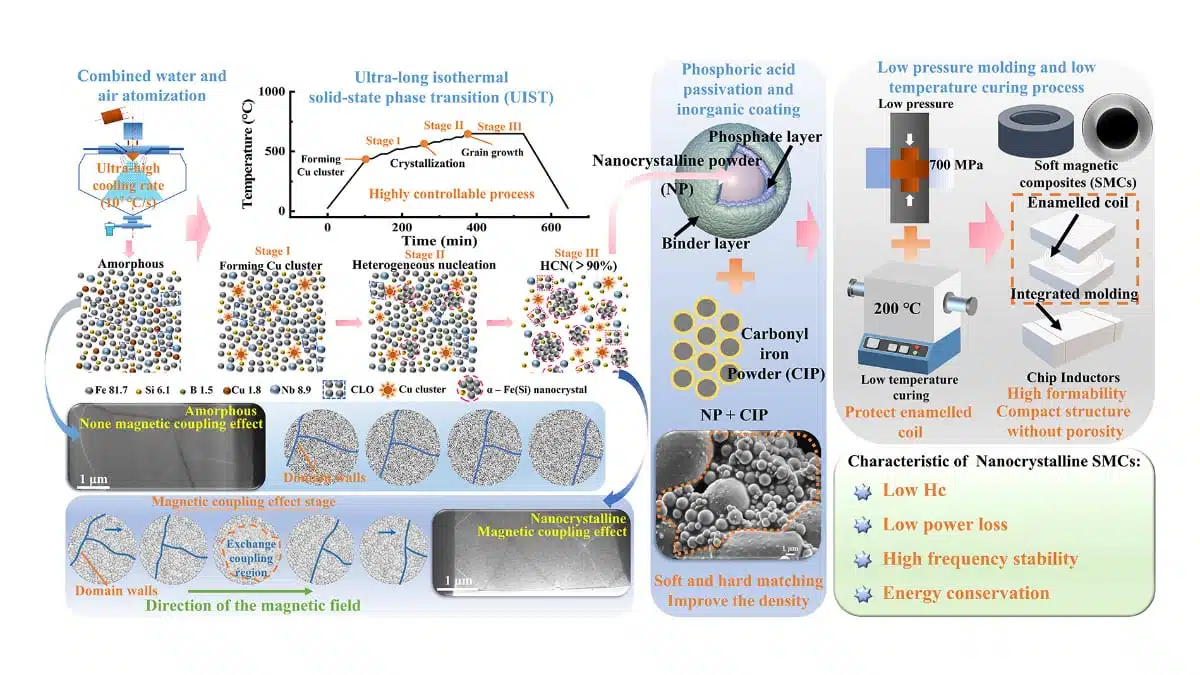
Researchers from Northeastern University, Shenyang and the State Key Laboratory of Digital Steel and Hengdian Group DMEGC Magnetics Co., China published article in Acta Materialia Volume 309, 1 May 2026, that investigate a new class of high‑crystallinity nanocrystalline soft magnetic composites designed to achieve ultra‑low power loss in the MHz range for advanced chip inductors.
Their work aims to develop an iron‑based nanocrystalline powder and processing route that deliver more than 90% nanocrystalline grain volume fraction, wide and easily controlled heat‑treatment windows, and compatibility with low‑pressure, low‑temperature chip inductor fabrication, thereby enabling high‑frequency, miniaturized power components with reduced core loss and improved efficiency.
Introduction
The article addresses the challenge of achieving low power loss in soft magnetic composites used for chip inductors operating in the MHz range. Chip inductors must simultaneously satisfy demands for high-frequency performance, miniaturization, and low power consumption in applications such as AI hardware, 5.5/6G infrastructure, micro-robots, drones, and wearable devices. Existing iron-based soft magnetic composites often require very high molding pressures and elevated heat-treatment temperatures, which are incompatible with low-pressure integrated molding and low-temperature baking processes used in modern chip inductor manufacturing.
Iron-based nanocrystalline soft magnetic powders inherently offer higher resistivity and lower power loss under high-frequency alternating fields, but their current implementations typically rely on tightly controlled, short-time heat treatments and result in dual-phase amorphous–nanocrystalline structures. These mixed-phase materials exhibit higher magnetostriction and stress sensitivity, leading to increased core loss and poor compatibility with low-temperature chip processes. Therefore, there is a strong motivation to develop a highly nanocrystalline, structurally stable soft magnetic powder that can be processed under relaxed thermal and pressure conditions while delivering low power loss and high-frequency stability.
The authors propose a new compositional design and heat-treatment strategy that produces high crystallinity nanocrystalline soft magnetic composites (HCN-SMCs) with a nanocrystalline volume fraction exceeding 90%. This microstructure is tailored to suppress eddy current loss and stabilize domain wall dynamics, enabling low power loss in the MHz range using a low-pressure and low-temperature process suitable for advanced chip inductors.
Key points
- Introduces high crystallinity nanocrystalline soft magnetic composites (HCN-SMCs) specifically engineered for low power loss in the MHz range for chip inductors.
- Uses an ultra-long isothermal solid-state phase transition (UIST) strategy, driven by copper-cluster-induced heterogeneous nucleation, to achieve a nanocrystalline volume fraction above 90% in soft magnetic powders.
- Employs a tailored alloy composition Fe81.7Si6.1Nb8.9B1.5Cu1.8 (wt%) that forms critical-state amorphous structures with high fractions of crystal-like orders (CLO) as precursors to nanocrystals.
- Demonstrates that the UIST process provides a wide process window (holding 1–6 h) without the need for rapid heating, rapid cooling, or applied magnetic fields, simplifying heat-treatment control.
- Achieves more than 90% nanocrystalline grain volume fraction in the powders, confirmed by transmittance imaging, leading to extremely low magnetic anisotropy via dislocation dipole annihilation and anisotropic exchange interactions.
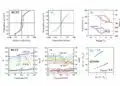
- Shows via Lorentz TEM and micromagnetic simulations that the HCN structure reduces eddy current loss by magnetic coupling that slows the average domain wall motion and yields nearly repeatable domain wall movement under alternating fields.
- Reports that Fe81.7Si6.1Nb8.9B1.5Cu1.8 HCN-SMCs exhibit a relative permeability of 17.51 and power loss of 266.6 kW·m−3 at 20 mT and 1 MHz, using only 700 MPa molding pressure and 200 °C heat treatment.
- Further optimization by blending with carbonyl iron reduces to 165.5 kW·m−3, surpassing state-of-the-art SMCs under comparable conditions.
- Demonstrates that the HCN-based chip inductor provides high-frequency stability and improved circuit efficiency, highlighting its promise for next-generation high-frequency miniaturized electronics.
- Confirms that the fabricated nanocrystalline SMCs meet functional requirements for low-temperature, low-voltage processing and high-frequency, low-loss operation in chip inductors.
Extended summary
The work starts from the observation that modern chip inductors, particularly those used in high-frequency, miniaturized power supply modules for advanced chips, are severely limited by core losses under MHz magnetic fields. Conventional soft magnetic composites are usually designed for high permeability and high saturation magnetization. Their processing, however, requires high compaction pressures above roughly 1500 MPa and heat treatments at temperatures often exceeding 400 °C, which are not compatible with integrated, low-pressure and low-temperature chip inductor manufacturing flows. At the same time, the move toward higher frequencies in power management for AI processors, advanced communication systems, and one-package chips demands materials with both low power loss and robust high-frequency stability at reduced size.
Iron-based nanocrystalline alloys, exemplified by FINEMET-type compositions, have been widely studied due to their combination of low coercivity and high resistivity, which is beneficial for high-frequency applications. These alloys are typically obtained from amorphous precursors via carefully controlled short-time annealing or magnetic-field-assisted heat treatments. However, the resulting microstructure is usually a dual-phase mixture of nanocrystalline grains embedded in an amorphous matrix. The substantial residual amorphous volume tends to increase the effective magnetostriction and make the magnetic properties strongly stress-dependent, which is detrimental under the low-temperature baking used in chip inductor processing and leads to increased power loss in the MHz regime. The authors identify two key requirements: increasing the nanocrystalline volume fraction and improving the controllability and robustness of the heat treatment.
To address this, the authors design an iron-based alloy with composition Fe81.7Si6.1Nb8.9B1.5Cu1.8 (wt%), incorporating copper to promote heterogeneous nucleation and niobium to control grain growth and glass-forming ability. The amorphous precursor powders are produced by a combined water–gas atomization process, ensuring fine particle sizes and high cooling rates. The core innovation lies in an ultra-long isothermal solid-state phase transition (UIST) strategy, in which the powders are heated stepwise to around 600 °C, held isothermally for 150 minutes, and then furnace-cooled under nitrogen. This approach stands in contrast to conventional nanocrystallization methods, which rely on rapid heating and carefully timed short anneals.
By tuning the Cu and Nb content, the authors obtain a critical amorphous state characterized by a high area fraction of crystal-like orders embedded in the amorphous matrix. These CLO regions act as structurally ordered precursors to nanocrystalline grains, facilitating their formation during the prolonged isothermal hold. Under the UIST conditions, these CLO regions transform into nanocrystals and coalesce into a high-crystallinity nanocrystalline microstructure with a nanocrystalline volume fraction greater than 90%, as verified by transmittance imaging of the powders. Importantly, the process exhibits a wide time window: stable magnetic properties are obtained with holding times between 1 and 6 hours, which greatly relaxes the demands on process control.
On the microstructural level, nanocrystalline alloys occupy an intermediate regime between fully amorphous and fully crystalline materials. Amorphous alloys, with long-range disorder, typically offer low coercivity but limited saturation magnetization, while long-range ordered crystalline materials such as pure iron and silicon steel provide high saturation magnetization but higher coercivity. The high crystallinity nanocrystalline (HCN) microstructure synthesized here provides a nearly fully nanocrystalline state with short-range order and strong exchange coupling between grains. The authors argue that this HCN state yields extremely low effective magnetic anisotropy through mechanisms such as dislocation dipole annihilation and anisotropic exchange interactions. Low effective anisotropy translates into reduced core loss under high-frequency excitation.
The magnetic loss behavior is further analyzed using Lorentz transmission electron microscopy (Lorentz-TEM) and micromagnetic simulations. These techniques reveal that the HCN structure enables strong magnetic coupling among nanograins, which moderates the motion of magnetic domain walls in alternating fields. The average domain wall velocity is reduced, and the wall trajectories become more repeatable from cycle to cycle. This reduction in dynamic irregularities in domain wall motion helps suppress eddy current loss and contributes to the observed high-frequency stability of the HCN-SMCs. The authors emphasize that the approximately repeatable domain wall motion, confined within the nanocrystalline grains, is a key factor in stabilizing magnetic properties up to MHz frequencies.
From the standpoint of materials processing and composite fabrication, the nanocrystalline powders are classified into particle-size-based grades (N1, N2, N3) and used to form soft magnetic composites by compaction and subsequent low-temperature treatment. Although detailed equations and full data are not visible in the preview, the article reports that the Fe81.7Si6.1Nb8.9B1.5Cu1.8 HCN-SMCs achieve a relative permeability of 17.51 and a power loss of 266.6 kW·m−3 at 20 mT and 1 MHz. These performance metrics are obtained using a molding pressure of only 700 MPa and a heat-treatment temperature of 200 °C, which are substantially lower than the conditions typically used for conventional SMCs. The ability to reach such low power loss at MHz frequencies under relaxed processing conditions is a central outcome of this work.
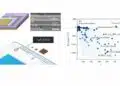
The authors further refine the composite by incorporating carbonyl iron into the HCN powder system. Carbonyl iron is known for its excellent soft magnetic properties and high saturation magnetization in composite form. In this hybrid formulation, the overall power loss is further reduced to 165.5 kW·m−3 at 20 mT and 1 MHz, outperforming state-of-the-art SMCs under similar conditions as reported in the literature. This demonstrates that the HCN microstructure is compatible with composite engineering approaches that leverage multiple powder types to tailor performance.
The study also assesses the implications for device-level performance by implementing an HCN-based chip inductor and evaluating its circuit efficiency and frequency response. The high-frequency stability of the nanocrystalline SMC, combined with its low power loss and moderate relative permeability, results in an inductor suitable for high-frequency power electronics in compact, thermally constrained environments. The authors highlight that the combination of high nanocrystalline volume fraction, wide processing window, and compatibility with low-pressure and low-temperature processing makes the proposed material highly attractive for integration into next-generation microelectronic terminals, including highly miniaturized, multi-chip power modules.
Conclusion
The article presents a comprehensive strategy for designing and processing high-crystallinity nanocrystalline soft magnetic composites tailored for MHz chip inductors. By introducing an Fe81.7Si6.1Nb8.9B1.5Cu1.8 alloy and applying an ultra-long isothermal solid-state phase transition, the authors achieve a nanocrystalline volume fraction above 90%, extremely low effective anisotropy, and significantly reduced power loss under high-frequency excitation. The approach relaxes the requirements on heat-treatment control, avoids rapid heating and quenching, and is compatible with low-pressure, low-temperature chip manufacturing processes.
Performance measurements show that the HCN-SMCs reach a relative permeability of 17.51 and power loss values as low as 266.6 kW·m−3 at 1 MHz and 20 mT, improving further to 165.5 kW·m−3 when combined with carbonyl iron. These values compare favorably with advanced SMC systems while using milder processing conditions. Lorentz-TEM and micromagnetic simulations support the conclusion that magnetic coupling in the highly nanocrystalline structure slows and regularizes domain wall motion, thereby minimizing eddy current loss and improving high-frequency stability.
The work’s limitations stem mainly from the focus on a specific alloy composition and processing route, along with the lack of publicly released datasets or open design tools. Future research could expand the compositional space, refine micromagnetic models for domain wall dynamics in HCN microstructures, and explore co-optimization with inductor geometries and packaging to further enhance circuit-level efficiency. The demonstrated compatibility of the HCN-SMCs with low-temperature and low-pressure processing suggests strong potential for broader adoption in miniaturized power modules for AI, communication, and wearable electronics.
References
- Jibiao Shen, Bin Wang, Ziyuan Rao, Cheng Yao, Zesheng Zhang, Bingxing Wang, Yong Tian, Lingwen Cai, Daxin Bao, Guodong Wang, “High crystallinity nanocrystalline soft magnetic composites with low power loss in MHz for advanced chip inductors,” Acta Materialia, Volume 309, 1 May 2026, Article 122133. https://doi.org/10.1016/j.actamat.2026.122133sciencedirect