




Passive Components Blog
No Result
View All Result
  • Home
  • NewsFilter
    • All
    • Aerospace & Defence
    • Antenna
    • Applications
    • Automotive
    • Capacitors
    • Circuit Protection Devices
    • electro-mechanical news
    • Filters
    • Fuses
    • Inductors
    • Industrial
    • Integrated Passives
    • inter-connect news
    • Market & Supply Chain
    • Market Insights
    • Medical
    • Modelling and Simulation
    • New Materials & Supply
    • New Technologies
    • Non-linear Passives
    • Oscillators
    • Passive Sensors News
    • Resistors
    • RF & Microwave
    • Telecommunication
    • Weekly Digest

    Smiths Interconnect invests £2m in Costa Rica electronics plant

    Kyocera Offers Small SAW Filters for IoT RF Modules

    Bourns Unveils High Volt GDT for High‑Energy Surge Protection

    TDK Releases DC Link Aluminum Capacitors for EV On‑Board Chargers

    Capacitech C-Link Supercapacitors for AI Data Center Voltage Spikes Mitigation

    Wk 8 Electronics Supply Chain Digest

    Modelithics Library for MATLAB: Measurement-Based Models for Microwave and RF Passive Components

    Bourns Extends Multilayer Chip Inductors Offer for RF and Wireless Designs

    Researchers developed a polymer capacitor by combining two cheap, commercially available plastics. The new polymer capacitor makes use of the transparent material — pictured here, with vintage Penn State athletic marks visible through it — to store four times the energy and withstand significantly more heat.  Credit: Penn State

    Penn State Demonstrated Polymer Alloy Capacitor Film with 4× Energy Density up to 250C

    Trending Tags

    • Ripple Current
    • RF
    • Leakage Current
    • Tantalum vs Ceramic
    • Snubber
    • Low ESR
    • Feedthrough
    • Derating
    • Dielectric Constant
    • New Products
    • Market Reports
  • VideoFilter
    • All
    • Antenna videos
    • Capacitor videos
    • Circuit Protection Video
    • Filter videos
    • Fuse videos
    • Inductor videos
    • Inter-Connect Video
    • Non-linear passives videos
    • Oscillator videos
    • Passive sensors videos
    • Resistor videos

    2026 Power Magnetics Design Trends: Flyback, DAB and Planar

    Enabling Software‑Defined Vehicle Architectures: Automotive Ethernet and Zonal Smart Power

    Calculating Resistance Value of a Flyback RC Snubber 

    One‑Pulse Characterization of Nonlinear Power Inductors

    Thermistor Linearization Challenges

    Coaxial Connectors and How to Connect with PCB

    PCB Manufacturing, Test Methods, Quality and Reliability

    Transformer Behavior – Current Transfer and Hidden Feedback

    Choosing the Right Capacitor: The Importance of Accurate Measurements

    Trending Tags

    • Capacitors explained
    • Inductors explained
    • Resistors explained
    • Filters explained
    • Application Video Guidelines
    • EMC
    • New Products
    • Ripple Current
    • Simulation
    • Tantalum vs Ceramic
  • Knowledge Blog
  • DossiersNew
  • Suppliers
    • Who is Who
  • PCNS
    • PCNS 2025
    • PCNS 2023
    • PCNS 2021
    • PCNS 2019
    • PCNS 2017
  • Events
  • Home
  • NewsFilter
    • All
    • Aerospace & Defence
    • Antenna
    • Applications
    • Automotive
    • Capacitors
    • Circuit Protection Devices
    • electro-mechanical news
    • Filters
    • Fuses
    • Inductors
    • Industrial
    • Integrated Passives
    • inter-connect news
    • Market & Supply Chain
    • Market Insights
    • Medical
    • Modelling and Simulation
    • New Materials & Supply
    • New Technologies
    • Non-linear Passives
    • Oscillators
    • Passive Sensors News
    • Resistors
    • RF & Microwave
    • Telecommunication
    • Weekly Digest

    Smiths Interconnect invests £2m in Costa Rica electronics plant

    Kyocera Offers Small SAW Filters for IoT RF Modules

    Bourns Unveils High Volt GDT for High‑Energy Surge Protection

    TDK Releases DC Link Aluminum Capacitors for EV On‑Board Chargers

    Capacitech C-Link Supercapacitors for AI Data Center Voltage Spikes Mitigation

    Wk 8 Electronics Supply Chain Digest

    Modelithics Library for MATLAB: Measurement-Based Models for Microwave and RF Passive Components

    Bourns Extends Multilayer Chip Inductors Offer for RF and Wireless Designs

    Researchers developed a polymer capacitor by combining two cheap, commercially available plastics. The new polymer capacitor makes use of the transparent material — pictured here, with vintage Penn State athletic marks visible through it — to store four times the energy and withstand significantly more heat.  Credit: Penn State

    Penn State Demonstrated Polymer Alloy Capacitor Film with 4× Energy Density up to 250C

    Trending Tags

    • Ripple Current
    • RF
    • Leakage Current
    • Tantalum vs Ceramic
    • Snubber
    • Low ESR
    • Feedthrough
    • Derating
    • Dielectric Constant
    • New Products
    • Market Reports
  • VideoFilter
    • All
    • Antenna videos
    • Capacitor videos
    • Circuit Protection Video
    • Filter videos
    • Fuse videos
    • Inductor videos
    • Inter-Connect Video
    • Non-linear passives videos
    • Oscillator videos
    • Passive sensors videos
    • Resistor videos

    2026 Power Magnetics Design Trends: Flyback, DAB and Planar

    Enabling Software‑Defined Vehicle Architectures: Automotive Ethernet and Zonal Smart Power

    Calculating Resistance Value of a Flyback RC Snubber 

    One‑Pulse Characterization of Nonlinear Power Inductors

    Thermistor Linearization Challenges

    Coaxial Connectors and How to Connect with PCB

    PCB Manufacturing, Test Methods, Quality and Reliability

    Transformer Behavior – Current Transfer and Hidden Feedback

    Choosing the Right Capacitor: The Importance of Accurate Measurements

    Trending Tags

    • Capacitors explained
    • Inductors explained
    • Resistors explained
    • Filters explained
    • Application Video Guidelines
    • EMC
    • New Products
    • Ripple Current
    • Simulation
    • Tantalum vs Ceramic
  • Knowledge Blog
  • DossiersNew
  • Suppliers
    • Who is Who
  • PCNS
    • PCNS 2025
    • PCNS 2023
    • PCNS 2021
    • PCNS 2019
    • PCNS 2017
  • Events
No Result
View All Result
Passive Components Blog
No Result
View All Result

Rohde & Schwarz Introduces New Family of High Performance LCR Meters

30.3.2022
Reading Time: 3 mins read
A A

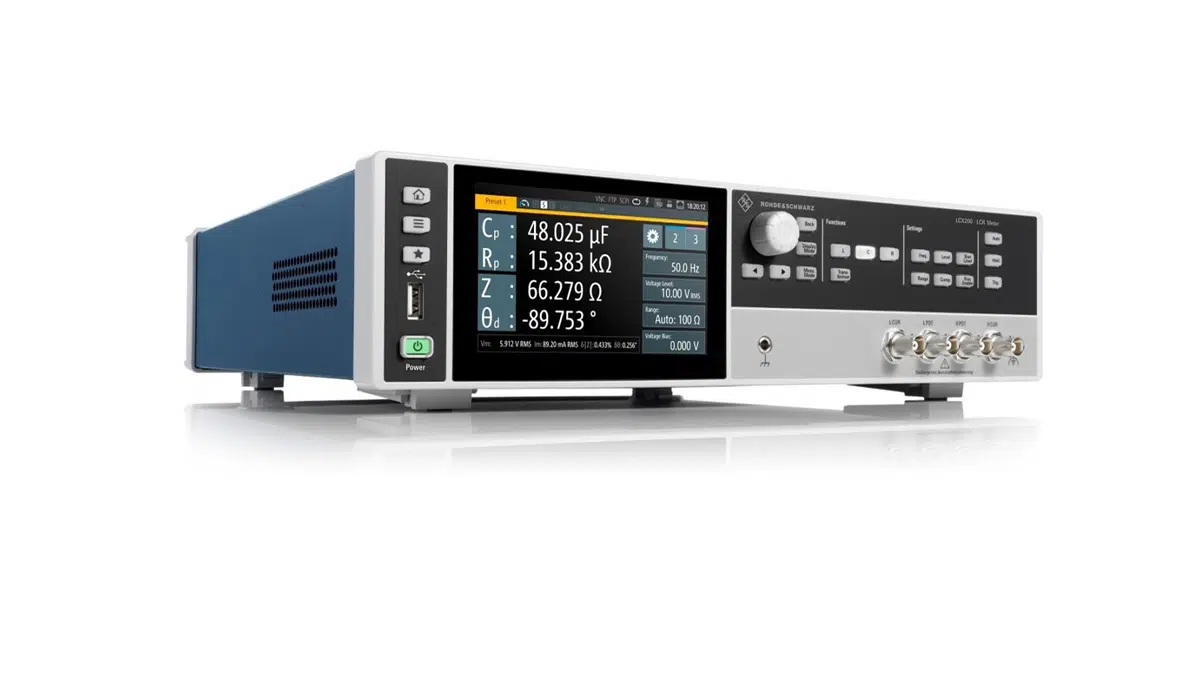
New family of R&S LCX strengthens Rohde & Schwarz portfolio for high performance LCR impedance meters.

With a completely new family of high performance LCR meters, the frequency range of impedance measurements provided by Rohde & Schwarz test equipment is dramatically extended to cover AC components operating from 4 Hz to 10 MHz, supporting all practical applications. The R&S LCX family of LCR meters serves all established impedance measurements plus specialized measurements for selected component types and provides both, the high accuracy required in R&D, and the high speed needed in production test and quality assurance.R&S LCX strengthens Rohde & Schwarz portfolio for high performance impedance measurements new family of high performance LCR meters.

RelatedPosts

Supercapacitor Balancing Methods

Improving Low Loss Dielectric Measurement Technique Using Vector Network Analyser

2-Port Shunt-Through Impedance Power Integrity Measurement

Rohde & Schwarz launches its new LCR meter family of high performance general purpose impedance testers covering a wide range of applications. With its supported frequency range from 4 Hz to 10 MHz, the R&S LCX is suitable not only for the vast majority of devices operating at conventional 50 or 60 Hz domestic power frequencies or 400 Hz for aircraft, but also for everything from low frequency seismic sensors to high power communication circuits operating at several Megahertz.

For engineers selecting suitable capacitors, inductance, resistors, and analog filters to match the device application, the R&S LCX models provide high precision impedance values with market-leading accuracy. Equally, higher speed measurements at production-use accuracy for quality control and monitoring are also supported. All the essential software and hardware required for production environments is available, including remote control and result logging, as well as rack mounting for the instrument, and a full range of test fixtures for handling components.

The auto-balancing bridge technology used by the R&S LCX supports conventional impedance measurements by measuring the AC voltage and current for the device under test, including the phase shift. This is then used to calculate complex impedance at any given operational point. As a general purpose LCR meter, the R&S LCX covers many applications, such as the measurement of equivalent series resistance (ESR) and equivalent series inductance (ESL) of electrolytic capacitors and DC-link capacitors. Furthermore, users can test transformers and measure DC resistance in addition to the full range of impedance measurements. To investigate components with impedance values varying at different frequencies and levels, option R&S LCX-K106 supports dynamic impedance measurements with the frequency, voltage or current as the swept parameter.

The R&S LCX family is launched with two models; the R&S LCX100 covers a frequency range from 4 Hz to 300 kHz, the R&S LCX200 a basic frequency range from 4 Hz to 500 kHz with options to cover all frequencies up to 10 MHz. Both models feature a large capacitive touchscreen and virtual keyboard to support tap-and-test for all main measurements. Alternatively, voltage, current, and frequency values can be set using the rotary knob. Less frequently used functions are menu-operated. Settings, results, and statistics can be displayed on the screen or output for automated post-processing. Up to four measurements can be selected and plotted versus time, with minimum and maximum values included in the display for at-a-glance pass/fail analysis.

For investigating impedance in a wider range of materials, the MFIA impedance analyzer from Zurich Instruments AG, a subsidiary of Rohde & Schwarz, complements the R&S LCX perfectly. With the MFIA researchers can characterize semi-conductors or undertake material research into materials including dielectrics, piezoelectrics, ceramics and composites, as well as tissue impedance analysis, cell growth, food research, microfluidics, and wearable sensors.
Related

Source: Rohde & Schwartz

Recent Posts

TDK Releases DC Link Aluminum Capacitors for EV On‑Board Chargers

23.2.2026
2

Capacitech C-Link Supercapacitors for AI Data Center Voltage Spikes Mitigation

23.2.2026
4

Bourns Extends Multilayer Chip Inductors Offer for RF and Wireless Designs

20.2.2026
11
Researchers developed a polymer capacitor by combining two cheap, commercially available plastics. The new polymer capacitor makes use of the transparent material — pictured here, with vintage Penn State athletic marks visible through it — to store four times the energy and withstand significantly more heat.  Credit: Penn State

Penn State Demonstrated Polymer Alloy Capacitor Film with 4× Energy Density up to 250C

19.2.2026
28

Vishay Unveils Ultra-Compact 0201 Thick Film Chip Resistors

19.2.2026
12

Würth Elektronik Component Data Live in Accuris

19.2.2026
16

Coilcraft Releases Automotive Common Mode Chokes

19.2.2026
17

MLCC Manufacturers Consider Price Increase as AI Demand Outpaces Supply

18.2.2026
290

TU Wien Sets New Benchmark in Superconducting Vacuum Gap nanoCapacitors

16.2.2026
14

Upcoming Events

Feb 24
16:00 - 17:00 CET

Mastering Galvanic Isolation: Ensuring Safety in Power Electronics

Feb 25
16:00 - 17:00 CET

Magnetic Modeling – How Frenetic Models Magnetics

Mar 3
16:00 - 17:00 CET

Cybersecurity at the Eleventh Hour – from RED to CRA – Information and Discussion

View Calendar

Popular Posts

  • Buck Converter Design and Calculation

    0 shares
    Share 0 Tweet 0
  • Boost Converter Design and Calculation

    0 shares
    Share 0 Tweet 0
  • LLC Resonant Converter Design and Calculation

    0 shares
    Share 0 Tweet 0
  • Flyback Converter Design and Calculation

    0 shares
    Share 0 Tweet 0
  • Ripple Current and its Effects on the Performance of Capacitors

    3 shares
    Share 3 Tweet 0
  • Dual Active Bridge (DAB) Topology

    0 shares
    Share 0 Tweet 0
  • What is a Dielectric Constant and DF of Plastic Materials?

    4 shares
    Share 4 Tweet 0
  • MLCC and Ceramic Capacitors

    0 shares
    Share 0 Tweet 0
  • MLCC Case Sizes Standards Explained

    0 shares
    Share 0 Tweet 0
  • SEPIC Converter Design and Calculation

    0 shares
    Share 0 Tweet 0

Newsletter Subscription


Passive Components Blog

© EPCI - Leading Passive Components Educational and Information Site

  • Home
  • Privacy Policy
  • EPCI Membership & Advertisement
  • About

No Result
View All Result
  • Home
  • Knowledge Blog
  • PCNS

© EPCI - Leading Passive Components Educational and Information Site

This website uses cookies. By continuing to use this website you are giving consent to cookies being used. Visit our Privacy and Cookie Policy.
Go to mobile version