











Passive Components Blog
No Result
View All Result
  • Home
  • NewsFilter
    • All
    • Aerospace & Defence
    • Antenna
    • Applications
    • Automotive
    • Capacitors
    • Circuit Protection Devices
    • electro-mechanical news
    • Filters
    • Fuses
    • Inductors
    • Industrial
    • Integrated Passives
    • inter-connect news
    • Market & Supply Chain
    • Market Insights
    • Medical
    • Modelling and Simulation
    • New Materials & Supply
    • New Technologies
    • Non-linear Passives
    • Oscillators
    • Passive Sensors News
    • Resistors
    • RF & Microwave
    • Telecommunication
    • Weekly Digest

    Modelithics Library for MATLAB: Measurement-Based Models for Microwave and RF Passive Components

    Bourns Extends Multilayer Chip Inductors Offer for RF and Wireless Designs

    Researchers developed a polymer capacitor by combining two cheap, commercially available plastics. The new polymer capacitor makes use of the transparent material — pictured here, with vintage Penn State athletic marks visible through it — to store four times the energy and withstand significantly more heat.  Credit: Penn State

    Penn State Demonstrated Polymer Alloy Capacitor Film with 4× Energy Density up to 250C

    ECIA January 2026 Reports Strong Sales Confidence

    Vishay Unveils Ultra-Compact 0201 Thick Film Chip Resistors

    Würth Elektronik Component Data Live in Accuris

    Coilcraft Releases Automotive Common Mode Chokes

    MLCC Manufacturers Consider Price Increase as AI Demand Outpaces Supply

    YAGEO Extends Antenna Portfolio with Wi‑Fi 6E/7 and Tri‑band GNSS Solutions

    Trending Tags

    • Ripple Current
    • RF
    • Leakage Current
    • Tantalum vs Ceramic
    • Snubber
    • Low ESR
    • Feedthrough
    • Derating
    • Dielectric Constant
    • New Products
    • Market Reports
  • VideoFilter
    • All
    • Antenna videos
    • Capacitor videos
    • Circuit Protection Video
    • Filter videos
    • Fuse videos
    • Inductor videos
    • Inter-Connect Video
    • Non-linear passives videos
    • Oscillator videos
    • Passive sensors videos
    • Resistor videos

    2026 Power Magnetics Design Trends: Flyback, DAB and Planar

    Enabling Software‑Defined Vehicle Architectures: Automotive Ethernet and Zonal Smart Power

    Calculating Resistance Value of a Flyback RC Snubber 

    One‑Pulse Characterization of Nonlinear Power Inductors

    Thermistor Linearization Challenges

    Coaxial Connectors and How to Connect with PCB

    PCB Manufacturing, Test Methods, Quality and Reliability

    Transformer Behavior – Current Transfer and Hidden Feedback

    Choosing the Right Capacitor: The Importance of Accurate Measurements

    Trending Tags

    • Capacitors explained
    • Inductors explained
    • Resistors explained
    • Filters explained
    • Application Video Guidelines
    • EMC
    • New Products
    • Ripple Current
    • Simulation
    • Tantalum vs Ceramic
  • Knowledge Blog
  • DossiersNew
  • Suppliers
    • Who is Who
  • PCNS
    • PCNS 2025
    • PCNS 2023
    • PCNS 2021
    • PCNS 2019
    • PCNS 2017
  • Events
  • Home
  • NewsFilter
    • All
    • Aerospace & Defence
    • Antenna
    • Applications
    • Automotive
    • Capacitors
    • Circuit Protection Devices
    • electro-mechanical news
    • Filters
    • Fuses
    • Inductors
    • Industrial
    • Integrated Passives
    • inter-connect news
    • Market & Supply Chain
    • Market Insights
    • Medical
    • Modelling and Simulation
    • New Materials & Supply
    • New Technologies
    • Non-linear Passives
    • Oscillators
    • Passive Sensors News
    • Resistors
    • RF & Microwave
    • Telecommunication
    • Weekly Digest

    Modelithics Library for MATLAB: Measurement-Based Models for Microwave and RF Passive Components

    Bourns Extends Multilayer Chip Inductors Offer for RF and Wireless Designs

    Researchers developed a polymer capacitor by combining two cheap, commercially available plastics. The new polymer capacitor makes use of the transparent material — pictured here, with vintage Penn State athletic marks visible through it — to store four times the energy and withstand significantly more heat.  Credit: Penn State

    Penn State Demonstrated Polymer Alloy Capacitor Film with 4× Energy Density up to 250C

    ECIA January 2026 Reports Strong Sales Confidence

    Vishay Unveils Ultra-Compact 0201 Thick Film Chip Resistors

    Würth Elektronik Component Data Live in Accuris

    Coilcraft Releases Automotive Common Mode Chokes

    MLCC Manufacturers Consider Price Increase as AI Demand Outpaces Supply

    YAGEO Extends Antenna Portfolio with Wi‑Fi 6E/7 and Tri‑band GNSS Solutions

    Trending Tags

    • Ripple Current
    • RF
    • Leakage Current
    • Tantalum vs Ceramic
    • Snubber
    • Low ESR
    • Feedthrough
    • Derating
    • Dielectric Constant
    • New Products
    • Market Reports
  • VideoFilter
    • All
    • Antenna videos
    • Capacitor videos
    • Circuit Protection Video
    • Filter videos
    • Fuse videos
    • Inductor videos
    • Inter-Connect Video
    • Non-linear passives videos
    • Oscillator videos
    • Passive sensors videos
    • Resistor videos

    2026 Power Magnetics Design Trends: Flyback, DAB and Planar

    Enabling Software‑Defined Vehicle Architectures: Automotive Ethernet and Zonal Smart Power

    Calculating Resistance Value of a Flyback RC Snubber 

    One‑Pulse Characterization of Nonlinear Power Inductors

    Thermistor Linearization Challenges

    Coaxial Connectors and How to Connect with PCB

    PCB Manufacturing, Test Methods, Quality and Reliability

    Transformer Behavior – Current Transfer and Hidden Feedback

    Choosing the Right Capacitor: The Importance of Accurate Measurements

    Trending Tags

    • Capacitors explained
    • Inductors explained
    • Resistors explained
    • Filters explained
    • Application Video Guidelines
    • EMC
    • New Products
    • Ripple Current
    • Simulation
    • Tantalum vs Ceramic
  • Knowledge Blog
  • DossiersNew
  • Suppliers
    • Who is Who
  • PCNS
    • PCNS 2025
    • PCNS 2023
    • PCNS 2021
    • PCNS 2019
    • PCNS 2017
  • Events
No Result
View All Result
Passive Components Blog
No Result
View All Result

ROHM Introduces New Nano Cap™ Power Supply Technology Significantly Reduces Needs for Capacitance

25.6.2020
Reading Time: 4 mins read
A A

ROHM announces the development of Nano Cap™ power supply technology that ensures stable control of power supply circuits in the automotive and industrial fields – even with ultra-small capacitances in the magnitude of nF (Nano: 10-9).

The growing awareness for sustainable energy consumption has led to greater electrification in a variety of applications. Especially in the automotive field, the number of electrical components continues to increase due to technological innovations spurred by advances in EVs and autonomous driving. Each of these electrical applications requires a variety of voltage sources, all of them stabilized by capacitors. This results in an increasing demand of external components, increasing PCB sizes and adding cost to the Bill of Material.

RelatedPosts

Modelithics Library for MATLAB: Measurement-Based Models for Microwave and RF Passive Components

Bourns Extends Multilayer Chip Inductors Offer for RF and Wireless Designs

Penn State Demonstrated Polymer Alloy Capacitor Film with 4× Energy Density up to 250C

Following the development of ultra high-speed pulse control technology Nano Pulse Control™ and ultra-low current technology Nano Energy™, ROHM has added a third Nano power supply technology, Nano Cap™, that reduces the number of external capacitors required for linear regulators.

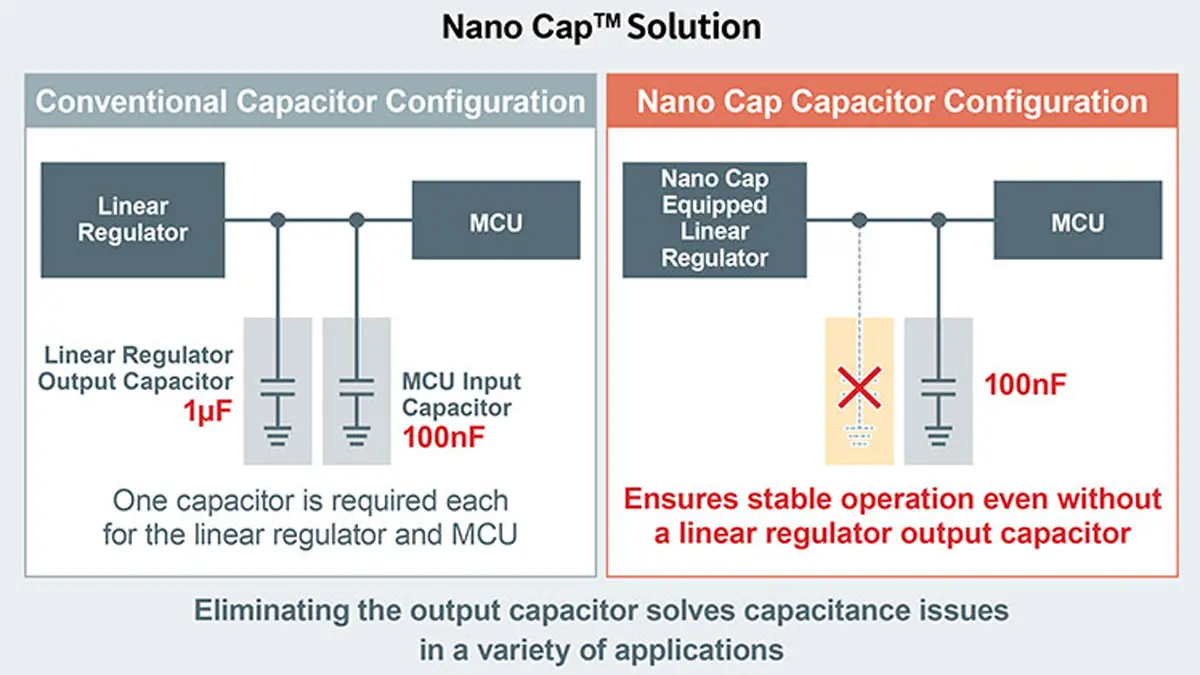
In a circuit, typically comprised of a linear regulator and MCU, a 1uF capacitor is usually required at the output of the linear regulator while 100nF is requested at the input of the MCU. However, leveraging ROHM’s linear regulator utilizing Nano Cap™ technology – developed by combining analog expertise covering circuit design, layout, and processes – eliminates the need for the capacitor at the regulator output and ensures stable operation with just the 100nF input capacitor. By decreasing both the number of capacitors along with the capacitance needed for power supply circuits in the automotive and other fields, ROHM can contribute to minimizing circuit design load.

Furthermore, Op amp samples utilizing Nano Cap™ technology have already been released in part, and linear regulators utilizing Nano Cap™ technology as well as LED drivers that built-in Nano Cap™ equipped regulators are scheduled to be released in 2020.

ROHM is committed to further enhancing the development of Nano CapTM technology to completely eliminate the need for capacitors while expanding the use of this technology not only to linear regulators, but Op amps, LED drivers, and other analog ICs as well, which contribute to society through the effective use of resources that minimizes environmental load.

About Nano Cap™ Technology

Nano Cap™ power supply technology refers to ultra-stable control technology achieved by combining advanced analog expertise covering circuit design, processes, and layout utilizing ROHM’s vertically integrated production system. Optimized control eliminates the problem of operational stability regarding capacitors in analog circuits, contributing to a reduction in design time for a wide range of applications in the automotive, industrial equipment, consumer, and other fields.

Details of Nano Cap™ Technology

Nano Cap provides stable control of linear regulator output by improving response in analog circuits while minimizing parasitic factors related to wiring and amplifiers, making it possible to reduce the output capacitance to less than 1/10th over conventional solutions.
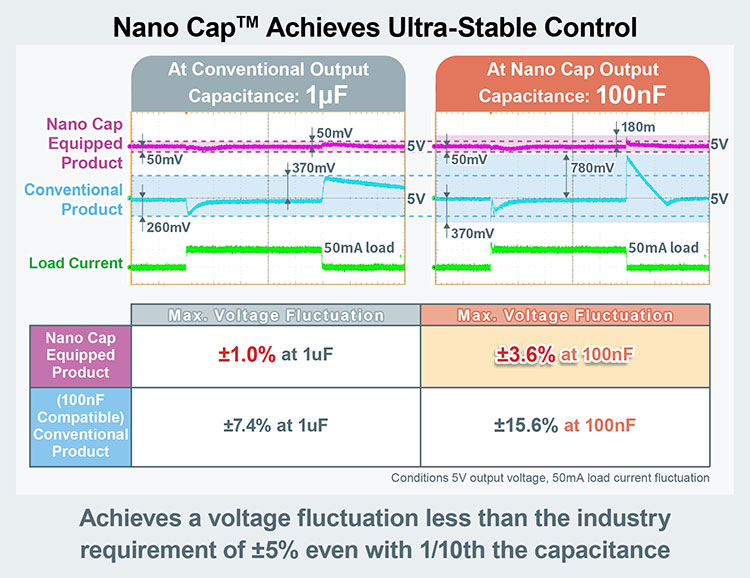
Nano Cap™ Acheives Ultra-Stable Control

As a result, circuits composed of a linear regulator and MCU which usually require a 1uF capacitor at the output of the linear regulator and a 100nF at the input of the MCU as mentioned above, ROHM’s Nano Cap™ linear regulator technology achieve stable operation using just one 100nF capacitor at the MCU side.

Given an industry requirement for output voltage fluctuation of ±5.0% max. (in case focusing on just fluctuation) with respect to 50mA load current fluctuation with 100nF capacitance, Nano Cap™ equipped chips achieve a stable operation of ±3.6% in the evaluations, compared with conventional linear regulators whose output voltage can vary by as much as ±15.6%.

Other Nano Power Supply Technologies

ROHM established Nano power supply technologies by incorporating proprietary analog expertise that combines circuit design, processes, and layout utilizing a vertically integrated production system. The following are other Nano power supply technologies centered on power supply ICs developed by ROHM that contribute to solving application issues in a wide range of products.

Nano Pulse Control™
Refers to ROHM’s ultra-high-speed pulse control technology for power supply ICs that achieves a switching ON time (control width of the power supply IC) on the order of nanoseconds (ns), making it possible to convert from high to low voltages using a single IC – unlike conventional solutions requiring 2 or more power supply ICs. This contributes to greater miniaturization and system simplification in 48V applications ranging from mild hybrid vehicles and industrial robots to base station sub power supplies.

Nano Energy™
This ultra-low current technology features a no-load current consumption in the nA range by minimizing the trade-off that occurs when reducing current consumption at ultra-light loads. As a result, 10-year drive on a single coin battery demanded by the IoT market is possible, supporting long-term operation in compact battery-driven applications, including portable devices, wearables, and IoT.

Related

Recent Posts

Researchers developed a polymer capacitor by combining two cheap, commercially available plastics. The new polymer capacitor makes use of the transparent material — pictured here, with vintage Penn State athletic marks visible through it — to store four times the energy and withstand significantly more heat.  Credit: Penn State

Penn State Demonstrated Polymer Alloy Capacitor Film with 4× Energy Density up to 250C

19.2.2026
19

Würth Elektronik Component Data Live in Accuris

19.2.2026
14

MLCC Manufacturers Consider Price Increase as AI Demand Outpaces Supply

18.2.2026
163

TU Wien Sets New Benchmark in Superconducting Vacuum Gap nanoCapacitors

16.2.2026
11

Empower Releases High-Density Embedded Silicon Capacitors

11.2.2026
55

TDK Unveils 125C Compact DC Link Film Capacitors

11.2.2026
34

SCHURTER Releases Coin Cell Supercapacitors for Backup Power

10.2.2026
26

Skeleton Technologies Expands in U.S. to Power AI Data Centers

9.2.2026
33

Smoltek CNF-MIM Capacitors Hit 1,000x Lower Leakage

6.2.2026
22

Upcoming Events

Feb 24
16:00 - 17:00 CET

Mastering Galvanic Isolation: Ensuring Safety in Power Electronics

Mar 3
16:00 - 17:00 CET

Cybersecurity at the Eleventh Hour – from RED to CRA – Information and Discussion

Mar 21
All day

PSMA Capacitor Workshop 2026

View Calendar

Popular Posts

  • Buck Converter Design and Calculation

    0 shares
    Share 0 Tweet 0
  • Boost Converter Design and Calculation

    0 shares
    Share 0 Tweet 0
  • LLC Resonant Converter Design and Calculation

    0 shares
    Share 0 Tweet 0
  • Flyback Converter Design and Calculation

    0 shares
    Share 0 Tweet 0
  • Ripple Current and its Effects on the Performance of Capacitors

    3 shares
    Share 3 Tweet 0
  • Dual Active Bridge (DAB) Topology

    0 shares
    Share 0 Tweet 0
  • What is a Dielectric Constant and DF of Plastic Materials?

    4 shares
    Share 4 Tweet 0
  • MLCC and Ceramic Capacitors

    0 shares
    Share 0 Tweet 0
  • MLCC Case Sizes Standards Explained

    0 shares
    Share 0 Tweet 0
  • SEPIC Converter Design and Calculation

    0 shares
    Share 0 Tweet 0

Newsletter Subscription


Passive Components Blog

© EPCI - Leading Passive Components Educational and Information Site

  • Home
  • Privacy Policy
  • EPCI Membership & Advertisement
  • About

No Result
View All Result
  • Home
  • Knowledge Blog
  • PCNS

© EPCI - Leading Passive Components Educational and Information Site

This website uses cookies. By continuing to use this website you are giving consent to cookies being used. Visit our Privacy and Cookie Policy.
Go to mobile version