











Passive Components Blog
No Result
View All Result
  • Home
  • NewsFilter
    • All
    • Aerospace & Defence
    • Antenna
    • Applications
    • Automotive
    • Capacitors
    • Circuit Protection Devices
    • electro-mechanical news
    • Filters
    • Fuses
    • Inductors
    • Industrial
    • Integrated Passives
    • inter-connect news
    • Market & Supply Chain
    • Market Insights
    • Medical
    • Modelling and Simulation
    • New Materials & Supply
    • New Technologies
    • Non-linear Passives
    • Oscillators
    • Passive Sensors News
    • Resistors
    • RF & Microwave
    • Telecommunication
    • Weekly Digest

    Samsung Launches Worlds First Automotive 47uF 4V MLCC in 0805 Size

    Würth Elektronik Present in IEEE APEC

    Samsung Three Pillars MLCC Strategy for AI Hardware Topology

    Bourns Releases High Clearance Transformer for Isolated DC/DC Supplies

    KYOCERA AVX Extends Ultra‑Broadband RF Capacitor Series

    Earthing Systems and IEC Classification Explained

    Smiths Interconnect invests £2m in Costa Rica electronics plant

    Kyocera Offers Small SAW Filters for IoT RF Modules

    Bourns Unveils High Volt GDT for High‑Energy Surge Protection

    Trending Tags

    • Ripple Current
    • RF
    • Leakage Current
    • Tantalum vs Ceramic
    • Snubber
    • Low ESR
    • Feedthrough
    • Derating
    • Dielectric Constant
    • New Products
    • Market Reports
  • VideoFilter
    • All
    • Antenna videos
    • Capacitor videos
    • Circuit Protection Video
    • Filter videos
    • Fuse videos
    • Inductor videos
    • Inter-Connect Video
    • Non-linear passives videos
    • Oscillator videos
    • Passive sensors videos
    • Resistor videos

    2026 Power Magnetics Design Trends: Flyback, DAB and Planar

    Enabling Software‑Defined Vehicle Architectures: Automotive Ethernet and Zonal Smart Power

    Calculating Resistance Value of a Flyback RC Snubber 

    One‑Pulse Characterization of Nonlinear Power Inductors

    Thermistor Linearization Challenges

    Coaxial Connectors and How to Connect with PCB

    PCB Manufacturing, Test Methods, Quality and Reliability

    Transformer Behavior – Current Transfer and Hidden Feedback

    Choosing the Right Capacitor: The Importance of Accurate Measurements

    Trending Tags

    • Capacitors explained
    • Inductors explained
    • Resistors explained
    • Filters explained
    • Application Video Guidelines
    • EMC
    • New Products
    • Ripple Current
    • Simulation
    • Tantalum vs Ceramic
  • Knowledge Blog
  • DossiersNew
  • Suppliers
    • Who is Who
  • PCNS
    • PCNS 2025
    • PCNS 2023
    • PCNS 2021
    • PCNS 2019
    • PCNS 2017
  • Events
  • Home
  • NewsFilter
    • All
    • Aerospace & Defence
    • Antenna
    • Applications
    • Automotive
    • Capacitors
    • Circuit Protection Devices
    • electro-mechanical news
    • Filters
    • Fuses
    • Inductors
    • Industrial
    • Integrated Passives
    • inter-connect news
    • Market & Supply Chain
    • Market Insights
    • Medical
    • Modelling and Simulation
    • New Materials & Supply
    • New Technologies
    • Non-linear Passives
    • Oscillators
    • Passive Sensors News
    • Resistors
    • RF & Microwave
    • Telecommunication
    • Weekly Digest

    Samsung Launches Worlds First Automotive 47uF 4V MLCC in 0805 Size

    Würth Elektronik Present in IEEE APEC

    Samsung Three Pillars MLCC Strategy for AI Hardware Topology

    Bourns Releases High Clearance Transformer for Isolated DC/DC Supplies

    KYOCERA AVX Extends Ultra‑Broadband RF Capacitor Series

    Earthing Systems and IEC Classification Explained

    Smiths Interconnect invests £2m in Costa Rica electronics plant

    Kyocera Offers Small SAW Filters for IoT RF Modules

    Bourns Unveils High Volt GDT for High‑Energy Surge Protection

    Trending Tags

    • Ripple Current
    • RF
    • Leakage Current
    • Tantalum vs Ceramic
    • Snubber
    • Low ESR
    • Feedthrough
    • Derating
    • Dielectric Constant
    • New Products
    • Market Reports
  • VideoFilter
    • All
    • Antenna videos
    • Capacitor videos
    • Circuit Protection Video
    • Filter videos
    • Fuse videos
    • Inductor videos
    • Inter-Connect Video
    • Non-linear passives videos
    • Oscillator videos
    • Passive sensors videos
    • Resistor videos

    2026 Power Magnetics Design Trends: Flyback, DAB and Planar

    Enabling Software‑Defined Vehicle Architectures: Automotive Ethernet and Zonal Smart Power

    Calculating Resistance Value of a Flyback RC Snubber 

    One‑Pulse Characterization of Nonlinear Power Inductors

    Thermistor Linearization Challenges

    Coaxial Connectors and How to Connect with PCB

    PCB Manufacturing, Test Methods, Quality and Reliability

    Transformer Behavior – Current Transfer and Hidden Feedback

    Choosing the Right Capacitor: The Importance of Accurate Measurements

    Trending Tags

    • Capacitors explained
    • Inductors explained
    • Resistors explained
    • Filters explained
    • Application Video Guidelines
    • EMC
    • New Products
    • Ripple Current
    • Simulation
    • Tantalum vs Ceramic
  • Knowledge Blog
  • DossiersNew
  • Suppliers
    • Who is Who
  • PCNS
    • PCNS 2025
    • PCNS 2023
    • PCNS 2021
    • PCNS 2019
    • PCNS 2017
  • Events
No Result
View All Result
Passive Components Blog
No Result
View All Result

Samsung Launches Worlds First Automotive 47uF 4V MLCC in 0805 Size

24.2.2026
Reading Time: 8 mins read
A A

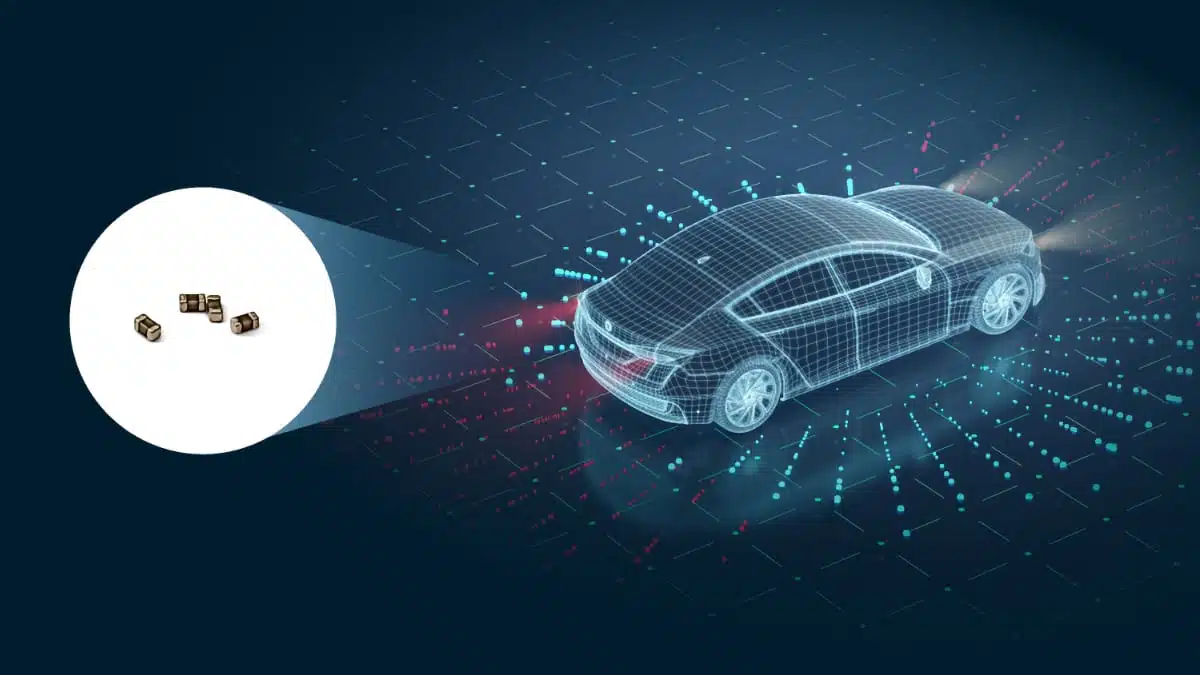
Samsung Electro-Mechanics has introduced an automotive-grade multilayer ceramic capacitor (MLCC) that combines 47 µF capacitance, 4 V rating and 0805 (2012 metric) size – claimed as the first of its kind for automotive use.

This Samsung Electro-Mechanics ultra-high-capacitance MLCC device targets compact, high-current power rails in ADAS and in-vehicle infotainment (IVI) where board area, thermal performance and reliability are under pressure.

RelatedPosts

Samsung Three Pillars MLCC Strategy for AI Hardware Topology

Samsung Q4 2025 Results: MLCC focus for AI, Server and Automotive

Samsung Unveils World First CLLC Resonant 1kV 33nF C0G MLCC in 1210 Size

Key features and benefits

Samsung’s new device family is built around a flagship 47 µF part in an 0805 (2.0 × 1.25 mm) package for automotive applications.

  • Ultra-high capacitance:
    • 47 µF nominal capacitance in 0805 size for the lead product CL21Z476MRY6PN.
    • 22 µF options (CL21Z226MQYVPN, CL21Z226MRYVPN) extend the series where lower capacitance or higher voltage is required.
  • Voltage ratings:
    • 4 V rated voltage for the 47 µF CL21Z476MRY6PN.
    • 4 V and 6.3 V rated voltages for the 22 µF series parts, supporting a range of low-voltage rails in modern SoCs and sensors.
  • Temperature characteristic:
    • X7T dielectric with an operating temperature range from −55 °C to +125 °C.
    • The parts are specified to be usable up to 125 °C without derating, which simplifies derating calculations in many ECUs where ambient and self-heating are well controlled.
  • Package and footprint:
    • Standard 0805 (2012 metric, 2.0 × 1.25 mm) footprint for straightforward routing and compatibility with existing designs.
    • Small case size supports high-density layouts in space-constrained ADAS and IVI modules.
  • Automotive qualification:
    • Designed to meet AEC-Q200 requirements for automotive passive components, addressing vibration, thermal cycling and endurance criteria typical for ECUs.

For design teams, the ability to realize 47 µF in a single 0805 MLCC can reduce capacitor count, free PCB area and simplify placement compared with parallel banks of lower-capacitance MLCCs.

Typical applications

The MLCC family is positioned as a decoupling solution for modern automotive electronics where processing performance and integration are rapidly increasing.

  • ADAS (Advanced Driver Assistance Systems):
    • Power decoupling on high-performance application processors used for sensor fusion, object recognition and driver monitoring.
    • Local bulk capacitance on low-voltage rails feeding cameras, radar modules and LiDAR controllers.
  • IVI (In-Vehicle Infotainment):
    • Decoupling for SoCs, memory and high-speed interfaces within head units and cockpit domain controllers.
    • Stabilization of DC/DC converter outputs supplying audio, connectivity and display subsystems.
  • General automotive ECUs:
    • Any module requiring compact bulk capacitance on low-voltage digital rails where ambient temperatures can reach up to 125 °C.
    • Point-of-load (POL) converters close to high-current ICs where small case size and low ESR are beneficial.

In these applications, a single 47 µF 0805 device can often replace multiple smaller capacitors, reducing BOM complexity and improving layout flexibility in dense multilayer PCBs.
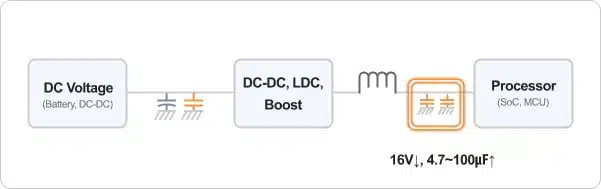
ECU application block diagram with MLCC capacitors location

Technical highlights

Samsung attributes the performance of the new MLCC to proprietary ceramic and electrode material technologies combined with ultra-precision stacking processes.

  • Dielectric system:
    • X7T temperature characteristic supports −55 °C to +125 °C operation with defined capacitance change over temperature.
    • X7T is particularly suitable for compact bulk decoupling in environments where Class II behavior is acceptable but elevated temperature stability is still needed.
  • High reliability and low ESR:
    • The product is presented as offering high reliability suitable for automotive use, supported by AEC-Q200 compliance.
    • Low ESR (equivalent series resistance) helps reduce supply ripple and improve transient response in high di/dt circuits common in ADAS and IVI power rails.
  • Space saving and design flexibility:
    • Achieving 47 µF in 0805 format enables designers to reduce the number of MLCCs in parallel or shrink the occupied footprint when compared to using multiple lower-capacitance capacitors.
    • The availability of 22 µF variants at 4 V and 6.3 V gives flexibility to align capacitance, voltage margin and footprint across different rails within the same ECU platform.

As always with high-capacitance Class II MLCCs, engineers should take into account capacitance variation with DC bias, temperature and AC load according to the manufacturer datasheet when designing margins.

Design-in notes for engineers

When designing in these MLCCs, a few practical considerations can help ensure robust performance in automotive systems.

  • Voltage derating and bias:
    • Even though the new 47 µF part is rated at 4 V and stated to be usable up to 125 °C without derating, typical automotive practice is still to allow some margin between operating voltage and rated voltage.
    • For low-voltage digital rails (for example 1.0–1.8 V), this device provides ample headroom while keeping DC bias-induced capacitance loss manageable according to the datasheet characteristics.
  • Placement and layout:
    • For decoupling, place the capacitor as close as possible to the IC power pins or DC/DC converter outputs to minimize loop inductance.
    • Consider using multiple vias to connect to power and ground planes to exploit the low ESR and minimize ESL benefits of the MLCC.
  • Thermal environment:
    • The X7T characteristic up to 125 °C makes the parts suitable near heat sources such as processors and power stages, but ambient and self-heating should still be evaluated to remain within specified temperature limits.
    • In tightly packed ADAS and IVI ECUs, thermal simulation or measurement can help confirm that capacitor body temperature stays within the intended operating range.
  • Reliability and qualification:
    • As AEC-Q200 compliant devices, these MLCCs are suitable for automotive grade applications subject to OEM-specific validation.
    • For safety-related functions, system-level FMEA should still consider capacitor failure modes, including open and short scenarios, and appropriate redundancy or protection.
  • Sizing and alternatives:
    • Designers migrating from electrolytic or tantalum capacitors in low-voltage sections may benefit from lower ESR and smaller size but should verify start-up behavior and control loop stability of regulators when switching to high-capacitance MLCCs.
    • The 22 µF, 6.3 V option is a candidate for rails where higher voltage margin is required, for example 3.3 V lines or boosted supply nodes inside camera or radar modules.

Early engagement with the full datasheet and, where possible, evaluation samples is recommended to fine-tune the number of capacitors, their placement and derating strategy in each specific ECU design.

Source

This article is based on information provided by Samsung Electro-Mechanics in their official product news communication for the automotive ultra-high-capacitance X7T 0805 MLCC series, complemented by general industry design practices for automotive MLCC application.


References

  1. Samsung Electro-Mechanics product news – Automotive ultra-high-capacitance MLCC 0805 47 µF 4 V
  2. CL21Z476MRY6PN product page – Samsung Electro-Mechanics
  3. CL21Z226MQYVPN product page – Samsung Electro-Mechanics
  4. CL21Z226MRYVPN product page – Samsung Electro-Mechanics

Related

Recent Posts

Würth Elektronik Present in IEEE APEC

24.2.2026
1

Samsung Three Pillars MLCC Strategy for AI Hardware Topology

24.2.2026
4

KYOCERA AVX Extends Ultra‑Broadband RF Capacitor Series

24.2.2026
4

TDK Releases DC Link Aluminum Capacitors for EV On‑Board Chargers

23.2.2026
8

Capacitech C-Link Supercapacitors for AI Data Center Voltage Spikes Mitigation

23.2.2026
15
Researchers developed a polymer capacitor by combining two cheap, commercially available plastics. The new polymer capacitor makes use of the transparent material — pictured here, with vintage Penn State athletic marks visible through it — to store four times the energy and withstand significantly more heat.  Credit: Penn State

Penn State Demonstrated Polymer Alloy Capacitor Film with 4× Energy Density up to 250C

19.2.2026
31

Vishay Unveils Ultra-Compact 0201 Thick Film Chip Resistors

19.2.2026
16

Würth Elektronik Component Data Live in Accuris

19.2.2026
17

Coilcraft Releases Automotive Common Mode Chokes

19.2.2026
18

Upcoming Events

Feb 24
16:00 - 17:00 CET

Mastering Galvanic Isolation: Ensuring Safety in Power Electronics

Feb 25
16:00 - 17:00 CET

Magnetic Modeling – How Frenetic Models Magnetics

Mar 3
16:00 - 17:00 CET

Cybersecurity at the Eleventh Hour – from RED to CRA – Information and Discussion

View Calendar

Popular Posts

  • Buck Converter Design and Calculation

    0 shares
    Share 0 Tweet 0
  • Boost Converter Design and Calculation

    0 shares
    Share 0 Tweet 0
  • LLC Resonant Converter Design and Calculation

    0 shares
    Share 0 Tweet 0
  • Flyback Converter Design and Calculation

    0 shares
    Share 0 Tweet 0
  • Ripple Current and its Effects on the Performance of Capacitors

    3 shares
    Share 3 Tweet 0
  • Dual Active Bridge (DAB) Topology

    0 shares
    Share 0 Tweet 0
  • What is a Dielectric Constant and DF of Plastic Materials?

    4 shares
    Share 4 Tweet 0
  • MLCC Manufacturers Consider Price Increase as AI Demand Outpaces Supply

    0 shares
    Share 0 Tweet 0
  • MLCC and Ceramic Capacitors

    0 shares
    Share 0 Tweet 0
  • MLCC Case Sizes Standards Explained

    0 shares
    Share 0 Tweet 0

Newsletter Subscription


Passive Components Blog

© EPCI - Leading Passive Components Educational and Information Site

  • Home
  • Privacy Policy
  • EPCI Membership & Advertisement
  • About

No Result
View All Result
  • Home
  • Knowledge Blog
  • PCNS

© EPCI - Leading Passive Components Educational and Information Site

This website uses cookies. By continuing to use this website you are giving consent to cookies being used. Visit our Privacy and Cookie Policy.
Go to mobile version