







Passive Components Blog
No Result
View All Result
  • Home
  • NewsFilter
    • All
    • Aerospace & Defence
    • Antenna
    • Applications
    • Automotive
    • Capacitors
    • Circuit Protection Devices
    • electro-mechanical news
    • Filters
    • Fuses
    • Inductors
    • Industrial
    • Integrated Passives
    • inter-connect news
    • Market & Supply Chain
    • Market Insights
    • Medical
    • Modelling and Simulation
    • New Materials & Supply
    • New Technologies
    • Non-linear Passives
    • Oscillators
    • Passive Sensors News
    • Resistors
    • RF & Microwave
    • Telecommunication
    • Weekly Digest

    2026 Power Magnetics Design Trends: Flyback, DAB and Planar

    Vishay Releases Sulfur‑Resistant Chip Resistors

    Würth Elektronik Introduces Lead-Free SMT Spacers

    Schurter Releases EKO HV Fuses up to 1000 VDC, 1100 A

    Empower Releases High-Density Embedded Silicon Capacitors

    TDK Unveils 125C Compact DC Link Film Capacitors

    SCHURTER Releases Coin Cell Supercapacitors for Backup Power

    Skeleton Technologies Expands in U.S. to Power AI Data Centers

    TDK Releases Stackable µPOL 25A Power Modules

    Trending Tags

    • Ripple Current
    • RF
    • Leakage Current
    • Tantalum vs Ceramic
    • Snubber
    • Low ESR
    • Feedthrough
    • Derating
    • Dielectric Constant
    • New Products
    • Market Reports
  • VideoFilter
    • All
    • Antenna videos
    • Capacitor videos
    • Circuit Protection Video
    • Filter videos
    • Fuse videos
    • Inductor videos
    • Inter-Connect Video
    • Non-linear passives videos
    • Oscillator videos
    • Passive sensors videos
    • Resistor videos

    2026 Power Magnetics Design Trends: Flyback, DAB and Planar

    Enabling Software‑Defined Vehicle Architectures: Automotive Ethernet and Zonal Smart Power

    Calculating Resistance Value of a Flyback RC Snubber 

    One‑Pulse Characterization of Nonlinear Power Inductors

    Thermistor Linearization Challenges

    Coaxial Connectors and How to Connect with PCB

    PCB Manufacturing, Test Methods, Quality and Reliability

    Transformer Behavior – Current Transfer and Hidden Feedback

    Choosing the Right Capacitor: The Importance of Accurate Measurements

    Trending Tags

    • Capacitors explained
    • Inductors explained
    • Resistors explained
    • Filters explained
    • Application Video Guidelines
    • EMC
    • New Products
    • Ripple Current
    • Simulation
    • Tantalum vs Ceramic
  • Knowledge Blog
  • DossiersNew
  • Suppliers
    • Who is Who
  • PCNS
    • PCNS 2025
    • PCNS 2023
    • PCNS 2021
    • PCNS 2019
    • PCNS 2017
  • Events
  • Home
  • NewsFilter
    • All
    • Aerospace & Defence
    • Antenna
    • Applications
    • Automotive
    • Capacitors
    • Circuit Protection Devices
    • electro-mechanical news
    • Filters
    • Fuses
    • Inductors
    • Industrial
    • Integrated Passives
    • inter-connect news
    • Market & Supply Chain
    • Market Insights
    • Medical
    • Modelling and Simulation
    • New Materials & Supply
    • New Technologies
    • Non-linear Passives
    • Oscillators
    • Passive Sensors News
    • Resistors
    • RF & Microwave
    • Telecommunication
    • Weekly Digest

    2026 Power Magnetics Design Trends: Flyback, DAB and Planar

    Vishay Releases Sulfur‑Resistant Chip Resistors

    Würth Elektronik Introduces Lead-Free SMT Spacers

    Schurter Releases EKO HV Fuses up to 1000 VDC, 1100 A

    Empower Releases High-Density Embedded Silicon Capacitors

    TDK Unveils 125C Compact DC Link Film Capacitors

    SCHURTER Releases Coin Cell Supercapacitors for Backup Power

    Skeleton Technologies Expands in U.S. to Power AI Data Centers

    TDK Releases Stackable µPOL 25A Power Modules

    Trending Tags

    • Ripple Current
    • RF
    • Leakage Current
    • Tantalum vs Ceramic
    • Snubber
    • Low ESR
    • Feedthrough
    • Derating
    • Dielectric Constant
    • New Products
    • Market Reports
  • VideoFilter
    • All
    • Antenna videos
    • Capacitor videos
    • Circuit Protection Video
    • Filter videos
    • Fuse videos
    • Inductor videos
    • Inter-Connect Video
    • Non-linear passives videos
    • Oscillator videos
    • Passive sensors videos
    • Resistor videos

    2026 Power Magnetics Design Trends: Flyback, DAB and Planar

    Enabling Software‑Defined Vehicle Architectures: Automotive Ethernet and Zonal Smart Power

    Calculating Resistance Value of a Flyback RC Snubber 

    One‑Pulse Characterization of Nonlinear Power Inductors

    Thermistor Linearization Challenges

    Coaxial Connectors and How to Connect with PCB

    PCB Manufacturing, Test Methods, Quality and Reliability

    Transformer Behavior – Current Transfer and Hidden Feedback

    Choosing the Right Capacitor: The Importance of Accurate Measurements

    Trending Tags

    • Capacitors explained
    • Inductors explained
    • Resistors explained
    • Filters explained
    • Application Video Guidelines
    • EMC
    • New Products
    • Ripple Current
    • Simulation
    • Tantalum vs Ceramic
  • Knowledge Blog
  • DossiersNew
  • Suppliers
    • Who is Who
  • PCNS
    • PCNS 2025
    • PCNS 2023
    • PCNS 2021
    • PCNS 2019
    • PCNS 2017
  • Events
No Result
View All Result
Passive Components Blog
No Result
View All Result

Sumida Metal Hybrid Inductor: CDMT Series

8.11.2016
Reading Time: 3 mins read
A A

source: Sumida news

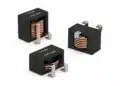
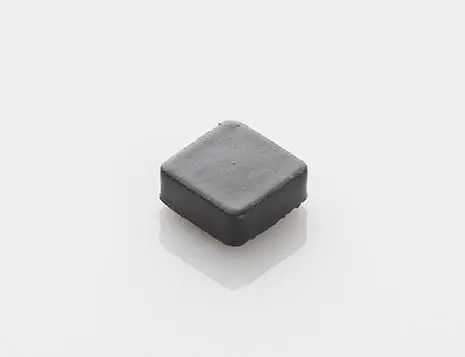
Sumida has expanded its lineup of Metal Hybrid Inductors, known as the CDMT series, which is made of two kinds of metal materials. The existing type under the CDMT series is CDMT40D20 (4.3mm x 4.3mm x H 2.1mm), CDMT40D30 (4.3mm x 4.3mm x H 3.1mm) and CDMT40D40 (4.3mm x 4.3mm x H 4.1mm) are newly added as an expansion.

RelatedPosts

2026 Power Magnetics Design Trends: Flyback, DAB and Planar

Vishay Releases Sulfur‑Resistant Chip Resistors

Würth Elektronik Introduces Lead-Free SMT Spacers


Along with the miniaturization trend of consumer electronics devices such as smart phones and tablet PCs, longer battery life is expected by consumers. High efficiency and low loss power circuit are needed for industrial equipments such as servers and telecommunications base stations. Sumida has developed high efficiency and low loss inductors which best suit the power supply circuits for these types of products.

Through the use of a newly developed metal composite material in the mold structure, the CDMT40D30 and CDMT40D40 have outstanding electrical performance and shielding properties, they also reflect minimum loss in performance when compared with other inductors of the same size. Thus, CDMT series including the new addition is suitable for various kinds of electronic devices.

Key Features

  • Dimension:
    CDMT40D30  4.3 x 4.3 x H 3.1mm (Max.)
    CDMT40D40  4.3 x 4.3 x H 4.1mm (Max.)
  • Weight:
    CDMT40D30 0.28g (Ref.)
    CDMT40D40 0.37g (Ref.)
  • Halogen-free
  • Operating temperature range: -40°C to +125°C  (Not including coil’s self temperature rise)

Applications

  • Telecommunication base stations, servers, SSDs, and other low profile high current applications

Main Electrical Characteristics: CDMT40D30

Part Name Inductance
[within](µH) ※1
D.C.R. (mΩ)
Typ. (Max.)
Saturation Current at
20°C (A) ※2
Temperature Rise Currrent
(A) ※3
*4 *5
CDMT40D30HF-3R3NC 3.30 ±30% 23.0 (25.3)  5.0 4.30 6.60
CDMT40D30HF-4R7NC 4.70 ±30% 37.0 (40.7) 4.0  3.60 5.10
CDMT40D30HF-6R8NC 6.80 ±30% 62.0 (68.2) 3.2 2.70 3.90


Main Electrical Characteristics: CDMT40D40

Part Name Inductance
[within](µH) ※1
D.C.R. (mΩ)
Typ. (Max.)
直流重畳許容電流で20°C (A) *2 温度上昇電流
(A) *3
*4 *5
CDMT40D40HF-8R2NC 8.20 ±30% 54.0 (59.4) 3.20 2.80 3.40
CDMT40D40HF-100NC 10.0 ±30% 80.0 (88.0) 2.80 2.30 3.10
CDMT40D40HF-150NC 15.0 ±30% 107 (118) 2.50 1.95 2.80


*1 Measuring frequency at 100KHZ 0.1V
*2 Saturation current: This indicates the actual value of D.C. current when the inductance becomes 30% lower than its nominal value.
*3 Temperature rise current: The actual value of D.C. current when the temperature of coil becomes △T=40°C (Ta=20°C).
*4 Measurement condition: Irms testing was performed by a product in 25°C ambient.
*5 Measurement condition: Irms testing was performed on copper traces in 25°C ambient.
** Discharge static electricity before handling this coil. Take the static electricity measures to prevent deterioration of electric characteristics.

Production Stage
Mass Production: December 2016

Related

Recent Posts

2026 Power Magnetics Design Trends: Flyback, DAB and Planar

13.2.2026
14

Vishay Releases Compact 0806 Low‑DCR Power Inductor

5.2.2026
33

Murata Publishes Power Delivery Guide for AI Servers

4.2.2026
115

Selecting Current Sense Transformers with Würth Elektronik REDEXPERT

3.2.2026
29

Enabling Software‑Defined Vehicle Architectures: Automotive Ethernet and Zonal Smart Power

2.2.2026
35

Bourns Releases High‑Q Air Coil Inductors for RF Aplications

29.1.2026
47

CMSE 2026 Announces Call for Presentations on High-Reliability Military and Space Electronics

28.1.2026
53

ESA Call for Papers 6th Space Passive Component Days – SPCD 2026

28.1.2026
55

Würth Elektronik Developed a Custom Transformer for Active Hand Orthosis

26.1.2026
49

Upcoming Events

Feb 24
16:00 - 17:00 CET

Designing Qi2 Wireless Power Systems: Practical Development and EMC Optimization

Mar 3
16:00 - 17:00 CET

Cybersecurity at the Eleventh Hour – from RED to CRA – Information and Discussion

Mar 21
All day

PSMA Capacitor Workshop 2026

View Calendar

Popular Posts

  • Buck Converter Design and Calculation

    0 shares
    Share 0 Tweet 0
  • Boost Converter Design and Calculation

    0 shares
    Share 0 Tweet 0
  • LLC Resonant Converter Design and Calculation

    0 shares
    Share 0 Tweet 0
  • Flyback Converter Design and Calculation

    0 shares
    Share 0 Tweet 0
  • Ripple Current and its Effects on the Performance of Capacitors

    3 shares
    Share 3 Tweet 0
  • Dual Active Bridge (DAB) Topology

    0 shares
    Share 0 Tweet 0
  • MLCC and Ceramic Capacitors

    0 shares
    Share 0 Tweet 0
  • What is a Dielectric Constant and DF of Plastic Materials?

    4 shares
    Share 4 Tweet 0
  • MLCC Case Sizes Standards Explained

    0 shares
    Share 0 Tweet 0
  • Degradation of Capacitors and its Failure Mechanisms

    0 shares
    Share 0 Tweet 0

Newsletter Subscription


Passive Components Blog

© EPCI - Leading Passive Components Educational and Information Site

  • Home
  • Privacy Policy
  • EPCI Membership & Advertisement
  • About

No Result
View All Result
  • Home
  • Knowledge Blog
  • PCNS

© EPCI - Leading Passive Components Educational and Information Site

This website uses cookies. By continuing to use this website you are giving consent to cookies being used. Visit our Privacy and Cookie Policy.
Go to mobile version