




Passive Components Blog
No Result
View All Result
  • Home
  • NewsFilter
    • All
    • Aerospace & Defence
    • Antenna
    • Applications
    • Automotive
    • Capacitors
    • Circuit Protection Devices
    • electro-mechanical news
    • Filters
    • Fuses
    • Inductors
    • Industrial
    • Integrated Passives
    • inter-connect news
    • Market & Supply Chain
    • Market Insights
    • Medical
    • Modelling and Simulation
    • New Materials & Supply
    • New Technologies
    • Non-linear Passives
    • Oscillators
    • Passive Sensors News
    • Resistors
    • RF & Microwave
    • Telecommunication
    • Weekly Digest

    Bourns Introduces Automotive Shielded Power Inductors for Compact DC‑DC Converters

    EMC Design Fundamentals: Safe Use of Varistors and Common Mode Chokes in Mains and Data-Line Filters

    Murata Unveils Lead Disc Ceramic Capacitors for Automotive Safety and EMI Suppression

    SCHURTER Releases Intelligent Three‑Terminal Fuses for Safer Li‑ion Battery Systems

    Can Copper Conductive Inks Displace Silver in Hybrid Electronics?

    Square-Wave Harmonics and RMS Currents in Power Converters

    LeanBOM: Practical Cross‑Technology Capacitor Search by Real Working Conditions

    In the Age of AI, Every Watt Counts: Implications for Components

    Stackpole Extends Resistance Range of 2512 High‑Power Current Sense Resistors

    Trending Tags

    • Ripple Current
    • RF
    • Leakage Current
    • Tantalum vs Ceramic
    • Snubber
    • Low ESR
    • Feedthrough
    • Derating
    • Dielectric Constant
    • New Products
    • Market Reports
  • VideoFilter
    • All
    • Antenna videos
    • Capacitor videos
    • Circuit Protection Video
    • Filter videos
    • Fuse videos
    • Inductor videos
    • Inter-Connect Video
    • Non-linear passives videos
    • Oscillator videos
    • Passive sensors videos
    • Resistor videos

    EMC Design Fundamentals: Safe Use of Varistors and Common Mode Chokes in Mains and Data-Line Filters

    Ferrite versus Nanocrystalline Power Inductor Cores: Turns, Gap and Size

    KYOCERA AVX Presents Antenna Integrator Studio Tutorial for Antenna Placement and RF Design

    Power Design Simulation Tools for Faster Inductor Selection and Loss Optimization

    EMC‑Compliant PCB and Connector Design Guidelines

    Why Isolated DC/DC Power Supplies Fail Late, Würth Elektronik Podcast

    Designing 800 V DC EMC Filters: Calculation, Simulation and Measurement

    Current Sense Transformer Datasheet and Design‑in Guide

    Designing a USB Type‑C Flyback Planar Transformer with Frenetic’s Planar Tool

    Trending Tags

    • Capacitors explained
    • Inductors explained
    • Resistors explained
    • Filters explained
    • Application Video Guidelines
    • EMC
    • New Products
    • Ripple Current
    • Simulation
    • Tantalum vs Ceramic
  • Knowledge Blog
  • Dossiers
    • AI Hardware Dossier
    • Power Converter Dossier
    • Automotive Dossier
    • Capacitor Dossier
    • Resistor Dossier
    • Inductor Dossier
    • Circuit Protection Dossier
  • Suppliers
    • Who is Who
  • PCNS
    • PCNS 2025
    • PCNS 2023
    • PCNS 2021
    • PCNS 2019
    • PCNS 2017
  • Events
  • Home
  • NewsFilter
    • All
    • Aerospace & Defence
    • Antenna
    • Applications
    • Automotive
    • Capacitors
    • Circuit Protection Devices
    • electro-mechanical news
    • Filters
    • Fuses
    • Inductors
    • Industrial
    • Integrated Passives
    • inter-connect news
    • Market & Supply Chain
    • Market Insights
    • Medical
    • Modelling and Simulation
    • New Materials & Supply
    • New Technologies
    • Non-linear Passives
    • Oscillators
    • Passive Sensors News
    • Resistors
    • RF & Microwave
    • Telecommunication
    • Weekly Digest

    Bourns Introduces Automotive Shielded Power Inductors for Compact DC‑DC Converters

    EMC Design Fundamentals: Safe Use of Varistors and Common Mode Chokes in Mains and Data-Line Filters

    Murata Unveils Lead Disc Ceramic Capacitors for Automotive Safety and EMI Suppression

    SCHURTER Releases Intelligent Three‑Terminal Fuses for Safer Li‑ion Battery Systems

    Can Copper Conductive Inks Displace Silver in Hybrid Electronics?

    Square-Wave Harmonics and RMS Currents in Power Converters

    LeanBOM: Practical Cross‑Technology Capacitor Search by Real Working Conditions

    In the Age of AI, Every Watt Counts: Implications for Components

    Stackpole Extends Resistance Range of 2512 High‑Power Current Sense Resistors

    Trending Tags

    • Ripple Current
    • RF
    • Leakage Current
    • Tantalum vs Ceramic
    • Snubber
    • Low ESR
    • Feedthrough
    • Derating
    • Dielectric Constant
    • New Products
    • Market Reports
  • VideoFilter
    • All
    • Antenna videos
    • Capacitor videos
    • Circuit Protection Video
    • Filter videos
    • Fuse videos
    • Inductor videos
    • Inter-Connect Video
    • Non-linear passives videos
    • Oscillator videos
    • Passive sensors videos
    • Resistor videos

    EMC Design Fundamentals: Safe Use of Varistors and Common Mode Chokes in Mains and Data-Line Filters

    Ferrite versus Nanocrystalline Power Inductor Cores: Turns, Gap and Size

    KYOCERA AVX Presents Antenna Integrator Studio Tutorial for Antenna Placement and RF Design

    Power Design Simulation Tools for Faster Inductor Selection and Loss Optimization

    EMC‑Compliant PCB and Connector Design Guidelines

    Why Isolated DC/DC Power Supplies Fail Late, Würth Elektronik Podcast

    Designing 800 V DC EMC Filters: Calculation, Simulation and Measurement

    Current Sense Transformer Datasheet and Design‑in Guide

    Designing a USB Type‑C Flyback Planar Transformer with Frenetic’s Planar Tool

    Trending Tags

    • Capacitors explained
    • Inductors explained
    • Resistors explained
    • Filters explained
    • Application Video Guidelines
    • EMC
    • New Products
    • Ripple Current
    • Simulation
    • Tantalum vs Ceramic
  • Knowledge Blog
  • Dossiers
    • AI Hardware Dossier
    • Power Converter Dossier
    • Automotive Dossier
    • Capacitor Dossier
    • Resistor Dossier
    • Inductor Dossier
    • Circuit Protection Dossier
  • Suppliers
    • Who is Who
  • PCNS
    • PCNS 2025
    • PCNS 2023
    • PCNS 2021
    • PCNS 2019
    • PCNS 2017
  • Events
No Result
View All Result
Passive Components Blog
No Result
View All Result

Würth Elektronik Developed a Custom Transformer for Active Hand Orthosis

26.1.2026
Reading Time: 4 mins read
A A

A pioneering collaboration between Würth Elektronik and the startup Powered Orthotics is helping people with limited hand function regain independence. The international medical project was presented at DLD Munich 2026, featuring the smart orthosis MotionMate, which enables users with impaired hand function to perform controlled gripping movements again. For this project, Würth Elektronik developed a custom transformer specifically for the orthosis.

MotionMate is designed as an open glove orthosis for people with limited hand function, for example after a stroke or accident. Around 100 million people worldwide are affected, including 550,000 in Germany alone.

RelatedPosts

EMC Design Fundamentals: Safe Use of Varistors and Common Mode Chokes in Mains and Data-Line Filters

In the Age of AI, Every Watt Counts: Implications for Components

Power Design Simulation Tools for Faster Inductor Selection and Loss Optimization

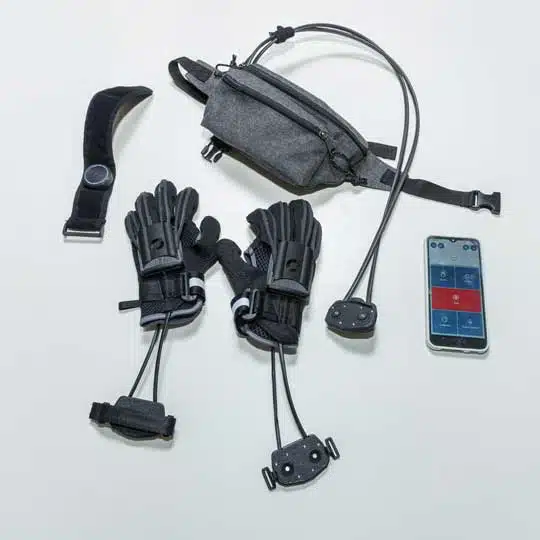
The system uses electric motors and cable-driven mechanisms to actively close the fingers and, unlike many existing solutions, to actively open them as well. This allows controlled support of gripping movements, based on the functional principle of tendons.

Unlike many existing orthoses, MotionMate’s development focuses on low weight and user-friendly handling, with the aim of enabling users to put on the device independently. Batteries and actuators are housed in a separate belt pack (650 g), keeping the orthosis itself light at 160 g. Depending on the user’s level of impairment, the system is controlled via movement signals from the user. A Bluetooth-connected control unit can be attached at different body locations, such as the chin, elbow, or the opposite hand. The system can also be operated via a smartphone app or by voice commands.
From Prototype to Serial Production

The intelligent active orthosis from Powered Orthotics is currently in the prototype stage and is being further developed for long-term use in collaboration with test users, supported by Würth Elektronik. Production is handled by Elbe Electronic GmbH.

During a panel discussion at DLD, Alexander Gerfer, CTO of Würth Elektronik eiSos Group, presented the innovative design alongside Ryan Alicea, Co-founder & CEO, Powered Orthotics, and Prof. Dr. Lorenzo Masia, Professor of Intelligent Bio-Robotic Systems at the Technical University of Munich, who acts as scientific mentor for the project. The panel was moderated by journalist Jennifer Wilton, former Editor-in-Chief of WELT.

Steffi Czerny, Managing Director of DLD Media, stressed that innovation is driven by collaboration across startups, industry, and research. She described DLD’s role as convening these communities, so ideas can be translated into technologies with real-world impact.

More Independence in Daily Life

“When hand function is lost, it’s not just a medical symptom, it’s a daily barrier to independence, dignity, and participation in life,” explained Ryan Alicea. “At Powered Orthotics, we’re closing the gap between what people need and what existing solutions realistically deliver by building MotionMate: a 160g powered hand orthosis that supports intuitive opening and closing in a wearable, practical form. Our goal is simple: give people the ability to do more for themselves, more often, and to put control back where it belongs: in their own hands.”

Custom Solution from Würth Elektronik

“The power supply for an orthosis has to meet some pretty specific requirements,” added Guillermo Regidor, Design Engineer at Würth Elektronik, who led the design work for the project. “It needs to be compact, efficient, and also meet the strictest safety standards of protection classes IEC 60601-1 and 1 MOPP (Means of Patient Protection). After all, the device is worn directly on the body. What was required was a flyback transformer with an input of 12 to 15 V, an output of 12 V, and a power rating of 1.5 A. Our search for an off-the-shelf component quickly showed that none of the solutions exactly met our customers’ requirements. The safety regulations in particular were a critical factor. For this reason, we decided for a specially adapted new development.”
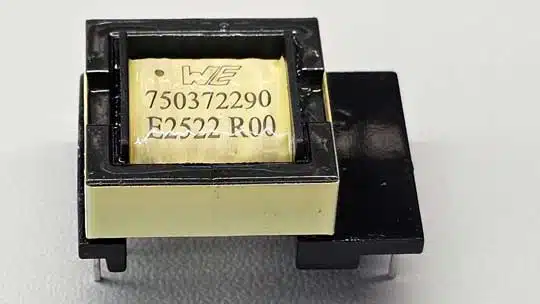
The custom transformer measures just 21.5 mm × 29 mm × 12 mm and weighs only 11.2 g. It operates at 98% efficiency and is optimized for automated mass production. In addition to this bespoke development, other components from Würth Elektronik are also used in the orthosis. Further development support includes tests in Würth Elektronik’s Waldenburg labs, for example assessing resistance to shock and vibration and temperature cycling.

On the Way to Serial Production

Following the initial prototype, 15 additional units will be produced and tested by users with relevant hand impairments in everyday life. Insights gained will then inform serial production, scheduled to begin in 2026.

“We are proud to work with Powered Orthotics on the MotionMate hand orthosis,” says Alexander Gerfer, CTO of Würth Elektronik eiSos Group. “Startups often face technical challenges alone, from power and safety to miniaturization and manufacturability. With our experience and custom solutions, we help turn the concept into a device that makes everyday tasks easier and supports users’ independence. MotionMate demonstrates what can be achieved when innovative startups and industry experts collaborate closely to solve challenges end-to-end.”

Related

Source: Würth Elektronik

Recent Posts

Bourns Introduces Automotive Shielded Power Inductors for Compact DC‑DC Converters

16.7.2026
11

EMC Design Fundamentals: Safe Use of Varistors and Common Mode Chokes in Mains and Data-Line Filters

16.7.2026
33

Murata Unveils Lead Disc Ceramic Capacitors for Automotive Safety and EMI Suppression

15.7.2026
24

Square-Wave Harmonics and RMS Currents in Power Converters

14.7.2026
24

In the Age of AI, Every Watt Counts: Implications for Components

13.7.2026
44

RF Filters and Passive Components Enabling the 7 Missile RF Subsystems

9.7.2026
51

Ferrite versus Nanocrystalline Power Inductor Cores: Turns, Gap and Size

9.7.2026
84

YAGEO Presents NANOMET Soft Magnetic Cores for High‑Density Power Conversion

8.7.2026
130

Coilcraft Releases High-Current Ferrite Beads for CISPR 25 EMC compliance

8.7.2026
44

Upcoming Events

Jul 21
16:00 - 17:00 CEST

Safety by design: X and Y Interference suppression capacitors for power line filters

Jul 28
8:00 - 11:00 CEST

Post Procurement Testing of EEE Components for LEO Space Applications

Jul 29
17:30 - 18:30 CEST

To Ferrite or to Nanocrystalline in Transformer Design

View Calendar

Popular Posts

  • Boost Converter Design and Calculation

    0 shares
    Share 0 Tweet 0
  • Buck Converter Design and Calculation

    0 shares
    Share 0 Tweet 0
  • Flyback Converter Design and Calculation

    0 shares
    Share 0 Tweet 0
  • YAGEO Announces July 2026 Capacitor Price Increase

    0 shares
    Share 0 Tweet 0
  • LLC Resonant Converter Design and Calculation

    0 shares
    Share 0 Tweet 0
  • MLCC and Ceramic Capacitors

    0 shares
    Share 0 Tweet 0
  • Earthing Systems and IEC Classification Explained

    0 shares
    Share 0 Tweet 0
  • Nvidia Vera Rubin: Why One AI Rack Needs So Many More MLCC Capacitors

    0 shares
    Share 0 Tweet 0
  • MLCCs in the Age of AI: Q2 2026 Market Tightness

    0 shares
    Share 0 Tweet 0
  • Dual Active Bridge (DAB) Topology

    0 shares
    Share 0 Tweet 0

Newsletter Subscription


Passive Components Blog

© EPCI - Leading Passive Components Educational and Information Site

  • Home
  • Privacy Policy
  • EPCI Membership & Advertisement
  • About

No Result
View All Result
  • Home
  • Knowledge Blog
  • Dossiers
  • PCNS

© EPCI - Leading Passive Components Educational and Information Site

This website uses cookies. By continuing to use this website you are giving consent to cookies being used. Visit our Privacy and Cookie Policy.
Go to mobile version