





Passive Components Blog
No Result
View All Result
  • Home
  • NewsFilter
    • All
    • Aerospace & Defence
    • Antenna
    • Applications
    • Automotive
    • Capacitors
    • Circuit Protection Devices
    • electro-mechanical news
    • Filters
    • Fuses
    • Inductors
    • Industrial
    • Integrated Passives
    • inter-connect news
    • Market & Supply Chain
    • Market Insights
    • Medical
    • Modelling and Simulation
    • New Materials & Supply
    • New Technologies
    • Non-linear Passives
    • Oscillators
    • Passive Sensors News
    • Resistors
    • RF & Microwave
    • Telecommunication
    • Weekly Digest

    Samsung Introduces Ultra-High-Voltage 1500 V MLCCs for xEV Powertrains

    YAGEO Q1 2026 Results: AI Servers and Pricing Power Behind a Moderate Q2 Outlook

    TDK Introduces High‑Voltage Common‑Mode Chokes for Compact 1250 V DC Converters

    Vishay Extends Power Inductors for DC/DC with 1212 Compact Case

    Modeling Planar Magnetics Temperature: Practical Guidelines for Power Electronics Engineers

    YAGEO Releases Ferrite Shielded Power Inductors for High‑Density Designs

    Samsung Presents MLCC Selection Guide for Humanoids and Robotic Applications

    AI-Assisted Structural Diagnostics and Physics-Based Reliability Interpretation of Tantalum Capacitor Anodes

    YAGEO Introduces EMI Suppression High‑Current 3‑phase Common Mode Chokes

    Trending Tags

    • Ripple Current
    • RF
    • Leakage Current
    • Tantalum vs Ceramic
    • Snubber
    • Low ESR
    • Feedthrough
    • Derating
    • Dielectric Constant
    • New Products
    • Market Reports
  • VideoFilter
    • All
    • Antenna videos
    • Capacitor videos
    • Circuit Protection Video
    • Filter videos
    • Fuse videos
    • Inductor videos
    • Inter-Connect Video
    • Non-linear passives videos
    • Oscillator videos
    • Passive sensors videos
    • Resistor videos

    Transformer-Based Power-Line Harvester Magnetic Design

    Thermal Modeling of Magnetics

    Standard vs Planar LLC transformers Comparison for Battery Chargers

    How Modern Tools Model Magnetic Components for Power Electronics

    Advanced Loss Modeling for Planar Magnetics in the Frenetic Planar Tool

    2026 Power Magnetics Design Trends: Flyback, DAB and Planar

    Enabling Software‑Defined Vehicle Architectures: Automotive Ethernet and Zonal Smart Power

    Calculating Resistance Value of a Flyback RC Snubber 

    One‑Pulse Characterization of Nonlinear Power Inductors

    Trending Tags

    • Capacitors explained
    • Inductors explained
    • Resistors explained
    • Filters explained
    • Application Video Guidelines
    • EMC
    • New Products
    • Ripple Current
    • Simulation
    • Tantalum vs Ceramic
  • Knowledge Blog
  • DossiersNew
  • Suppliers
    • Who is Who
  • PCNS
    • PCNS 2025
    • PCNS 2023
    • PCNS 2021
    • PCNS 2019
    • PCNS 2017
  • Events
  • Home
  • NewsFilter
    • All
    • Aerospace & Defence
    • Antenna
    • Applications
    • Automotive
    • Capacitors
    • Circuit Protection Devices
    • electro-mechanical news
    • Filters
    • Fuses
    • Inductors
    • Industrial
    • Integrated Passives
    • inter-connect news
    • Market & Supply Chain
    • Market Insights
    • Medical
    • Modelling and Simulation
    • New Materials & Supply
    • New Technologies
    • Non-linear Passives
    • Oscillators
    • Passive Sensors News
    • Resistors
    • RF & Microwave
    • Telecommunication
    • Weekly Digest

    Samsung Introduces Ultra-High-Voltage 1500 V MLCCs for xEV Powertrains

    YAGEO Q1 2026 Results: AI Servers and Pricing Power Behind a Moderate Q2 Outlook

    TDK Introduces High‑Voltage Common‑Mode Chokes for Compact 1250 V DC Converters

    Vishay Extends Power Inductors for DC/DC with 1212 Compact Case

    Modeling Planar Magnetics Temperature: Practical Guidelines for Power Electronics Engineers

    YAGEO Releases Ferrite Shielded Power Inductors for High‑Density Designs

    Samsung Presents MLCC Selection Guide for Humanoids and Robotic Applications

    AI-Assisted Structural Diagnostics and Physics-Based Reliability Interpretation of Tantalum Capacitor Anodes

    YAGEO Introduces EMI Suppression High‑Current 3‑phase Common Mode Chokes

    Trending Tags

    • Ripple Current
    • RF
    • Leakage Current
    • Tantalum vs Ceramic
    • Snubber
    • Low ESR
    • Feedthrough
    • Derating
    • Dielectric Constant
    • New Products
    • Market Reports
  • VideoFilter
    • All
    • Antenna videos
    • Capacitor videos
    • Circuit Protection Video
    • Filter videos
    • Fuse videos
    • Inductor videos
    • Inter-Connect Video
    • Non-linear passives videos
    • Oscillator videos
    • Passive sensors videos
    • Resistor videos

    Transformer-Based Power-Line Harvester Magnetic Design

    Thermal Modeling of Magnetics

    Standard vs Planar LLC transformers Comparison for Battery Chargers

    How Modern Tools Model Magnetic Components for Power Electronics

    Advanced Loss Modeling for Planar Magnetics in the Frenetic Planar Tool

    2026 Power Magnetics Design Trends: Flyback, DAB and Planar

    Enabling Software‑Defined Vehicle Architectures: Automotive Ethernet and Zonal Smart Power

    Calculating Resistance Value of a Flyback RC Snubber 

    One‑Pulse Characterization of Nonlinear Power Inductors

    Trending Tags

    • Capacitors explained
    • Inductors explained
    • Resistors explained
    • Filters explained
    • Application Video Guidelines
    • EMC
    • New Products
    • Ripple Current
    • Simulation
    • Tantalum vs Ceramic
  • Knowledge Blog
  • DossiersNew
  • Suppliers
    • Who is Who
  • PCNS
    • PCNS 2025
    • PCNS 2023
    • PCNS 2021
    • PCNS 2019
    • PCNS 2017
  • Events
No Result
View All Result
Passive Components Blog
No Result
View All Result

TDK Introduces 350V Safety Film Capacitors for Compact EMI Suppression

26.2.2026
Reading Time: 7 mins read
A A

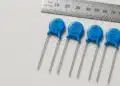
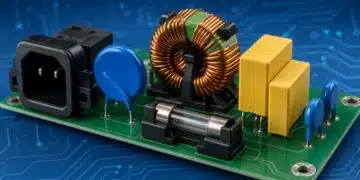
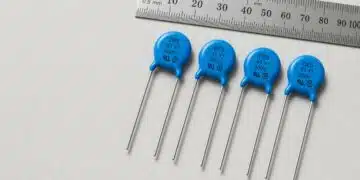
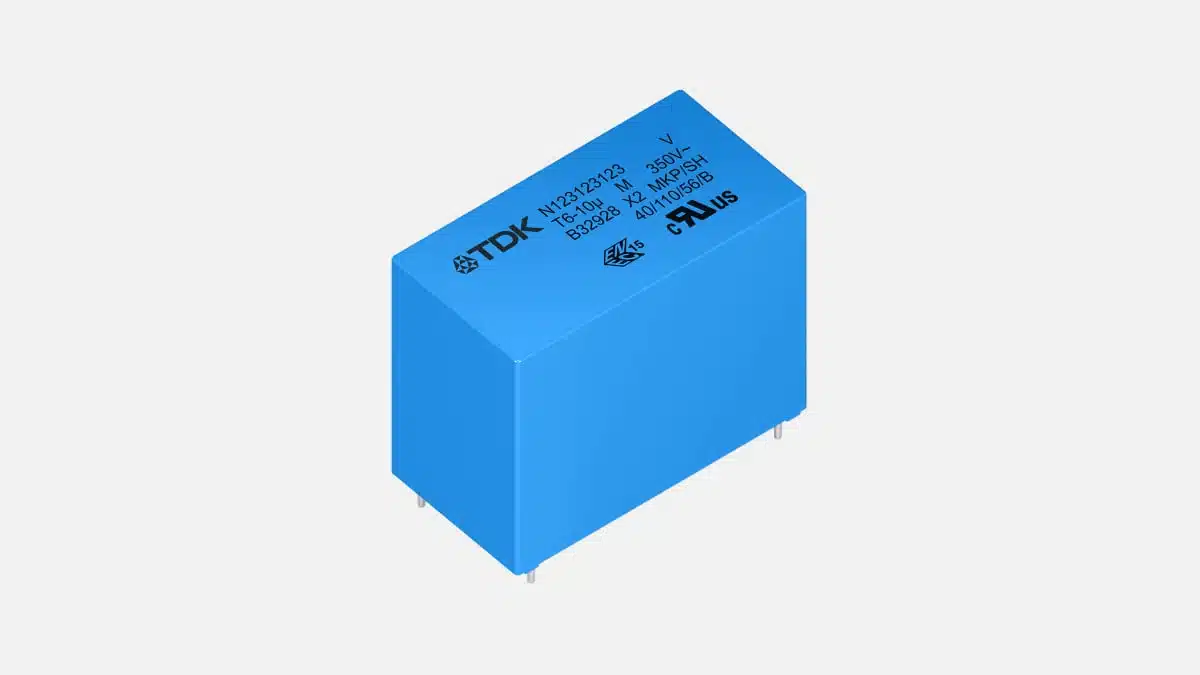
TDK has extended its X2 safety film capacitor portfolio with the B3292xU/V series, adding compact 350 V AC types for interference suppression in demanding industrial and automotive environments in series with the mains.

The series targets engineers who need higher AC voltage capability, AEC‑Q200 compliance, and small footprints for on‑board chargers, EV charging systems, PV inverters, and other grid‑connected electronics.

RelatedPosts

TDK Introduces High‑Voltage Common‑Mode Chokes for Compact 1250 V DC Converters

TDK Releases Ultra‑small EMI Noise Suppression Filters

TDK and Nippon Chemical Launch Joint Venture for MLCC Materials

Key features and benefits

The new B3292xU/V film capacitors are X2‑class safety capacitors designed for EMI suppression “across the line” and for use in series with the mains in single‑phase systems. They are suitable wherever space is tight but elevated AC voltages and robust surge capability are required.

Main electrical and construction features include:

  • X2 safety class for interference suppression in across‑the‑line and series‑with‑mains positions
  • Rated voltage of 350 V AC for the new compact variants, supporting higher mains and derating margins
  • Peak pulse voltage capability up to 2.5 kV in accordance with IEC 60384‑14
  • High DC test voltage of 1505 V for 2 s, underlining insulation strength
  • Capacitance range for the new compact versions from 47 nF to 1.8 µF with 15 mm and 22.5 mm lead spacing
  • Overall B3292xU/V family coverage from 47 nF up to 20 µF with lead spacings from 15 mm to 52.5 mm

For engineers, the combination of higher AC rating and compact dimensions enables more generous design margins in universal input systems, or the option to reduce the number of parallel capacitors for the same effective capacitance and safety performance. Good self‑healing properties support long‑term stability after transient overvoltage events.

The series is specified for severe ambient conditions:

  • Maximum operating temperature up to +110 °C
  • THB (temperature, humidity, bias) test passed at +85 °C, 85% RH, rated voltage, 1000 h to Grade III, Test Condition B
  • AEC‑Q200 compliant versions for automotive use

This robustness is important for equipment mounted in harsh environments such as charging stations, outdoor PV inverters, or under‑hood automotive electronics.

Typical applications

TDK positions the B3292xU/V capacitors as EMI suppression components in AC‑connected power electronics, especially where compact size and automotive qualification are required.

Typical use cases include:

  • Capacitive power supplies and compact auxiliary power stages connected directly to the mains
  • Energy meters and smart metering equipment with limited PCB area and long service life requirements
  • Industrial drives and motor control units where filters must fit into narrow drive housings
  • On‑board chargers (OBC) in electric vehicles, particularly in EMI filters in series with the mains input
  • EV charging stations and wallboxes (AC side EMI suppression and capacitive dropper circuits)
  • PV inverters and other renewable energy inverters with stringent grid‑code EMI limits

In these circuits, X2 capacitors are typically placed between line and neutral or in series with the mains to shape the impedance seen by conducted noise. Higher AC rating and strong THB performance help maintain EMI compliance over the full lifetime, even under elevated temperature and humidity.

Technical highlights

Voltage, capacitance and form factors

The new compact variants of the B3292xU/V series:

  • Are rated 350 V AC
  • Offer capacitance values from 47 nF to 1.8 µF
  • Use lead spacings of 15 mm and 22.5 mm, suitable for tight PCB layouts and high‑density boards

The extended B3292xU/V portfolio as a whole:

  • Covers a capacitance range from 47 nF to 20 µF
  • Offers lead spacings from 15 mm up to 52.5 mm, enabling scaling to higher capacitance values without changing series

This allows designers to stay within one family across multiple power levels and board form factors, simplifying qualification, sourcing, and EMC tuning.

Environmental robustness and reliability

The B3292xU/V series is designed for demanding operating conditions:

  • THB test passed at +85 °C, 85% RH, at rated voltage for 1000 hours (Grade III, Test Condition B)
  • Maximum operating temperature of +110 °C, supporting designs with high internal ambient or limited cooling
  • AEC‑Q200 compliance, making the series suitable for automotive ECUs, charging systems, and other transportation electronics

The THB performance is particularly important for outdoor installations (EV charging, PV, metering) where moisture and high temperature combine to stress polymer film dielectrics. The specified test conditions give designers a clear benchmark for long‑term stability.

Safety and standards

The capacitors are X2 class safety components for interference suppression:

  • Designed for “across the line” and series‑with‑mains positions in AC systems
  • Compliant with IEC 60384‑14, including surge testing up to 2.5 kV
  • High DC test voltage (1505 V, 2 s) demonstrates insulation and safety margin

Using capacitors with explicit X2 classification simplifies safety approvals for equipment, as the components are tested for operation directly on the mains under typical overvoltage categories.

Design‑in notes for engineers

When selecting X2 capacitors for EMI suppression or capacitive dropper functions, several practical aspects should be considered:

  • Voltage derating: Even with a 350 V AC rating, designers should consider the maximum mains tolerance, overvoltage category, and local standards, and apply appropriate derating where necessary according to the manufacturer datasheet.
  • Temperature and humidity: Applications in EV charging, PV inverters, or outdoor metering systems should take advantage of the THB Grade III data to evaluate lifetime under local climate profiles.
  • Board layout: The 15 mm and 22.5 mm lead spacings of the compact versions enable shorter creepage on the PCB; however, clearance and creepage distances on the board must still meet system‑level safety standards.
  • EMC tuning: For EMI filters, starting from TDK’s recommended X2 capacitance values for typical topologies can reduce tuning effort; SPICE models allow iterative optimization of capacitor values and series resistances.
  • Automotive use: AEC‑Q200 compliance helps streamline qualification at OEMs and Tier‑1s, but designers should still confirm that the chosen variant meets their specific OEM test profiles and derating policies.

In many designs, combining a compact 350 V AC X2 capacitor with common‑mode chokes and surge protection devices enables a slimline EMI input filter that fits into modern, miniaturized housings without sacrificing safety margin or thermal stability.

Source

This article is based on technical information from an official TDK Electronics press release and related product information pages; engineers should refer to the current TDK datasheet and catalog entries for definitive ratings and ordering details.
References

  1. TDK extends X2 portfolio with compact 350 V AC capacitors for industrial and automotive (press release)
  2. TDK EMI suppression film capacitors – product catalog overview
  3. TDK film capacitor design tools
  4. TDK film capacitor SPICE model libraries

Related

Recent Posts

Samsung Introduces Ultra-High-Voltage 1500 V MLCCs for xEV Powertrains

16.4.2026
2

YAGEO Q1 2026 Results: AI Servers and Pricing Power Behind a Moderate Q2 Outlook

16.4.2026
3

TDK Introduces High‑Voltage Common‑Mode Chokes for Compact 1250 V DC Converters

16.4.2026
4

Vishay Extends Power Inductors for DC/DC with 1212 Compact Case

16.4.2026
3

YAGEO Releases Ferrite Shielded Power Inductors for High‑Density Designs

15.4.2026
8

Samsung Presents MLCC Selection Guide for Humanoids and Robotic Applications

15.4.2026
11

AI-Assisted Structural Diagnostics and Physics-Based Reliability Interpretation of Tantalum Capacitor Anodes

14.4.2026
14

YAGEO Introduces EMI Suppression High‑Current 3‑phase Common Mode Chokes

14.4.2026
18

KYOCERA AVX MIL-PRF-32535 BME NP0 MLCCs Approved to the DLA QPD

14.4.2026
19

Upcoming Events

Apr 21
16:00 - 17:00 CEST

Heatsink Solutions: Thermal Management in electronic devices

Apr 22
17:00 - 18:00 CEST

Derating Tantalum, Film, and Ceramic Capacitors

Apr 29
10:00 - 11:00 CDT

SEPIC Design Done Right

View Calendar

Popular Posts

  • Buck Converter Design and Calculation

    0 shares
    Share 0 Tweet 0
  • Boost Converter Design and Calculation

    0 shares
    Share 0 Tweet 0
  • Flyback Converter Design and Calculation

    0 shares
    Share 0 Tweet 0
  • LLC Resonant Converter Design and Calculation

    0 shares
    Share 0 Tweet 0
  • MLCC and Ceramic Capacitors

    0 shares
    Share 0 Tweet 0
  • Dual Active Bridge (DAB) Topology

    0 shares
    Share 0 Tweet 0
  • Capacitor Charging and Discharging

    0 shares
    Share 0 Tweet 0
  • Plastic Materials Dielectric Constant and DF

    4 shares
    Share 4 Tweet 0
  • MLCC Case Sizes Standards Explained

    0 shares
    Share 0 Tweet 0
  • Ripple Current and its Effects on the Performance of Capacitors

    3 shares
    Share 3 Tweet 0

Newsletter Subscription


Passive Components Blog

© EPCI - Leading Passive Components Educational and Information Site

  • Home
  • Privacy Policy
  • EPCI Membership & Advertisement
  • About

No Result
View All Result
  • Home
  • Knowledge Blog
  • PCNS

© EPCI - Leading Passive Components Educational and Information Site

This website uses cookies. By continuing to use this website you are giving consent to cookies being used. Visit our Privacy and Cookie Policy.
Go to mobile version