










Passive Components Blog
No Result
View All Result
  • Home
  • NewsFilter
    • All
    • Aerospace & Defence
    • Antenna
    • Applications
    • Automotive
    • Capacitors
    • Circuit Protection Devices
    • electro-mechanical news
    • Filters
    • Fuses
    • Inductors
    • Industrial
    • Integrated Passives
    • inter-connect news
    • Market & Supply Chain
    • Market Insights
    • Medical
    • Modelling and Simulation
    • New Materials & Supply
    • New Technologies
    • Non-linear Passives
    • Oscillators
    • Passive Sensors News
    • Resistors
    • RF & Microwave
    • Telecommunication
    • Weekly Digest

    April 2026 Interconnect, Passives and Electromechanical Components Market Insights

    SPICE Simulation of Non-Linear Resistors: Vishay’s Thermistor and PPTC Modelling Ecosystem

    KYOCERA AVX Introduces Traction‑Grade DC Link Film Capacitors

    When More Capacitance Hurts Reliability: The Role of the Metallic Skeleton in Tantalum Anodes

    Why Power Inductors Use a Ferrite Core With an Air Gap

    Wk 16 Electronics Supply Chain Digest

    YAGEO Introduces High‑Current Y2/X1 Film Capacitors for Wide-bandgap Power Systems

    Amphenol Explanded Liquid Cooling Connectors for AI, ESS and EV Systems

    Hirose Introduced BGA connector for PCIe Gen6 for AI and Edge Computing

    Trending Tags

    • Ripple Current
    • RF
    • Leakage Current
    • Tantalum vs Ceramic
    • Snubber
    • Low ESR
    • Feedthrough
    • Derating
    • Dielectric Constant
    • New Products
    • Market Reports
  • VideoFilter
    • All
    • Antenna videos
    • Capacitor videos
    • Circuit Protection Video
    • Filter videos
    • Fuse videos
    • Inductor videos
    • Inter-Connect Video
    • Non-linear passives videos
    • Oscillator videos
    • Passive sensors videos
    • Resistor videos

    Why Power Inductors Use a Ferrite Core With an Air Gap

    Transformer-Based Power-Line Harvester Magnetic Design

    Thermal Modeling of Magnetics

    Standard vs Planar LLC transformers Comparison for Battery Chargers

    How Modern Tools Model Magnetic Components for Power Electronics

    Advanced Loss Modeling for Planar Magnetics in the Frenetic Planar Tool

    2026 Power Magnetics Design Trends: Flyback, DAB and Planar

    Enabling Software‑Defined Vehicle Architectures: Automotive Ethernet and Zonal Smart Power

    Calculating Resistance Value of a Flyback RC Snubber 

    Trending Tags

    • Capacitors explained
    • Inductors explained
    • Resistors explained
    • Filters explained
    • Application Video Guidelines
    • EMC
    • New Products
    • Ripple Current
    • Simulation
    • Tantalum vs Ceramic
  • Knowledge Blog
  • DossiersNew
  • Suppliers
    • Who is Who
  • PCNS
    • PCNS 2025
    • PCNS 2023
    • PCNS 2021
    • PCNS 2019
    • PCNS 2017
  • Events
  • Home
  • NewsFilter
    • All
    • Aerospace & Defence
    • Antenna
    • Applications
    • Automotive
    • Capacitors
    • Circuit Protection Devices
    • electro-mechanical news
    • Filters
    • Fuses
    • Inductors
    • Industrial
    • Integrated Passives
    • inter-connect news
    • Market & Supply Chain
    • Market Insights
    • Medical
    • Modelling and Simulation
    • New Materials & Supply
    • New Technologies
    • Non-linear Passives
    • Oscillators
    • Passive Sensors News
    • Resistors
    • RF & Microwave
    • Telecommunication
    • Weekly Digest

    April 2026 Interconnect, Passives and Electromechanical Components Market Insights

    SPICE Simulation of Non-Linear Resistors: Vishay’s Thermistor and PPTC Modelling Ecosystem

    KYOCERA AVX Introduces Traction‑Grade DC Link Film Capacitors

    When More Capacitance Hurts Reliability: The Role of the Metallic Skeleton in Tantalum Anodes

    Why Power Inductors Use a Ferrite Core With an Air Gap

    Wk 16 Electronics Supply Chain Digest

    YAGEO Introduces High‑Current Y2/X1 Film Capacitors for Wide-bandgap Power Systems

    Amphenol Explanded Liquid Cooling Connectors for AI, ESS and EV Systems

    Hirose Introduced BGA connector for PCIe Gen6 for AI and Edge Computing

    Trending Tags

    • Ripple Current
    • RF
    • Leakage Current
    • Tantalum vs Ceramic
    • Snubber
    • Low ESR
    • Feedthrough
    • Derating
    • Dielectric Constant
    • New Products
    • Market Reports
  • VideoFilter
    • All
    • Antenna videos
    • Capacitor videos
    • Circuit Protection Video
    • Filter videos
    • Fuse videos
    • Inductor videos
    • Inter-Connect Video
    • Non-linear passives videos
    • Oscillator videos
    • Passive sensors videos
    • Resistor videos

    Why Power Inductors Use a Ferrite Core With an Air Gap

    Transformer-Based Power-Line Harvester Magnetic Design

    Thermal Modeling of Magnetics

    Standard vs Planar LLC transformers Comparison for Battery Chargers

    How Modern Tools Model Magnetic Components for Power Electronics

    Advanced Loss Modeling for Planar Magnetics in the Frenetic Planar Tool

    2026 Power Magnetics Design Trends: Flyback, DAB and Planar

    Enabling Software‑Defined Vehicle Architectures: Automotive Ethernet and Zonal Smart Power

    Calculating Resistance Value of a Flyback RC Snubber 

    Trending Tags

    • Capacitors explained
    • Inductors explained
    • Resistors explained
    • Filters explained
    • Application Video Guidelines
    • EMC
    • New Products
    • Ripple Current
    • Simulation
    • Tantalum vs Ceramic
  • Knowledge Blog
  • DossiersNew
  • Suppliers
    • Who is Who
  • PCNS
    • PCNS 2025
    • PCNS 2023
    • PCNS 2021
    • PCNS 2019
    • PCNS 2017
  • Events
No Result
View All Result
Passive Components Blog
No Result
View All Result

Würth Elektronik and Grinn Launch Edge AI Cooperation

13.3.2026
Reading Time: 3 mins read
A A

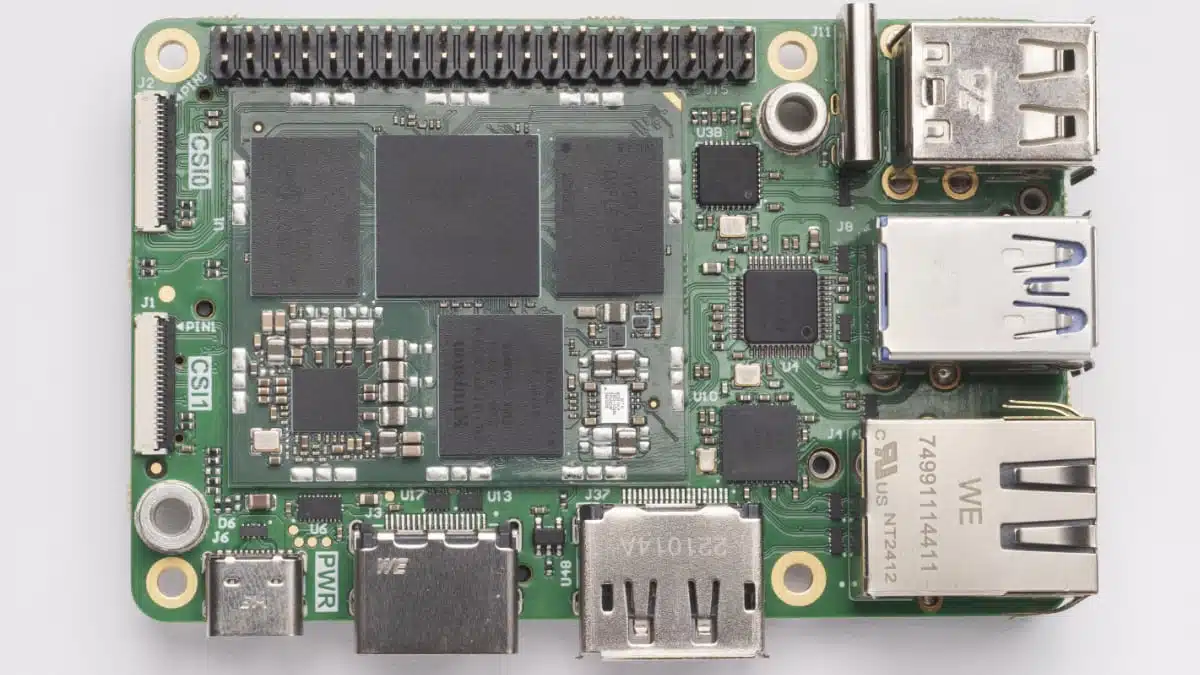
Würth Elektronik and embedded systems developer Grinn have announced a strategic cooperation in the field of edge AI solutions.

The first joint product, the Grinn GenioBoard – Edge AI SBC single‑board computer is now available through Würth Elektronik’s sales channels. With this step, Würth Elektronik positions itself as a partner for rapid product development in edge AI, combining components, design tools, and engineering support in areas such as EMC, thermal design, sensing, wireless connectivity, power supply, and cyber security.

RelatedPosts

Würth Elektronik Expanded Capacity for Validation and Services in Asia

Würth Elektronik Releases Heat Sinks for TO and IC packages

Würth Elektronik ICS to Acquire MRS Electronic and Expand Vehicle Electronics Portfolio

Edge AI platform for demanding IoT applications

The Grinn GenioBoard – Edge AI SBC provides a powerful starting point for developing local AI instances with a focus on computer vision and intelligent IoT peripherals. Typical use cases include remote monitoring and control with AI‑based person and object detection, vision‑guided robotics in industrial environments, and human–machine interfaces with gesture recognition. By enabling AI processing directly at the edge, the platform helps developers reduce latency, increase data privacy, and build more autonomous systems without constant cloud connectivity.

Powerful and energy‑efficient system design

To address security‑critical applications, the Grinn GenioBoard integrates Infineon’s OPTIGA Trust M SLS32AIA010M security module for hardware‑based protection and device authentication. At the heart of the design is the GenioSOM‑700 CPU system‑on‑module, based on the MediaTek MT8390 platform with integrated NPU and GPU for efficient AI and graphics acceleration. The board provides an M.2 M‑Key slot for AI accelerator cards such as the DEEPX DX‑M1 M, and an M.2 E‑Key slot for cellular, Wi‑Fi, and other wireless modules, giving developers a flexible expansion path for connectivity and compute resources.

Würth Elektronik complements the platform with three dedicated M.2 modules for LTE, Wi‑Fi, and Bluetooth, along with matching antenna solutions for reliable RF performance. A dedicated sensor board for the 40‑pin GPIO header will allow quick evaluation of pressure, acceleration, temperature, and humidity sensors, helping engineers shorten design‑in time for typical IoT sensing scenarios. Early prototypes are already available and offer a preview of the performance envelope of the combined hardware, security, and connectivity ecosystem.

Strong partnership focused on design enablement

“Through our collaboration with Grinn, we are becoming an edge AI design enabler. Whether EMC, power supply, thermal management, wireless, sensors, or cybersecurity – we combine all key competencies under one roof and support our customers on the entire journey from idea to production‑ready end product,” says Alexander Gerfer, CTO at Würth Elektronik eiSos Group. He emphasizes that Grinn is an experienced partner with 18 years of system development expertise and a quality‑ and service‑oriented approach that matches Würth Elektronik’s own priorities.

“With our Genio Systems‑on‑Modules and the development board, which can be seen at the Würth Elektronik booth at embedded world, developers can typically reduce the time from concept to finished product by around twelve months. The support provided by Würth Elektronik will make it even easier for companies to implement robust, durable IoT solutions with intelligent peripherals,” explains Robert Orteba, CEO at Grinn sp. z o.o. According to Grinn, the collaboration gives customers access to a complete ecosystem from module level to system design support, helping them scale projects from prototypes to series production more efficiently.

Source

This article is based on information provided by Würth Elektronik in its official press release about the cooperation with Grinn and the Grinn GenioBoard – Edge AI SBC single‑board computer.


References

  1. Würth Elektronik press release – Faster to market maturity for IoT edge computing

Related

Recent Posts

KYOCERA AVX Introduces Traction‑Grade DC Link Film Capacitors

21.4.2026
13

Würth Elektronik Expanded Capacity for Validation and Services in Asia

16.4.2026
15

KYOCERA AVX MIL-PRF-32535 BME NP0 MLCCs Approved to the DLA QPD

16.4.2026
29

Murata Automotive MLCCs Push Capacitance Limits for ADAS and Power Lines

16.4.2026
50

Würth Elektronik Releases Heat Sinks for TO and IC packages

31.3.2026
34

DigiKey Launches “Engineering Unlocked” Video Series

26.3.2026
21

Würth Elektronik Unveils High-Current Automotive Power Inductor

16.4.2026
43

Würth Elektronik Presents Differential Pressure Sensor for HVAC and Medical

17.3.2026
22

Murata New Vibration Sensor Targets High‑Frequency Predictive Maintenance

10.3.2026
61

Upcoming Events

Apr 22
17:00 - 17:30 CEST

Magnetics in a high frequency GaN era

Apr 22
17:00 - 18:00 CEST

Derating Tantalum, Film, and Ceramic Capacitors

Apr 29
10:00 - 11:00 CDT

SEPIC Design Done Right

View Calendar

Popular Posts

  • Buck Converter Design and Calculation

    0 shares
    Share 0 Tweet 0
  • Boost Converter Design and Calculation

    0 shares
    Share 0 Tweet 0
  • Flyback Converter Design and Calculation

    0 shares
    Share 0 Tweet 0
  • LLC Resonant Converter Design and Calculation

    0 shares
    Share 0 Tweet 0
  • MLCC and Ceramic Capacitors

    0 shares
    Share 0 Tweet 0
  • Dual Active Bridge (DAB) Topology

    0 shares
    Share 0 Tweet 0
  • Capacitor Charging and Discharging

    0 shares
    Share 0 Tweet 0
  • Ripple Current and its Effects on the Performance of Capacitors

    3 shares
    Share 3 Tweet 0
  • MLCC Case Sizes Standards Explained

    0 shares
    Share 0 Tweet 0
  • What Electronics Engineer Needs to Know About Passive Low Pass Filters

    0 shares
    Share 0 Tweet 0

Newsletter Subscription


Passive Components Blog

© EPCI - Leading Passive Components Educational and Information Site

  • Home
  • Privacy Policy
  • EPCI Membership & Advertisement
  • About

No Result
View All Result
  • Home
  • Knowledge Blog
  • PCNS

© EPCI - Leading Passive Components Educational and Information Site

This website uses cookies. By continuing to use this website you are giving consent to cookies being used. Visit our Privacy and Cookie Policy.
Go to mobile version