




Passive Components Blog
No Result
View All Result
  • Home
  • NewsFilter
    • All
    • Aerospace & Defence
    • Antenna
    • Applications
    • Automotive
    • Capacitors
    • Circuit Protection Devices
    • electro-mechanical news
    • Filters
    • Fuses
    • Inductors
    • Industrial
    • Integrated Passives
    • inter-connect news
    • Market & Supply Chain
    • Market Insights
    • Medical
    • Modelling and Simulation
    • New Materials & Supply
    • New Technologies
    • Non-linear Passives
    • Oscillators
    • Passive Sensors News
    • Resistors
    • RF & Microwave
    • Telecommunication
    • Weekly Digest

    YAGEO Introduces High‑Current Y2/X1 Film Capacitors for Wide-bandgap Power Systems

    Amphenol Explanded Liquid Cooling Connectors for AI, ESS and EV Systems

    Hirose Introduced BGA connector for PCIe Gen6 for AI and Edge Computing

    YAGEO Introduces High Rel MLCCs Beyond MIL-Spec Limits

    Würth Elektronik Expanded Capacity for Validation and Services in Asia

    Samsung Introduces Ultra-High-Voltage 1500 V MLCCs for xEV Powertrains

    YAGEO Q1 2026 Results: AI Servers and Pricing Power Behind a Moderate Q2 Outlook

    TDK Introduces High‑Voltage Common‑Mode Chokes for Compact 1250 V DC Converters

    Vishay Extends Power Inductors for DC/DC with 1212 Compact Case

    Trending Tags

    • Ripple Current
    • RF
    • Leakage Current
    • Tantalum vs Ceramic
    • Snubber
    • Low ESR
    • Feedthrough
    • Derating
    • Dielectric Constant
    • New Products
    • Market Reports
  • VideoFilter
    • All
    • Antenna videos
    • Capacitor videos
    • Circuit Protection Video
    • Filter videos
    • Fuse videos
    • Inductor videos
    • Inter-Connect Video
    • Non-linear passives videos
    • Oscillator videos
    • Passive sensors videos
    • Resistor videos

    Transformer-Based Power-Line Harvester Magnetic Design

    Thermal Modeling of Magnetics

    Standard vs Planar LLC transformers Comparison for Battery Chargers

    How Modern Tools Model Magnetic Components for Power Electronics

    Advanced Loss Modeling for Planar Magnetics in the Frenetic Planar Tool

    2026 Power Magnetics Design Trends: Flyback, DAB and Planar

    Enabling Software‑Defined Vehicle Architectures: Automotive Ethernet and Zonal Smart Power

    Calculating Resistance Value of a Flyback RC Snubber 

    One‑Pulse Characterization of Nonlinear Power Inductors

    Trending Tags

    • Capacitors explained
    • Inductors explained
    • Resistors explained
    • Filters explained
    • Application Video Guidelines
    • EMC
    • New Products
    • Ripple Current
    • Simulation
    • Tantalum vs Ceramic
  • Knowledge Blog
  • DossiersNew
  • Suppliers
    • Who is Who
  • PCNS
    • PCNS 2025
    • PCNS 2023
    • PCNS 2021
    • PCNS 2019
    • PCNS 2017
  • Events
  • Home
  • NewsFilter
    • All
    • Aerospace & Defence
    • Antenna
    • Applications
    • Automotive
    • Capacitors
    • Circuit Protection Devices
    • electro-mechanical news
    • Filters
    • Fuses
    • Inductors
    • Industrial
    • Integrated Passives
    • inter-connect news
    • Market & Supply Chain
    • Market Insights
    • Medical
    • Modelling and Simulation
    • New Materials & Supply
    • New Technologies
    • Non-linear Passives
    • Oscillators
    • Passive Sensors News
    • Resistors
    • RF & Microwave
    • Telecommunication
    • Weekly Digest

    YAGEO Introduces High‑Current Y2/X1 Film Capacitors for Wide-bandgap Power Systems

    Amphenol Explanded Liquid Cooling Connectors for AI, ESS and EV Systems

    Hirose Introduced BGA connector for PCIe Gen6 for AI and Edge Computing

    YAGEO Introduces High Rel MLCCs Beyond MIL-Spec Limits

    Würth Elektronik Expanded Capacity for Validation and Services in Asia

    Samsung Introduces Ultra-High-Voltage 1500 V MLCCs for xEV Powertrains

    YAGEO Q1 2026 Results: AI Servers and Pricing Power Behind a Moderate Q2 Outlook

    TDK Introduces High‑Voltage Common‑Mode Chokes for Compact 1250 V DC Converters

    Vishay Extends Power Inductors for DC/DC with 1212 Compact Case

    Trending Tags

    • Ripple Current
    • RF
    • Leakage Current
    • Tantalum vs Ceramic
    • Snubber
    • Low ESR
    • Feedthrough
    • Derating
    • Dielectric Constant
    • New Products
    • Market Reports
  • VideoFilter
    • All
    • Antenna videos
    • Capacitor videos
    • Circuit Protection Video
    • Filter videos
    • Fuse videos
    • Inductor videos
    • Inter-Connect Video
    • Non-linear passives videos
    • Oscillator videos
    • Passive sensors videos
    • Resistor videos

    Transformer-Based Power-Line Harvester Magnetic Design

    Thermal Modeling of Magnetics

    Standard vs Planar LLC transformers Comparison for Battery Chargers

    How Modern Tools Model Magnetic Components for Power Electronics

    Advanced Loss Modeling for Planar Magnetics in the Frenetic Planar Tool

    2026 Power Magnetics Design Trends: Flyback, DAB and Planar

    Enabling Software‑Defined Vehicle Architectures: Automotive Ethernet and Zonal Smart Power

    Calculating Resistance Value of a Flyback RC Snubber 

    One‑Pulse Characterization of Nonlinear Power Inductors

    Trending Tags

    • Capacitors explained
    • Inductors explained
    • Resistors explained
    • Filters explained
    • Application Video Guidelines
    • EMC
    • New Products
    • Ripple Current
    • Simulation
    • Tantalum vs Ceramic
  • Knowledge Blog
  • DossiersNew
  • Suppliers
    • Who is Who
  • PCNS
    • PCNS 2025
    • PCNS 2023
    • PCNS 2021
    • PCNS 2019
    • PCNS 2017
  • Events
No Result
View All Result
Passive Components Blog
No Result
View All Result

YAGEO Introduces High‑Current Y2/X1 Film Capacitors for Wide-bandgap Power Systems

17.4.2026
Reading Time: 8 mins read
A A

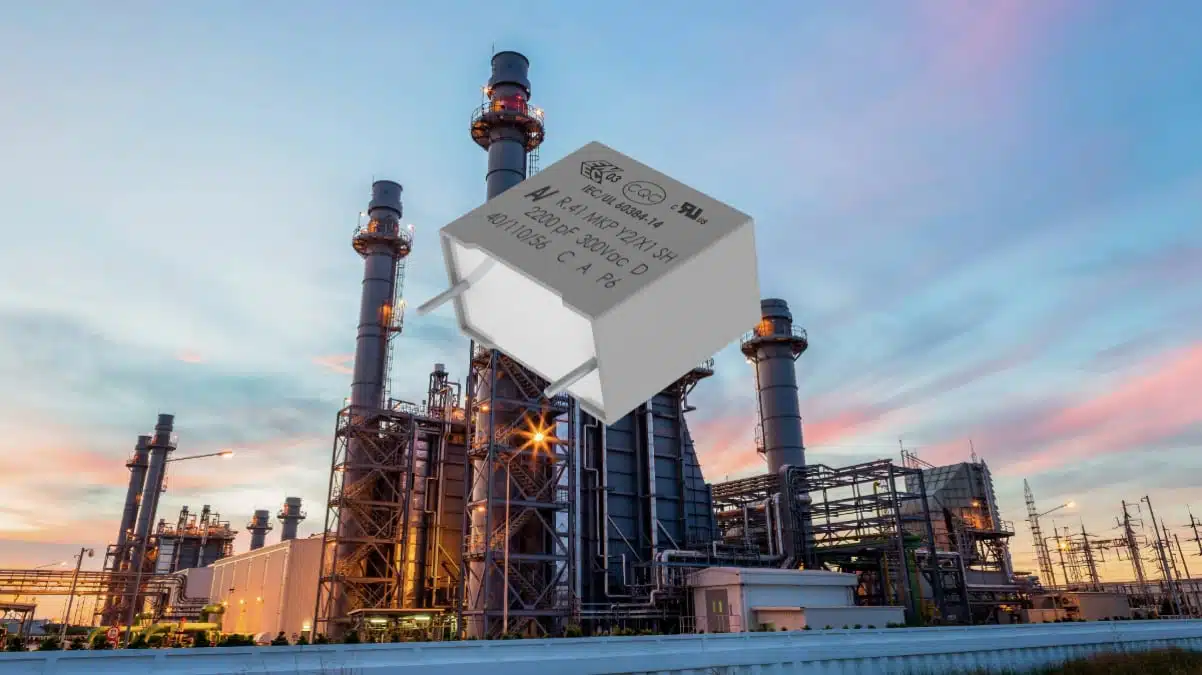
YAGEO Group has introduced the R41D V234 Series, a new high-current Y2/X1 metallized polypropylene film capacitor family aimed at EMI suppression in modern wide-bandgap power converters using SiC and GaN devices.

The YAGEO film capacitor series builds on the established R41D platform but adds significantly higher ripple current capability, allowing designers to handle fast switching edges and higher transient currents while reducing capacitor count in EMI filters.

RelatedPosts

YAGEO Introduces High Rel MLCCs Beyond MIL-Spec Limits

YAGEO Q1 2026 Results: AI Servers and Pricing Power Behind a Moderate Q2 Outlook

YAGEO Releases Ferrite Shielded Power Inductors for High‑Density Designs

Key features and benefits

  • Safety‑class EMI suppression capacitor: Y2/X1 classification for use directly on the AC line in EMI filters, supporting line‑to‑ground and line‑to‑line positions where safety approvals are mandatory.
  • Optimized for wide‑bandgap power stages: High dV/dt capability (up to 6000 V/µs depending on lead pitch) enables robust operation with fast SiC and GaN switching edges without excessive capacitor stress.
  • High ripple current capability: The V234 c‑spec option offers approximately double Irms compared with standard designs, allowing fewer capacitors in parallel for the same ripple current handling.
  • Compact radial package: Capacitance range from 0.001 µF to 0.22 µF at 300 VAC in radial, through‑hole packages, supporting efficient board layout in dense power electronics.
  • Extended reliability: High Temperature Bias (THB) performance, endurance in hot and humid environments, and a maximum operating temperature of 125 °C (for 2 000 hours) to support long field lifetimes.
  • Global approvals and automotive readiness: ENEC, UL, cUL, CQC approvals, compliance with RoHS/REACH/halogen‑free requirements, and AEC‑Q200 compliant construction for both automotive and industrial deployments.

Typical applications

The R41D V234 safety capacitor series targets EMI suppression stages in advanced power conversion systems, particularly where wide‑bandgap devices push switching frequencies and dV/dt beyond legacy capacitor capabilities.

Typical use cases include:

  • On‑board chargers in electric vehicles (OBC), in both AC input Y2/X1 positions and DC‑side EMI filters.
  • DC/DC converters in automotive and industrial systems, especially those based on SiC or GaN switches.
  • Solar inverters and energy storage systems, where high‑efficiency PFC and DC link stages require robust EMI suppression.
  • EV charging stations (AC and DC), including high‑power public chargers with three‑phase inputs.
  • Three‑phase UPS systems and other critical power backup equipment.
  • HVDC filters and general AC input EMI filtering in high‑performance power supplies.

In many of these applications, the higher Irms capability can enable designers to consolidate several smaller capacitors into a single R41D V234 device, simplifying layout and potentially improving reliability by reducing the number of solder joints.

Technical highlights

Core electrical parameters

  • Capacitance range: 0.001 µF to 0.22 µF.
  • Rated AC voltage: 300 VAC, 50/60 Hz (Y2/X1 safety class).
  • Recommended DC voltage: 1200 VDC for DC applications and DC‑biased EMI nodes.
  • High dV/dt capability:
    • 6000 V/µs at 10 mm lead pitch.
    • 4500 V/µs at 15 mm lead pitch.
    • 3000 V/µs at 22.5 mm lead pitch.
  • High Irms capability with V234 c‑spec: up to around two times the ripple current of standard R41D‑class designs (exact values according to the manufacturer datasheet for each part number).

A high dV/dt rating indicates that the capacitor can withstand very steep voltage edges without internal failures such as partial discharges or excessive heating, which is critical in SiC/GaN converters where switching slopes are much faster than in traditional silicon MOSFET or IGBT designs. The enhanced Irms rating reflects the ability to dissipate higher ripple current without exceeding thermal limits.

Reliability and environmental performance

  • High Temperature Bias (THB) grade performance at both AC and DC voltages.
  • Specified endurance tests in hot and humid conditions, for example at 85 °C/85% RH and elevated voltages over hundreds to thousands of hours, according to the series catalogue.
  • Maximum operating temperature: up to 125 °C for 2 000 hours.
  • Designed for long operational lifetime in both AC and DC applications, including harsh ambient conditions.

These characteristics are important in applications such as under‑hood automotive units, outdoor EV chargers, or solar inverters, where capacitors must withstand wide temperature swings and humidity over many years.

Compliance and safety

  • Safety approvals: ENEC, UL, cUL, CQC for Y2/X1 configurations.
  • AEC‑Q200 compliant, supporting use in automotive systems.
  • RoHS, REACH, and halogen‑free compliant materials for environmental regulatory alignment.

Selected parameter overview

Below is a concise summary of the key series‑level parameters. For exact ratings and tolerances, engineers should refer to the official series datasheet.

ParameterR41D V234 Series value / note
Capacitance range0.001 µF to 0.22 µF
AC rated voltage300 VAC, 50/60 Hz
Recommended DC voltage1200 VDC
Safety classY2 / X1
dV/dt capability6000 / 4500 / 3000 V/µs (10 / 15 / 22.5 mm lead pitch)
Max operating temperature125 °C (2 000 hours)
Ripple current (Irms)Up to ~2× standard designs (V234 c‑spec; per datasheet)
ApprovalsENEC, UL, cUL, CQC
Automotive qualificationAEC‑Q200 compliant

Design‑in notes for engineers

Selecting the right R41D V234 capacitor

  • Match dV/dt to switch technology: In fast SiC or GaN stages, choose lead spacing and dV/dt capability with margin above the worst‑case switching slopes, including overshoot and ringing, to reduce stress and increase lifetime.
  • Size for ripple current, not only capacitance: Treat Irms as a primary dimensioning parameter in EMI filters. Use the V234 Irms ratings to minimize the number of parallel capacitors while keeping self‑heating within acceptable limits.
  • Consider thermal environment: In hot ambient or enclosed designs, derate ripple current to account for reduced cooling. The 125 °C capability offers headroom, but local board temperature and airflow still matter.
  • Verify safety spacing and creepage: Select the appropriate lead pitch and case size to meet insulation coordination requirements for Y2/X1 capacitors at the actual system voltage and pollution degree.
  • Check THB and humidity robustness: For outdoor or high‑humidity systems (EV charging, solar, grid‑tied storage), leverage the THB grade performance and use the datasheet test conditions as guidance for expected field robustness.
  • Automotive considerations: For automotive OBC and DC/DC converters, confirm AEC‑Q200 status for the specific part number and include the capacitor in your system‑level environmental and vibration qualification plan.

Circuit‑level integration hints

  • In AC input EMI filters, place the R41D V234 device at the Y or X1 positions where high dV/dt across the capacitor is expected due to common‑mode chokes and fast rectifier or converter stages.
  • When replacing multi‑capacitor banks, verify that the single R41D V234 part meets both EMI attenuation and thermal limits across the full operating range.
  • In three‑phase systems, coordinate selection across phases for symmetrical leakage current and consistent EMI performance.
  • Consider using the YAGEO/KEMET simulation tools (such as Y‑SIM) to validate EMI performance and power loss when combining R41D V234 with other passives in the filter.

Source

This article is based on information provided by YAGEO Group in their official R41D V234 Series product brief and related product pages, with additional independent commentary and application context for design engineers.


References

  1. YAGEO Group – R41D V234 Series product brief / press release
  2. R41D V234 Product Brief PDF
  3. YAGEO Group – Similar EMI suppression capacitors

Related

Recent Posts

Amphenol Explanded Liquid Cooling Connectors for AI, ESS and EV Systems

17.4.2026
1

Hirose Introduced BGA connector for PCIe Gen6 for AI and Edge Computing

17.4.2026
3

YAGEO Introduces High Rel MLCCs Beyond MIL-Spec Limits

16.4.2026
21

Samsung Introduces Ultra-High-Voltage 1500 V MLCCs for xEV Powertrains

16.4.2026
11

YAGEO Q1 2026 Results: AI Servers and Pricing Power Behind a Moderate Q2 Outlook

16.4.2026
34

TDK Introduces High‑Voltage Common‑Mode Chokes for Compact 1250 V DC Converters

16.4.2026
11

Vishay Extends Power Inductors for DC/DC with 1212 Compact Case

16.4.2026
10

YAGEO Releases Ferrite Shielded Power Inductors for High‑Density Designs

15.4.2026
12

Samsung Presents MLCC Selection Guide for Humanoids and Robotic Applications

15.4.2026
17

Upcoming Events

Apr 21
16:00 - 17:00 CEST

Heatsink Solutions: Thermal Management in electronic devices

Apr 22
17:00 - 17:30 CEST

Magnetics in a high frequency GaN era

Apr 22
17:00 - 18:00 CEST

Derating Tantalum, Film, and Ceramic Capacitors

View Calendar

Popular Posts

  • Buck Converter Design and Calculation

    0 shares
    Share 0 Tweet 0
  • Boost Converter Design and Calculation

    0 shares
    Share 0 Tweet 0
  • Flyback Converter Design and Calculation

    0 shares
    Share 0 Tweet 0
  • LLC Resonant Converter Design and Calculation

    0 shares
    Share 0 Tweet 0
  • MLCC and Ceramic Capacitors

    0 shares
    Share 0 Tweet 0
  • Dual Active Bridge (DAB) Topology

    0 shares
    Share 0 Tweet 0
  • Capacitor Charging and Discharging

    0 shares
    Share 0 Tweet 0
  • Plastic Materials Dielectric Constant and DF

    4 shares
    Share 4 Tweet 0
  • MLCC Case Sizes Standards Explained

    0 shares
    Share 0 Tweet 0
  • Ripple Current and its Effects on the Performance of Capacitors

    3 shares
    Share 3 Tweet 0

Newsletter Subscription


Passive Components Blog

© EPCI - Leading Passive Components Educational and Information Site

  • Home
  • Privacy Policy
  • EPCI Membership & Advertisement
  • About

No Result
View All Result
  • Home
  • Knowledge Blog
  • PCNS

© EPCI - Leading Passive Components Educational and Information Site

This website uses cookies. By continuing to use this website you are giving consent to cookies being used. Visit our Privacy and Cookie Policy.
Go to mobile version