



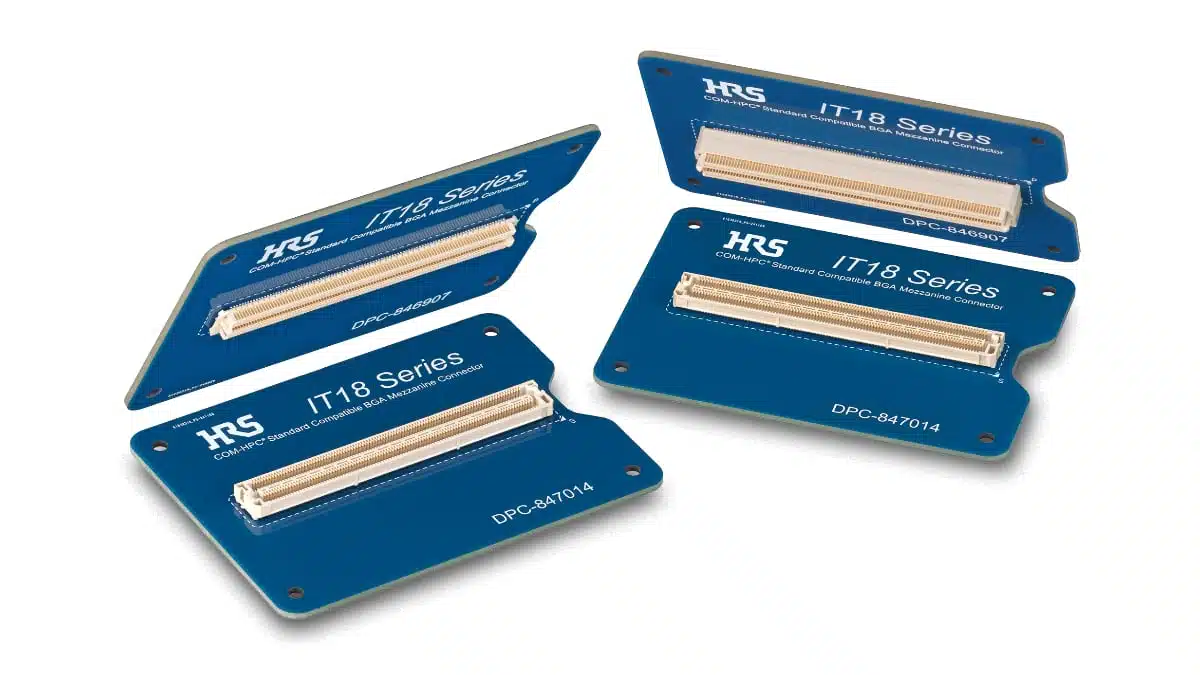
Hirose Electric has introduced the IT18 series, a COM‑HPC compliant BGA mezzanine connector designed for high‑speed, high‑density embedded computing modules in the AI and edge computing era.
The connector targets industrial and embedded system designers who need reliable, low‑profile interconnects capable of handling PCIe Gen6 and high‑speed Ethernet in compact form factors.
Key features and benefits
- COM‑HPC standard compliance – IT18 is designed to meet the PICMG COM‑HPC module standard, simplifying adoption for new and existing COM‑HPC carrier boards and CPU modules and reducing custom connector risk.
- High‑speed capability for AI workloads – Supports PCIe Gen5 at 32 GT/s and PCIe Gen6 at 64 GT/s PAM4, plus 100 Gbps Ethernet using four 25 Gbps lanes, enabling high‑bandwidth links to GPUs, accelerators, storage, and high‑speed networking in edge systems.
- High‑density 400‑position layout – A 0.635 mm pitch with 400 contacts allows large signal counts in a relatively small footprint, supporting complex module pinouts without expanding board size.
- Low‑profile stacking options – Available in 5 mm and 10 mm stacking heights, giving designers flexibility to optimize z‑height, airflow, and mechanical robustness depending on system constraints.
- Reliable BGA termination with pin‑in‑ball structure – The pin‑in‑ball configuration is intended to improve solder joint robustness and mounting reliability, which is important for industrial applications exposed to temperature cycling and vibration.
- Improved routing and signal integrity – Optimized line spacing and a footprint layout that incorporates additional ground vias support controlled impedance routing and crosstalk suppression, helping maintain eye diagrams at PCIe Gen6 data rates.
- Mechanical reinforcement features – Weld (retention) tabs help strengthen the joint between the connector and PCB, mitigating stress on solder balls during handling, assembly, and system operation.
- Metal cap for assembly protection – The connector is supplied with a metal cap that protects the body during reflow, reduces the risk of deformation, and shields against contamination from foreign material during production handling.
- Licensed COM‑HPC connector – IT18 is an officially licensed COM‑HPC connector by Samtec, which helps ensure ecosystem compatibility and reduces interoperability concerns at the module–carrier interface.
Typical applications
The IT18 series targets embedded compute modules where high throughput and reliability are required in constrained industrial environments.
- Industrial PCs and embedded controllers for real‑time control, data logging, and supervisory systems.
- Industrial and humanoid robots needing high‑speed sensor fusion, motion planning, and AI inference at the edge.
- AGVs and AMRs, where compact edge compute modules run navigation, SLAM, and fleet coordination algorithms locally.
- Medical equipment that benefits from high‑bandwidth data transfer between imaging, processing, and user interface subsystems.
- Test and measuring instruments, including high‑speed data acquisition and protocol analyzers using PCIe and Ethernet inside the chassis.
- Semiconductor manufacturing tools that rely on deterministic, high‑reliability controllers installed close to process chambers.
- Broadcast and professional AV equipment, where dense high‑speed I/O and codecs must fit into compact modules.
- Gaming and amusement devices that integrate powerful CPUs/GPUs in modular, easily upgradable COM‑HPC form factors.
In general, any design using COM‑HPC modules and requiring PCIe Gen5/Gen6 or 100G Ethernet between a module and its carrier board is a candidate for the IT18 series.
Technical highlights
The IT18 connector is engineered around the requirements of next‑generation COM‑HPC modules and high‑speed serial interconnects.
Mechanical and layout characteristics
- Pitch and pin count: 0.635 mm pitch with 400 positions, supporting dense mapping of power, ground, high‑speed differential pairs, sideband signals, and management lines.
- Stacking heights: 5 mm and 10 mm available, allowing use in low‑profile fanless systems or more spacious designs with heatsinks and airflow channels.
- BGA style termination: Ball grid array interface on the PCB side, designed for automated SMT assembly and reflow with the pin‑in‑ball structure for improved joint robustness.
- Weld tabs: Additional mechanical anchors to the PCB to share mechanical loads and protect solder joints during board flex, insertion, or transportation.
- Metal cap: Supplied to cover the connector during reflow, preventing deformation and helping block dust or particles from entering the contact area before mating.
High‑speed and signal integrity aspects
- Supported interfaces:
- PCI Express Gen5 at 32 GT/s per lane.
- PCI Express Gen6 at 64 GT/s PAM4 per lane.
- 100 Gbps Ethernet via four lanes at 25 Gbps each.
- Open pin‑field layout: The contact field supports flexible pin mapping so that OEMs can allocate differential pairs, power zones, and control signals in line with COM‑HPC specification profiles or proprietary variants.
- Optimized routing space: Narrow pitch with carefully managed line spacing leaves enough routing clearance on the PCB layers to fan‑out high‑speed pairs and maintain reference planes.
- Crosstalk suppression: The recommended footprint implements additional ground vias and controlled via‑to‑trace spacing to help reduce near‑end and far‑end crosstalk, which is critical at PCIe Gen6 speeds.
Designers should always refer to the manufacturer’s recommended land patterns, via structures, and stack‑up guidelines in the datasheet for detailed SI performance and eye‑diagram compliance.
Source
This article is based on Hirose Electric’s official press release and associated IT18 series product information, interpreted and reorganized for design and purchasing engineers working with COM‑HPC embedded systems.