




Passive Components Blog
No Result
View All Result
  • Home
  • NewsFilter
    • All
    • Aerospace & Defence
    • Antenna
    • Applications
    • Automotive
    • Capacitors
    • Circuit Protection Devices
    • electro-mechanical news
    • Filters
    • Fuses
    • Inductors
    • Industrial
    • Integrated Passives
    • inter-connect news
    • Market & Supply Chain
    • Market Insights
    • Medical
    • Modelling and Simulation
    • New Materials & Supply
    • New Technologies
    • Non-linear Passives
    • Oscillators
    • Passive Sensors News
    • Resistors
    • RF & Microwave
    • Telecommunication
    • Weekly Digest

    Bourns SSD‑1000A AEC‑Q Digital Current Sensors

    YAGEO High‑Capacitance X7R Automotive MLCC Extensions

    How Metal Prices Are Driving Passive Component Price Hikes

    Modelithics COMPLETE Library v25.8 for Keysight ADS

    Taiyo Yuden Releases 165C Automotive Multilayer Metal Power Inductor in 1608 Size

    Energy-Controlled Structural Evolution of Amorphous Ta₂O₅ in Tantalum Anodes

    Jianghai Vibration‑Resistant Aluminum Capacitors Guidelines for Industrial Electronics

    2025 Top Passive Components Blog Articles

    Exxelia Releases Custom Smart Integrated Magnetics for Space Applications

    Trending Tags

    • Ripple Current
    • RF
    • Leakage Current
    • Tantalum vs Ceramic
    • Snubber
    • Low ESR
    • Feedthrough
    • Derating
    • Dielectric Constant
    • New Products
    • Market Reports
  • VideoFilter
    • All
    • Antenna videos
    • Capacitor videos
    • Circuit Protection Video
    • Filter videos
    • Fuse videos
    • Inductor videos
    • Inter-Connect Video
    • Non-linear passives videos
    • Oscillator videos
    • Passive sensors videos
    • Resistor videos

    One‑Pulse Characterization of Nonlinear Power Inductors

    Thermistor Linearization Challenges

    Coaxial Connectors and How to Connect with PCB

    PCB Manufacturing, Test Methods, Quality and Reliability

    Transformer Behavior – Current Transfer and Hidden Feedback

    Choosing the Right Capacitor: The Importance of Accurate Measurements

    RF Inductors: Selection and Design Challenges for High-Frequency Circuits

    Transformer Safety IEC 61558 Standard

    3-Phase EMI Filter Design, Simulation, Calculation and Test

    Trending Tags

    • Capacitors explained
    • Inductors explained
    • Resistors explained
    • Filters explained
    • Application Video Guidelines
    • EMC
    • New Products
    • Ripple Current
    • Simulation
    • Tantalum vs Ceramic
  • Knowledge Blog
  • Suppliers
    • Who is Who
  • PCNS
    • PCNS 2025
    • PCNS 2023
    • PCNS 2021
    • PCNS 2019
    • PCNS 2017
  • Events
  • Home
  • NewsFilter
    • All
    • Aerospace & Defence
    • Antenna
    • Applications
    • Automotive
    • Capacitors
    • Circuit Protection Devices
    • electro-mechanical news
    • Filters
    • Fuses
    • Inductors
    • Industrial
    • Integrated Passives
    • inter-connect news
    • Market & Supply Chain
    • Market Insights
    • Medical
    • Modelling and Simulation
    • New Materials & Supply
    • New Technologies
    • Non-linear Passives
    • Oscillators
    • Passive Sensors News
    • Resistors
    • RF & Microwave
    • Telecommunication
    • Weekly Digest

    Bourns SSD‑1000A AEC‑Q Digital Current Sensors

    YAGEO High‑Capacitance X7R Automotive MLCC Extensions

    How Metal Prices Are Driving Passive Component Price Hikes

    Modelithics COMPLETE Library v25.8 for Keysight ADS

    Taiyo Yuden Releases 165C Automotive Multilayer Metal Power Inductor in 1608 Size

    Energy-Controlled Structural Evolution of Amorphous Ta₂O₅ in Tantalum Anodes

    Jianghai Vibration‑Resistant Aluminum Capacitors Guidelines for Industrial Electronics

    2025 Top Passive Components Blog Articles

    Exxelia Releases Custom Smart Integrated Magnetics for Space Applications

    Trending Tags

    • Ripple Current
    • RF
    • Leakage Current
    • Tantalum vs Ceramic
    • Snubber
    • Low ESR
    • Feedthrough
    • Derating
    • Dielectric Constant
    • New Products
    • Market Reports
  • VideoFilter
    • All
    • Antenna videos
    • Capacitor videos
    • Circuit Protection Video
    • Filter videos
    • Fuse videos
    • Inductor videos
    • Inter-Connect Video
    • Non-linear passives videos
    • Oscillator videos
    • Passive sensors videos
    • Resistor videos

    One‑Pulse Characterization of Nonlinear Power Inductors

    Thermistor Linearization Challenges

    Coaxial Connectors and How to Connect with PCB

    PCB Manufacturing, Test Methods, Quality and Reliability

    Transformer Behavior – Current Transfer and Hidden Feedback

    Choosing the Right Capacitor: The Importance of Accurate Measurements

    RF Inductors: Selection and Design Challenges for High-Frequency Circuits

    Transformer Safety IEC 61558 Standard

    3-Phase EMI Filter Design, Simulation, Calculation and Test

    Trending Tags

    • Capacitors explained
    • Inductors explained
    • Resistors explained
    • Filters explained
    • Application Video Guidelines
    • EMC
    • New Products
    • Ripple Current
    • Simulation
    • Tantalum vs Ceramic
  • Knowledge Blog
  • Suppliers
    • Who is Who
  • PCNS
    • PCNS 2025
    • PCNS 2023
    • PCNS 2021
    • PCNS 2019
    • PCNS 2017
  • Events
No Result
View All Result
Passive Components Blog
No Result
View All Result

YAGEO High‑Capacitance X7R Automotive MLCC Extensions

8.1.2026
Reading Time: 5 mins read
A A

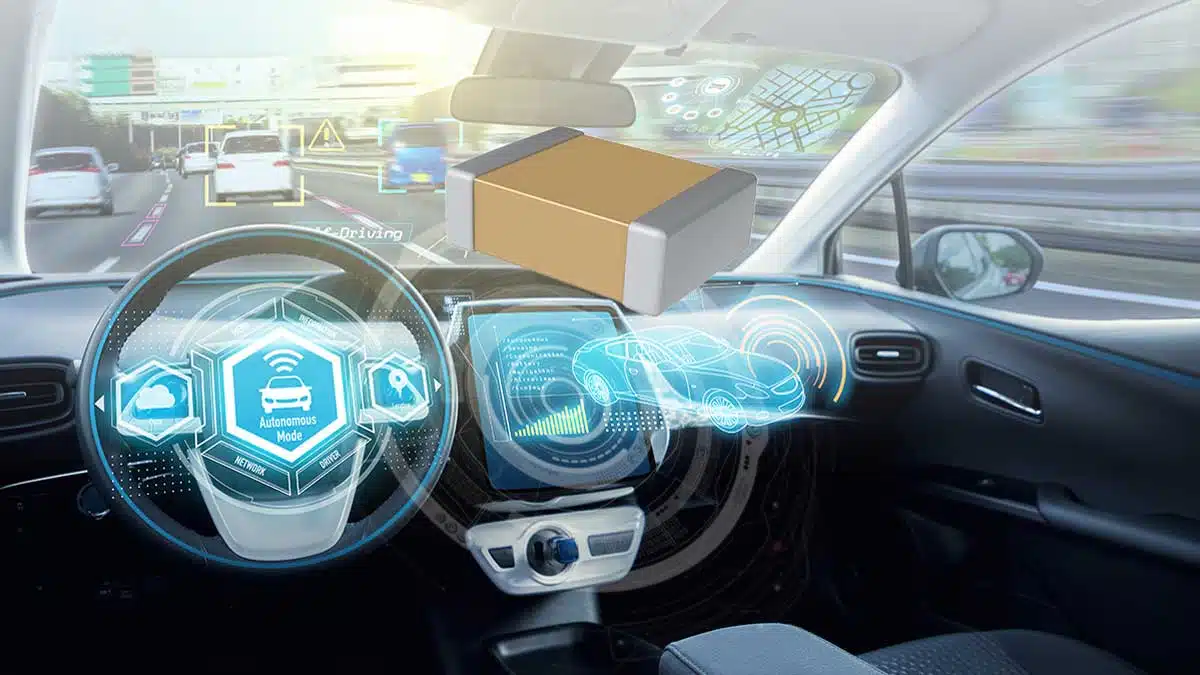
YAGEO Group, including the former KEMET ceramic business, has expanded its automotive‑grade X7R multilayer ceramic capacitor (MLCC) portfolio with new high‑capacitance values.

The MLCC ceramic capacitors extension targets demanding automotive and industrial electronics where compact, temperature‑stable decoupling and filtering components are critical for reliability and safety. The YAGEO broadened range gives design engineers more options to meet EMC, miniaturization and lifetime requirements without resorting to larger package sizes or alternative technologies.

RelatedPosts

How Metal Prices Are Driving Passive Component Price Hikes

Reliability Improvement in BaTiO3 MLCCs Using Ni–Sn and Ni–In Alloy Electrodes

Current Sense Transformer and its Calculation

Key features and benefits

The extended X7R automotive MLCC family is designed as a general‑purpose workhorse for decoupling, bypassing and filtering in automotive and industrial control electronics. It combines a wide capacitance range with automotive qualification and robust mechanical construction according to the manufacturer documentation.

Key characteristics include:

  • Capacitance range from 1000 pF up to 6.8 μF, covering small signal decoupling through to bulk bypass roles in dense automotive PCBs.
  • Availability in both standard and flexible termination constructions to reduce the risk of board‑flex or thermal‑mechanical cracking.
  • Automotive qualification to AEC‑Q200, suitable for use in control units, power electronics and other safety‑relevant modules.
  • RoHS and REACH compliant materials, easing environmental compliance in global platforms.
  • DC voltage ratings from 6.3 V up to 3000 V, enabling use from low‑voltage logic rails up to high‑voltage power conversion and snubber networks according to the manufacturer product brief.
  • Operating temperature range up to 125 °C for X7R and up to 150 °C for certain related dielectric options in the wider automotive MLCC portfolio, supporting under‑hood and drivetrain installations.

For purchasing teams, the combination of AEC‑Q200 qualification, extended capacitance range and broad voltage coverage simplifies AVL management because a single family can be specified over many projects.

Typical applications

The X7R automotive MLCC extensions are aimed at a wide set of power and signal‑conditioning tasks in vehicles and industrial systems. The series is particularly useful where stable capacitance over temperature and long‑term reliability are more important than ultra‑tight capacitance tolerance.

Representative application areas include:

  • Decoupling and bypassing on power rails in ECUs, inverters, DC‑DC converters and control boards, where MLCCs must handle continuous ripple current and voltage transients.
  • Filtering in power and signal lines to support EMC compliance, suppress conducted noise and maintain audio/video quality in infotainment or driver‑assistance systems.
  • Resonant power stages and timing circuits when paired with C0G or U2J capacitors from the same automotive portfolio for frequency‑stable positions, while X7R devices handle bulk energy storage.
  • Under‑hood power electronics and EV/HEV subsystems that require components tolerant to high ambient temperature, vibration and thermal cycling.
  • High‑voltage snubber and converter applications, where suitable high‑voltage X7R MLCC types can be used to shape switching edges and limit overvoltage stress, according to the manufacturer.
  • EMI suppression and stable filtering functions in communication, connectivity and telematics modules to protect sensitive RF and digital circuits.

For design engineers, the extended capacitance options help avoid paralleling large numbers of smaller capacitors, saving PCB space, placement costs and potential yield issues.

Technical highlights

The devices use X7R dielectric, which is classified as a “temperature stable” Class II ceramic with controlled capacitance change over the full automotive temperature range.

Key technical points:

  • X7R dielectric supports a maximum operating temperature of 125 °C and maintains capacitance within ±15% from −55 °C to +125 °C, which simplifies worst‑case design calculations for timing constants and decoupling margins.
  • The MLCCs exhibit a predictable change in capacitance with time (aging) and with applied DC bias, which must be considered in derating but allows consistent modeling in simulations.
  • Minimal capacitance change versus ambient temperature in normal operation helps maintain stable impedance over the frequency range relevant to power rail decoupling.
  • Package sizes span the common EIA footprint range from 0402 up to 2225 within the broader automotive MLCC portfolio, enabling both fine‑pitch logic decoupling and higher‑energy positions in power stages according to the product documentation.
  • The family includes constructions with enhanced mechanical robustness using flexible terminations, which mitigate board‑flex and thermal‑shock induced cracking—one of the main field failure modes for large MLCCs.

When comparing with C0G/U2J options, engineers can treat X7R as the choice for higher capacitance density where moderate variation in capacitance over temperature and voltage is acceptable.

Source

This article is based on an official YAGEO Group press release and associated automotive MLCC product documentation describing the extension of the KEMET X7R automotive MLCC portfolio with new high‑capacitance values.


References

  1. YAGEO Group – YAGEO Group’s Automotive MLCC Products (press release)
  2. YAGEO Group / KEMET Automotive MLCC Product Guide (Product Brief PDF)
  3. YAGEO Group – Automotive MLCC capacitors product overview

Related

Recent Posts

Bourns SSD‑1000A AEC‑Q Digital Current Sensors

8.1.2026
15

How Metal Prices Are Driving Passive Component Price Hikes

8.1.2026
41

Modelithics COMPLETE Library v25.8 for Keysight ADS

7.1.2026
20

Taiyo Yuden Releases 165C Automotive Multilayer Metal Power Inductor in 1608 Size

7.1.2026
23

Energy-Controlled Structural Evolution of Amorphous Ta₂O₅ in Tantalum Anodes

6.1.2026
28

Jianghai Vibration‑Resistant Aluminum Capacitors Guidelines for Industrial Electronics

6.1.2026
20

2025 Top Passive Components Blog Articles

5.1.2026
59
Credit: Institute of Science Tokyo

Researchers Demonstrated 30nm Ferroelectric Capacitor for Compact Memory

2.1.2026
29

Towards Green and Sustainable Supercapacitors

30.12.2025
38

Upcoming Events

Jan 27
16:00 - 17:00 CET

Simplifying Vehicle Development with Automotive Ethernet and Zonal Smart Switch Technologies

Feb 24
16:00 - 17:00 CET

Designing Qi2 Wireless Power Systems: Practical Development and EMC Optimization

View Calendar

Popular Posts

  • Buck Converter Design and Calculation

    0 shares
    Share 0 Tweet 0
  • Boost Converter Design and Calculation

    0 shares
    Share 0 Tweet 0
  • LLC Resonant Converter Design and Calculation

    0 shares
    Share 0 Tweet 0
  • Flyback Converter Design and Calculation

    0 shares
    Share 0 Tweet 0
  • Ripple Current and its Effects on the Performance of Capacitors

    3 shares
    Share 3 Tweet 0
  • What Electronics Engineer Needs to Know About Passive Low Pass Filters

    0 shares
    Share 0 Tweet 0
  • MLCC and Ceramic Capacitors

    0 shares
    Share 0 Tweet 0
  • Dual Active Bridge (DAB) Topology

    0 shares
    Share 0 Tweet 0
  • SEPIC Converter Design and Calculation

    0 shares
    Share 0 Tweet 0
  • What is a Dielectric Constant and DF of Plastic Materials?

    4 shares
    Share 4 Tweet 0

Newsletter Subscription


Passive Components Blog

© EPCI - Leading Passive Components Educational and Information Site

  • Home
  • Privacy Policy
  • EPCI Membership & Advertisement
  • About

No Result
View All Result
  • Home
  • Knowledge Blog
  • PCNS

© EPCI - Leading Passive Components Educational and Information Site

This website uses cookies. By continuing to use this website you are giving consent to cookies being used. Visit our Privacy and Cookie Policy.
Go to mobile version