







Passive Components Blog
No Result
View All Result
  • Home
  • NewsFilter
    • All
    • Aerospace & Defence
    • Antenna
    • Applications
    • Automotive
    • Capacitors
    • Circuit Protection Devices
    • electro-mechanical news
    • Filters
    • Fuses
    • Inductors
    • Industrial
    • Integrated Passives
    • inter-connect news
    • Market & Supply Chain
    • Market Insights
    • Medical
    • Modelling and Simulation
    • New Materials & Supply
    • New Technologies
    • Non-linear Passives
    • Oscillators
    • Passive Sensors News
    • Resistors
    • RF & Microwave
    • Telecommunication
    • Weekly Digest

    Murata Publishes Power Delivery Guide for AI Servers

    Selecting Current Sense Transformers with Würth Elektronik REDEXPERT

    Mechanical Drift Indicator of Tantalum Capacitor Anodes Degradation under Reverse Bias

    Enabling Software‑Defined Vehicle Architectures: Automotive Ethernet and Zonal Smart Power

    Calculating Resistance Value of a Flyback RC Snubber 

    Wk 5 Electronics Supply Chain Digest

    Top 10 Connector Vendors by Product Type

    Bourns Releases High‑Q Air Coil Inductors for RF Aplications

    CMSE 2026 Announces Call for Presentations on High-Reliability Military and Space Electronics

    Trending Tags

    • Ripple Current
    • RF
    • Leakage Current
    • Tantalum vs Ceramic
    • Snubber
    • Low ESR
    • Feedthrough
    • Derating
    • Dielectric Constant
    • New Products
    • Market Reports
  • VideoFilter
    • All
    • Antenna videos
    • Capacitor videos
    • Circuit Protection Video
    • Filter videos
    • Fuse videos
    • Inductor videos
    • Inter-Connect Video
    • Non-linear passives videos
    • Oscillator videos
    • Passive sensors videos
    • Resistor videos

    Enabling Software‑Defined Vehicle Architectures: Automotive Ethernet and Zonal Smart Power

    Calculating Resistance Value of a Flyback RC Snubber 

    One‑Pulse Characterization of Nonlinear Power Inductors

    Thermistor Linearization Challenges

    Coaxial Connectors and How to Connect with PCB

    PCB Manufacturing, Test Methods, Quality and Reliability

    Transformer Behavior – Current Transfer and Hidden Feedback

    Choosing the Right Capacitor: The Importance of Accurate Measurements

    RF Inductors: Selection and Design Challenges for High-Frequency Circuits

    Trending Tags

    • Capacitors explained
    • Inductors explained
    • Resistors explained
    • Filters explained
    • Application Video Guidelines
    • EMC
    • New Products
    • Ripple Current
    • Simulation
    • Tantalum vs Ceramic
  • Knowledge Blog
  • DossiersNew
  • Suppliers
    • Who is Who
  • PCNS
    • PCNS 2025
    • PCNS 2023
    • PCNS 2021
    • PCNS 2019
    • PCNS 2017
  • Events
  • Home
  • NewsFilter
    • All
    • Aerospace & Defence
    • Antenna
    • Applications
    • Automotive
    • Capacitors
    • Circuit Protection Devices
    • electro-mechanical news
    • Filters
    • Fuses
    • Inductors
    • Industrial
    • Integrated Passives
    • inter-connect news
    • Market & Supply Chain
    • Market Insights
    • Medical
    • Modelling and Simulation
    • New Materials & Supply
    • New Technologies
    • Non-linear Passives
    • Oscillators
    • Passive Sensors News
    • Resistors
    • RF & Microwave
    • Telecommunication
    • Weekly Digest

    Murata Publishes Power Delivery Guide for AI Servers

    Selecting Current Sense Transformers with Würth Elektronik REDEXPERT

    Mechanical Drift Indicator of Tantalum Capacitor Anodes Degradation under Reverse Bias

    Enabling Software‑Defined Vehicle Architectures: Automotive Ethernet and Zonal Smart Power

    Calculating Resistance Value of a Flyback RC Snubber 

    Wk 5 Electronics Supply Chain Digest

    Top 10 Connector Vendors by Product Type

    Bourns Releases High‑Q Air Coil Inductors for RF Aplications

    CMSE 2026 Announces Call for Presentations on High-Reliability Military and Space Electronics

    Trending Tags

    • Ripple Current
    • RF
    • Leakage Current
    • Tantalum vs Ceramic
    • Snubber
    • Low ESR
    • Feedthrough
    • Derating
    • Dielectric Constant
    • New Products
    • Market Reports
  • VideoFilter
    • All
    • Antenna videos
    • Capacitor videos
    • Circuit Protection Video
    • Filter videos
    • Fuse videos
    • Inductor videos
    • Inter-Connect Video
    • Non-linear passives videos
    • Oscillator videos
    • Passive sensors videos
    • Resistor videos

    Enabling Software‑Defined Vehicle Architectures: Automotive Ethernet and Zonal Smart Power

    Calculating Resistance Value of a Flyback RC Snubber 

    One‑Pulse Characterization of Nonlinear Power Inductors

    Thermistor Linearization Challenges

    Coaxial Connectors and How to Connect with PCB

    PCB Manufacturing, Test Methods, Quality and Reliability

    Transformer Behavior – Current Transfer and Hidden Feedback

    Choosing the Right Capacitor: The Importance of Accurate Measurements

    RF Inductors: Selection and Design Challenges for High-Frequency Circuits

    Trending Tags

    • Capacitors explained
    • Inductors explained
    • Resistors explained
    • Filters explained
    • Application Video Guidelines
    • EMC
    • New Products
    • Ripple Current
    • Simulation
    • Tantalum vs Ceramic
  • Knowledge Blog
  • DossiersNew
  • Suppliers
    • Who is Who
  • PCNS
    • PCNS 2025
    • PCNS 2023
    • PCNS 2021
    • PCNS 2019
    • PCNS 2017
  • Events
No Result
View All Result
Passive Components Blog
No Result
View All Result

Digitally Controlled Current Limiter Safely Charges Large Capacitor Banks

28.6.2018
Reading Time: 4 mins read
A A

Source: ElectronicDesign article

Ilija Uzelac | Jun 27, 2018. Using voltage feedback from the capacitor bank being charged, a MOSFET-based current-control approach applies a stepped series of increased charging currents to limit inrush current.

RelatedPosts

Murata Publishes Power Delivery Guide for AI Servers

Selecting Current Sense Transformers with Würth Elektronik REDEXPERT

Mechanical Drift Indicator of Tantalum Capacitor Anodes Degradation under Reverse Bias

At a power-on cycle, inrush current, if not limited, can peak to tens of even hundreds of amps when capacitive load is present, thereby increasing the probability of failure and decreasing usable lifetime of a device. With large capacitor banks, an inrush current limiter is a necessary component.

A MOSFET as a voltage-controlled current device is perfectly suitable to be part of an inrush-current limiter. Power supplies with pulsed current across a current passing MOSFET at increasing duty-cycle rate are very common inrush-current limiter designs with active components. However, such designs stress the MOSFET due to currents often order of magnitude higher than the maximum safe current in a dc mode.

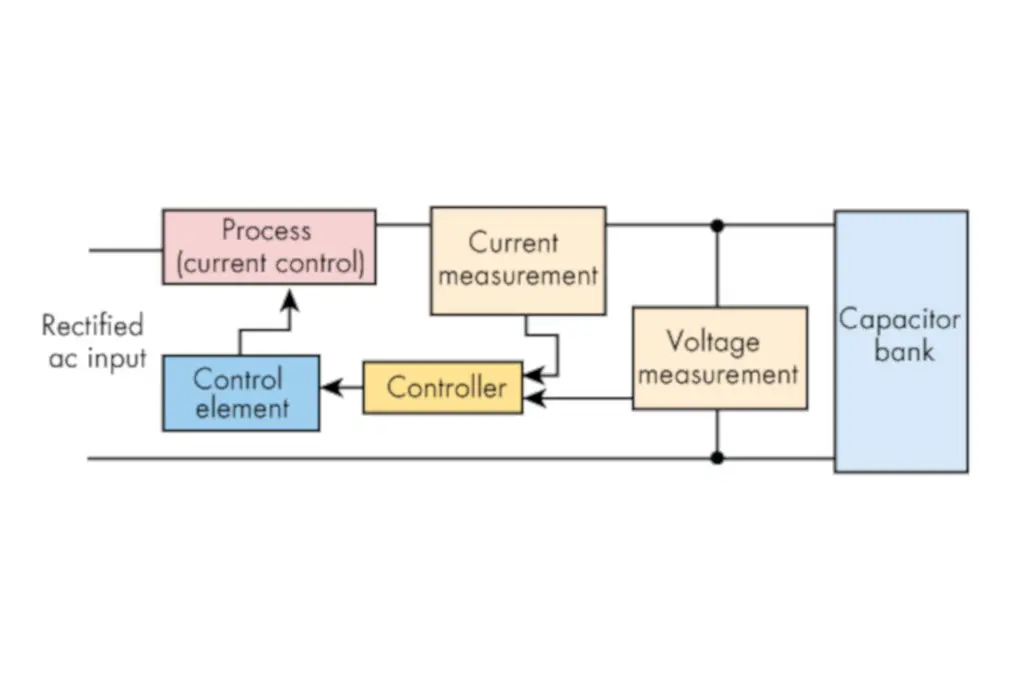
This current-limiter circuit design idea is based on a feedback-controlled current, where current across a MOSFET rises with an increase of the actual voltage across the capacitor bank Vcap(Fig. 1). Based on that voltage, a controller sets the maximum charging current while current limit is controlled through a real-time feedback sense of the charging current.

Fig 1. – see featured image. The maximum charging current is established by a controller that measures the voltage across the capacitor bank during charging cycle.

Charging current is determined based on a MOSFET safe-operating dc curve; its maximal drain current is a function of drain-to-source voltage (VDS). VDS is the difference between rectified ac input voltage, and Vcap in this design idea. Current rating also depends significantly on MOSFET temperature. For example, the datasheet for the APT75M50L N-channel MOSFET used in this design idea shows that in dc mode, the maximal current is ≈1 A at VDS = 300 V, and ≈4 A at VDS = 100 V at a case temperature of 25°C and junction temperature of 150°C.

In the practical circuit design (Fig. 2), U1 through U5 are photovoltaic MOSFET drivers. For the circuit to operate, U1’s driver is first activated via the digital on/off control pin, which in turn drives power MOSFET Q1 (the control element). With U1 active and the capacitor bank at 0 V, the charging current is set by R3, while Q2 acts as current limiter controlling the gate-source voltage of Q1. At this stage, Q3 through Q6 are not conducting and given Q2’s VBE = 0.48 V, the charging current is set and limited to 0.48 V/R3 ≈ 0.5 A. Resistors R16 through R23 form voltage dividers, providing a measure of the capacitor bank voltage for the quad comparator U6 (LM339), which uses a reference voltage of 2.5 V from the bandgap reference U7.

2. Photovoltaic gate drivers control the MOSFETs, which, in turn, control and step the current flow.

The role of each comparator is to control conductivity of branches with resistors R4 through R7 being either conductive or cut off, therefore setting different current limits depending on the Vcap. With the given resistor values, comparators U6A to U6D will be triggered when the Vcap exceeds approximately 60 V, 120 V, 175 V and 215 V, and will make branches with R4 through R7 respectively conductive.

For example, when the Vcap exceeds 60 V, it will trigger comparator U6A, setting its output low. This turns on MOSFET driver U2, driving Q3 into a fully conductive mode, and the branch with R4 will start to conduct current in parallel with R3. The charging current passing through Q1 is now determined by a parallel combination of resistors R3 and R4 + RDS (the on-resistance of Q3, maximum value 40 mΩ), while Q2 maintains the same current-limiting function. The new current limit is 0.48 V/(R3 || (R4 + RDS) ≈ 0.9 A.

A printed-circuit board was built and tested extensively to prove the robustness and efficiency of this circuit. The input voltage is rectified 240 V ac from a 120/240-V ac transformer. The charging current was measured across a 1-Ω resistor with an isolated oscilloscope probe. The approximate maximum current levels were 0.5 A for Vcap of 0 to 60 V; 0.9 A for Vcap of 60 to 120 V; 1.5 A for Vcap of 120 to 180 V; 2.25 A for Vcap of 180 to 215 V; and 5.7 A for Vcap above 215 V.

3. The voltage versus time graph shows inflection points (knees) where the charging current changes.

In the graph of the Vcap during its charging cycle (Fig. 3), the different knee points illustrate different charging currents, quantified with a changing slope of the line. Resistors R1 and R8 through R11 are fail-safe measures that keep the MOSFETs shut off in a case of open-circuit failure of photovoltaic MOSFET drivers. VCC can be either 3.3 V or 5 V with the given resistor values, or higher if resistor values R2, R12 to R15, and R24 are appropriately re-scaled.

Ilija Uzelac is a Research Scientist at Georgia Institute of Technology, with a PhD in Physics from Vanderbilt University, and a Master’s in Electrical Engineering from University of Belgrade, Serbia.

References

1) Ilija Uzelac, “Feedback-Controlled Constant-Current Limiter Includes Digital On/Off Control,” Electronic Design.

2) Ilija Uzelac and Ron Reiserer, “Series-connected MOSFETs increase voltage & power handling,” EDN.

Related

Recent Posts

Murata Publishes Power Delivery Guide for AI Servers

4.2.2026
12

Mechanical Drift Indicator of Tantalum Capacitor Anodes Degradation under Reverse Bias

3.2.2026
16

Enabling Software‑Defined Vehicle Architectures: Automotive Ethernet and Zonal Smart Power

2.2.2026
18

Calculating Resistance Value of a Flyback RC Snubber 

2.2.2026
16

CMSE 2026 Announces Call for Presentations on High-Reliability Military and Space Electronics

28.1.2026
46

ESA Call for Papers 6th Space Passive Component Days – SPCD 2026

28.1.2026
42

Power Electronics Tools for Passives and Magnetic Designs

3.2.2026
74

Samsung Q4 2025 Results: MLCC focus for AI, Server and Automotive

26.1.2026
102

Capacitor Technology Dossier

26.1.2026
140

Upcoming Events

Feb 24
16:00 - 17:00 CET

Designing Qi2 Wireless Power Systems: Practical Development and EMC Optimization

Mar 3
16:00 - 17:00 CET

Cybersecurity at the Eleventh Hour – from RED to CRA – Information and Discussion

Mar 21
All day

PSMA Capacitor Workshop 2026

View Calendar

Popular Posts

  • Buck Converter Design and Calculation

    0 shares
    Share 0 Tweet 0
  • Boost Converter Design and Calculation

    0 shares
    Share 0 Tweet 0
  • LLC Resonant Converter Design and Calculation

    0 shares
    Share 0 Tweet 0
  • Flyback Converter Design and Calculation

    0 shares
    Share 0 Tweet 0
  • Ripple Current and its Effects on the Performance of Capacitors

    3 shares
    Share 3 Tweet 0
  • How Metal Prices Are Driving Passive Component Price Hikes

    0 shares
    Share 0 Tweet 0
  • MLCC and Ceramic Capacitors

    0 shares
    Share 0 Tweet 0
  • Dual Active Bridge (DAB) Topology

    0 shares
    Share 0 Tweet 0
  • What is a Dielectric Constant and DF of Plastic Materials?

    4 shares
    Share 4 Tweet 0
  • Degradation of Capacitors and its Failure Mechanisms

    0 shares
    Share 0 Tweet 0

Newsletter Subscription


Passive Components Blog

© EPCI - Leading Passive Components Educational and Information Site

  • Home
  • Privacy Policy
  • EPCI Membership & Advertisement
  • About

No Result
View All Result
  • Home
  • Knowledge Blog
  • PCNS

© EPCI - Leading Passive Components Educational and Information Site

This website uses cookies. By continuing to use this website you are giving consent to cookies being used. Visit our Privacy and Cookie Policy.
Go to mobile version