




Passive Components Blog
No Result
View All Result
  • Home
  • NewsFilter
    • All
    • Aerospace & Defence
    • Antenna
    • Applications
    • Automotive
    • Capacitors
    • Circuit Protection Devices
    • electro-mechanical news
    • Filters
    • Fuses
    • Inductors
    • Industrial
    • Integrated Passives
    • inter-connect news
    • Market & Supply Chain
    • Market Insights
    • Medical
    • Modelling and Simulation
    • New Materials & Supply
    • New Technologies
    • Non-linear Passives
    • Oscillators
    • Passive Sensors News
    • Resistors
    • RF & Microwave
    • Telecommunication
    • Weekly Digest

    Wk 26 Electronics Supply Chain Digest

    High-Q RF & Microwave MLCCs: A Cross-Vendor Benchmark

    Molex Unveils Automotive Ethernet Connectors for Next‑Gen SDV Architectures

    TAIYO YUDEN Introduced Hybrid Aluminum Capacitors for 48V Automotive Power Supplies

    ECIA Industry Pulse June 2026 Reaches Five‑Year High

    YAGEO Announces July 2026 Capacitor Price Increase

    YAGEO Presents Single-Phase Common Mode Chokes for Industrial EMI Suppression

    Enabling the 800 V AI Server Era: How C0G High-Voltage MLCC Supports Next-Generation Power Architectures

    binder Prints Electronics on 3D Components Connector Surface

    Trending Tags

    • Ripple Current
    • RF
    • Leakage Current
    • Tantalum vs Ceramic
    • Snubber
    • Low ESR
    • Feedthrough
    • Derating
    • Dielectric Constant
    • New Products
    • Market Reports
  • VideoFilter
    • All
    • Antenna videos
    • Capacitor videos
    • Circuit Protection Video
    • Filter videos
    • Fuse videos
    • Inductor videos
    • Inter-Connect Video
    • Non-linear passives videos
    • Oscillator videos
    • Passive sensors videos
    • Resistor videos

    KYOCERA AVX Presents Antenna Integrator Studio Tutorial for Antenna Placement and RF Design

    Power Design Simulation Tools for Faster Inductor Selection and Loss Optimization

    EMC‑Compliant PCB and Connector Design Guidelines

    Why Isolated DC/DC Power Supplies Fail Late, Würth Elektronik Podcast

    Designing 800 V DC EMC Filters: Calculation, Simulation and Measurement

    Current Sense Transformer Datasheet and Design‑in Guide

    Designing a USB Type‑C Flyback Planar Transformer with Frenetic’s Planar Tool

    Magnetics Design in High‑Frequency GaN Converters

    Qi2 Wireless Charging: Inductors, Capacitors and EMC Filters

    Trending Tags

    • Capacitors explained
    • Inductors explained
    • Resistors explained
    • Filters explained
    • Application Video Guidelines
    • EMC
    • New Products
    • Ripple Current
    • Simulation
    • Tantalum vs Ceramic
  • Knowledge Blog
  • DossiersNew
  • Suppliers
    • Who is Who
  • PCNS
    • PCNS 2025
    • PCNS 2023
    • PCNS 2021
    • PCNS 2019
    • PCNS 2017
  • Events
  • Home
  • NewsFilter
    • All
    • Aerospace & Defence
    • Antenna
    • Applications
    • Automotive
    • Capacitors
    • Circuit Protection Devices
    • electro-mechanical news
    • Filters
    • Fuses
    • Inductors
    • Industrial
    • Integrated Passives
    • inter-connect news
    • Market & Supply Chain
    • Market Insights
    • Medical
    • Modelling and Simulation
    • New Materials & Supply
    • New Technologies
    • Non-linear Passives
    • Oscillators
    • Passive Sensors News
    • Resistors
    • RF & Microwave
    • Telecommunication
    • Weekly Digest

    Wk 26 Electronics Supply Chain Digest

    High-Q RF & Microwave MLCCs: A Cross-Vendor Benchmark

    Molex Unveils Automotive Ethernet Connectors for Next‑Gen SDV Architectures

    TAIYO YUDEN Introduced Hybrid Aluminum Capacitors for 48V Automotive Power Supplies

    ECIA Industry Pulse June 2026 Reaches Five‑Year High

    YAGEO Announces July 2026 Capacitor Price Increase

    YAGEO Presents Single-Phase Common Mode Chokes for Industrial EMI Suppression

    Enabling the 800 V AI Server Era: How C0G High-Voltage MLCC Supports Next-Generation Power Architectures

    binder Prints Electronics on 3D Components Connector Surface

    Trending Tags

    • Ripple Current
    • RF
    • Leakage Current
    • Tantalum vs Ceramic
    • Snubber
    • Low ESR
    • Feedthrough
    • Derating
    • Dielectric Constant
    • New Products
    • Market Reports
  • VideoFilter
    • All
    • Antenna videos
    • Capacitor videos
    • Circuit Protection Video
    • Filter videos
    • Fuse videos
    • Inductor videos
    • Inter-Connect Video
    • Non-linear passives videos
    • Oscillator videos
    • Passive sensors videos
    • Resistor videos

    KYOCERA AVX Presents Antenna Integrator Studio Tutorial for Antenna Placement and RF Design

    Power Design Simulation Tools for Faster Inductor Selection and Loss Optimization

    EMC‑Compliant PCB and Connector Design Guidelines

    Why Isolated DC/DC Power Supplies Fail Late, Würth Elektronik Podcast

    Designing 800 V DC EMC Filters: Calculation, Simulation and Measurement

    Current Sense Transformer Datasheet and Design‑in Guide

    Designing a USB Type‑C Flyback Planar Transformer with Frenetic’s Planar Tool

    Magnetics Design in High‑Frequency GaN Converters

    Qi2 Wireless Charging: Inductors, Capacitors and EMC Filters

    Trending Tags

    • Capacitors explained
    • Inductors explained
    • Resistors explained
    • Filters explained
    • Application Video Guidelines
    • EMC
    • New Products
    • Ripple Current
    • Simulation
    • Tantalum vs Ceramic
  • Knowledge Blog
  • DossiersNew
  • Suppliers
    • Who is Who
  • PCNS
    • PCNS 2025
    • PCNS 2023
    • PCNS 2021
    • PCNS 2019
    • PCNS 2017
  • Events
No Result
View All Result
Passive Components Blog
No Result
View All Result

YMIN Releases Square Supercapacitors for AI Server Power System

27.5.2026
Reading Time: 6 mins read
A A

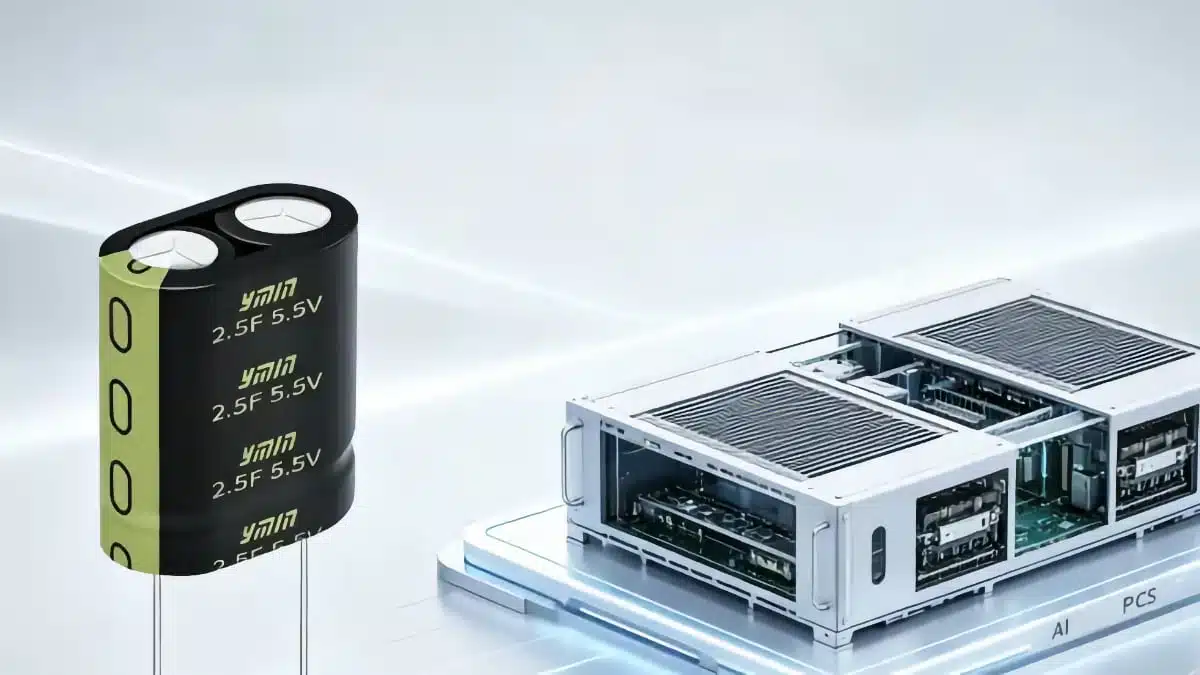
YMIN introduces SDF square supercapacitors, which serve as an ideal solution to provide a localized, ultra-low-ESR energy buffer layer directly at the AI PCS (Power Conversion System) bus. This enhancement improves transient performance and power density for AI server and data center designs.

High‑power AI servers are driving millisecond‑scale load steps that can easily exceed several times the rated power of the power conversion system. In these conditions, traditional buffering with electrolytic or film capacitors struggles to maintain bus stability without oversizing the entire PCS.

RelatedPosts

YMIN Hybrid Aluminum Capacitors for Automotive LiDAR Power Rails

YMIN Introduces Vibration Resistant Compact Low ESR Aluminum Capacitors for Home Appliances

YMIN Introduces Polymer Tantalum Capacitors for AI Server SSDs

Key features and benefits

  • Ultra‑low ESR for bus stability
    ESR specified below 0.8 mΩ reduces the voltage drop associated with fast current steps and limits self‑heating during high di/dt events.
  • High pulse current capability
    The recommended 3.0 V, 330 F SDF device supports up to 360 A charge and discharge current in the millisecond range, matching typical AI GPU load transients in the 200 ms to 1 s window.
  • Square form factor for higher power density
    The 30 × 20 × 55 mm square package reduces volume by about 30–40% and weight by about 20–30% compared with cylindrical supercapacitors of similar performance, which eases mechanical integration in dense PCS modules.
  • Wide operating temperature range
    Operation from −40 °C to 70 °C allows use in data‑center environments with elevated inlet temperatures and in infrastructure deployed in less controlled ambient conditions.
  • Long cycle life
    A specified cycle life of 500 000 cycles supports 24/7 high‑frequency charge/discharge operation typical of AI workloads and grid‑connected PCS assets.
  • System‑level cost and size reduction
    By absorbing transient peaks locally, the SDF buffer lets designers reduce peak redundancy in upstream UPS/HVDC, rectifier stages, bus capacitors and power devices, which can shrink system size, weight and cooling costs.

Typical applications

SDF square supercapacitors are positioned as transient buffer elements in power conversion systems where load steps are both large and fast:

  • AI server and data‑center PCS DC bus buffering to stabilize GPU/CPU supply rails during rapid load ramps.
  • UPS/HVDC front‑end “peak shaving and valley filling” to decouple short‑term load surges from upstream power infrastructure.
  • GPU cluster power distribution shelves where multiple accelerators switch states in a correlated way, causing millisecond‑scale bus disturbances.
  • High‑density modular PCS frames where cylindrical supercapacitors are difficult to place close to the load due to size and height constraints.

In practice, these supercapacitors sit in parallel with the DC bus, often on the same board or sub‑rack as the high‑current GPU power stages, providing a local energy reservoir that can be accessed with minimal parasitic inductance.

Technical highlights

The press release highlights one recommended SDF configuration as a reference point for design‑in.

SDF supercapacitor specifications

ParameterValue / description
Capacitance330 F (single cell)
Rated voltage3.0 V
ESR (typical / max)< 0.8 mΩ
Max charge/discharge currentUp to 360 A (millisecond‑level pulses)
Package typeSquare supercapacitor
Package dimensions30 × 20 × 55 mm
Operating temperature−40 °C to 70 °C
Cycle life500 000 cycles

According to the manufacturer, the square form factor enables better use of board and rack volume compared to equivalent cylindrical cans, especially when lining up multiple devices along the PCS busbar or power board edge. The specified ESR combined with high capacitance and short interconnects makes SDF devices suitable for limiting voltage sag and overshoot when AI accelerators ramp current within a few hundred microseconds to several milliseconds.

How SDF buffers improve AI PCS behavior

In AI server racks, a single GPU can exceed 700 W and full clusters can exhibit load jumps that are several times the rated steady‑state power of the PCS. If only traditional electrolytic or film capacitors are used, the buffer’s ESR and limited dynamic response can cause bus voltage dips or overshoots that risk GPU or CPU resets, and the usual remedy is to over‑dimension the entire power chain.

The SDF series addresses three pain points cited by YMIN:

  • Insufficient bus stability under high di/dt load steps when buffer ESR is too high.
  • Excessive system redundancy caused by oversizing bus capacitors, rectifiers and UPS/HVDC stages to cover short transients.
  • Poor adaptability of conventional aluminum electrolytic, film and cylindrical supercapacitors in terms of response speed, form factor and mass.

By moving a low‑ESR, high‑capacitance energy buffer physically close to the GPU power stages, designers reduce parasitic inductance in the current path and keep the dynamic support where it is most effective. This allows upstream converters to be sized closer to average or moderately elevated power instead of worst‑case instantaneous peaks, which can yield meaningful savings in magnetic components, semiconductor ratings and thermal design.

Design‑in notes for engineers

When evaluating SDF square supercapacitors against existing designs, power and hardware engineers can use the following practical guidelines:

  • Place SDF devices as close as possible to the GPU/CPU DC bus.
    Short copper planes or busbars minimize parasitic inductance and ensure the ultra‑low ESR of the device actually translates into effective voltage stabilization.
  • Dimension the number of cells for both energy and peak current.
    The 330 F / 3.0 V rating and 360 A pulse capability provide a starting point, but total required capacitance depends on the allowed bus voltage deviation, load profile and desired buffer time window.
  • Coordinate protection and control.
    Ensure that PCS control loops, current limiting and fault protection schemes account for the strong transient support provided by the supercapacitor so that the upstream converter does not react unnecessarily aggressively to short‑term disturbances.
  • Check thermal design under repeated pulses.
    Although ESR is low, repeated high‑current pulses cause losses; verify that mounting, airflow and ambient conditions keep the device within its −40 °C to 70 °C rating for the actual mission profile.
  • Compare square vs cylindrical options at system level.
    Rather than only matching capacitance, consider board area, clearance/heights, mass and mechanical fixation; the SDF square package can simplify layout in 1U/2U servers and blade‑style power modules.
  • Plan for lifecycle and serviceability.
    With a 500 000‑cycle specification, SDF devices are suited for long‑term deployment, but service intervals and monitoring (for example, ESR or capacity drift) should still be defined for critical installations.

For new AI or data‑center projects, involving the manufacturer’s FAE team early can help optimize the number of devices, their configuration, and their integration with existing UPS/HVDC and PCS architectures.

Source

This article is based on the manufacturer’s press release and related information published by Shanghai YMIN Electronics about the SDF series square supercapacitors for AI server and data‑center PCS applications.
References

  1. YMIN SDF series square supercapacitors provide millisecond-level peak shaving and valley filling solutions for AI server PCS
  2. YMIN Electric Double Layer Capacitor (supercapacitors) product overview

Related

Recent Posts

High-Q RF & Microwave MLCCs: A Cross-Vendor Benchmark

2.7.2026
56

TAIYO YUDEN Introduced Hybrid Aluminum Capacitors for 48V Automotive Power Supplies

2.7.2026
43

YAGEO Announces July 2026 Capacitor Price Increase

1.7.2026
427

YAGEO Presents Single-Phase Common Mode Chokes for Industrial EMI Suppression

1.7.2026
26

Enabling the 800 V AI Server Era: How C0G High-Voltage MLCC Supports Next-Generation Power Architectures

1.7.2026
114

binder Prints Electronics on 3D Components Connector Surface

1.7.2026
17

Vishay Introduces SMD Polymer PTC Thermistors for Fast Resettable Overcurrent Protection

30.6.2026
42

MLCCs in the Age of AI: Q2 2026 Market Tightness

30.6.2026
324

AI Hardware Demand for Passive Components Dossier

30.6.2026
111

Upcoming Events

Jul 14
16:00 - 17:00 CEST

EMC Design Essentials: Mastering Varistors and Common Mode Chokes

Jul 21
16:00 - 17:00 CEST

Safety by design: X and Y Interference suppression capacitors for power line filters

Jul 28
8:00 - 11:00 CEST

Post Procurement Testing of EEE Components for LEO Space Applications

View Calendar

Popular Posts

  • Boost Converter Design and Calculation

    0 shares
    Share 0 Tweet 0
  • Buck Converter Design and Calculation

    0 shares
    Share 0 Tweet 0
  • Flyback Converter Design and Calculation

    0 shares
    Share 0 Tweet 0
  • LLC Resonant Converter Design and Calculation

    0 shares
    Share 0 Tweet 0
  • MLCC and Ceramic Capacitors

    0 shares
    Share 0 Tweet 0
  • Nvidia Vera Rubin: Why One AI Rack Needs So Many More MLCC Capacitors

    0 shares
    Share 0 Tweet 0
  • Earthing Systems and IEC Classification Explained

    0 shares
    Share 0 Tweet 0
  • YAGEO Announces July 2026 Capacitor Price Increase

    0 shares
    Share 0 Tweet 0
  • MLCC Case Sizes Standards Explained

    0 shares
    Share 0 Tweet 0
  • Dual Active Bridge (DAB) Topology

    0 shares
    Share 0 Tweet 0

Newsletter Subscription


Passive Components Blog

© EPCI - Leading Passive Components Educational and Information Site

  • Home
  • Privacy Policy
  • EPCI Membership & Advertisement
  • About

No Result
View All Result
  • Home
  • Knowledge Blog
  • Dossiers
  • PCNS

© EPCI - Leading Passive Components Educational and Information Site

This website uses cookies. By continuing to use this website you are giving consent to cookies being used. Visit our Privacy and Cookie Policy.
Go to mobile version