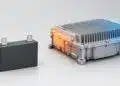




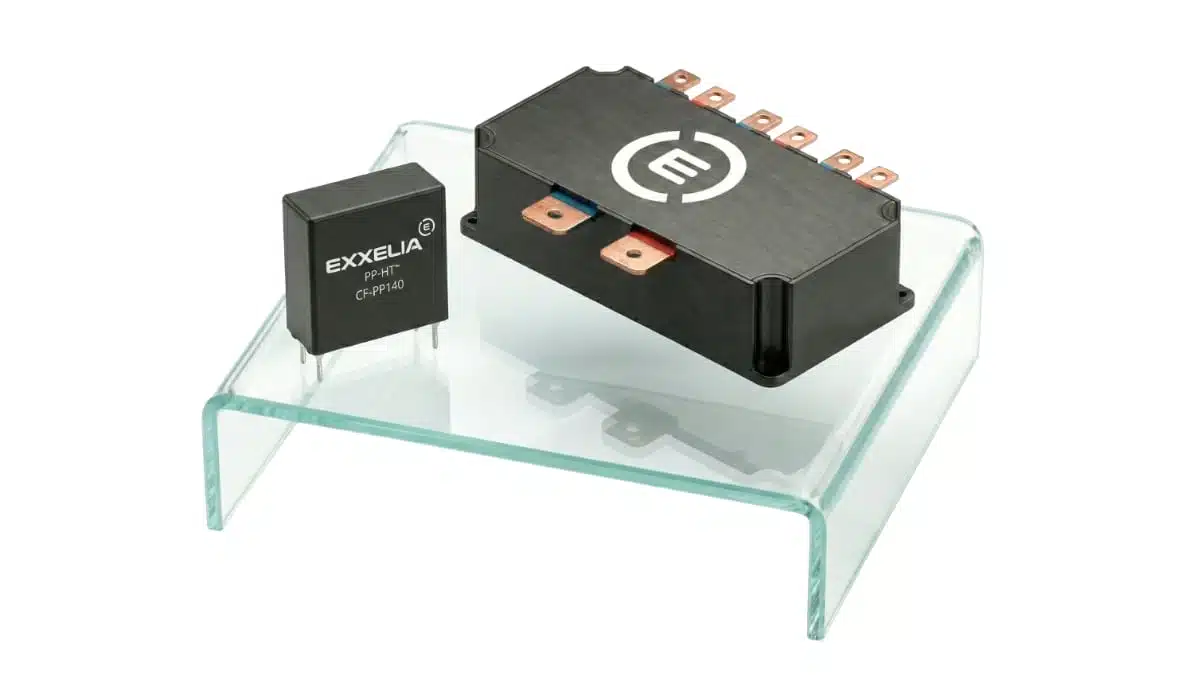
Exxelia’s CF-PP140 polypropylene film capacitors extend the usable temperature range of PP technology up to 140 °C while delivering high volumetric energy density in compact packages.
This combination targets designers who need lighter, smaller DC energy storage in harsh, thermally constrained power electronics such as UAVs, eVTOLs and heavy mobile equipment.
Key features and benefits
- High operating temperature up to 140 °C
CF-PP140 uses a high‑temperature polypropylene dielectric (PP‑HT) that raises the typical PP limit from around 105 °C to 140 °C, enabling operation closer to hot power stages without derating the entire system unnecessarily. - Wide DC voltage range from 450 V to 1500 V
The series supports a broad range of DC bus voltages commonly found in aerospace, e‑mobility and industrial power converters, simplifying standardization across different platforms. - High energy density up to 250 J/L
Compared with conventional polypropylene film capacitors, CF‑PP140 offers roughly 30% higher volumetric energy density, which directly translates into footprint and weight savings on crowded power boards. - Capacitance range and tolerances suited for DC link use
Capacitance values span approximately 0.8 µF to 210 µF with typical tolerances of 5% or 10%, allowing designers to select either tighter control or cost‑optimized options depending on bus stability requirements. - Self‑healing metallized PP construction
The capacitors use metallized polypropylene with self‑healing properties that clear localized dielectric breakdowns, improving long‑term reliability under repetitive high‑energy pulses and transient events. - Standardized and customizable footprints
The range offers standard case styles to ease drop‑in integration plus custom variants, including combined “Power Block” assemblies with integrated busbars, reducing assembly time and stray inductance.
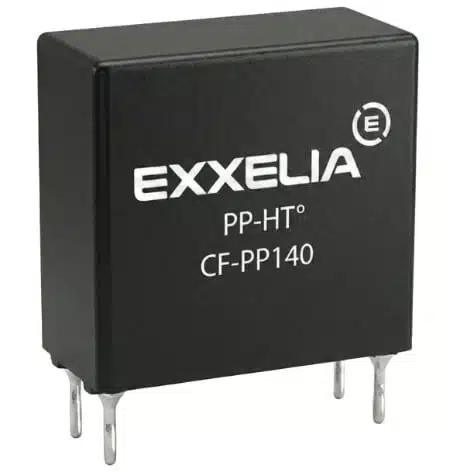
The Exxelia CF-PP140 PP film capacitor series forms a comprehensive range of standard components designed for applications requiring high energy density in a compact footprint. They support operating voltages from 450 V to 1500 V, offer an energy density of up to 250 J/L while pushing the polypropylene operating temperature up to 140°C. These capacitors feature a standard footprint to ease system integration, making them suitable for constrained electronic architectures.
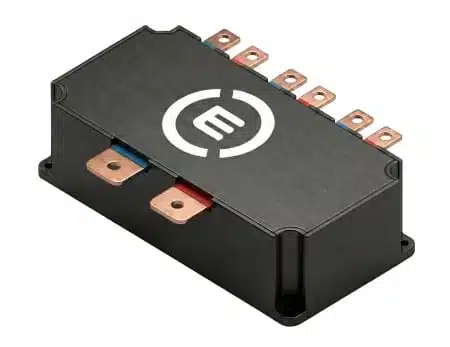
Complementary, Exxelia offers a higher level of integration by combining a CF-PP140 and busbar from Exxelia SVM into fully customized “Power Block” capacitors. These tailored blocks can meet customers’ specific size and electrical performance requirements, even in the most extreme applications.
Positioning versus other film dielectrics
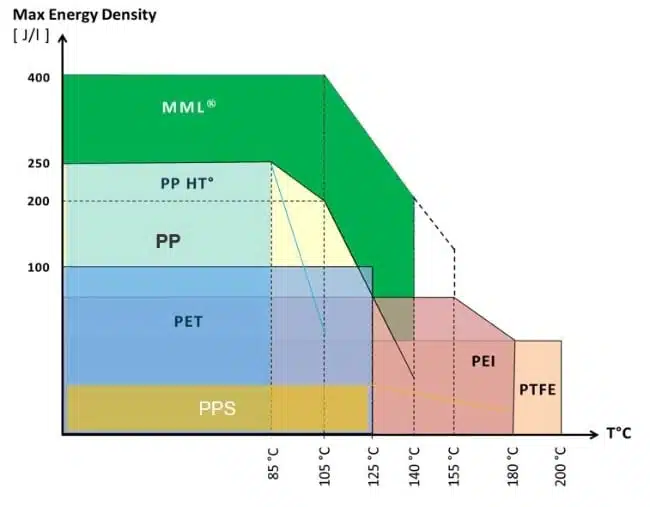
CF‑PP140 sits between standard polypropylene and high‑temperature polymer dielectrics:
| Dielectric type | Typical max temp | Volumetric energy density | Practical implication |
|---|---|---|---|
| Standard PP | ≈105 °C | Baseline for comparison | Often oversized or derated in hot zones |
| CF‑PP140 PP‑HT | 140 °C | Up to 250 J/L | Smaller parts for same energy at higher temperature |
| PET / PPS | Higher than PP | Lower than CF‑PP140 at same temp | May require larger volume for same energy |
| PEI / PTFE | Very high temp | Lower volumetric efficiency than CF‑PP140 | Robust but bulkier for a given energy |
According to Exxelia, CF‑PP140 offers higher energy density at elevated temperature than PET or PPS while remaining more compact than PEI or PTFE solutions, which is attractive where both space and thermal margins are tight.
Typical applications
The CF‑PP140 series targets power electronics that must combine high energy storage, high operating temperature and limited volume.
- Unmanned aerial vehicles (UAVs)
Weight and volume are critical in UAVs, and power stages are often tightly enclosed with minimal airflow; a high‑temperature DC link capacitor helps maintain reliability without oversizing the enclosure. - eVTOL and more‑electric aircraft
In compact propulsion inverters and high‑power DC distribution, CF‑PP140 can be used as a main DC link or snubber capacitor close to power modules where ambient and case temperatures are elevated. - Heavy vehicles and off‑highway machinery
Agricultural tractors, construction machinery and other heavy vehicles increasingly rely on electrified drives and auxiliary inverters, which may sit near engines or hydraulics; high‑temperature film capacitors reduce the need for aggressive cooling of the DC link. - Industrial drives and converters
CF‑PP140 is also suited to compact servo drives, high‑power DC/DC converters, and other industrial equipment exposed to high ambient temperatures or sealed housings with limited convection. - Custom “Power Block” assemblies
For high‑current buses, Exxelia can integrate CF‑PP140 elements with laminated busbars in a single assembly to form low‑inductance power blocks, appropriate for fast‑switching wide‑bandgap inverters.
Technical highlights
This section summarizes the key electrical and environmental characteristics as reported by Exxelia and distribution partners; exact values should be verified in the manufacturer datasheet for design‑in decisions.
- Dielectric system
High‑temperature polypropylene (PP‑HT) film with metallized electrodes, optimized for self‑healing behavior and stable capacitance up to 140 °C. - Voltage ratings
Operating DC voltage range from 450 V up to 1500 V, covering typical battery packs and DC buses in aerospace, industrial and e‑mobility platforms. - Capacitance range
Approximate capacitance span from 0.8 µF to 210 µF, depending on voltage rating and case size, with 5% or 10% tolerance options according to the referenced product overview. - Energy density
Up to 250 J/L in custom configurations, giving about 30% higher energy density compared with typical polypropylene designs in similar applications. - Temperature capability
Continuous operation up to 140 °C allows placement closer to switching devices or within hot compartments without violating film‑capacitor temperature limits. - Mechanical and connection options
Standardized footprints are intended to simplify PCB or busbar layout; SMD and dual‑in‑line options can be provided on request for higher integration density.
Where datasheet parameters such as dissipation factor, insulation resistance or surge voltage are needed for detailed calculations, designers should refer directly to the official CF‑PP140 datasheet or product specification according to the manufacturer.
Dielectric trade‑offs in practice
For engineers comparing technologies, CF‑PP140 aims to provide a compromise between classic PP film and higher‑temperature engineering polymers: it retains the low loss and self‑healing behavior of PP while extending temperature capability and improving volumetric efficiency, which is beneficial in high‑frequency DC link or pulse storage blocks where both loss and size are critical.
Overview of operating window
The following table summarizes the intended operating window as described in public information; designers should always check the latest datasheet values.
| Parameter | Typical CF‑PP140 value or range |
|---|---|
| Dielectric | High‑temperature polypropylene (PP‑HT) |
| Capacitance range | ≈0.8 µF to 210 µF (series‑dependent) |
| Tolerance options | 5%, 10% |
| Rated DC voltage | 450 V to 1500 V |
| Max operating temperature | 140 °C |
| Energy density | Up to 250 J/L (custom designs) |
Values in this table are indicative and must be confirmed in the official Exxelia CF‑PP140 documentation according to the manufacturer.
Design‑in notes for engineers
This section focuses on practical implications when using CF‑PP140 in new or existing platforms.
- Thermal placement and derating strategy
With a 140 °C upper limit, CF‑PP140 can be placed closer to power semiconductors or within hotter compartments, but engineers should still apply a margin below the maximum rating and consider core temperature rise due to ripple current. - Comparing size versus temperature
When upgrading from a 105 °C polypropylene DC link capacitor, CF‑PP140 may allow either higher ambient temperature at similar size or reduced capacitor volume at the same temperature limit; evaluating both options early in mechanical design can free significant board area. - Energy storage and ripple handling
The higher volumetric energy density means fewer parts may be needed to achieve a target stored energy; this can simplify parallel banks and reduce interconnect inductance, but ripple current and ESR limits should be checked in the datasheet for worst‑case mission profiles. - EMC and busbar integration
For fast‑switching SiC or GaN inverters, the Power Block option, combining CF‑PP140 with a laminated busbar, can help minimize loop inductance and improve EMC by shrinking the current loop and reducing overshoot. - Environmental and lifetime considerations
As with all metallized PP capacitors, lifetime is sensitive to temperature, voltage stress and ripple; mission‑profile based lifetime calculations using the manufacturer’s models are recommended for aerospace and safety‑critical use. - Alternative dielectrics comparison
If a design currently uses PET, PPS, PEI or PTFE film capacitors, CF‑PP140 may offer a route to reduce volume while maintaining sufficient temperature margin, but compatibility with existing qualification standards and burn‑in procedures should be verified. - Layout and mounting
Where SMD or DIL terminations are requested, pay attention to pad geometry and creepage/clearance at the highest DC ratings; even though the capacitor is compact, board‑level insulation rules still apply for 1500 V buses.
Source
This article is based on an Exxelia press release announcing the CF‑PP140 film capacitor range and on publicly available product information from Exxelia and its authorized distribution partners, with all technical details to be verified against the official manufacturer datasheet according to the manufacturer.