



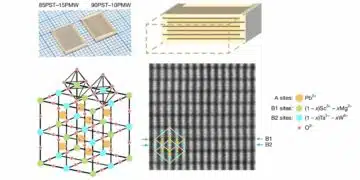




Researchers from University of Cambridge, UK, led by M. Romero and colleagues, have reported a new class of electrocaloric multilayer ceramic capacitors (MLCCs) based on a tailored solid solution of PbSc₀․₅Ta₀․₅O₃ (PST) and PbMg₀․₅W₀․₅O₃ (PMW).
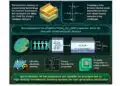
Their work, published in Nature under the title “Electrocaloric effects across room temperature in multilayer capacitors,” demonstrates practical electrocaloric cooling across and below room temperature in a form factor very close to standard MLCC components. This article summarizes the key findings and discusses their relevance for future passive component technologies and solid‑state cooling of electronics.
Electrocaloric effect in a nutshell
The electrocaloric (EC) effect is a reversible temperature change in a dielectric material driven by an electric field. When an electric field is applied, electric dipoles in the ferroelectric material become more ordered, which can reduce entropy and cause the material to heat up or cool down depending on the thermodynamic path. By cycling the electric field and coupling the material to heat exchangers, it is possible to build a solid‑state heat pump – essentially an electrically driven refrigerator without moving mechanical parts or refrigerant gases.
Ferroelectric ceramics such as PST have long been known for strong EC responses, but practical implementation has been limited by narrow temperature windows, high processing demands and reliability concerns under high fields.
From PST to PST–PMW: materials design
Limitations of pure PST
Pure PbSc₀․₅Ta₀․₅O₃ is a classic relaxor ferroelectric that can exhibit large EC temperature changes, but it suffers from two major drawbacks.
- Strong EC effects appear mainly above room temperature, which is not ideal for cooling typical electronic systems operating around ambient.
- Achieving the required B‑site cation ordering (Sc/Ta ordering on the perovskite B‑sites) demands very long, energy‑intensive annealing – reported on the order of weeks – which is impractical for mass production.
Adding PMW: a solid solution approach
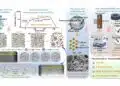
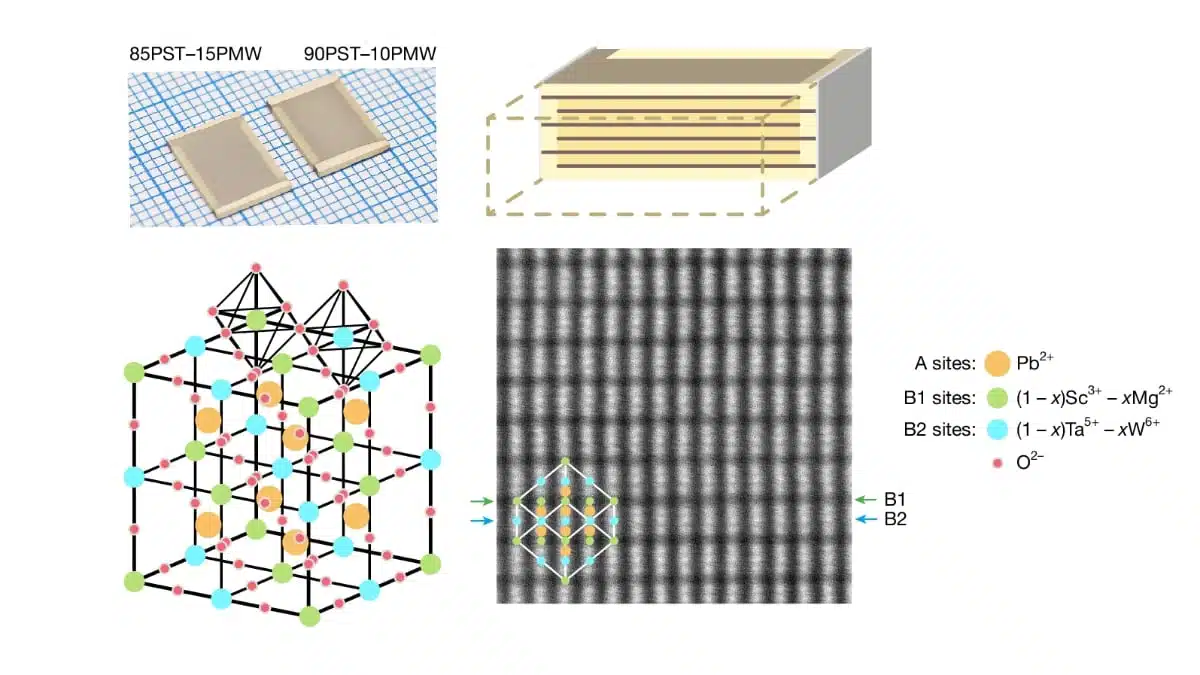
To overcome these issues, the authors develop a solid solution between PST and PbMg₀․₅W₀․₅O₃ (PMW). PMW is another perovskite with different cation valence and size, which helps tune the phase transition while enabling densification at lower temperatures. They systematically screen compositions (1−x)PST–xPMW in the range 0.05 ≤ x ≤ 0.25 and identify two promising candidates, 90PST–10PMW and 85PST–15PMW, as optimal compromises between strong EC performance and broad operating temperature range.
Structural characterization (X‑ray diffraction and STEM) shows that these compositions maintain a very high degree of B‑site ordering (S₁₁₁ ≈ 0.97–0.99) even after conventional sintering at around 1250 °C, without lengthy post‑annealing. At the same time, the Curie‑like transition region is shifted and broadened, so significant EC effects are obtained both below and above room temperature rather than only at elevated temperatures.
Multilayer capacitor structure and processing
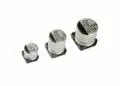
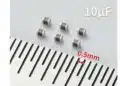
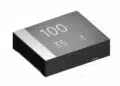
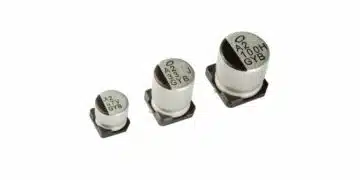
The devices themselves are multilayer ceramic capacitors with a construction quite close to familiar MLCC technology.
- Dielectric: PST–PMW ceramic with compositions near 85PST–15PMW or 90PST–10PMW.
- Electrodes: Silver–palladium internal electrodes compatible with the firing profile.
- Processing: Sintering at about 1250 °C, a compromise between PST and PMW sintering temperatures, yields dense ceramics while preserving B‑site ordering, eliminating the need for 42‑day anneals used in earlier PST systems.
The chips contain multiple active dielectric layers with thickness in the micrometre range, leading to applied fields of roughly 17 V/µm at 600 V total bias. From a component engineering point of view, a key result is that the new EC MLCCs can be processed with realistic ceramic manufacturing conditions and noble‑metal electrodes, bringing them much closer to industrial feasibility than highly idealised test structures.
Electrocaloric performance
Temperature change and entropy change
Electrocaloric performance is evaluated both indirectly (via P–E loops and Maxwell relations) and directly (via calorimetry and temperature measurements).
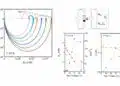
- Indirect measurements indicate temperature changes |ΔT| up to around 4–4.5 K in the active ceramic layers and entropy changes |ΔS| of order 34 kJ·K⁻¹·m⁻³ at about 600 V.
- Direct measurements on the full MLCC chips show effective temperature swings of approximately 3 K, once the thermal mass of electrodes and packaging is taken into account.
Importantly, the strong EC response persists over a broad temperature range from roughly 230 K up through and past room temperature. That is a significant improvement over pure PST‑based devices, which tended to show large EC effects primarily above ambient.
Reliability under high fields
The capacitors are cycled under high electric fields to assess robustness. The reported PST–PMW MLCCs withstand more than 10⁷ electric field cycles at ~17 V/µm (about 600 V across the chip) without dielectric breakdown, while maintaining their EC performance. This level of endurance is critical if EC MLCCs are to be used as active cooling elements in real systems, where millions of cycles are quickly accumulated during operation.
Cooling cycles and efficiency
To understand practical cooling potential, the authors construct thermodynamic EC cooling cycles based on their measured EC maps (entropy and temperature as functions of field). They focus on Brayton‑like cycles with an ideal fluid regenerator and assume nearly complete recovery of electrical work, which is a reasonable target for optimised solid‑state systems.
Key points:
- The volumetric heat pumped per cycle can reach on the order of 9.3 MJ·m⁻³ for temperature lifts typical of electronic cooling tasks.
- For temperature differences around 10 K, the coefficient of performance (COP) can approach about 70% of the Carnot limit, and for larger spans up to ~30 K, the cycle efficiency fraction can approach roughly 90% in their idealised models.
While these values are based on idealised assumptions and do not include all packaging and system‑level losses, they clearly indicate that electrocaloric MLCCs can, in principle, achieve high thermodynamic efficiency compared to conventional compressor‑based cooling.
Practical implications for passive components
From a passive‑component perspective, this work is interesting for several reasons:
- Form factor familiarity: The EC devices are very close to standard MLCCs in geometry and processing, which simplifies thinking about integration on boards or modules.
- Localised, on‑board cooling: Because they are driven electrically and do not require mechanical motion, these capacitors could be placed close to hotspots – power stages, RF power amplifiers, laser drivers, or stacked dies in 3D ICs.
- System simplification: Replacing or supplementing conventional cooling solutions with solid‑state EC modules could eliminate pumps, valves, and refrigerant circuits in certain niche applications.
For the passive component industry, this points toward a new category of “active” capacitors whose primary function is not only energy storage or filtering but also heat pumping. If cost, materials (e.g. lead content) and long‑term reliability challenges are addressed, one could imagine EC‑enabled MLCCs becoming part of thermal management libraries alongside traditional heat sinks and fans.
Potential application areas
Electrocaloric MLCCs are particularly promising where:
- Targeted cooling of small areas is needed. Examples include on‑chip hot spots, power electronics modules, or sensitive optical components.
- Size, noise and vibration must be minimised – in wearable electronics, portable medical devices, or precision instruments
- Traditional air‑cooled heat sinks reach their limits due to high power density and restricted airflow.
In such scenarios, arrays of EC MLCCs could be combined with micro‑heat‑exchangers and regenerators to build compact, silent cooling modules driven only by electrical control signals.
Materials strategy beyond PST–PMW
One of the most important messages of the paper is methodological rather than device‑specific. The approach of combining two perovskite systems to:
- Maintain high B‑site ordering and a strong first‑order phase transition,
- Reduce processing demands (no extremely long anneals), and
- Tailor the transition temperature window around the desired operating range,
can be transferred to other electrocaloric material systems. This materials‑engineering strategy enlarges the design space for future EC dielectrics, potentially including lead‑reduced or lead‑free compositions in the longer term.
Conclusion
The PST–PMW multilayer capacitors demonstrated by Romero et al. show that electrocaloric cooling can be realised in a practical MLCC‑like form factor, with strong and repeatable temperature changes across and below room temperature. By careful materials design, the authors achieve high B‑site ordering and large latent heat without the need for extremely long annealing, while preserving robust dielectric strength under high fields over more than ten million cycles.
The resulting devices deliver temperature swings of around 3 K at realistic voltages and offer promising thermodynamic efficiency in modelled cooling cycles, pointing towards compact, silent solid‑state cooling solutions for electronics and other high‑density systems. For the passive component community, this work signals a potential future in which MLCCs are not only electrical building blocks, but also active elements in thermal management architectures.
Reference
M. Romero et al., “Electrocaloric effects across room temperature in multilayer capacitors,” Nature, 2026, DOI: 10.1038/s41586‑026‑10492‑w