




Passive Components Blog
No Result
View All Result
  • Home
  • NewsFilter
    • All
    • Aerospace & Defence
    • Antenna
    • Applications
    • Automotive
    • Capacitors
    • Circuit Protection Devices
    • electro-mechanical news
    • Filters
    • Fuses
    • Inductors
    • Industrial
    • Integrated Passives
    • inter-connect news
    • Market & Supply Chain
    • Market Insights
    • Medical
    • Modelling and Simulation
    • New Materials & Supply
    • New Technologies
    • Non-linear Passives
    • Oscillators
    • Passive Sensors News
    • Resistors
    • RF & Microwave
    • Telecommunication
    • Weekly Digest

    Tapped Inductor Buck Converter Fundamentals

    TAIYO YUDEN Releases Mini Metal Power Inductors

    Molecular Memristor Shows Record 145 kH Emergent Inductance

    Planar vs Conventional Transformer: When it Make Sense

    Researchers Propose Next‑Gen Compact Memory Using Ultra-thin Ferroelectric Capacitors

    Nichicon ADN Automotive Hybrid Aluminum Capacitors Now Available in EMEA

    Wk 19 Electronics Supply Chain Digest

    Electrocaloric Multilayer Capacitors: Towards Quiet, Solid‑State Cooling Around Room Temperature

    High-Crystallinity Nanocrystalline Composites for MHz Chip Inductors

    Trending Tags

    • Ripple Current
    • RF
    • Leakage Current
    • Tantalum vs Ceramic
    • Snubber
    • Low ESR
    • Feedthrough
    • Derating
    • Dielectric Constant
    • New Products
    • Market Reports
  • VideoFilter
    • All
    • Antenna videos
    • Capacitor videos
    • Circuit Protection Video
    • Filter videos
    • Fuse videos
    • Inductor videos
    • Inter-Connect Video
    • Non-linear passives videos
    • Oscillator videos
    • Passive sensors videos
    • Resistor videos

    Tapped Inductor Buck Converter Fundamentals

    Planar vs Conventional Transformer: When it Make Sense

    Modeling Fringing Field Losses in Inductors & Transformers

    Why Power Inductors Use a Ferrite Core With an Air Gap

    Transformer-Based Power-Line Harvester Magnetic Design

    Thermal Modeling of Magnetics

    Standard vs Planar LLC transformers Comparison for Battery Chargers

    How Modern Tools Model Magnetic Components for Power Electronics

    Advanced Loss Modeling for Planar Magnetics in the Frenetic Planar Tool

    Trending Tags

    • Capacitors explained
    • Inductors explained
    • Resistors explained
    • Filters explained
    • Application Video Guidelines
    • EMC
    • New Products
    • Ripple Current
    • Simulation
    • Tantalum vs Ceramic
  • Knowledge Blog
  • DossiersNew
  • Suppliers
    • Who is Who
  • PCNS
    • PCNS 2025
    • PCNS 2023
    • PCNS 2021
    • PCNS 2019
    • PCNS 2017
  • Events
  • Home
  • NewsFilter
    • All
    • Aerospace & Defence
    • Antenna
    • Applications
    • Automotive
    • Capacitors
    • Circuit Protection Devices
    • electro-mechanical news
    • Filters
    • Fuses
    • Inductors
    • Industrial
    • Integrated Passives
    • inter-connect news
    • Market & Supply Chain
    • Market Insights
    • Medical
    • Modelling and Simulation
    • New Materials & Supply
    • New Technologies
    • Non-linear Passives
    • Oscillators
    • Passive Sensors News
    • Resistors
    • RF & Microwave
    • Telecommunication
    • Weekly Digest

    Tapped Inductor Buck Converter Fundamentals

    TAIYO YUDEN Releases Mini Metal Power Inductors

    Molecular Memristor Shows Record 145 kH Emergent Inductance

    Planar vs Conventional Transformer: When it Make Sense

    Researchers Propose Next‑Gen Compact Memory Using Ultra-thin Ferroelectric Capacitors

    Nichicon ADN Automotive Hybrid Aluminum Capacitors Now Available in EMEA

    Wk 19 Electronics Supply Chain Digest

    Electrocaloric Multilayer Capacitors: Towards Quiet, Solid‑State Cooling Around Room Temperature

    High-Crystallinity Nanocrystalline Composites for MHz Chip Inductors

    Trending Tags

    • Ripple Current
    • RF
    • Leakage Current
    • Tantalum vs Ceramic
    • Snubber
    • Low ESR
    • Feedthrough
    • Derating
    • Dielectric Constant
    • New Products
    • Market Reports
  • VideoFilter
    • All
    • Antenna videos
    • Capacitor videos
    • Circuit Protection Video
    • Filter videos
    • Fuse videos
    • Inductor videos
    • Inter-Connect Video
    • Non-linear passives videos
    • Oscillator videos
    • Passive sensors videos
    • Resistor videos

    Tapped Inductor Buck Converter Fundamentals

    Planar vs Conventional Transformer: When it Make Sense

    Modeling Fringing Field Losses in Inductors & Transformers

    Why Power Inductors Use a Ferrite Core With an Air Gap

    Transformer-Based Power-Line Harvester Magnetic Design

    Thermal Modeling of Magnetics

    Standard vs Planar LLC transformers Comparison for Battery Chargers

    How Modern Tools Model Magnetic Components for Power Electronics

    Advanced Loss Modeling for Planar Magnetics in the Frenetic Planar Tool

    Trending Tags

    • Capacitors explained
    • Inductors explained
    • Resistors explained
    • Filters explained
    • Application Video Guidelines
    • EMC
    • New Products
    • Ripple Current
    • Simulation
    • Tantalum vs Ceramic
  • Knowledge Blog
  • DossiersNew
  • Suppliers
    • Who is Who
  • PCNS
    • PCNS 2025
    • PCNS 2023
    • PCNS 2021
    • PCNS 2019
    • PCNS 2017
  • Events
No Result
View All Result
Passive Components Blog
No Result
View All Result

TAIYO YUDEN Releases Mini Metal Power Inductors

13.5.2026
Reading Time: 7 mins read
A A

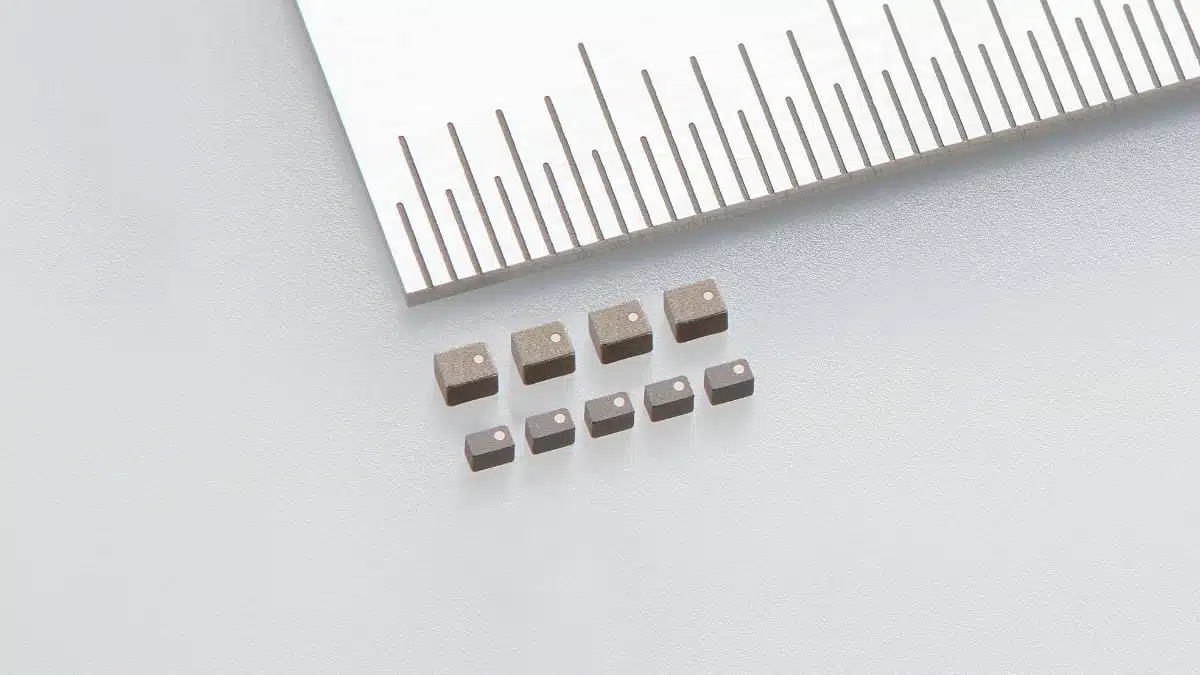
TAIYO YUDEN has expanded its MCOIL LSCN series with nine new multilayer metal SMD power inductors in ultra‑compact case sizes aimed at power stages in smartphones and wearable devices.

The new SMD inductor parts focus on reducing footprint while maintaining current capability and DC saturation performance, which is critical where every square millimeter of PCB and every milliamp of efficiency matters.

RelatedPosts

Conductive Polymer Capacitor Market and Design‑In Guide to 2035

Taiyo Yuden Releases 165C Automotive Multilayer Metal Power Inductor in 1608 Size

TAIYO YUDEN Extends Polymer Hybrid Aluminum Capacitors with Higher Ripple Current and Lower Profile

Key features and benefits

  • Miniaturized case sizes for high‑density designs
    The new inductors are released in four compact footprints, including 0.8 x 0.45 x 0.65 mm and 1.0 x 0.8 x 0.80 mm, enabling tighter layouts in compact devices where board space is heavily constrained.
  • Significant footprint reduction vs. previous generation
    The LSCND0805FET1R2MJ achieves roughly 30% smaller footprint than the company’s previous smallest multilayer metal power inductor rated at 1.0 x 0.5 x 0.33 mm, supporting further size reduction in ultra‑miniaturized modules.
  • Smaller size at equivalent electrical performance
    The LSCND1008HKT1R5MF, specified with nominal inductance of 1.5 microhenry and saturation current of 1.2 ampere, offers about 40% smaller footprint than the earlier LSCNB1210EKT1R5MB while maintaining similar inductance and saturation current, which means designers can free up PCB area without sacrificing power capability.
  • Metallic magnetic material with strong DC saturation characteristics
    By using metallic magnetic core materials, the inductors keep inductance more stable under DC bias compared to many ferrite solutions, improving efficiency and helping buck converters maintain regulation at higher load currents.
  • Optimized for efficiency and battery runtime
    The combination of small case size, low profile, and good saturation behavior supports high‑efficiency power stages, which translates into longer battery life in smartphones, smartwatches, and TWS earphones where average and peak loads continue to increase.
  • Volume production readiness
    Mass production started in April 2026 at TAIYO YUDEN’s Wakayama facility, with samples available, which is relevant for OEMs needing secure supply for upcoming design cycles in consumer and wearable platforms.

Typical applications

TAIYO YUDEN positions the new MCOIL LSCN series parts primarily as choke coils in compact DC‑DC converter stages. In practice, they fit into several common use cases in handheld and wearable platforms:

  • Power supply choke for application processors and baseband SoCs in smartphones, where high transient currents combine with aggressive board area targets.
  • Buck/boost converter output inductors in smartwatches and fitness bands, with strict thickness and footprint budgets under the main board shield can.
  • DC‑DC inductors in TWS earphones and charging cases, supporting functions such as active noise cancellation, Bluetooth radio, and audio signal processing in very small modules.
  • Local regulation stages for imaging subsystems, sensors, and AI co‑processors in mobile platforms, where small inductors allow regulators to be placed closer to the load.
  • General compact consumer electronics, such as portable audio and small IoT nodes, where high‑current inductors in sub‑millimeter footprints can simplify power tree integration.

In all of these applications, the trade‑off between footprint, height, inductor value, and saturation current is critical, and the new parts are targeted exactly at designs where this balance is under pressure.

Technical highlights

While the press release focuses on flagship examples, the new lineup consists of nine multilayer metal power inductors across four package sizes within the MCOIL LSCN family. Detailed values for each part number, such as DCR, inductance tolerance, and full current ratings, should be taken directly from the manufacturer’s datasheet.

Example performance specifications

Part numberCase size (L x W x H, mm)Nominal inductanceSaturation currentKey benefit vs. previous part
LSCND0805FET1R2MJ0.8 x 0.45 x 0.65According to datasheetAccording to datasheetFootprint about 30% smaller than earlier 1.0 x 0.5 mm device
LSCND1008HKT1R5MF1.0 x 0.8 x 0.801.5 microhenry1.2 ampereFootprint about 40% smaller than LSCNB1210EKT1R5MB at equivalent rating
LSCNB1210EKT1R5MB1.25 x 1.05 x 0.51.5 microhenry1.2 ampereReference point for footprint reduction

The reduction in footprint without downgrading inductance or saturation current is particularly important in power trees where the inductor is one of the larger discrete components. Moving from a 1.25 x 1.05 mm footprint to 1.0 x 0.8 mm can free routing channels and may allow narrower module outlines or more functionality in the same board area.

Manufacturing and supply

Mass production of the new LSCN series inductors has started at WAKAYAMA TAIYO YUDEN CO., LTD. in Japan. This indicates that the devices are not just engineering samples but are already in volume production, which is relevant for projects entering qualification and ramp. Samples are indicated at a nominal price of 50 yen per unit, giving purchasing teams an initial cost benchmark for early bill‑of‑materials estimation.

For final cost and supply chain planning, OEMs should confirm pricing and availability through authorized distributors or direct TAIYO YUDEN channels, as actual price will depend on volume, logistics, and commercial terms.

Design‑in notes for engineers

  • Check DC bias and saturation margin
    Metal composite inductors typically exhibit better DC saturation characteristics than many ferrites, but designers should still confirm that the inductance at peak load current remains within the range required for converter stability and ripple current. Using the inductance vs. current curves in the datasheet helps set an adequate margin.
  • Balance footprint against loss and temperature rise
    Smaller inductors have less core and copper volume, so they can run hotter at the same current. It is important to check both rated current and temperature rise current in the datasheet, and to simulate or measure worst‑case operating conditions, especially in sealed wearable enclosures with limited airflow.
  • Consider height and mechanical constraints
    The new LSCN parts offer low profiles down to around 0.65–0.80 mm, which is key under shielding cans and inside stacked assemblies such as TWS earphones. Mechanical clearance to lids, batteries, and RF shields should be verified early in layout.
  • Place inductors close to the converter
    In noise‑sensitive designs like Bluetooth audio and RF front‑ends, routing from the power IC to the inductor should be as short and wide as possible to reduce parasitic inductance and radiated emissions. The reduced footprint of these LSCN inductors can help place them closer to the power stage pins.
  • EMC and audible noise considerations
    Metal composite structures can offer favorable noise characteristics, but designers should still consider EMC test results of the complete converter and, where necessary, pair these inductors with proper layout practices and input/output filtering to meet regulatory or customer‑specific limits.
  • Use manufacturer tools and documentation
    For detailed electrical characteristics, temperature coefficients, and recommended land patterns, engineers should refer to the individual LSCN series datasheets and any design support tools provided by TAIYO YUDEN. This is particularly important when pushing operating temperature or current close to rated limits.

Source

This article is based on information from an official TAIYO YUDEN press release on the launch of new MCOIL LSCN series multilayer metal power inductors, complemented by the manufacturer’s online product information and search tools.

References

  1. TAIYO YUDEN press release – “TAIYO YUDEN Launches New Metal Power Inductors Combining Advanced Performance with a Smaller Size”
  2. TAIYO YUDEN product search – MCOIL LSCN series (LSCND…)

Related

Recent Posts

Tapped Inductor Buck Converter Fundamentals

13.5.2026
3

Planar vs Conventional Transformer: When it Make Sense

11.5.2026
32

High-Crystallinity Nanocrystalline Composites for MHz Chip Inductors

7.5.2026
63

Würth Elektronik Introduces Compact Flat-wire SMT Power Inductors for Automotive

5.5.2026
49

Modeling Fringing Field Losses in Inductors & Transformers

30.4.2026
52

Modelithics Releases COMPLETE v26.1 for Keysight ADS

23.4.2026
23

April 2026 Interconnect, Passives and Electromechanical Components Market Insights

22.4.2026
140

Why Power Inductors Use a Ferrite Core With an Air Gap

20.4.2026
105

TDK Introduces High‑Voltage Common‑Mode Chokes for Compact 1250 V DC Converters

16.4.2026
51

Upcoming Events

May 13
17:00 - 17:30 CEST

Winding Loss Modeling for Toroidal Magnetics – Including Gapped Cores

May 19
16:00 - 17:00 CEST

Designing Qi2 Wireless Power Systems: Practical Development and EMC Optimization

Jun 2
16:00 - 17:00 CEST

Calculation, Simulation and Measurement of 800V EMC Filters

View Calendar

Popular Posts

  • Buck Converter Design and Calculation

    0 shares
    Share 0 Tweet 0
  • Boost Converter Design and Calculation

    0 shares
    Share 0 Tweet 0
  • Flyback Converter Design and Calculation

    0 shares
    Share 0 Tweet 0
  • LLC Resonant Converter Design and Calculation

    0 shares
    Share 0 Tweet 0
  • MLCC and Ceramic Capacitors

    0 shares
    Share 0 Tweet 0
  • Dual Active Bridge (DAB) Topology

    0 shares
    Share 0 Tweet 0
  • Capacitor Charging and Discharging

    0 shares
    Share 0 Tweet 0
  • What Electronics Engineer Needs to Know About Passive Low Pass Filters

    0 shares
    Share 0 Tweet 0
  • Ripple Current and its Effects on the Performance of Capacitors

    3 shares
    Share 3 Tweet 0
  • MLCC Case Sizes Standards Explained

    0 shares
    Share 0 Tweet 0

Newsletter Subscription


Passive Components Blog

© EPCI - Leading Passive Components Educational and Information Site

  • Home
  • Privacy Policy
  • EPCI Membership & Advertisement
  • About

No Result
View All Result
  • Home
  • Knowledge Blog
  • PCNS

© EPCI - Leading Passive Components Educational and Information Site

This website uses cookies. By continuing to use this website you are giving consent to cookies being used. Visit our Privacy and Cookie Policy.
Go to mobile version