










Passive Components Blog
No Result
View All Result
  • Home
  • NewsFilter
    • All
    • Aerospace & Defence
    • Antenna
    • Applications
    • Automotive
    • Capacitors
    • Circuit Protection Devices
    • electro-mechanical news
    • Filters
    • Fuses
    • Inductors
    • Industrial
    • Integrated Passives
    • inter-connect news
    • Market & Supply Chain
    • Market Insights
    • Medical
    • Modelling and Simulation
    • New Materials & Supply
    • New Technologies
    • Non-linear Passives
    • Oscillators
    • Passive Sensors News
    • Resistors
    • RF & Microwave
    • Telecommunication
    • Weekly Digest

    Designing a 2 kW LLC Transformer with Integrated Resonant Inductor

    Middle East Conflict: The Potential Impact to Passive Components

    Inductor Technology Dossier

    Coilcraft Releases TLVR Inductors for High Density VRMs and PoL Converters

    Rutheniums Critical Role in Passive Component Supply Chains

    Bourns Expands its Modular Contacts for Power-Dense Systems

    Murata to Decouple China Rare Earth Supply in 3 Years

    Samtec AcceleRate Slim ARC6 Cable Assemblies with New Signaling Options

    Hirose Electric to Establish Automotive Connector Plant in India

    Trending Tags

    • Ripple Current
    • RF
    • Leakage Current
    • Tantalum vs Ceramic
    • Snubber
    • Low ESR
    • Feedthrough
    • Derating
    • Dielectric Constant
    • New Products
    • Market Reports
  • VideoFilter
    • All
    • Antenna videos
    • Capacitor videos
    • Circuit Protection Video
    • Filter videos
    • Fuse videos
    • Inductor videos
    • Inter-Connect Video
    • Non-linear passives videos
    • Oscillator videos
    • Passive sensors videos
    • Resistor videos

    Thermal Modeling of Magnetics

    Standard vs Planar LLC transformers Comparison for Battery Chargers

    How Modern Tools Model Magnetic Components for Power Electronics

    Advanced Loss Modeling for Planar Magnetics in the Frenetic Planar Tool

    2026 Power Magnetics Design Trends: Flyback, DAB and Planar

    Enabling Software‑Defined Vehicle Architectures: Automotive Ethernet and Zonal Smart Power

    Calculating Resistance Value of a Flyback RC Snubber 

    One‑Pulse Characterization of Nonlinear Power Inductors

    Thermistor Linearization Challenges

    Trending Tags

    • Capacitors explained
    • Inductors explained
    • Resistors explained
    • Filters explained
    • Application Video Guidelines
    • EMC
    • New Products
    • Ripple Current
    • Simulation
    • Tantalum vs Ceramic
  • Knowledge Blog
  • DossiersNew
  • Suppliers
    • Who is Who
  • PCNS
    • PCNS 2025
    • PCNS 2023
    • PCNS 2021
    • PCNS 2019
    • PCNS 2017
  • Events
  • Home
  • NewsFilter
    • All
    • Aerospace & Defence
    • Antenna
    • Applications
    • Automotive
    • Capacitors
    • Circuit Protection Devices
    • electro-mechanical news
    • Filters
    • Fuses
    • Inductors
    • Industrial
    • Integrated Passives
    • inter-connect news
    • Market & Supply Chain
    • Market Insights
    • Medical
    • Modelling and Simulation
    • New Materials & Supply
    • New Technologies
    • Non-linear Passives
    • Oscillators
    • Passive Sensors News
    • Resistors
    • RF & Microwave
    • Telecommunication
    • Weekly Digest

    Designing a 2 kW LLC Transformer with Integrated Resonant Inductor

    Middle East Conflict: The Potential Impact to Passive Components

    Inductor Technology Dossier

    Coilcraft Releases TLVR Inductors for High Density VRMs and PoL Converters

    Rutheniums Critical Role in Passive Component Supply Chains

    Bourns Expands its Modular Contacts for Power-Dense Systems

    Murata to Decouple China Rare Earth Supply in 3 Years

    Samtec AcceleRate Slim ARC6 Cable Assemblies with New Signaling Options

    Hirose Electric to Establish Automotive Connector Plant in India

    Trending Tags

    • Ripple Current
    • RF
    • Leakage Current
    • Tantalum vs Ceramic
    • Snubber
    • Low ESR
    • Feedthrough
    • Derating
    • Dielectric Constant
    • New Products
    • Market Reports
  • VideoFilter
    • All
    • Antenna videos
    • Capacitor videos
    • Circuit Protection Video
    • Filter videos
    • Fuse videos
    • Inductor videos
    • Inter-Connect Video
    • Non-linear passives videos
    • Oscillator videos
    • Passive sensors videos
    • Resistor videos

    Thermal Modeling of Magnetics

    Standard vs Planar LLC transformers Comparison for Battery Chargers

    How Modern Tools Model Magnetic Components for Power Electronics

    Advanced Loss Modeling for Planar Magnetics in the Frenetic Planar Tool

    2026 Power Magnetics Design Trends: Flyback, DAB and Planar

    Enabling Software‑Defined Vehicle Architectures: Automotive Ethernet and Zonal Smart Power

    Calculating Resistance Value of a Flyback RC Snubber 

    One‑Pulse Characterization of Nonlinear Power Inductors

    Thermistor Linearization Challenges

    Trending Tags

    • Capacitors explained
    • Inductors explained
    • Resistors explained
    • Filters explained
    • Application Video Guidelines
    • EMC
    • New Products
    • Ripple Current
    • Simulation
    • Tantalum vs Ceramic
  • Knowledge Blog
  • DossiersNew
  • Suppliers
    • Who is Who
  • PCNS
    • PCNS 2025
    • PCNS 2023
    • PCNS 2021
    • PCNS 2019
    • PCNS 2017
  • Events
No Result
View All Result
Passive Components Blog
No Result
View All Result

How to Weaken the Link Between Component Shortages & Counterfeits

19.3.2019
Reading Time: 4 mins read
A A

Source: EPSnews

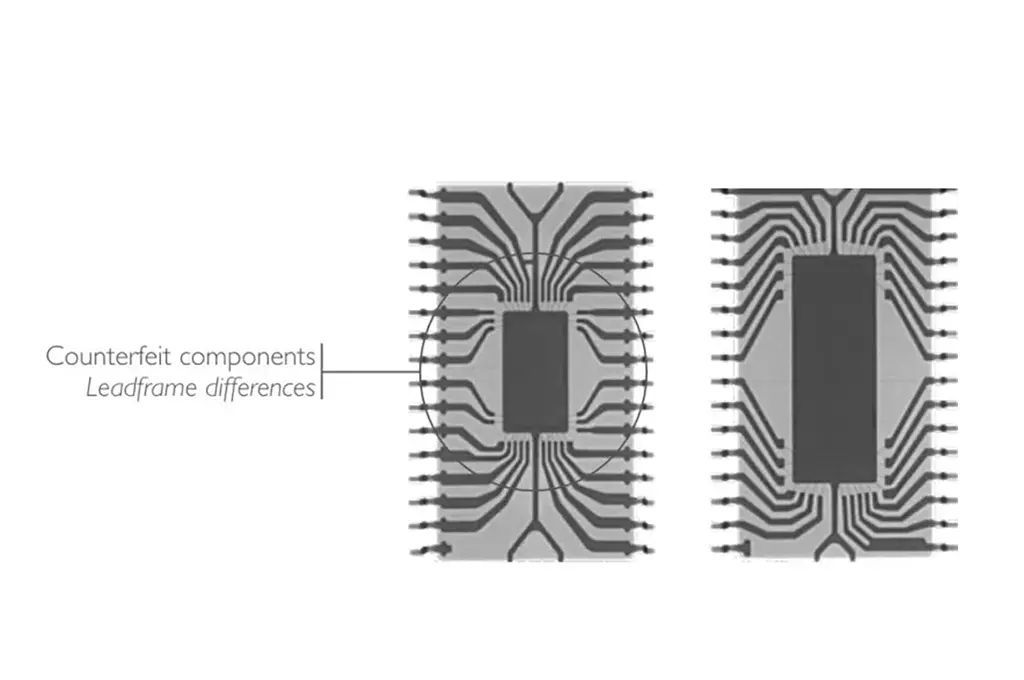
by EBN and Dr. Bill Cardoso, CEO of Creative Electron. Component shortages always prompt OEMs and EMS providers to seek alternative sources. Periods of scarcity also exacerbate the flow of counterfeit devices into the electronics supply chain.

RelatedPosts

Designing a 2 kW LLC Transformer with Integrated Resonant Inductor

Middle East Conflict: The Potential Impact to Passive Components

Inductor Technology Dossier

The extent of this problem remains an unknown as incidents of counterfeits are under-reported. But there are estimates:

  • The counterfeit semiconductor market has reached $75 billion according to Industry Week.
  • Havocscope estimates that $169 billion in counterfeit parts are currently circulating in the marketplace.
  • The United States Government seized $123,892 million in counterfeit electronics in 2016 (the most current year tracked by the Department of Homeland Security in its Year End Intellectual Property Rights Review).

EPSNews’ sister publication, EBN, recently interviewed Dr. Bill Cardoso, CEO of Creative Electron, to get his thoughts on the link between component shortages and counterfeit devices. Creative Electron is in the trenches of the battle against counterfeits, building x-ray inspection systems that identify fake parts.

EBN: What are the most difficult challenges facing component suppliers and OEMs today?

Cardoso: OEMs and EMS companies are facing the same issues with components and put simply: it is getting the right devices, in the right quantity to the line when they’re needed. I know that sounds like an over simplification, but it’s not. A surface mount technology (SMT) line can stop for many reasons, but the largest culprit is materials management. We invest millions trying to speed up the line and product changeover then we stop that line and lose efficiency because the component we need is missing, or even worse, incorrect.

It starts in the supply chain, where component shortages have occurred recently for several reasons, like companies trying to phase out devices and encourage redesigns. But it doesn’t stop there. When goods reach the factory, they need to be inspected and counted. Once in the factory material management systems they need to be tracked, spoilage and waste calculated, and their veracity ensured.

Veracity brings me to the other major challenge to the industry and that is counterfeiting. Counterfeiting is costing the industry billions and needs to be stamped out through detection and better materials traceability.

EBN: In the current electronics component shortage, customers are more willing to go to different sources. What advice do you have for OEMs about best practices to minimize counterfeit risk?

Cardoso: Absolutely, counterfeit numbers always grow when component shortages disrupt the supply chain. And yes, people have to get components from sources they may not normally like to use, like the grey market. The only two tools for counterfeit reduction are traceability and detection, and I’d suggest manufacturers need both.

We have worked with numerous companies to assist in this area and counterfeit detection has become an important part of the products we offer. There’s a whole lot of advice and resources on our website about counterfeit detection using x-ray, including a great article written by our very own VP of Technology Dr. Glen Thomas, entitled ‘Counterfeit Detection Using X-Ray Image as a Fingerprint’.

We worked hard to make our customers lives as simple as possible in this area, using artificial intelligence (AI) to make detection simpler and more automated. Our AI systems are recognizing anomalies in component images and flagging them for further investigation.

My advice to manufacturers is have a fully traceable supply chain, but not to rely on it. Do your own inspection and test to make sure what you are putting on a PCB is what you and your customer is expecting! Whilst criminal, it’s important to remember counterfeiting is very profitable and the bad guys will go to a lot of effort to protect their business. It’s an arms race as they get smarter in producing and hiding counterfeits and we get better at detecting them.

EBN: How has component testing evolved recently? What should OEMs know about current capabilities and technologies?

Cardoso: As mentioned, the biggest development we see is the use of artificial intelligence to learn what a good component looks like and to throw up a flag when an outlier is detected. This needs to be done economically and at speed. We do it in our Parts Counter as a by-product of an essential process. Components are lost when reels are changed, so usage number do not tell the whole story. More and more manufacturers look to x-ray inspection for the exact number of components on a reel before it is returned to stores or delivered to the line. If we can check for counterfeits when we x-ray to count, that offer minimum disruption and no additional cost or investment.

What OEMs and EMS companies need to know is that solutions exist, are in relatively inexpensive and reliable. They will only get better, smarter and more reliable.

EBN: What trends are you seeing in terms of testing and how will those evolve over the next few years?

Cardoso: I think test and inspection data is fast becoming the currency of the smart factory and many people agree with me. I recently took part in a debate on this topic with vendors from AOI and Thermal Process inspection on that very topic chaired by one of your writers, Philip Spagnoli Stoten, during the APEX Expo in San Diego. This was picked up by EBN as Electronics Supply Chain Roundtable: Is Inspection Data the Currency of the Smart Factory?

For me, there is a clear trend towards data from inspection and test being used collectively to create better processes in manufacturing rather than just playing a go-no-go role. X-ray, like other non-contact optical inspections, is a unique process because of its non-destructive nature and has a huge role to play in delivering good contextualized data.

In my view inspection and test will become part of the solution, not merely the identification of the problem.


featured image source: Creative Electron
Related

Recent Posts

Middle East Conflict: The Potential Impact to Passive Components

20.3.2026
11

Inductor Technology Dossier

19.3.2026
27

Rutheniums Critical Role in Passive Component Supply Chains

19.3.2026
17

Murata to Decouple China Rare Earth Supply in 3 Years

19.3.2026
94

Hirose Electric to Establish Automotive Connector Plant in India

19.3.2026
8

Samsung Outlines Growth Roadmap at its 52nd General Shareholders Meeting

19.3.2026
14

February 2026 Interconnect, Passives and Electromechanical Components Market Insights

9.3.2026
84

ECIA February 2026 Industry Pulse Signals Strong Component Growth

6.3.2026
37

Inductors and Ferrite Beads Price Hikes 

5.3.2026
90

Upcoming Events

Mar 21
All day

PSMA Capacitor Workshop 2026

Mar 24
9:00 - 10:00 CET

Power protection in the digital age – eFuse and hot-swap strategies for modern data center design

Apr 21
16:00 - 17:00 CEST

Heatsink Solutions: Thermal Management in electronic devices

View Calendar

Popular Posts

  • Buck Converter Design and Calculation

    0 shares
    Share 0 Tweet 0
  • Boost Converter Design and Calculation

    0 shares
    Share 0 Tweet 0
  • Flyback Converter Design and Calculation

    0 shares
    Share 0 Tweet 0
  • LLC Resonant Converter Design and Calculation

    0 shares
    Share 0 Tweet 0
  • MLCC Manufacturers Consider Price Increase as AI Demand Outpaces Supply

    0 shares
    Share 0 Tweet 0
  • MLCC and Ceramic Capacitors

    0 shares
    Share 0 Tweet 0
  • Dual Active Bridge (DAB) Topology

    0 shares
    Share 0 Tweet 0
  • Ripple Current and its Effects on the Performance of Capacitors

    3 shares
    Share 3 Tweet 0
  • MLCC Case Sizes Standards Explained

    0 shares
    Share 0 Tweet 0
  • What is a Dielectric Constant and DF of Plastic Materials?

    4 shares
    Share 4 Tweet 0

Newsletter Subscription


Passive Components Blog

© EPCI - Leading Passive Components Educational and Information Site

  • Home
  • Privacy Policy
  • EPCI Membership & Advertisement
  • About

No Result
View All Result
  • Home
  • Knowledge Blog
  • PCNS

© EPCI - Leading Passive Components Educational and Information Site

This website uses cookies. By continuing to use this website you are giving consent to cookies being used. Visit our Privacy and Cookie Policy.
Go to mobile version