






Passive Components Blog
No Result
View All Result
  • Home
  • NewsFilter
    • All
    • Aerospace & Defence
    • Antenna
    • Applications
    • Automotive
    • Capacitors
    • Circuit Protection Devices
    • electro-mechanical news
    • Filters
    • Fuses
    • Inductors
    • Industrial
    • Integrated Passives
    • inter-connect news
    • Market & Supply Chain
    • Market Insights
    • Medical
    • Modelling and Simulation
    • New Materials & Supply
    • New Technologies
    • Non-linear Passives
    • Oscillators
    • Passive Sensors News
    • Resistors
    • RF & Microwave
    • Telecommunication
    • Weekly Digest

    Wk 5 Electronics Supply Chain Digest

    Top 10 Connector Vendors by Product Type

    Bourns Releases High‑Q Air Coil Inductors for RF Aplications

    CMSE 2026 Announces Call for Presentations on High-Reliability Military and Space Electronics

    ESA Call for Papers 6th Space Passive Component Days – SPCD 2026

    Würth Elektronik Offers Halogen‑Free EMC Gaskets for Displays and Housings

    Component Distribution Supply Chain January 2026

    Binder Unveils M8 Flange Solder Connectors for Flexible Cabling

    Power Electronics Tools for Passives and Magnetic Designs

    Trending Tags

    • Ripple Current
    • RF
    • Leakage Current
    • Tantalum vs Ceramic
    • Snubber
    • Low ESR
    • Feedthrough
    • Derating
    • Dielectric Constant
    • New Products
    • Market Reports
  • VideoFilter
    • All
    • Antenna videos
    • Capacitor videos
    • Circuit Protection Video
    • Filter videos
    • Fuse videos
    • Inductor videos
    • Inter-Connect Video
    • Non-linear passives videos
    • Oscillator videos
    • Passive sensors videos
    • Resistor videos

    One‑Pulse Characterization of Nonlinear Power Inductors

    Thermistor Linearization Challenges

    Coaxial Connectors and How to Connect with PCB

    PCB Manufacturing, Test Methods, Quality and Reliability

    Transformer Behavior – Current Transfer and Hidden Feedback

    Choosing the Right Capacitor: The Importance of Accurate Measurements

    RF Inductors: Selection and Design Challenges for High-Frequency Circuits

    Transformer Safety IEC 61558 Standard

    3-Phase EMI Filter Design, Simulation, Calculation and Test

    Trending Tags

    • Capacitors explained
    • Inductors explained
    • Resistors explained
    • Filters explained
    • Application Video Guidelines
    • EMC
    • New Products
    • Ripple Current
    • Simulation
    • Tantalum vs Ceramic
  • Knowledge Blog
  • DossiersNew
  • Suppliers
    • Who is Who
  • PCNS
    • PCNS 2025
    • PCNS 2023
    • PCNS 2021
    • PCNS 2019
    • PCNS 2017
  • Events
  • Home
  • NewsFilter
    • All
    • Aerospace & Defence
    • Antenna
    • Applications
    • Automotive
    • Capacitors
    • Circuit Protection Devices
    • electro-mechanical news
    • Filters
    • Fuses
    • Inductors
    • Industrial
    • Integrated Passives
    • inter-connect news
    • Market & Supply Chain
    • Market Insights
    • Medical
    • Modelling and Simulation
    • New Materials & Supply
    • New Technologies
    • Non-linear Passives
    • Oscillators
    • Passive Sensors News
    • Resistors
    • RF & Microwave
    • Telecommunication
    • Weekly Digest

    Wk 5 Electronics Supply Chain Digest

    Top 10 Connector Vendors by Product Type

    Bourns Releases High‑Q Air Coil Inductors for RF Aplications

    CMSE 2026 Announces Call for Presentations on High-Reliability Military and Space Electronics

    ESA Call for Papers 6th Space Passive Component Days – SPCD 2026

    Würth Elektronik Offers Halogen‑Free EMC Gaskets for Displays and Housings

    Component Distribution Supply Chain January 2026

    Binder Unveils M8 Flange Solder Connectors for Flexible Cabling

    Power Electronics Tools for Passives and Magnetic Designs

    Trending Tags

    • Ripple Current
    • RF
    • Leakage Current
    • Tantalum vs Ceramic
    • Snubber
    • Low ESR
    • Feedthrough
    • Derating
    • Dielectric Constant
    • New Products
    • Market Reports
  • VideoFilter
    • All
    • Antenna videos
    • Capacitor videos
    • Circuit Protection Video
    • Filter videos
    • Fuse videos
    • Inductor videos
    • Inter-Connect Video
    • Non-linear passives videos
    • Oscillator videos
    • Passive sensors videos
    • Resistor videos

    One‑Pulse Characterization of Nonlinear Power Inductors

    Thermistor Linearization Challenges

    Coaxial Connectors and How to Connect with PCB

    PCB Manufacturing, Test Methods, Quality and Reliability

    Transformer Behavior – Current Transfer and Hidden Feedback

    Choosing the Right Capacitor: The Importance of Accurate Measurements

    RF Inductors: Selection and Design Challenges for High-Frequency Circuits

    Transformer Safety IEC 61558 Standard

    3-Phase EMI Filter Design, Simulation, Calculation and Test

    Trending Tags

    • Capacitors explained
    • Inductors explained
    • Resistors explained
    • Filters explained
    • Application Video Guidelines
    • EMC
    • New Products
    • Ripple Current
    • Simulation
    • Tantalum vs Ceramic
  • Knowledge Blog
  • DossiersNew
  • Suppliers
    • Who is Who
  • PCNS
    • PCNS 2025
    • PCNS 2023
    • PCNS 2021
    • PCNS 2019
    • PCNS 2017
  • Events
No Result
View All Result
Passive Components Blog
No Result
View All Result

Murata Adds Component Functionality to SimSurfing Design Support Software

21.9.2018
Reading Time: 3 mins read
A A

Source: Murata news

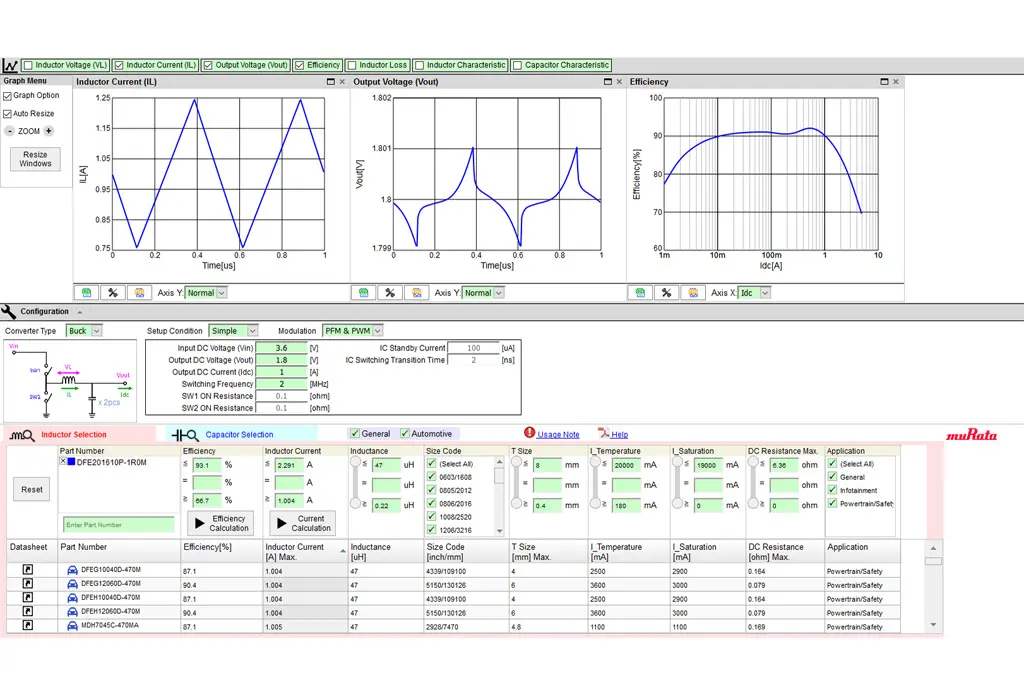
Nagaokakyo, Kyoto Prefecture, Japan, September 21, 2018 – Murata today announced that it has integrated a DC-DC converter design inductor/capacitor selection support tool (DC-DC converter tool) into its SimSurfing power circuit design support software. Additionally, a noise filter selection support tool (noise filter tool) is scheduled to be incorporated by end of September.

RelatedPosts

Wk 5 Electronics Supply Chain Digest

Top 10 Connector Vendors by Product Type

Bourns Releases High‑Q Air Coil Inductors for RF Aplications

SimSurfing is an online-based power circuit design support software tool that supports circuit designers and component engineers. Using SimSurfing, the optimal components can be selected quickly and easily by visually checking graphs that represent the impedance, transmission, and reflection characteristics of various Murata products such as capacitors, inductors and EMI suppression filters (ferrite beads and common mode choke coils). The software can be accessed free of charge on the Murata website: https://www.murata.com/tool.

Given that both of these tools are online, the component characteristics of new Murata products will be immediately included in the SimSurfing library. This allows engineers to select optimal components from the latest DC-DC converter and noise filter solutions. Moreover, to make more advanced design capabilities possible, Murata also incorporated a wealth of design guidance developed over many years.

Features of the New Tools

DC-DC converter design inductor/capacitor selection support tool
DC-DC converters are composed of many types of power inductors and capacitors. This makes it difficult to select suitable components that create highly efficient DC-DC converters meeting specific requirements. In many cases, the actions involved in configuring a DC-DC converter cannot be ascertained until the circuit has actually been configured.

Indicators used to evaluate the performance of DC-DC converters include a) efficiency*1, b) ripple current*2, and c) load transient response characteristics*3. In the past, analyzing these indicators took long hours of advanced technology analysis using proprietary software.

The new DC-DC converter tool is equipped with a function that enables the high-speed simulation of DC-DC converter behavior. The tool performs high-speed analysis and representation of the actions and performance of DC-DC converters (a-c above) by inputting the minimum parameters such as the input and output voltages, switching frequency, inductance and capacitance. This makes it easy for an engineer to select optimal inductors and capacitors for the task at hand, resulting in a substantial shortening of the overall design time.

This DC-DC converter tool is compatible with a wide range of applications including equipment for automotive and smartphone use. In addition, Murata incorporated a wealth of database information and measurement know-how on power inductor loss for DC-DC converters.

*3 c: The analysis function for load response characteristics is scheduled to be added in 2019.

Noise filter selection support tool
In general, noise filters are made up of complex combinations of inductors, capacitors, ferrite beads and common mode choke coils. Filter circuits are designed with impedance peaks set at multiple frequencies. During the conventional design process, it is difficult to specify the filter types (element configuration) and the constants for each element. Furthermore, it takes time to perform analysis on design circuits because of the need for engineers to obtain the characteristic data for multiple devices from component manufacturers, load this data and then conduct simulations.

This new noise filter tool leverages abundant noise countermeasures know-how developed over many years. With this new tool, engineers can freely select and combine inductors, capacitors, ferrite beads and common mode choke coils with various characteristics and analyze noise filter circuit characteristics for any desired frequency, while also analyzing losses in both the common mode and the differential mode. In addition, it supports the design of circuitry corresponding to “CISPR25,” the international standard used for circuit protection from noise externally radiated by automotive electronic components.

Product website
DC-DC converter design inductor/capacitor selection support tool can be found at: https://ds.murata.co.jp/mpst/. The link to the noise filter selection support tool will be announced by end of September

Explanation of Terms
*1 Output power ÷ input power
*2 A pulsation component included in direct current
*3 The response characteristics of the output voltage in response to fluctuations in the load current
Related

Recent Posts

Bourns Releases High‑Q Air Coil Inductors for RF Aplications

29.1.2026
24

CMSE 2026 Announces Call for Presentations on High-Reliability Military and Space Electronics

28.1.2026
36

ESA Call for Papers 6th Space Passive Component Days – SPCD 2026

28.1.2026
27

Samsung Q4 2025 Results: MLCC focus for AI, Server and Automotive

26.1.2026
84

Würth Elektronik Developed a Custom Transformer for Active Hand Orthosis

26.1.2026
40

Capacitor Technology Dossier

26.1.2026
107

Passive Components in Quantum Computing

22.1.2026
131

Miniaturization of MLCCs and Electrolytics, KAVX Tech Chat

21.1.2026
75

Exxelia Offers Custom Naval Transformers and Inductors

21.1.2026
18

Upcoming Events

Feb 24
16:00 - 17:00 CET

Designing Qi2 Wireless Power Systems: Practical Development and EMC Optimization

Mar 3
16:00 - 17:00 CET

Cybersecurity at the Eleventh Hour – from RED to CRA – Information and Discussion

Mar 21
All day

PSMA Capacitor Workshop 2026

View Calendar

Popular Posts

  • Buck Converter Design and Calculation

    0 shares
    Share 0 Tweet 0
  • Boost Converter Design and Calculation

    0 shares
    Share 0 Tweet 0
  • LLC Resonant Converter Design and Calculation

    0 shares
    Share 0 Tweet 0
  • Flyback Converter Design and Calculation

    0 shares
    Share 0 Tweet 0
  • Ripple Current and its Effects on the Performance of Capacitors

    3 shares
    Share 3 Tweet 0
  • How Metal Prices Are Driving Passive Component Price Hikes

    0 shares
    Share 0 Tweet 0
  • MLCC and Ceramic Capacitors

    0 shares
    Share 0 Tweet 0
  • Dual Active Bridge (DAB) Topology

    0 shares
    Share 0 Tweet 0
  • What is a Dielectric Constant and DF of Plastic Materials?

    4 shares
    Share 4 Tweet 0
  • Degradation of Capacitors and its Failure Mechanisms

    0 shares
    Share 0 Tweet 0

Newsletter Subscription


Passive Components Blog

© EPCI - Leading Passive Components Educational and Information Site

  • Home
  • Privacy Policy
  • EPCI Membership & Advertisement
  • About

No Result
View All Result
  • Home
  • Knowledge Blog
  • PCNS

© EPCI - Leading Passive Components Educational and Information Site

This website uses cookies. By continuing to use this website you are giving consent to cookies being used. Visit our Privacy and Cookie Policy.
Go to mobile version