





Passive Components Blog
No Result
View All Result
  • Home
  • NewsFilter
    • All
    • Aerospace & Defence
    • Antenna
    • Applications
    • Automotive
    • Capacitors
    • Circuit Protection Devices
    • electro-mechanical news
    • Filters
    • Fuses
    • Inductors
    • Industrial
    • Integrated Passives
    • inter-connect news
    • Market & Supply Chain
    • Market Insights
    • Medical
    • Modelling and Simulation
    • New Materials & Supply
    • New Technologies
    • Non-linear Passives
    • Oscillators
    • Passive Sensors News
    • Resistors
    • RF & Microwave
    • Telecommunication
    • Weekly Digest

    Stackpole Releases High-Frequency Thin Film Chip Resistors for RF up to 50 GHz

    Knowles Expands High‑Q Ceramic Core Inductors for RF designs

    Vishay Unveils 1.5 kV IHDV High Voltage Power Inductors for EV and Industrial Converters

    SCHURTER Introduces PPTC Resettable Overcurrent Protection for Compact Electronics

    TrendForce: CSP in‑house AI ASIC Boom Reshapes Capacitor Demand

    Würth Elektroniks Flexible EMI Shielding Sheets Provides Quick and Easy Schielding Solution

    Samsung Introduces Automotive 1206 100uF X7T MLCC for Power Rails in ADAS and SoCs

    Hirose Releases Ultra‑low Profile FPC‑to‑board Connector

    YMIN Hybrid Aluminum Capacitors for Automotive LiDAR Power Rails

    Trending Tags

    • Ripple Current
    • RF
    • Leakage Current
    • Tantalum vs Ceramic
    • Snubber
    • Low ESR
    • Feedthrough
    • Derating
    • Dielectric Constant
    • New Products
    • Market Reports
  • VideoFilter
    • All
    • Antenna videos
    • Capacitor videos
    • Circuit Protection Video
    • Filter videos
    • Fuse videos
    • Inductor videos
    • Inter-Connect Video
    • Non-linear passives videos
    • Oscillator videos
    • Passive sensors videos
    • Resistor videos

    Why Isolated DC/DC Power Supplies Fail Late, Würth Elektronik Podcast

    Designing 800 V DC EMC Filters: Calculation, Simulation and Measurement

    Current Sense Transformer Datasheet and Design‑in Guide

    Designing a USB Type‑C Flyback Planar Transformer with Frenetic’s Planar Tool

    Magnetics Design in High‑Frequency GaN Converters

    Qi2 Wireless Charging: Inductors, Capacitors and EMC Filters

    Two‑capacitor paradox explained for engineers

    Capacitances of Nonlinear MLCCs: What Datasheets Don’t Tell You

    Tapped Inductor Buck Converter Fundamentals

    Trending Tags

    • Capacitors explained
    • Inductors explained
    • Resistors explained
    • Filters explained
    • Application Video Guidelines
    • EMC
    • New Products
    • Ripple Current
    • Simulation
    • Tantalum vs Ceramic
  • Knowledge Blog
  • DossiersNew
  • Suppliers
    • Who is Who
  • PCNS
    • PCNS 2025
    • PCNS 2023
    • PCNS 2021
    • PCNS 2019
    • PCNS 2017
  • Events
  • Home
  • NewsFilter
    • All
    • Aerospace & Defence
    • Antenna
    • Applications
    • Automotive
    • Capacitors
    • Circuit Protection Devices
    • electro-mechanical news
    • Filters
    • Fuses
    • Inductors
    • Industrial
    • Integrated Passives
    • inter-connect news
    • Market & Supply Chain
    • Market Insights
    • Medical
    • Modelling and Simulation
    • New Materials & Supply
    • New Technologies
    • Non-linear Passives
    • Oscillators
    • Passive Sensors News
    • Resistors
    • RF & Microwave
    • Telecommunication
    • Weekly Digest

    Stackpole Releases High-Frequency Thin Film Chip Resistors for RF up to 50 GHz

    Knowles Expands High‑Q Ceramic Core Inductors for RF designs

    Vishay Unveils 1.5 kV IHDV High Voltage Power Inductors for EV and Industrial Converters

    SCHURTER Introduces PPTC Resettable Overcurrent Protection for Compact Electronics

    TrendForce: CSP in‑house AI ASIC Boom Reshapes Capacitor Demand

    Würth Elektroniks Flexible EMI Shielding Sheets Provides Quick and Easy Schielding Solution

    Samsung Introduces Automotive 1206 100uF X7T MLCC for Power Rails in ADAS and SoCs

    Hirose Releases Ultra‑low Profile FPC‑to‑board Connector

    YMIN Hybrid Aluminum Capacitors for Automotive LiDAR Power Rails

    Trending Tags

    • Ripple Current
    • RF
    • Leakage Current
    • Tantalum vs Ceramic
    • Snubber
    • Low ESR
    • Feedthrough
    • Derating
    • Dielectric Constant
    • New Products
    • Market Reports
  • VideoFilter
    • All
    • Antenna videos
    • Capacitor videos
    • Circuit Protection Video
    • Filter videos
    • Fuse videos
    • Inductor videos
    • Inter-Connect Video
    • Non-linear passives videos
    • Oscillator videos
    • Passive sensors videos
    • Resistor videos

    Why Isolated DC/DC Power Supplies Fail Late, Würth Elektronik Podcast

    Designing 800 V DC EMC Filters: Calculation, Simulation and Measurement

    Current Sense Transformer Datasheet and Design‑in Guide

    Designing a USB Type‑C Flyback Planar Transformer with Frenetic’s Planar Tool

    Magnetics Design in High‑Frequency GaN Converters

    Qi2 Wireless Charging: Inductors, Capacitors and EMC Filters

    Two‑capacitor paradox explained for engineers

    Capacitances of Nonlinear MLCCs: What Datasheets Don’t Tell You

    Tapped Inductor Buck Converter Fundamentals

    Trending Tags

    • Capacitors explained
    • Inductors explained
    • Resistors explained
    • Filters explained
    • Application Video Guidelines
    • EMC
    • New Products
    • Ripple Current
    • Simulation
    • Tantalum vs Ceramic
  • Knowledge Blog
  • DossiersNew
  • Suppliers
    • Who is Who
  • PCNS
    • PCNS 2025
    • PCNS 2023
    • PCNS 2021
    • PCNS 2019
    • PCNS 2017
  • Events
No Result
View All Result
Passive Components Blog
No Result
View All Result

High Energy Density Polymer Film Capacitors via Molecular and Interfacial Design

15.10.2025
Reading Time: 4 mins read
A A

Team of researchers from China and Spain published article Breaking the energy density barrier in polymer film capacitors via molecular and interfacial design in Journal of Colloid and Interface Science that introduces new ways to achieve high energy density film capacitors while maintaining its efficiency up to 150°C.

Introduction

Polymer film capacitors are prized for fast charge–discharge and high power density, yet their energy density and high‑temperature reliability have been persistent bottlenecks.

RelatedPosts

Stackpole Releases High-Frequency Thin Film Chip Resistors for RF up to 50 GHz

Knowles Expands High‑Q Ceramic Core Inductors for RF designs

Vishay Unveils 1.5 kV IHDV High Voltage Power Inductors for EV and Industrial Converters

This article presents a tripartite design that combines molecularly engineered polythioureas, interfacial band alignment using nanofillers, and a rational sandwich architecture to suppress leakage, homogenize electric fields, and raise breakdown strength.

The result is a notable leap in discharged energy density and efficiency at both room temperature and up to 150°C, addressing the classic trade‑off between thermomechanical stability and dielectric insulation in polymer systems.

further ref article: What is a Dielectric Constant and DF of Plastic Materials?

Key points

  • Problem focus: Low energy density and thermal leakage in polymer dielectrics limit miniaturization and high‑temperature operation.
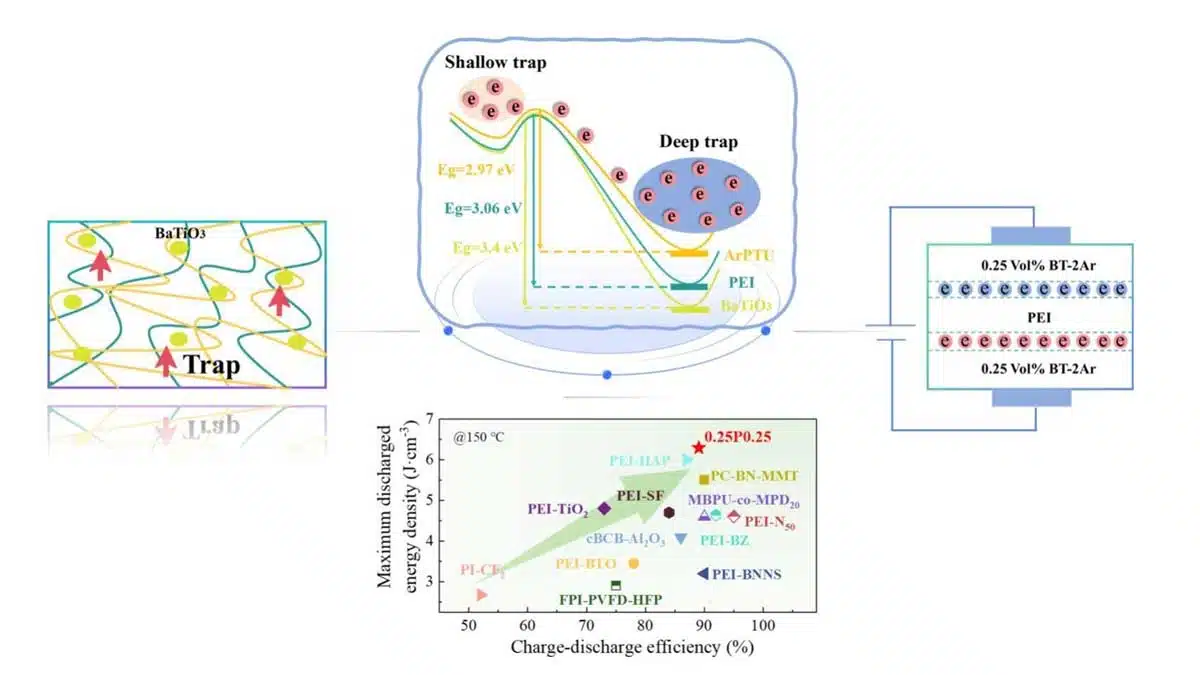
  • Molecular design: Tailored thiourea‑based polymers (ArPTU, MePTU, MetaPTU) modulate free volume and charge distribution in PEI, decoupling thermal stability from electrical insulation.
  • Interfacial engineering: BT nanofillers create rectifying heterointerfaces with deep carrier traps, suppressing field distortion and conduction losses.
  • Structural strategy: A sandwich architecture homogenizes electric fields and improves breakdown strength, synergizing with interfacial effects.
  • Performance gains: Discharged energy density of 7.33 J/cm³ at 660 MV/m with 90.0% efficiency (RT), and 6.29 J/cm³ at 620 MV/m with 89.1% efficiency (150 °C).

Extended summary of the article

The authors target the central barriers to high‑energy polymer dielectrics: temperature‑driven leakage, reduced bandgaps in aromatic backbones, and field inhomogeneities that precipitate early breakdown. While polymers like BOPP are industrial workhorses, their efficiency collapses above ~105 °C due to sharp rises in leakage current. The work reframes material selection around bandgap engineering and interfacial rectification, aiming to suppress charge injection and transport under strong fields and heat.

A series of polythiourea frameworks—aromatic (ArPTU), methylene‑bridged (MePTU), and meta‑phenylene‑bridged (MetaPTU)—are synthesized to tune free volume and electrostatic interactions within a polyetherimide (PEI) matrix. This molecular adjustment optimizes charge distribution without overly compromising the polymer bandgap, a common pitfall of high‑Tg aromatic systems. The ArPTU units, in particular, facilitate effective cross‑linking between BaTiO₃ (BT) nanofillers and PEI, yielding a rectifying effect that curbs disordered charge motion at elevated temperatures.

Nanofiller choice and placement are leveraged to engineer band offsets at the polymer–filler interface. BT induces energy level mismatch that generates built‑in heterojunction electric fields, thereby enhancing carrier scattering and trapping. These deep, high‑density interfacial traps reduce local field distortion and suppress leakage across a broad thermal window. Complementing this, a rationally designed sandwich architecture further homogenizes electric field distribution and shepherds breakdown pathways in‑plane, delaying failure and boosting intrinsic breakdown strength.

The synergy of molecular doping, interfacial band structure control, and multilayer field management manifests in substantial energy storage gains. The optimized sandwich films deliver discharged energy density of 7.33 J/cm³ at 660 MV/m with 90.0% efficiency at room temperature, and 6.29 J/cm³ at 620 MV/m with 89.1% efficiency at 150 °C—benchmarks that underscore robust suppression of leakage and efficient polarization under demanding conditions. These outcomes illustrate a viable pathway to high‑temperature‑stable polymer dielectrics without sacrificing insulation quality, supporting next‑generation capacitor miniaturization and integration in grids and EV power electronics.

The discharged energy density of a linear dielectric under an electric field is:

U = 1 2 ε ₀ ε r E 2

Where U is energy density, ε₀ is vacuum permittivity, εᵣ is relative permittivity, and E is the applied electric field. In practice, discharged energy may be reported with efficiency η from polarization hysteresis; the reported values (7.33 J/cm³ at 660 MV/m, 6.29 J/cm³ at 620 MV/m) reflect minimized loss via interfacial traps and field homogenization.

Conclusion

By tightly coupling molecular free‑volume engineering with interfacial rectification and sandwich‑layer field homogenization, the study achieves high energy density and efficiency from ambient up to 150 °C. It resolves the classic Tg–Eg trade‑off through polythioureas, strategically aligns bands with BT nanofillers to trap carriers, and structurally evens fields to raise breakdown strength—together delivering a scalable recipe for high‑performance polymer capacitors in harsh environments.

Read the full scientific paper:

Yang Liu, Yonghao Zhang, Tao Liu, Tiezhu Guo, Weichen Zhao, Tao Zhou, Yao Zhou, Wenfeng Liu, Jordi Jacas, Joan Ramon Morante Lleonart, Andreu Cabot, Di Zhou, Breaking the energy density barrier in polymer film capacitors via molecular and interfacial design,
Journal of Colloid and Interface Science, Volume 703, Part 2, 2026, 139174, ISSN 0021-9797,
https://doi.org/10.1016/j.jcis.2025.139174.

Related

Source: Science Direct

Recent Posts

Knowles Expands High‑Q Ceramic Core Inductors for RF designs

19.6.2026
8

Vishay Unveils 1.5 kV IHDV High Voltage Power Inductors for EV and Industrial Converters

19.6.2026
11

SCHURTER Introduces PPTC Resettable Overcurrent Protection for Compact Electronics

18.6.2026
18

TrendForce: CSP in‑house AI ASIC Boom Reshapes Capacitor Demand

18.6.2026
34

Würth Elektroniks Flexible EMI Shielding Sheets Provides Quick and Easy Schielding Solution

17.6.2026
31

Samsung Introduces Automotive 1206 100uF X7T MLCC for Power Rails in ADAS and SoCs

17.6.2026
24

YMIN Hybrid Aluminum Capacitors for Automotive LiDAR Power Rails

17.6.2026
25

Samsung Presents Ultra‑Thin Silicon Capacitors for AI and Server PDN

17.6.2026
38

YAGEO Introduces 310VAC SMD Y2 Safety MP Capacitors for Compact EMI Filtering

16.6.2026
30

Upcoming Events

Jul 14
16:00 - 17:00 CEST

EMC Design Essentials: Mastering Varistors and Common Mode Chokes

Jul 21
16:00 - 17:00 CEST

Safety by design: X and Y Interference suppression capacitors for power line filters

View Calendar

Popular Posts

  • Boost Converter Design and Calculation

    0 shares
    Share 0 Tweet 0
  • Buck Converter Design and Calculation

    0 shares
    Share 0 Tweet 0
  • LLC Resonant Converter Design and Calculation

    0 shares
    Share 0 Tweet 0
  • Flyback Converter Design and Calculation

    0 shares
    Share 0 Tweet 0
  • MLCC and Ceramic Capacitors

    0 shares
    Share 0 Tweet 0
  • Earthing Systems and IEC Classification Explained

    0 shares
    Share 0 Tweet 0
  • SEPIC Converter Design and Calculation

    0 shares
    Share 0 Tweet 0
  • Dual Active Bridge (DAB) Topology

    0 shares
    Share 0 Tweet 0
  • Nvidia Vera Rubin: Why One AI Rack Needs So Many More MLCC Capacitors

    0 shares
    Share 0 Tweet 0
  • MLCC Case Sizes Standards Explained

    0 shares
    Share 0 Tweet 0

Newsletter Subscription


Passive Components Blog

© EPCI - Leading Passive Components Educational and Information Site

  • Home
  • Privacy Policy
  • EPCI Membership & Advertisement
  • About

No Result
View All Result
  • Home
  • Knowledge Blog
  • Dossiers
  • PCNS

© EPCI - Leading Passive Components Educational and Information Site

This website uses cookies. By continuing to use this website you are giving consent to cookies being used. Visit our Privacy and Cookie Policy.
Go to mobile version