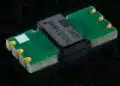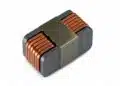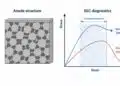















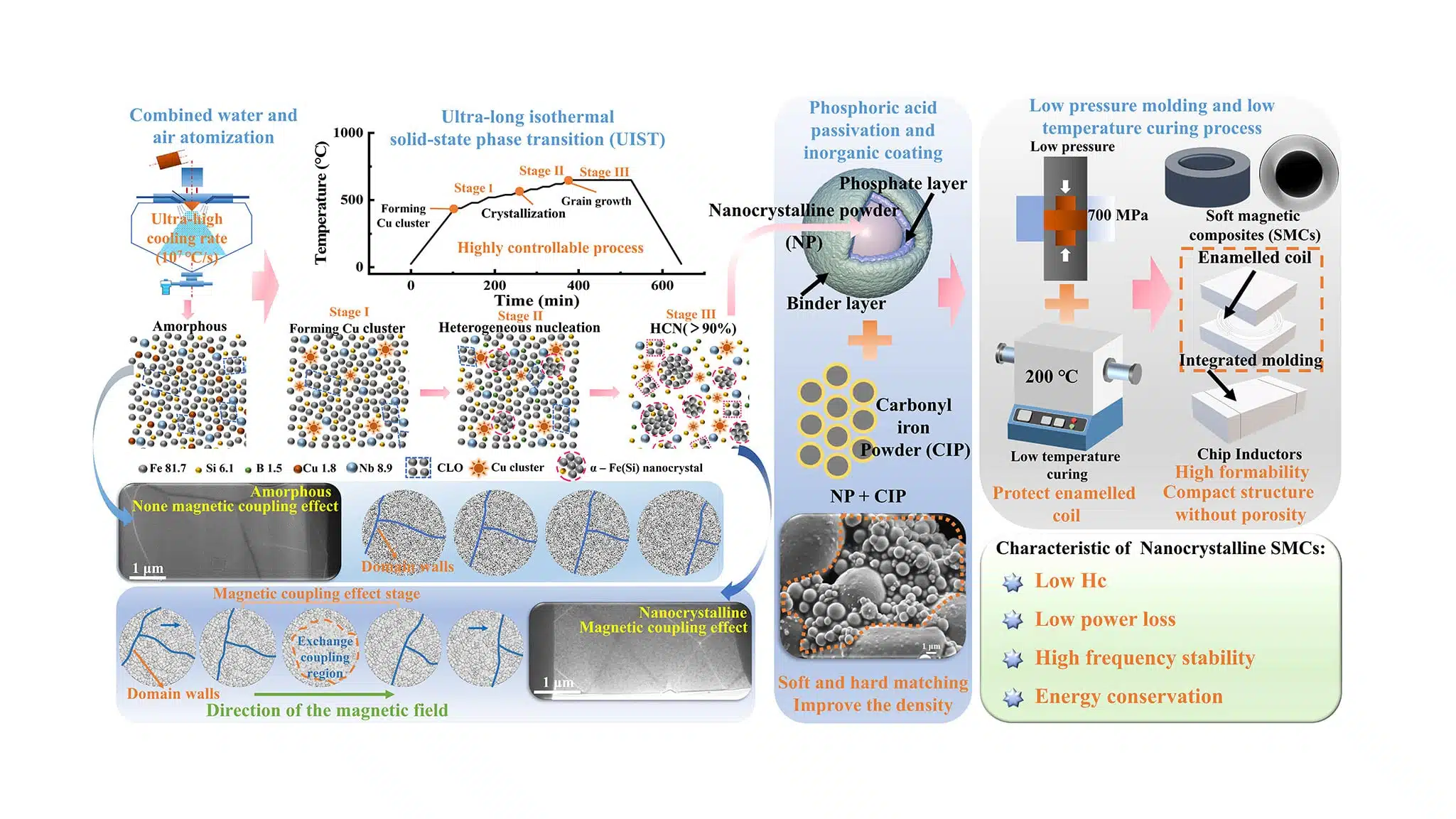
Researchers from State Key Laboratory of Digital Steel, Northeastern University, Shenyang, China developed high‑crystallinity Fe‑based nanocrystalline soft magnetic composites that achieve very low core loss at MHz frequencies under low‑pressure, low‑temperature processing conditions suitable for chip inductors.
Their work demonstrates that carefully tailored alloy design and ultra‑long isothermal solid‑state phase transitions can deliver >90% nanocrystalline volume fraction with stable, low‑loss high‑frequency performance for advanced miniaturized power modules.
Introduction
This article addresses the development of soft magnetic composites for chip inductors that must operate efficiently in the MHz frequency range while supporting ongoing trends toward device miniaturization and low power consumption. The authors focus on reducing core power loss under high‑frequency magnetic fields, which is a critical bottleneck for the performance and endurance of power modules in advanced electronics. They concentrate on materials and processes that can meet the low‑pressure, low‑temperature constraints of integrated chip inductor fabrication.
Conventional soft magnetic composites are typically optimized for high permeability and high saturation magnetization and often require very high molding pressures and elevated heat treatment temperatures. These characteristics are incompatible with the thermal and mechanical limits of chip inductor manufacturing, especially in high‑frequency miniature devices such as swarm drones, micro‑robots, and wearable systems. Iron‑based nanocrystalline alloys offer inherently higher resistivity and lower power loss, but their dual‑phase microstructure and stringent heat treatment requirements limit their suitability for robust, low‑temperature processes.
In this context, the article proposes a compositional design and a new heat treatment concept to realize high‑crystallinity nanocrystalline soft magnetic composites with low power loss in the MHz range. The core idea is to use copper‑cluster‑induced heterogeneous nucleation within a carefully tailored Fe–Si–Nb–B–Cu alloy and to implement an ultra‑long isothermal solid‑state phase transition that yields a very high nanocrystalline volume fraction and stable magnetic properties over an extended processing window.
Key points
- The work targets chip inductors for high‑frequency, miniaturized electronic devices, where low core power loss under MHz magnetic fields is essential for efficiency and endurance.
- Existing soft magnetic composites usually require molding pressures above 1500 MPa and high post‑processing temperatures, making them unsuitable for low‑pressure integrated molding and low‑temperature baking in chip inductor production.
- Iron‑based nanocrystalline soft magnetic powders are attractive due to their high resistivity and low power loss but typically form dual‑phase amorphous–nanocrystalline structures that are stress‑sensitive and incompatible with low‑temperature baking.
- The authors design an Fe81.7Si6.1Nb8.9B1.5Cu1.8 alloy based on copper cluster‑induced heterogeneous nucleation to obtain a high‑volume fraction of nanoscale grains after heat treatment.
- A novel ultra‑long isothermal solid‑state phase transition (UIST) strategy is introduced, involving stepwise heating to 600 °C, a 150‑minute isothermal hold, and furnace cooling under nitrogen, which offers a wide 1–6 h process window for stable magnetic properties.
- Transmittance imaging confirms that the resulting high‑crystallinity nanocrystalline structure achieves a nanocrystalline volume fraction exceeding 90% in the soft magnetic powders.
- The high‑crystallinity nanocrystalline microstructure combines very low magnetic anisotropy, arising from dislocation dipole annihilation and anisotropic exchange interactions, with strong exchange coupling between grains.
- Lorentz TEM and micromagnetic simulations show that magnetic coupling slows the average domain wall motion and yields approximately repeatable domain wall trajectories under alternating fields, which reduces eddy current loss and enhances high‑frequency stability.
- Fe81.7Si6.1Nb8.9B1.5Cu1.8 soft magnetic composites with this structure exhibit a relative permeability of 17.51 and a core loss of 266.6 kW·m−3 at 20 mT and 1 MHz, using 700 MPa compaction pressure and 200 °C heat treatment.
- Further optimization with carbonyl iron reduces core loss to 165.5 kW·m−3 under the same field and frequency, outperforming state‑of‑the‑art soft magnetic composites fabricated under more severe processing conditions.
Extended summary
The article starts from the observation that power modules in modern electronic systems face rising performance demands due to the proliferation of artificial intelligence, ultrawide‑bandgap semiconductors, and new infrastructure such as 5.5/6G communication networks and advanced electronic terminals. Chip inductors, as integrated inductors within these power modules, are responsible for supplying stable power to front‑end circuitry on motherboards and graphics cards. In high‑frequency miniaturized systems like swarm drones and wearable devices, the efficiency and thermal behavior of these inductors are strongly governed by core power loss in the MHz range.
Soft magnetic composites used in chip inductors are typically engineered to offer low permeability with minimized power loss, but mainstream soft magnetic composite technologies originate from applications prioritizing higher permeability and high saturation magnetization. Achieving those properties often requires molding pressures above 1500 MPa and high heat treatment temperatures, which conflict with the lower pressures and low‑temperature baking needed for chip inductor integration. Iron‑based nanocrystalline powders, with their short‑range ordered atomic structure, can reach higher resistivity and lower core loss at high frequency and are therefore promising candidates for such applications. However, widely used alloys like FINEMET require tightly controlled heat treatment conditions with short annealing times at specific temperatures or field‑assisted annealing, and they retain a substantial amorphous fraction. The amorphous phase elevates the magnetostriction coefficient and stress sensitivity, causing power loss to increase when the material is subjected to low‑temperature baking typical for chip inductors.
To address these issues, the authors set two primary objectives: to increase the volume fraction of nanocrystalline grains in iron‑based soft magnetic powders and to improve the controllability and robustness of the nanocrystallization heat treatment. They also emphasize the importance of understanding how domain wall creep behavior in nanocrystalline structures influences power loss and microstructural morphology under high‑frequency excitation. Their proposed solution is a compositional design concept centered on an Fe–Si–Nb–B–Cu alloy with a specific composition Fe81.7Si6.1Nb8.9B1.5Cu1.8 (in weight percent). By tuning the ratios of copper and niobium, they obtain an amorphous precursor featuring a critical‑state amorphous structure with a high area fraction of crystal‑like orders distributed in the matrix. These crystal‑like orders serve as key precursors for nanocrystalline grain formation during the subsequent heat treatment.
The heat treatment method developed in this work is described as an ultra‑long isothermal solid‑state phase transition. Amorphous magnetic powder, prepared via combined water and gas atomization, is first converted into nanocrystalline powder by segmenting the heating profile and using the ultra‑long isothermal process. The process consists of stepwise heating to 600 °C, followed by an isothermal hold of 150 minutes and then furnace cooling in a high‑purity nitrogen environment. After this treatment, the nanocrystalline powder is classified into particle size grades denoted as N1, N2, and N3. One of the notable outcomes of the ultra‑long isothermal approach is that the magnetic properties of the resulting nanocrystalline composites remain stable for holding times within a broad range of 1–6 hours, which substantially relaxes the time‑temperature control requirements compared with conventional nanocrystallization methods.
Microstructural characterization demonstrates that the internal nanocrystalline volume fraction in the treated soft magnetic powders exceeds 90%, based on transmittance imaging. The authors refer to this as a high‑crystallinity nanocrystalline microstructure. They highlight that this microstructure combines extremely low magnetic anisotropy with strong exchange coupling between nanocrystals. The low anisotropy is associated with dislocation dipole annihilation and anisotropic exchange interactions, which together reduce pinning effects and lower field‑dependent contributions to power loss. The strong exchange coupling ensures coherent magnetization processes across the grain network, which is advantageous in high‑frequency environments.
The paper then examines the link between this microstructure and magnetization dynamics using Lorentz transmission electron microscopy and micromagnetic simulations. Lorentz TEM observations provide direct evidence of domain wall structures and movements in the high‑crystallinity nanocrystalline powders, while micromagnetic simulations allow detailed analysis of domain wall motion under high‑frequency alternating fields. These studies indicate that the magnetic coupling within the dense nanocrystalline network slows the average motion of domain walls, which helps to reduce eddy current loss at MHz frequencies. Moreover, the simulations show that domain walls move in an approximately repeatable manner within the nanocrystalline regions during alternating magnetization cycles, supporting the observed high‑frequency stability of the soft magnetic composites.
On the processing side, the authors fabricate soft magnetic composites by compacting the nanocrystalline powders under relatively low pressure and then applying a low‑temperature heat treatment. For the Fe81.7Si6.1Nb8.9B1.5Cu1.8 composition with the high‑crystallinity nanocrystalline structure, they report a relative permeability of 17.51 and a core power loss of 266.6 kW·m−3 at a magnetic induction of 20 mT and a frequency of 1 MHz. These values are achieved using a compaction pressure of 700 MPa and a heat treatment temperature of 200 °C, conditions that are significantly less severe than those often used in conventional soft magnetic composite processing. The moderate permeability is intentionally selected to match chip inductor design requirements, while the low loss level at MHz frequency is the central performance benefit.
To further improve performance, the authors incorporate carbonyl iron into the composite. This optimization step yields a further reduction in core loss to 165.5 kW·m−3 under the same induction and frequency. Under comparable testing conditions, this performance is reported to surpass that of state‑of‑the‑art soft magnetic composites. The combination of low coercivity, low power loss, and excellent high‑frequency stability demonstrates that the high‑crystallinity nanocrystalline composite can meet the functional requirements of low‑temperature, low‑voltage chip inductor fabrication while maintaining reliable operation under high‑frequency magnetic fields.
The article concludes by highlighting the broader implications of the proposed structural and process design strategy. By enabling a high volume fraction of nanocrystalline grains with strong exchange coupling and very low anisotropy, the ultra‑long isothermal solid‑state phase transition approach provides a robust and controllable route for tuning nanocrystalline soft magnetic composites. The demonstrated circuit‑level efficiency of chip inductors based on these materials underlines their potential for use in high‑frequency microelectronic terminals and advanced power modules in next‑generation electronic systems.
Conclusion
The study presents a comprehensive strategy for designing and processing iron‑based high‑crystallinity nanocrystalline soft magnetic composites that exhibit low power loss in the MHz range while remaining compatible with the low‑pressure, low‑temperature requirements of chip inductor fabrication. By combining a tailored Fe–Si–Nb–B–Cu composition that promotes copper‑cluster‑induced heterogeneous nucleation with an ultra‑long isothermal solid‑state phase transition, the authors achieve a nanocrystalline volume fraction above 90% and a microstructure with very low magnetic anisotropy and strong exchange coupling.
Experimental results on Fe81.7Si6.1Nb8.9B1.5Cu1.8 soft magnetic composites show that it is possible to reach low core losses at 1 MHz and 20 mT using moderate compaction pressures and low heat‑treatment temperatures, and that further improvements are feasible by introducing carbonyl iron. Limitations include the need for precise compositional control and access to advanced characterization techniques to fully exploit the high‑crystallinity nanocrystalline microstructure. Future work can build on this foundation by exploring additional alloy systems, refining domain wall engineering strategies, and integrating these materials into a wider range of high‑frequency power modules and microelectronic platforms.
References
- J. Shen, B. Wang, Z. Rao, C. Yao, Z. Zhang, B. Wang, Y. Tian, L. Cai, D. Bao, G. Wang, “High crystallinity nanocrystalline soft magnetic composites with low power loss in MHz for advanced chip inductors,” Acta Materialia, Volume 309, 1 May 2026, Article 122133. https://www.sciencedirect.com/science/article/abs/pii/S1359645426002399