
















Passive Components Blog
No Result
View All Result
  • Home
  • NewsFilter
    • All
    • Aerospace & Defence
    • Antenna
    • Applications
    • Automotive
    • Capacitors
    • Circuit Protection Devices
    • electro-mechanical news
    • Filters
    • Fuses
    • Inductors
    • Industrial
    • Integrated Passives
    • inter-connect news
    • Market & Supply Chain
    • Market Insights
    • Medical
    • Modelling and Simulation
    • New Materials & Supply
    • New Technologies
    • Non-linear Passives
    • Oscillators
    • Passive Sensors News
    • Resistors
    • RF & Microwave
    • Telecommunication
    • Weekly Digest

    KYOCERA AVX MIL-PRF-32535 BME NP0 MLCCs Approved to the DLA QPD

    ECIA March 2026 Industry Pulse Points to Best Sales Climate in Five Years

    Vishay Releases 2-Way Wilkinson Divider / Combiner for 15–20 GHz RF Front Ends

    Wk 15 Electronics Supply Chain Digest

    Exxelia Releases Updated Microwave Materials and Frequency Tuning Catalogues

    Coilcraft Unveils Molded Power Inductors for High‑Current VRMs

    Murata Automotive MLCCs Push Capacitance Limits for ADAS and Power Lines

    TDK Releases Ultra‑small EMI Noise Suppression Filters

    Littelfuse Presents Ultra-Miniature Half-Pitch SMT DIP Switches

    Trending Tags

    • Ripple Current
    • RF
    • Leakage Current
    • Tantalum vs Ceramic
    • Snubber
    • Low ESR
    • Feedthrough
    • Derating
    • Dielectric Constant
    • New Products
    • Market Reports
  • VideoFilter
    • All
    • Antenna videos
    • Capacitor videos
    • Circuit Protection Video
    • Filter videos
    • Fuse videos
    • Inductor videos
    • Inter-Connect Video
    • Non-linear passives videos
    • Oscillator videos
    • Passive sensors videos
    • Resistor videos

    Transformer-Based Power-Line Harvester Magnetic Design

    Thermal Modeling of Magnetics

    Standard vs Planar LLC transformers Comparison for Battery Chargers

    How Modern Tools Model Magnetic Components for Power Electronics

    Advanced Loss Modeling for Planar Magnetics in the Frenetic Planar Tool

    2026 Power Magnetics Design Trends: Flyback, DAB and Planar

    Enabling Software‑Defined Vehicle Architectures: Automotive Ethernet and Zonal Smart Power

    Calculating Resistance Value of a Flyback RC Snubber 

    One‑Pulse Characterization of Nonlinear Power Inductors

    Trending Tags

    • Capacitors explained
    • Inductors explained
    • Resistors explained
    • Filters explained
    • Application Video Guidelines
    • EMC
    • New Products
    • Ripple Current
    • Simulation
    • Tantalum vs Ceramic
  • Knowledge Blog
  • DossiersNew
  • Suppliers
    • Who is Who
  • PCNS
    • PCNS 2025
    • PCNS 2023
    • PCNS 2021
    • PCNS 2019
    • PCNS 2017
  • Events
  • Home
  • NewsFilter
    • All
    • Aerospace & Defence
    • Antenna
    • Applications
    • Automotive
    • Capacitors
    • Circuit Protection Devices
    • electro-mechanical news
    • Filters
    • Fuses
    • Inductors
    • Industrial
    • Integrated Passives
    • inter-connect news
    • Market & Supply Chain
    • Market Insights
    • Medical
    • Modelling and Simulation
    • New Materials & Supply
    • New Technologies
    • Non-linear Passives
    • Oscillators
    • Passive Sensors News
    • Resistors
    • RF & Microwave
    • Telecommunication
    • Weekly Digest

    KYOCERA AVX MIL-PRF-32535 BME NP0 MLCCs Approved to the DLA QPD

    ECIA March 2026 Industry Pulse Points to Best Sales Climate in Five Years

    Vishay Releases 2-Way Wilkinson Divider / Combiner for 15–20 GHz RF Front Ends

    Wk 15 Electronics Supply Chain Digest

    Exxelia Releases Updated Microwave Materials and Frequency Tuning Catalogues

    Coilcraft Unveils Molded Power Inductors for High‑Current VRMs

    Murata Automotive MLCCs Push Capacitance Limits for ADAS and Power Lines

    TDK Releases Ultra‑small EMI Noise Suppression Filters

    Littelfuse Presents Ultra-Miniature Half-Pitch SMT DIP Switches

    Trending Tags

    • Ripple Current
    • RF
    • Leakage Current
    • Tantalum vs Ceramic
    • Snubber
    • Low ESR
    • Feedthrough
    • Derating
    • Dielectric Constant
    • New Products
    • Market Reports
  • VideoFilter
    • All
    • Antenna videos
    • Capacitor videos
    • Circuit Protection Video
    • Filter videos
    • Fuse videos
    • Inductor videos
    • Inter-Connect Video
    • Non-linear passives videos
    • Oscillator videos
    • Passive sensors videos
    • Resistor videos

    Transformer-Based Power-Line Harvester Magnetic Design

    Thermal Modeling of Magnetics

    Standard vs Planar LLC transformers Comparison for Battery Chargers

    How Modern Tools Model Magnetic Components for Power Electronics

    Advanced Loss Modeling for Planar Magnetics in the Frenetic Planar Tool

    2026 Power Magnetics Design Trends: Flyback, DAB and Planar

    Enabling Software‑Defined Vehicle Architectures: Automotive Ethernet and Zonal Smart Power

    Calculating Resistance Value of a Flyback RC Snubber 

    One‑Pulse Characterization of Nonlinear Power Inductors

    Trending Tags

    • Capacitors explained
    • Inductors explained
    • Resistors explained
    • Filters explained
    • Application Video Guidelines
    • EMC
    • New Products
    • Ripple Current
    • Simulation
    • Tantalum vs Ceramic
  • Knowledge Blog
  • DossiersNew
  • Suppliers
    • Who is Who
  • PCNS
    • PCNS 2025
    • PCNS 2023
    • PCNS 2021
    • PCNS 2019
    • PCNS 2017
  • Events
No Result
View All Result
Passive Components Blog
No Result
View All Result

New Bimetallic Alloy Nanoparticles For Printed Electronic Circuits

6.1.2016
Reading Time: 2 mins read
A A

source: ECN article

Tue, 01/05/2016 – 11:56am by Toyohashi University of Technology

RelatedPosts

KYOCERA AVX MIL-PRF-32535 BME NP0 MLCCs Approved to the DLA QPD

ECIA March 2026 Industry Pulse Points to Best Sales Climate in Five Years

Vishay Releases 2-Way Wilkinson Divider / Combiner for 15–20 GHz RF Front Ends

A Toyohashi Tech researcher, in cooperation with researchers at Duke University, has invented a production method for oxidation-resistant copper alloy nanoparticles for printed electronics. These novel nanoparticles were produced by an environmentally friendly and economical ‘wire explosion’ method. This invention will expand the application range of printed electronics.

“Printed electronics” has the potential to enable low-cost fabrication of electronics on flexible or curved surfaces, which will lead to the use of electronics in more varied applications. We will be able to fabricate homemade mobile phones or smart watches using a printer in the future. However, the low performance and high cost of current conductive inks limit the advancement of printed electronics.

Now, researchers at Toyohashi Tech and Duke University have found a way to produce new copper alloy nanoparticles, which can be used as the main component of affordable conductive inks with high oxidation resistance. The researchers electrically exploded alloy or twisted metal wires in water with a mild reducing agent (Vitamin C) in order to produce the nanoparticles. The reduction in conductivity was subsequently measured under harsh conditions (high temperature and high humidity).

“We have been working on developing a ‘wire explosion’ method to produce novel metal nanoparticles. Then, we found that some of the produced copper alloy nanoparticles possessed both high oxidation resistance and low electrical resistance,” explains Assistant Professor Go Kawamura. “Moreover, the nanoparticles have the advantage of being inexpensive because the production process is very economical and environmentally friendly.”

As a result, copper nanoparticles alloyed with 1% Sn, 5% Ag, 5% Ni, or 30% Ni had electrical conductivities similar to that of copper; however, unlike copper, the nanoparticles remained conductive after 24 h at 85 °C and 85% relative humidity. With further improvement of the electrical conductivity and oxidation resistance, copper alloy nanoparticles prepared by wire explosion could be used for the production of high-performance affordable conductive inks, which will contribute to the advancement of printed electronics. The researchers also hope this work motivates additional study of combining wire explosion with chemical modification of the explosion medium to control the composition and surface chemistry of nanoparticles.

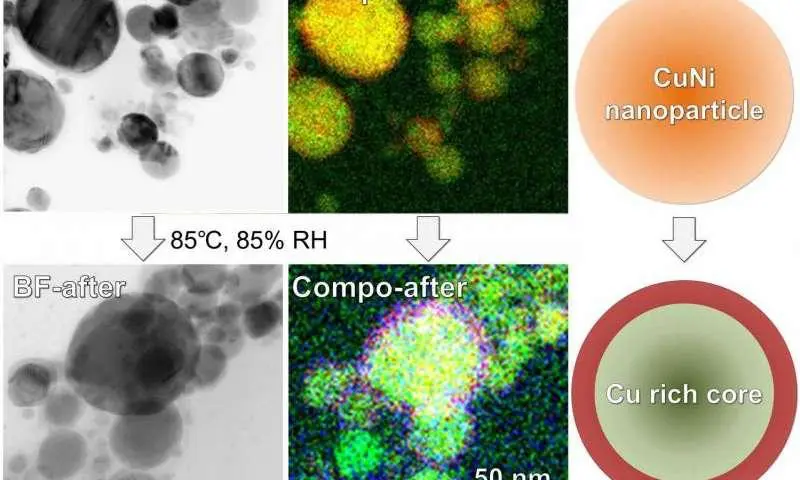
featured picture: These are bright-field (BF) scanning transmission electron microscope images, composed (Compo) elemental mappings, and illustrations of Cu alloy nanoparticles containing 30 percent Ni before and after oxidation treatment at 85 °C and 85 percent relative humidity. Credit: COPYRIGHT (C) 2016 Toyohashi University Of Technology.

Related

Recent Posts

Peak Nano to Develop Fusion Grade High Energy Film Capacitors

11.3.2026
49

Paumanok Unveils Aluminum Capacitor Foils World Markets Study 2025-2030

6.11.2025
44

Murata and QuantumScape Joint Development for Solid Batteries Ceramic Separators

14.10.2025
54

Researchers Demonstrated High Energy Ceramic Capacitors Stable in Wide Temperature Range

2.10.2025
43

Improving SMPS Performance with Thermal Interface Material

30.9.2025
45

Flaked Tantalum Powders: High Capacitance Powders for High Reliable Tantalum Capacitors

29.9.2025
65

Life Cycle Assessment of a Graphene-Based Supercapacitor

26.9.2025
132

Advancements in Flexible End Terminations for Robust MLCCs in EV

26.9.2025
79

Johnson’s Approximation Modeling Improves Understanding of MLCC Dielectrics Voltage Dependence

26.6.2024
113

Upcoming Events

Apr 21
16:00 - 17:00 CEST

Heatsink Solutions: Thermal Management in electronic devices

May 5
16:00 - 17:00 CEST

Understanding and Selecting Capacitors – Fundamentals, Technologies and Latest Trends

May 19
16:00 - 17:00 CEST

Designing Qi2 Wireless Power Systems: Practical Development and EMC Optimization

View Calendar

Popular Posts

  • Buck Converter Design and Calculation

    0 shares
    Share 0 Tweet 0
  • Boost Converter Design and Calculation

    0 shares
    Share 0 Tweet 0
  • Flyback Converter Design and Calculation

    0 shares
    Share 0 Tweet 0
  • LLC Resonant Converter Design and Calculation

    0 shares
    Share 0 Tweet 0
  • MLCC and Ceramic Capacitors

    0 shares
    Share 0 Tweet 0
  • Dual Active Bridge (DAB) Topology

    0 shares
    Share 0 Tweet 0
  • Capacitor Charging and Discharging

    0 shares
    Share 0 Tweet 0
  • Plastic Materials Dielectric Constant and DF

    4 shares
    Share 4 Tweet 0
  • Ripple Current and its Effects on the Performance of Capacitors

    3 shares
    Share 3 Tweet 0
  • MLCC Case Sizes Standards Explained

    0 shares
    Share 0 Tweet 0

Newsletter Subscription


Passive Components Blog

© EPCI - Leading Passive Components Educational and Information Site

  • Home
  • Privacy Policy
  • EPCI Membership & Advertisement
  • About

No Result
View All Result
  • Home
  • Knowledge Blog
  • PCNS

© EPCI - Leading Passive Components Educational and Information Site

This website uses cookies. By continuing to use this website you are giving consent to cookies being used. Visit our Privacy and Cookie Policy.
Go to mobile version