




Passive Components Blog
No Result
View All Result
  • Home
  • NewsFilter
    • All
    • Aerospace & Defence
    • Antenna
    • Applications
    • Automotive
    • Capacitors
    • Circuit Protection Devices
    • electro-mechanical news
    • Filters
    • Fuses
    • Inductors
    • Industrial
    • Integrated Passives
    • inter-connect news
    • Market & Supply Chain
    • Market Insights
    • Medical
    • Modelling and Simulation
    • New Materials & Supply
    • New Technologies
    • Non-linear Passives
    • Oscillators
    • Passive Sensors News
    • Resistors
    • RF & Microwave
    • Telecommunication
    • Weekly Digest

    Nippon Chemi-Con Announces New Capacitor series for AI, Automotive and Immersion Cooling

    Ultrahigh Energy Storage in Lead‑Free BiFeO₃‑Based Ceramic Capacitors via Local Polar Structure Design

    Molex Expanded AirBorn SInergy Hybrid Connectors with 25 A Power Modules

    Murata Expands Ansys Simulation Models for RF inductors, MLCCs, and Power Inductors

    Sumida Introduces SMD Metal Inductors for High‑Current Automotive DC/DC Converters

    Hirose Releases 0.5 mm Floating Board-to-Board Connector for EV Powertrain Designs

    Imec Presents High-density MIMCAP RF interposer for III-V chiplets

    Wk 24 Electronics Supply Chain Digest

    Bourns Completes Rakon Acquisition, Enters Timing Market

    Trending Tags

    • Ripple Current
    • RF
    • Leakage Current
    • Tantalum vs Ceramic
    • Snubber
    • Low ESR
    • Feedthrough
    • Derating
    • Dielectric Constant
    • New Products
    • Market Reports
  • VideoFilter
    • All
    • Antenna videos
    • Capacitor videos
    • Circuit Protection Video
    • Filter videos
    • Fuse videos
    • Inductor videos
    • Inter-Connect Video
    • Non-linear passives videos
    • Oscillator videos
    • Passive sensors videos
    • Resistor videos

    Why Isolated DC/DC Power Supplies Fail Late, Würth Elektronik Podcast

    Designing 800 V DC EMC Filters: Calculation, Simulation and Measurement

    Current Sense Transformer Datasheet and Design‑in Guide

    Designing a USB Type‑C Flyback Planar Transformer with Frenetic’s Planar Tool

    Magnetics Design in High‑Frequency GaN Converters

    Qi2 Wireless Charging: Inductors, Capacitors and EMC Filters

    Two‑capacitor paradox explained for engineers

    Capacitances of Nonlinear MLCCs: What Datasheets Don’t Tell You

    Tapped Inductor Buck Converter Fundamentals

    Trending Tags

    • Capacitors explained
    • Inductors explained
    • Resistors explained
    • Filters explained
    • Application Video Guidelines
    • EMC
    • New Products
    • Ripple Current
    • Simulation
    • Tantalum vs Ceramic
  • Knowledge Blog
  • DossiersNew
  • Suppliers
    • Who is Who
  • PCNS
    • PCNS 2025
    • PCNS 2023
    • PCNS 2021
    • PCNS 2019
    • PCNS 2017
  • Events
  • Home
  • NewsFilter
    • All
    • Aerospace & Defence
    • Antenna
    • Applications
    • Automotive
    • Capacitors
    • Circuit Protection Devices
    • electro-mechanical news
    • Filters
    • Fuses
    • Inductors
    • Industrial
    • Integrated Passives
    • inter-connect news
    • Market & Supply Chain
    • Market Insights
    • Medical
    • Modelling and Simulation
    • New Materials & Supply
    • New Technologies
    • Non-linear Passives
    • Oscillators
    • Passive Sensors News
    • Resistors
    • RF & Microwave
    • Telecommunication
    • Weekly Digest

    Nippon Chemi-Con Announces New Capacitor series for AI, Automotive and Immersion Cooling

    Ultrahigh Energy Storage in Lead‑Free BiFeO₃‑Based Ceramic Capacitors via Local Polar Structure Design

    Molex Expanded AirBorn SInergy Hybrid Connectors with 25 A Power Modules

    Murata Expands Ansys Simulation Models for RF inductors, MLCCs, and Power Inductors

    Sumida Introduces SMD Metal Inductors for High‑Current Automotive DC/DC Converters

    Hirose Releases 0.5 mm Floating Board-to-Board Connector for EV Powertrain Designs

    Imec Presents High-density MIMCAP RF interposer for III-V chiplets

    Wk 24 Electronics Supply Chain Digest

    Bourns Completes Rakon Acquisition, Enters Timing Market

    Trending Tags

    • Ripple Current
    • RF
    • Leakage Current
    • Tantalum vs Ceramic
    • Snubber
    • Low ESR
    • Feedthrough
    • Derating
    • Dielectric Constant
    • New Products
    • Market Reports
  • VideoFilter
    • All
    • Antenna videos
    • Capacitor videos
    • Circuit Protection Video
    • Filter videos
    • Fuse videos
    • Inductor videos
    • Inter-Connect Video
    • Non-linear passives videos
    • Oscillator videos
    • Passive sensors videos
    • Resistor videos

    Why Isolated DC/DC Power Supplies Fail Late, Würth Elektronik Podcast

    Designing 800 V DC EMC Filters: Calculation, Simulation and Measurement

    Current Sense Transformer Datasheet and Design‑in Guide

    Designing a USB Type‑C Flyback Planar Transformer with Frenetic’s Planar Tool

    Magnetics Design in High‑Frequency GaN Converters

    Qi2 Wireless Charging: Inductors, Capacitors and EMC Filters

    Two‑capacitor paradox explained for engineers

    Capacitances of Nonlinear MLCCs: What Datasheets Don’t Tell You

    Tapped Inductor Buck Converter Fundamentals

    Trending Tags

    • Capacitors explained
    • Inductors explained
    • Resistors explained
    • Filters explained
    • Application Video Guidelines
    • EMC
    • New Products
    • Ripple Current
    • Simulation
    • Tantalum vs Ceramic
  • Knowledge Blog
  • DossiersNew
  • Suppliers
    • Who is Who
  • PCNS
    • PCNS 2025
    • PCNS 2023
    • PCNS 2021
    • PCNS 2019
    • PCNS 2017
  • Events
No Result
View All Result
Passive Components Blog
No Result
View All Result

Life Cycle Assessment of a Graphene-Based Supercapacitor

26.9.2025
Reading Time: 4 mins read
A A

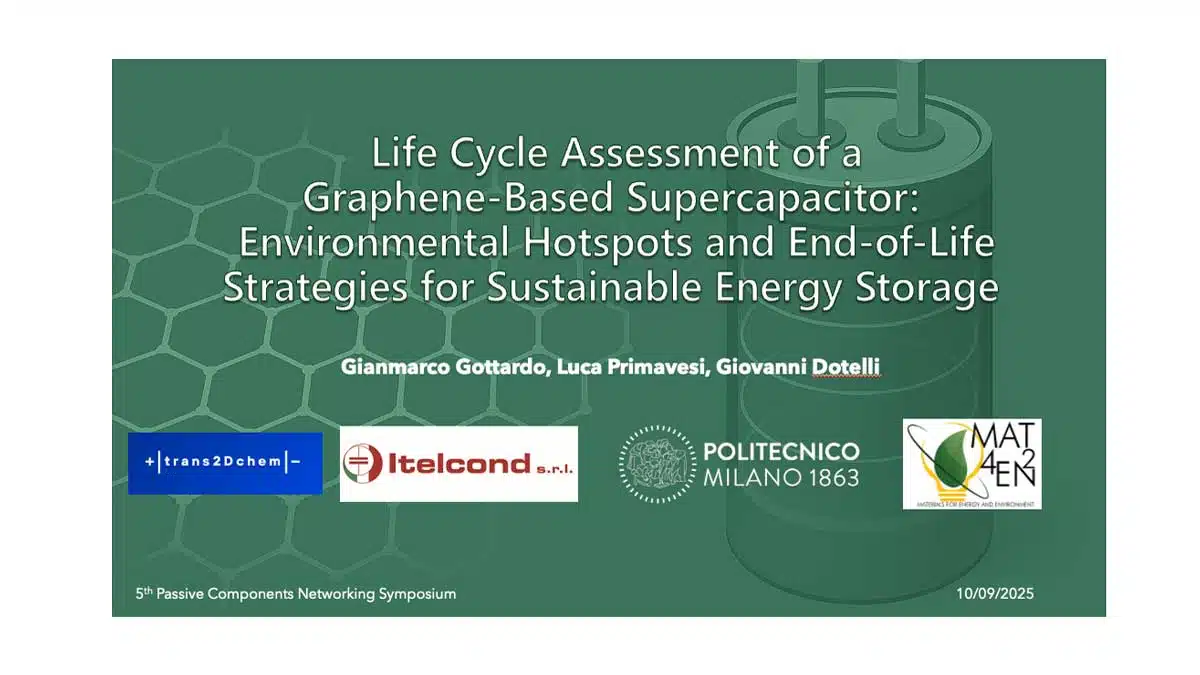
The paper “Life Cycle Assessment of a Graphene-Based Supercapacitor: Environmental Hotspots and End-of-Life Strategies for Sustainable Energy Storage” was presented by Gianmarco Gottardo, Politecnico di Milano, Milan, Italy at the 5th PCNS Passive Components Networking Symposium 9-12th September 2025, Seville, Spain as paper No. 2.6.

Introduction  

The global energy landscape is undergoing a critical transformation as reliance on fossil fuels proves increasingly unsustainable due to resource depletion, environmental degradation, and geopolitical pressures.

RelatedPosts

Advances in the Environmental Performance of Polymer Capacitors

How to Manage Supercapacitors Leakage Current and Self Discharge 

Qualification of Commercial Supercapacitors for Space Applications

In this context, advanced energy storage solutions are essential to support renewable energy integration and achieve carbon neutrality. Supercapacitors (SCs), particularly those employing graphene-based electrodes, have emerged as promising candidates for high-power, durable, and sustainable energy storage.

However, their environmental implications across manufacturing and end-of-life management require thorough evaluation. This study presents a Life Cycle Assessment (LCA) of a Nitrogen and Fluorine doped graphene-based cylindrical supercapacitor, focusing on environmental hotspots and sustainable disposal strategies to enhance its role in future energy systems.

Key Points  

  • Supercapacitors deliver high power, long lifespan, and safety, but have lower energy density than batteries.  
  • Graphene oxide (GO) production is the most significant environmental hotspot in manufacturing.  
  • End-of-life recycling provides substantial environmental benefits, especially through the recovery of graphene, PTFE, and aluminum.  
  • Energy source for production and effective recycling strategies critically affect overall sustainability.  
  • A cradle-to-grave LCA approach following ISO 14040/14044 identifies clear pathways to reduce environmental impacts.

Extended Summary  

The study evaluates the environmental performance of an innovative graphene-based supercapacitor using a Life Cycle Assessment that spans from raw material acquisition to end-of-life treatment. The declared unit is a single supercapacitor manufactured by Itelcond s.r.l., characterized by a 4700 F capacitance and 2.8 V rating, delivering 5.12 Wh of stored energy at a gravimetric energy density of 35.05 Wh/kg.

The methodology adheres to ISO 14040 and ISO 14044 standards and leverages SimaPro software and ecoinvent datasets for modeling. The LCA covers manufacturing (rolling, impregnation, assembly, burn-in, and palletizing), distribution, and end-of-life stages, with the use phase excluded due to the absence of a defined application scenario. Primary data from the manufacturer and background datasets from ecoinvent underpin the assessment.

Results identify the manufacturing phase—particularly the rolling stage producing the dry capacitor—as the dominant contributor to environmental impacts across most categories, including climate change, ozone depletion, and resource use. This is primarily due to the energy-intensive production of graphene oxide and the use of chemicals such as potassium permanganate and sulfuric acid. Electricity consumption, even with partial photovoltaic support, remains a key driver of emissions.

The impregnation phase is the second-largest contributor, mainly via electrolyte production impacts. Distribution impacts are negligible due to short regional transportation distances. Conversely, the end-of-life phase offers significant environmental credits through recycling. Mechanical and thermal treatments allow recovery of graphene, PTFE, aluminum, and electrolyte, substantially offsetting manufacturing emissions. In the climate change category, end-of-life credits reduce total emissions by nearly 31%, lowering the footprint from 7.22 kg CO2 eq to 5.25 kg CO2 eq per supercapacitor.

Scenario analysis comparing recycling with waste-to-energy (WtE) incineration reinforces the environmental superiority of recycling. Recycling reduces impacts by 14–32% across most categories and delivers peak benefits in ozone depletion (89% reduction) and ecotoxicity. WtE scenarios lack the negative impact offsets offered by material recovery, resulting in higher total impacts.

Overall, the study highlights that the environmental performance of graphene-based supercapacitors can be drastically improved through clean energy sourcing for production and robust recycling processes. These improvements not only reduce the carbon footprint but also enhance circularity by substituting virgin materials with recovered components.

Conclusion  

Graphene-based supercapacitors present a high-potential technology for sustainable energy storage, yet their environmental performance is closely tied to material production and disposal strategies. The Life Cycle Assessment demonstrates that manufacturing, especially graphene oxide synthesis, dominates environmental impacts, while end-of-life recycling can significantly mitigate them. Transitioning to cleaner energy sources for production and implementing comprehensive recycling pathways are essential to unlocking the full sustainability potential of these devices. This research offers a foundation for further studies focused on real-world application modeling and comparative analyses with other energy storage technologies.

2_6_Politecnico Milano Conference_Paper_GottardoDownload

Related

Source: PCNS

Recent Posts

Nippon Chemi-Con Announces New Capacitor series for AI, Automotive and Immersion Cooling

16.6.2026
6

Ultrahigh Energy Storage in Lead‑Free BiFeO₃‑Based Ceramic Capacitors via Local Polar Structure Design

16.6.2026
8

Murata Expands Ansys Simulation Models for RF inductors, MLCCs, and Power Inductors

16.6.2026
6

Knowles Releases 3825 X1/Y2 Safety MLCCs for High‑Voltage Applications

11.6.2026
35

TAIYO YUDEN Releases 220uF 1210 Automotive MLCC

11.6.2026
49

HEICO’s Exxelia Expands High-Voltage Ceramic Capacitor Portfolio with CalRamic Acquisition

10.6.2026
45

CapXon Earns EcoVadis Bronze Medal for Sustainability Performance

10.6.2026
27

All‑Water Supercapacitor Based on 1‑nm Clay Channels and Nanoconfined Water Electrolyte

10.6.2026
40

Modelithics Releases COMPLETE Library v26.2 for Keysight Genesys

8.6.2026
21

Upcoming Events

Jun 16
16:00 - 17:00 CEST

EMC with EMC – EMC‑compliant design with electromechanical connectors

Jul 14
16:00 - 17:00 CEST

EMC Design Essentials: Mastering Varistors and Common Mode Chokes

Jul 21
16:00 - 17:00 CEST

Safety by design: X and Y Interference suppression capacitors for power line filters

View Calendar

Popular Posts

  • Buck Converter Design and Calculation

    0 shares
    Share 0 Tweet 0
  • Boost Converter Design and Calculation

    0 shares
    Share 0 Tweet 0
  • LLC Resonant Converter Design and Calculation

    0 shares
    Share 0 Tweet 0
  • MLCC and Ceramic Capacitors

    0 shares
    Share 0 Tweet 0
  • Flyback Converter Design and Calculation

    0 shares
    Share 0 Tweet 0
  • Earthing Systems and IEC Classification Explained

    0 shares
    Share 0 Tweet 0
  • SEPIC Converter Design and Calculation

    0 shares
    Share 0 Tweet 0
  • Dual Active Bridge (DAB) Topology

    0 shares
    Share 0 Tweet 0
  • What Electronics Engineer Needs to Know About Passive Low Pass Filters

    0 shares
    Share 0 Tweet 0
  • MLCC Case Sizes Standards Explained

    0 shares
    Share 0 Tweet 0

Newsletter Subscription


Passive Components Blog

© EPCI - Leading Passive Components Educational and Information Site

  • Home
  • Privacy Policy
  • EPCI Membership & Advertisement
  • About

No Result
View All Result
  • Home
  • Knowledge Blog
  • Dossiers
  • PCNS

© EPCI - Leading Passive Components Educational and Information Site

This website uses cookies. By continuing to use this website you are giving consent to cookies being used. Visit our Privacy and Cookie Policy.
Go to mobile version