




Passive Components Blog
No Result
View All Result
  • Home
  • NewsFilter
    • All
    • Aerospace & Defence
    • Antenna
    • Applications
    • Automotive
    • Capacitors
    • Circuit Protection Devices
    • electro-mechanical news
    • Filters
    • Fuses
    • Inductors
    • Industrial
    • Integrated Passives
    • inter-connect news
    • Market & Supply Chain
    • Market Insights
    • Medical
    • Modelling and Simulation
    • New Materials & Supply
    • New Technologies
    • Non-linear Passives
    • Oscillators
    • Passive Sensors News
    • Resistors
    • RF & Microwave
    • Telecommunication
    • Weekly Digest

    Würth Elektronik Expands Nanocrystalline Cable Cores for Broadband EMI Suppression

    High‑Speed Supercapacitor Balancing for AI Data Center Power Systems

    Bourns Introduced Automotive TVS Diodes for Compact ESD Protection

    EMC‑Compliant PCB and Connector Design Guidelines

    Practical Value of Structural Diagnostics for Tantalum Capacitor Anodes

    Hall-Effect Sensing for Harsh Environments: TT Electronics Selected in NASA’s Dragonfly Fan

    Bourns Releases Automotive Gate Driver Transformer for Isolated Power

    Stackpole Releases High-Frequency Thin Film Chip Resistors for RF up to 50 GHz

    Knowles Expands High‑Q Ceramic Core Inductors for RF designs

    Trending Tags

    • Ripple Current
    • RF
    • Leakage Current
    • Tantalum vs Ceramic
    • Snubber
    • Low ESR
    • Feedthrough
    • Derating
    • Dielectric Constant
    • New Products
    • Market Reports
  • VideoFilter
    • All
    • Antenna videos
    • Capacitor videos
    • Circuit Protection Video
    • Filter videos
    • Fuse videos
    • Inductor videos
    • Inter-Connect Video
    • Non-linear passives videos
    • Oscillator videos
    • Passive sensors videos
    • Resistor videos

    EMC‑Compliant PCB and Connector Design Guidelines

    Why Isolated DC/DC Power Supplies Fail Late, Würth Elektronik Podcast

    Designing 800 V DC EMC Filters: Calculation, Simulation and Measurement

    Current Sense Transformer Datasheet and Design‑in Guide

    Designing a USB Type‑C Flyback Planar Transformer with Frenetic’s Planar Tool

    Magnetics Design in High‑Frequency GaN Converters

    Qi2 Wireless Charging: Inductors, Capacitors and EMC Filters

    Two‑capacitor paradox explained for engineers

    Capacitances of Nonlinear MLCCs: What Datasheets Don’t Tell You

    Trending Tags

    • Capacitors explained
    • Inductors explained
    • Resistors explained
    • Filters explained
    • Application Video Guidelines
    • EMC
    • New Products
    • Ripple Current
    • Simulation
    • Tantalum vs Ceramic
  • Knowledge Blog
  • DossiersNew
  • Suppliers
    • Who is Who
  • PCNS
    • PCNS 2025
    • PCNS 2023
    • PCNS 2021
    • PCNS 2019
    • PCNS 2017
  • Events
  • Home
  • NewsFilter
    • All
    • Aerospace & Defence
    • Antenna
    • Applications
    • Automotive
    • Capacitors
    • Circuit Protection Devices
    • electro-mechanical news
    • Filters
    • Fuses
    • Inductors
    • Industrial
    • Integrated Passives
    • inter-connect news
    • Market & Supply Chain
    • Market Insights
    • Medical
    • Modelling and Simulation
    • New Materials & Supply
    • New Technologies
    • Non-linear Passives
    • Oscillators
    • Passive Sensors News
    • Resistors
    • RF & Microwave
    • Telecommunication
    • Weekly Digest

    Würth Elektronik Expands Nanocrystalline Cable Cores for Broadband EMI Suppression

    High‑Speed Supercapacitor Balancing for AI Data Center Power Systems

    Bourns Introduced Automotive TVS Diodes for Compact ESD Protection

    EMC‑Compliant PCB and Connector Design Guidelines

    Practical Value of Structural Diagnostics for Tantalum Capacitor Anodes

    Hall-Effect Sensing for Harsh Environments: TT Electronics Selected in NASA’s Dragonfly Fan

    Bourns Releases Automotive Gate Driver Transformer for Isolated Power

    Stackpole Releases High-Frequency Thin Film Chip Resistors for RF up to 50 GHz

    Knowles Expands High‑Q Ceramic Core Inductors for RF designs

    Trending Tags

    • Ripple Current
    • RF
    • Leakage Current
    • Tantalum vs Ceramic
    • Snubber
    • Low ESR
    • Feedthrough
    • Derating
    • Dielectric Constant
    • New Products
    • Market Reports
  • VideoFilter
    • All
    • Antenna videos
    • Capacitor videos
    • Circuit Protection Video
    • Filter videos
    • Fuse videos
    • Inductor videos
    • Inter-Connect Video
    • Non-linear passives videos
    • Oscillator videos
    • Passive sensors videos
    • Resistor videos

    EMC‑Compliant PCB and Connector Design Guidelines

    Why Isolated DC/DC Power Supplies Fail Late, Würth Elektronik Podcast

    Designing 800 V DC EMC Filters: Calculation, Simulation and Measurement

    Current Sense Transformer Datasheet and Design‑in Guide

    Designing a USB Type‑C Flyback Planar Transformer with Frenetic’s Planar Tool

    Magnetics Design in High‑Frequency GaN Converters

    Qi2 Wireless Charging: Inductors, Capacitors and EMC Filters

    Two‑capacitor paradox explained for engineers

    Capacitances of Nonlinear MLCCs: What Datasheets Don’t Tell You

    Trending Tags

    • Capacitors explained
    • Inductors explained
    • Resistors explained
    • Filters explained
    • Application Video Guidelines
    • EMC
    • New Products
    • Ripple Current
    • Simulation
    • Tantalum vs Ceramic
  • Knowledge Blog
  • DossiersNew
  • Suppliers
    • Who is Who
  • PCNS
    • PCNS 2025
    • PCNS 2023
    • PCNS 2021
    • PCNS 2019
    • PCNS 2017
  • Events
No Result
View All Result
Passive Components Blog
No Result
View All Result

Improving SMPS Performance with Thermal Interface Material

30.9.2025
Reading Time: 4 mins read
A A

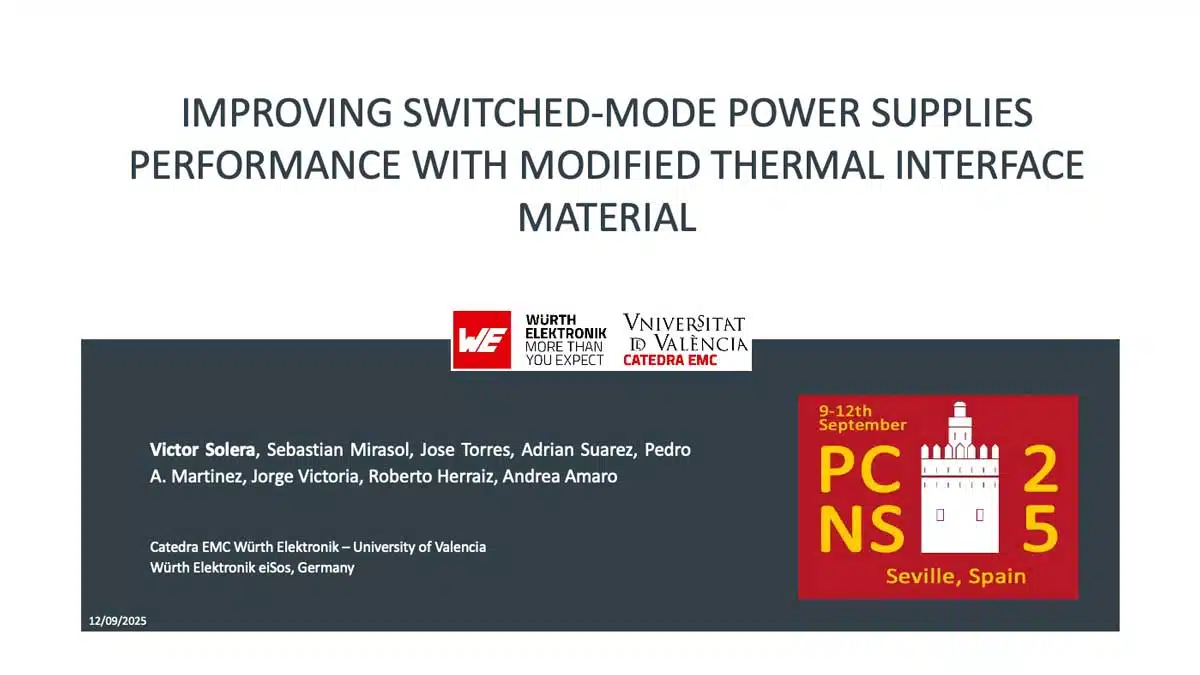
The paper “Improving Switched-Mode Power Supplies Performance with Modified Thermal Interface Material” was presented by Víctor Solera, Department of Electronic Engineering, University of Valencia, Spain at the 5th PCNS Passive Components Networking Symposium 9-12th September 2025, Seville, Spain as paper No. 5.3.

Introduction

Switched-mode power supplies (SMPS) are widely used in modern electronics due to their high energy efficiency and compact size.

RelatedPosts

Advances in the Environmental Performance of Polymer Capacitors

How to Manage Supercapacitors Leakage Current and Self Discharge 

Qualification of Commercial Supercapacitors for Space Applications

As power density increases, effective thermal management becomes essential to maintain component reliability and performance. Heatsinks paired with thermal interface materials (TIMs) are standard solutions for dissipating heat.

However, TIMs introduce a new challenge: they can form parasitic capacitances that generate common-mode (CM) currents, leading to electromagnetic interference (EMI) issues. This article investigates the impact of TIMs on EMI in SMPS and explores a hybrid solution—Shielded Thermal Interface Material (Shielded TIM)—to mitigate CM currents without significantly compromising thermal performance.

Key Points

  • SMPS require high power density and efficient thermal management, often achieved with heatsinks and TIMs.
  • TIMs improve thermal conductivity and provide electrical insulation but can introduce parasitic capacitances causing CM emissions.
  • A hybrid Shielded TIM, integrating a thermal conductive insulator with copper foil, reduces CM currents while maintaining insulation.
  • Experimental tests show Shielded TIM reduces CM emissions by up to 30 dB without a significant loss in thermal performance.
  • The parasitic capacitance effect of TIMs can be modeled in circuit simulations to predict EMI behavior during design.

Extended Summary

The article begins with an overview of the growing adoption of SMPS in compact electronic systems. High switching speeds enable increased power density but generate heat that must be managed effectively. Standard solutions involve mounting mosfets to metal heatsinks, often through TIMs like thermal gap fillers, thermal transfer tapes, graphite sheets, graphite foam gaskets, and thermal conductive insulators. Each TIM type provides thermal conduction, surface compliance, and often electrical isolation.

However, TIMs create an unintended electrical effect: they act as dielectrics between conductive surfaces, forming parasitic parallel plate capacitors. In SMPS, this parasitic capacitance is subjected to high dv/dt switching events, resulting in CM currents that can compromise EMC compliance. The extent of this effect depends on the TIM’s thickness, permittivity, and the area of the mosfet baseplate.

To address this issue, the study introduces a hybrid material called Shielded TIM. It consists of two thermal conductive insulator layers sandwiching a copper foil, which is connected to the mosfet source. This configuration divides the parasitic capacitance into two series segments, effectively reducing the CM current path to ground. The copper shield also redirects high-frequency currents, reducing the EMI impact.

Experimental validation used a 3.3 V to 10 V boost converter operating at 300 kHz. CM emissions were measured with LISNs and a spectrum analyzer for both a standard TIM and the Shielded TIM. Results showed a substantial reduction in CM current peaks, with improvements up to 30 dB at higher harmonics. Thermal performance tests using thermocouples confirmed that the Shielded TIM maintained comparable steady-state temperatures to a single TIM layer, despite the extra layers.

Additionally, the article demonstrates how TIM parasitic effects can be modeled as equivalent capacitors in simulation. The capacitance is calculated using the standard formula C = ε₀ · εᵣ · A⁄d. Comparing simulation and measurement showed good agreement, enabling EMC risk evaluation during the design phase.

Conclusion

TIMs are essential for SMPS thermal management but can significantly increase CM emissions due to parasitic capacitance. The proposed Shielded TIM solution effectively reduces CM currents while preserving thermal and electrical isolation. Experimental results confirm its EMI advantages and acceptable thermal performance. Furthermore, modeling TIM parasitics in simulations allows designers to predict and mitigate EMI issues early in the design process, supporting reliable and high-performance SMPS designs.
5_3_U Valencia WE Paper_PCNS_VictorDownload

Related

Source: PCNS

Recent Posts

EMC‑Compliant PCB and Connector Design Guidelines

22.6.2026
22

Würth Elektroniks Flexible EMI Shielding Sheets Provides Quick and Easy Schielding Solution

17.6.2026
43

Why Isolated DC/DC Power Supplies Fail Late, Würth Elektronik Podcast

8.6.2026
89

Designing 800 V DC EMC Filters: Calculation, Simulation and Measurement

4.6.2026
140

Qi2 Wireless Charging: Inductors, Capacitors and EMC Filters

21.5.2026
71

High-Crystallinity Nanocrystalline Composites for MHz Chip Inductors

7.5.2026
117

Kyocera Developed Multilayer Ceramic Core Substrate for AI Packages

30.4.2026
149

Panasonic Releases Transparent EMI Shielding Film for Displays

16.3.2026
99

Peak Nano to Develop Fusion Grade High Energy Film Capacitors

11.3.2026
66

Upcoming Events

Jun 30
17:00 - 18:00 CEST

PSMA Capacitor Committee Webinar: High Voltage Pulse Capacitors

Jul 14
16:00 - 17:00 CEST

EMC Design Essentials: Mastering Varistors and Common Mode Chokes

Jul 21
16:00 - 17:00 CEST

Safety by design: X and Y Interference suppression capacitors for power line filters

View Calendar

Popular Posts

  • Boost Converter Design and Calculation

    0 shares
    Share 0 Tweet 0
  • Buck Converter Design and Calculation

    0 shares
    Share 0 Tweet 0
  • LLC Resonant Converter Design and Calculation

    0 shares
    Share 0 Tweet 0
  • Flyback Converter Design and Calculation

    0 shares
    Share 0 Tweet 0
  • MLCC and Ceramic Capacitors

    0 shares
    Share 0 Tweet 0
  • Earthing Systems and IEC Classification Explained

    0 shares
    Share 0 Tweet 0
  • Nvidia Vera Rubin: Why One AI Rack Needs So Many More MLCC Capacitors

    0 shares
    Share 0 Tweet 0
  • Dual Active Bridge (DAB) Topology

    0 shares
    Share 0 Tweet 0
  • SEPIC Converter Design and Calculation

    0 shares
    Share 0 Tweet 0
  • MLCC Case Sizes Standards Explained

    0 shares
    Share 0 Tweet 0

Newsletter Subscription


Passive Components Blog

© EPCI - Leading Passive Components Educational and Information Site

  • Home
  • Privacy Policy
  • EPCI Membership & Advertisement
  • About

No Result
View All Result
  • Home
  • Knowledge Blog
  • Dossiers
  • PCNS

© EPCI - Leading Passive Components Educational and Information Site

This website uses cookies. By continuing to use this website you are giving consent to cookies being used. Visit our Privacy and Cookie Policy.
Go to mobile version