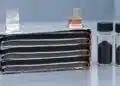






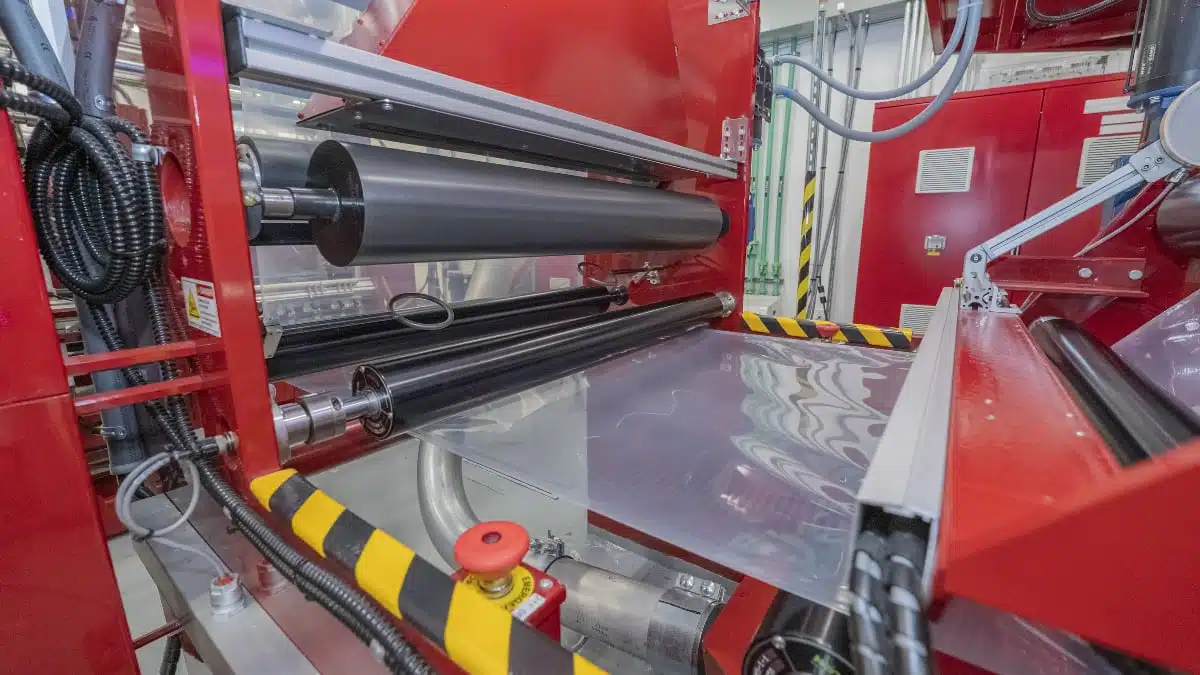
Peak Nano is expanding U.S. production of NanoPlex HDC nanolayer dielectric film with a new cast-film line at its Macedonia, Ohio, facility.
The project targets a 20-fold production increase, with up to three million pounds of additional annual capacity at full production in the first quarter of 2028. NanoPlex HDC is a dielectric material for energy-storage and pulsed-power capacitors, including oil-impregnated film/foil constructions.
Key features and benefits
- New Davis-Standard cast-film line supporting mono-, multi-, and nanolayered films.
- $20 million investment in equipment, facilities, and staffing.
- HDC 4125 and HDC 3125 grades with different dielectric constant, dissipation factor, and breakdown strength.
- Standard film thicknesses of 8 µm and 12 µm.
- Metallization, slitting, and alternative thicknesses available on request.
- U.S. film production with in-line inspection and lot traceability under ISO 9001 certification.
The expansion builds on NanoPlex HDC production using a Davis-Standard cast nanolayer line commissioned in 2022. Recruitment and training across three shifts are underway ahead of the new line’s planned production ramp.
Technical highlights
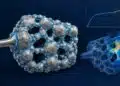
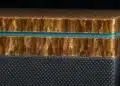
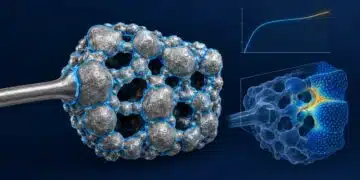
NanoPlex HDC uses a nanolayer polymer architecture. The NanoPlex manufacturing platform can stack up to 4,096 layers within a film, allowing dielectric properties to be tailored through the layered structure.
The HDC family comprises two grades. Their electrical properties create a material-selection trade-off between dielectric constant, dissipation factor, and breakdown strength.
| Parameter | HDC 4125 | HDC 3125 | Test conditions |
|---|---|---|---|
| Relative dielectric constant | 4.9 | 3.8 | 1 kHz, 25 °C |
| Dissipation factor | 1.0% | 0.4% | 1 kHz, 25 °C |
| Breakdown strength | 780 kV/mm | 840 kV/mm | 25 °C |
| Maximum temperature | 125 °C | 125 °C | — |
| Film thickness | 8 µm, 12 µm | 8 µm, 12 µm | — |
| Roll width | 620 mm, 740 mm | 620 mm, 740 mm | — |
| Film length | 500–5,000 m | 500–5,000 m | — |
Dielectric constant and dissipation factor are measured using ASTM D150. Breakdown strength is measured using ASTM D149.
HDC 4125 combines the higher dielectric constant with the higher dissipation factor. HDC 3125 combines the lower dissipation factor with the higher breakdown strength. Grade selection therefore involves more than choosing the highest permittivity: dielectric loss and electrical stress must also fit the capacitor’s operating duty.
Film handling and dimensional stability
Both grades have machine-direction and transverse-direction shrinkage below 0.1% at 130 °C under JIS K7133 testing. At 150 °C, their shrinkage characteristics differ.
| Parameter | HDC 4125 | HDC 3125 |
|---|---|---|
| Shrinkage at 150 °C, MD/TD | 0.75% / 0.63% | 2.1% / 0.53% |
| Tensile strength, MD/TD | 63 / 57 MPa | 57 / 55 MPa |
| Density | 1.5 g/cm³ | 1.36 g/cm³ |
MD denotes machine direction; TD denotes transverse direction. These directional properties are relevant when developing film-handling, winding, and thermal-processing conditions.
Typical applications
NanoPlex HDC targets energy-storage and pulsed-power applications. Oil-impregnated film/foil capacitors are a principal construction format for the material.
Target applications include:
- Aircraft electromagnetic launch systems and directed-energy systems.
- Laser fusion reactors and inertial confinement fusion.
- Mobile grid power systems.
- Motor-start capacitors.
The production expansion also targets demand from power grids, AI data centres, industrial power, fusion energy, and defence systems.
Application fit
The material choice begins with the capacitor architecture and discharge duty. HDC 4125 offers a relative dielectric constant of 4.9, while HDC 3125 offers a dissipation factor of 0.4% at 1 kHz and 25 °C. These characteristics support different balances between capacitance density and dielectric loss.
For capacitor manufacturers, NanoPlex HDC supports qualification on existing metallizing and winding equipment. Film samples, custom configurations, and applications-engineering support are available for development and qualification.
For purchasing teams, the new capacity is a planned addition to an existing U.S. production base. The first-quarter 2028 full-production target should be kept distinct from current material supply when scheduling qualification lots and production procurement.
Design-in notes for engineers
- Select HDC 4125 or HDC 3125 against the required balance of permittivity, dissipation factor, and electrical stress.
- Treat film breakdown strength as a material test result, not as the finished capacitor’s continuous operating-voltage rating.
- Assess dielectric loss under the intended pulse repetition, frequency, and thermal conditions rather than relying on the room-temperature test point.
- Include directional shrinkage and tensile properties when developing winding and thermal-processing conditions.
- Define film thickness, slit width, metallization, and impregnation requirements with the capacitor manufacturing process.
- Validate the finished capacitor under actual electrical, thermal, and discharge conditions before production release.
Further reading
- Peak Nano to Develop Fusion Grade High Energy Film Capacitors
- Peak Nano Installs Production Line for Innovative Capacitor Films
- Film Capacitor Technologies and Applications 2024
Source
This article is based on the Peak Nano product announcement and official product documentation. Engineers should refer to the current manufacturer datasheet for final design and qualification.
References
- NanoPlex HDC — Ultra High-Power Films, Peak Nano, 2025.
- NanoPlex High Dielectric Constant Film (HDC), Peak Nano.
- Peak NanoPlex Technology, Peak Nano.
- Peak Nano Expands U.S. Capacitor Film Production 20-Fold in Ohio, and Opens Hiring Across Three Shifts, Peak Nano via PR Newswire, November 10, 2026.