• 69 pages, 23 tables, 9 figures
  • Issued: August 2026

Instant PDF delivery after payment, plus emailed invoice.

Industrial and Robotics Passive Components Technology Dossier


Robots don’t fail at the algorithm. They fail at the joint, the DC-link, the connector.

The Annual Industrial and Robotics Passive Components Dossier 08/26 shows exactly where capacitors, magnetics, resistors, supercapacitors and protection devices become the limiting factor in industrial automation and robotics — and what to do about it before your next design freeze.

Industrial robot installations hit 542,076 units in 2024, with the operational fleet already at 4.66 million and climbing toward 700,000+ annual installs by 2028. Every one of those machines is redistributing power electronics from the cabinet into the joint — and that shift is rewriting the passive-component spec sheet.

Why this matters now

Three forces are colliding on your BOM right now

  • Power is moving into the robot. 24 V control rails are being layered with 48 V robot buses and 800 V-class industrial DC links — pushing bulk capacitance, current sensing and EMI filtering out of the cabinet and into limbs, joints and zonal controllers.
  • Humanoids multiply the problem. A 48 V, 40-joint humanoid platform means 40 separate bulk-capacitor banks, 40 sets of high-frequency decoupling, and 40 points of failure if qualification is treated as an afterthought.
  • Supply is tightening exactly where you need it most. Automotive-grade MLCCs and DC-link film capacitors are running 20–36 week lead times in 2026, with high-capacitance GPU/HBM-class MLCCs stretching to 40 weeks and spot prices up 50–60%.

If your design locks in a single-source part in any of these categories, you are one allocation cycle away from a redesign.

What you get

What’s inside

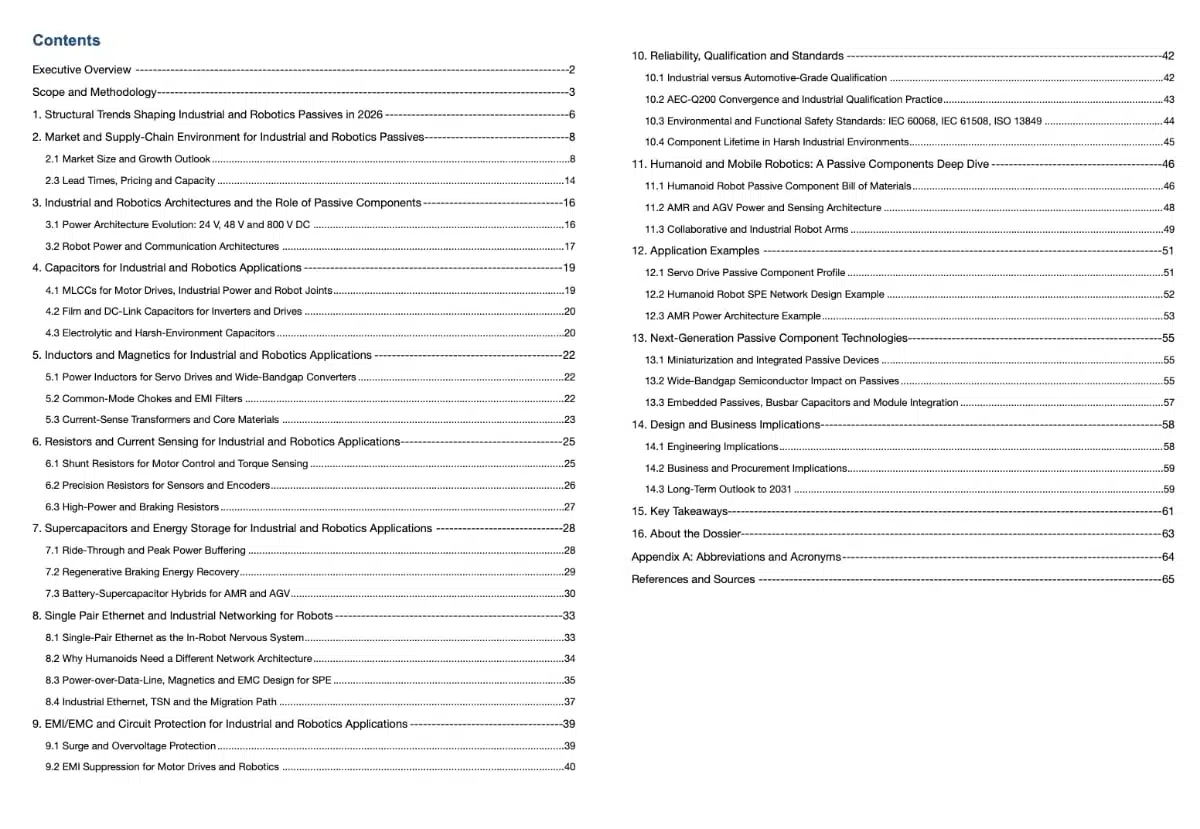
Fifteen chapters engineered for people who spec, qualify and source components — not for generalist market-research reading.

  • The seven structural trends rewriting passive-component requirements: distributed power architecture, joint-level power density, robotics scale, Single Pair Ethernet, SiC/GaN conversion, qualification convergence and supply resilience.
  • Full architecture mapping across 24 V, 48 V and 800 V-class systems, translating each voltage tier directly into capacitor, magnetics, shunt and protection requirements.
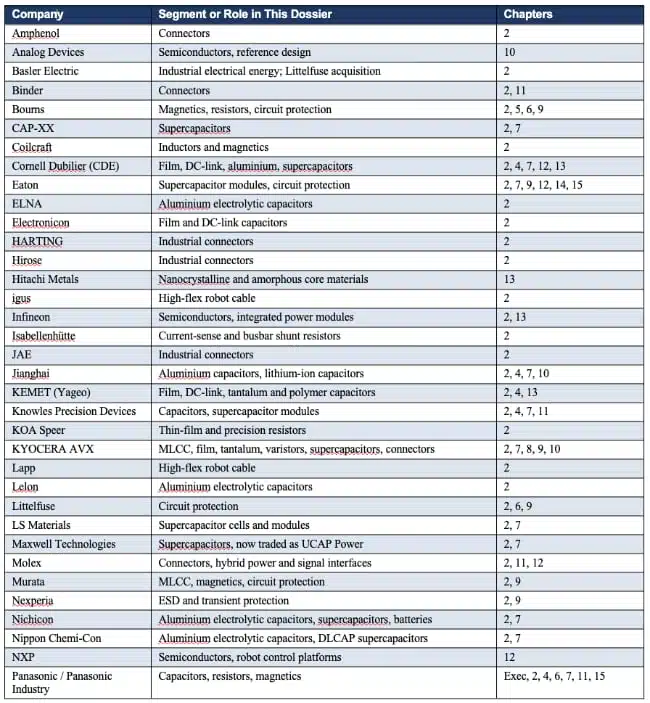
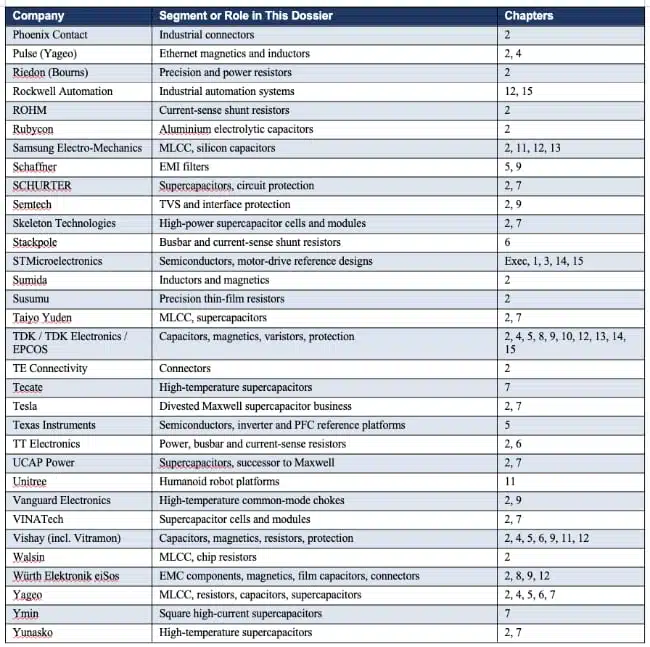
  • Component-by-component deep dives — MLCCs, film and electrolytic capacitors, power inductors, common-mode chokes, current-sense transformers, shunt resistors, precision resistors, supercapacitors and EMI/surge protection — each with named parts, real specifications and sourcing notes.
  • Single Pair Ethernet decoded as an architecture decision, not a cable swap: where 10BASE-T1S, 100BASE-T1 and 1000BASE-T1 actually fit, and what PoDL can and can’t replace.
  • Qualification and standards clarity — AEC-Q200 convergence, IEC 60068/61508, ISO 13849, and what “qualified” should actually mean for your platform.
  • Worked application examples for servo drives, humanoid SPE networks and AMR power architectures, so you can benchmark your own design against real reference numbers.
  • A 2026 supply-chain risk map covering lead times, pricing moves and supplier concentration — including where a top-5 MLCC supplier is not your best option for film, magnetics or protection.

CONTENT

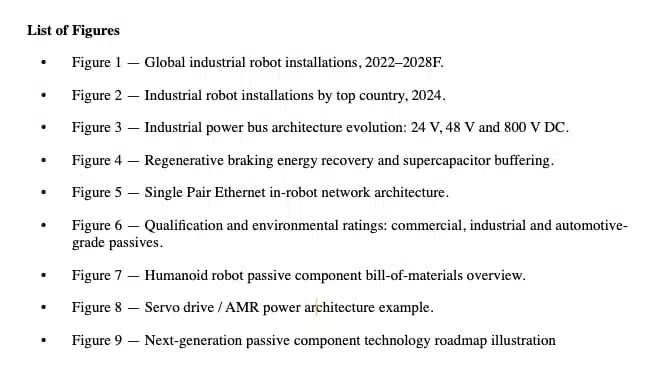
List of Figures

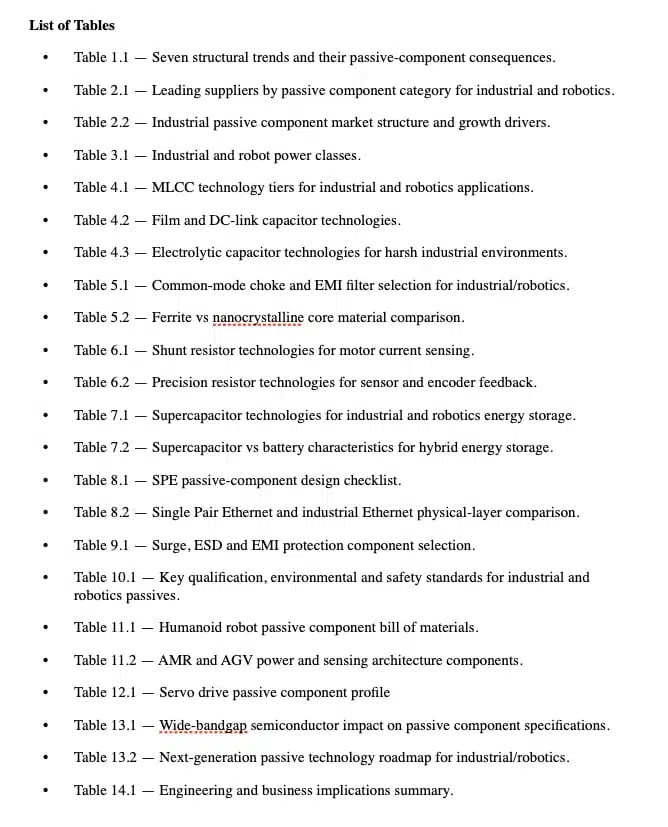
List of Tables

Who needs this on their desk

  • Power electronics and motion-control engineers designing servo drives, VFDs and robot joints who are tired of translating generic catalogue specs into actual system margin.
  • Robotics hardware architects building cobots, AMRs, AGVs and humanoids who need power, network and EMC design connected in one framework.
  • Component and qualification engineers building approved-part lists who need a defensible logic for derating, alternates and lifecycle risk.
  • Procurement and supply-chain leads who need to know which categories are genuinely constrained in 2026 — and which ones just look that way.
  • Platform and product leaders making multi-year architecture bets who need to see the passive-component consequences before they’re locked into silicon and mechanical design.

The bottom line

This is not another automation market report padded with TAM slides. It’s a passive-component playbook built from real architectures, real part numbers and real 2026 supply data — designed to be used at the design-review table, not filed after one read.